UGEE Registration: Dates, Steps & How to Apply

At Phodu Club, we see this all the time: students spend months preparing for UGEE, master complex concepts for IIIT Hyderabad, and build a strong exam strategy, only to panic at the last moment because of registration mistakes.
For the 2027 cycle, students must remember that the application process is just as important as exam preparation. A missed deadline, incorrect academic information, or incomplete application details can create unnecessary problems despite months of hard work.
The UGEE registration process requires careful attention to deadlines, document uploads, and application details. Let’s look at the expected UGEE 2027 registration process, key steps based on the previous cycle, and what future aspirants need to get right.
Quick Answer / TL;DR
- The UGEE 2027 registration window is expected to open around February 2027 and close around April 2027, based on the previous admission cycle.
- Applications are expected to be accepted only through the official IIIT Hyderabad UG admissions portal.
- The UGEE 2027 written examination is expected to be conducted around May 2027, followed by interviews for shortlisted candidates.
- The UGEE 2027 application fee is expected to follow the previous cycle pattern. The exact fee will be announced by IIIT Hyderabad along with the official notification.
UGEE Exam Pattern & Shortlisting Process
Before students even begin their UGEE registration, we always tell them that understanding the unique structure of this exam is absolutely crucial. You are not just taking another JEE Main; you are taking an exam designed to test how you think, not just what formulas you have memorized.
Applicants in this mode need to appear for a computer-based undergraduate entrance examination (UGEE) conducted by IIIT Hyderabad. This exam is for three hours and has two highly distinct sections:
- a) SUPR: Subject Proficiency test for 60 minutes.
- b) REAP: Research Aptitude test for 120 minutes.
Understanding SUPR (Subject Proficiency): SUPR is designed to test your foundational knowledge in Physics, Chemistry, and Mathematics. It is a 60-minute sprint. Our students often find that the level of questions is somewhere between JEE Main and BITSAT. The challenge here is not necessarily the depth of the concepts, but the speed at which you must recall and apply them. You need to be incredibly sharp with your standard 11th and 12th-grade curriculum to clear this section efficiently.
Understanding REAP (Research Aptitude): REAP is where the true test begins. For 120 minutes, students are tested on their critical thinking, spatial reasoning, data interpretation, and linguistics. You might be asked to decode an artificial language, analyze a complex data set, or visualize 3D object rotations. This section tests your raw cognitive horsepower. If you want a deeper dive into this, read our comprehensive breakdown: What REAP Really Tests: A Closer Look at IIITH’s Research Exam .
The Shortlisting Logic: Applicants are filtered based on their performance in SUPR, and then ranked strictly on their REAP score in order to shortlist for the interview. This means SUPR is a qualifying threshold. If you do not clear the SUPR cutoff, your REAP score does not even matter. But once you cross that threshold, your REAP score becomes the sole determinant of your rank for the interview call.
Crucial Rule: There is a strict negative marking penalty of 25% in both the sections. This completely changes how you attempt the paper. You cannot rely on blind guessing.
The Interview Stage: Candidates shortlisted from this exam were called for an interview on campus. We always emphasize to our students that the written exam only gets you to the door. The decision on the final offer of admission is solely based on the interview performance, and the decision of the interview committee is final. For the 2026 cycle, these interviews were conducted from June 4 to June 6, 2026 (On campus).
If you want to know how our top students handle this final stage, check out our guide on Why the UGEE Interview Can Make or Break Your Admission .
UGEE 2027 Timeline & Event Tracker
To give you a clear picture of how the UGEE admission schedule is structured, here is the expected timeline based on the previous admission cycle. The 2027 schedule is likely to follow a similar pattern, with registration, examination, and interview stages taking place within a closely planned timeframe.
| Event | UGEE 2027 Expected Dates |
| Application Portal Opens | Early to mid-February 2027 |
| Application Portal Closes | Late March to early April 2027 |
| Admit Card Release | Mid to late April 2027 (~10 days before exam) |
| Entrance Exam Date | Early May 2027 |
| Result Declaration | Mid to late May 2027 |
| Interviews | Early to mid-June 2027 |
| Seat Allotment Rounds | June–July 2027 |
| Physical Reporting to Campus | Late July to early August 2027 |
Students should keep track of official announcements from IIIT Hyderabad and complete each step within the given deadlines to avoid last-minute issues.
Step-by-Step Strategy: How Students Apply
We built Phodu Club to simplify your preparation, and that includes taking the friction out of the administrative side. Here is exactly how successful applicants navigated the UGEE registration process and the methodology you should apply for the next cycle:
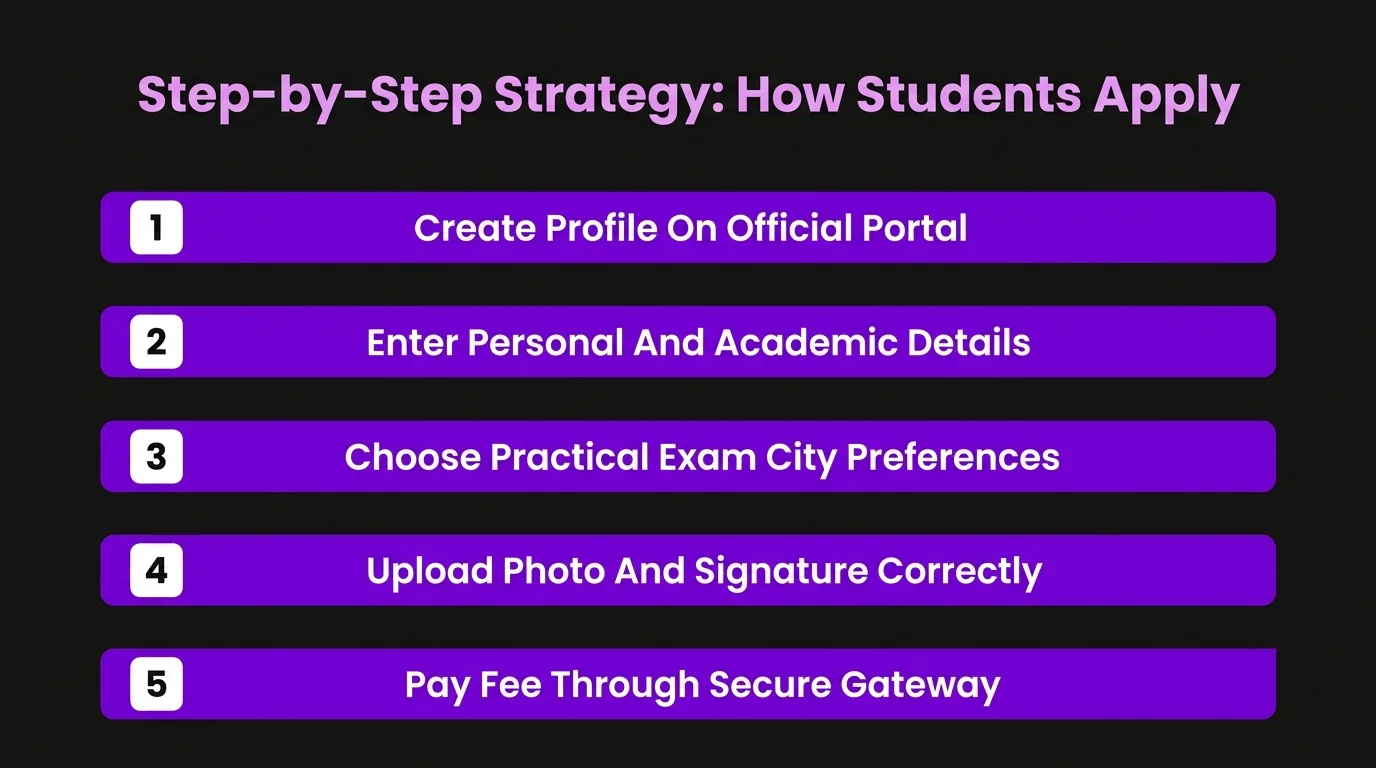
Step 1: Create a Profile on the Official Portal
Candidates must go to the official IIIT Hyderabad UG admissions website. They navigate to the UGEE channel and register with a primary email address and a mobile number. What we see work best: Using a personal email address (like Gmail) rather than a school-provided email. School domains frequently have strict firewalls that block the crucial IIITH verification links or filter them into spam folders. You will receive all interview and admit card communications on this email, so choose one you check daily.
Step 2: Fill in Personal and Academic Details
Once registered, students log in with the credentials sent to their email. They must provide their basic details, parent/guardian information, and academic history. What we see work best: Keeping your official Class 10 marksheet right in front of you on the desk. You must type your name, your parents' names, and your date of birth exactly as they appear on that official document. Even a slight spelling deviation can cause a headache during the document verification stage of the interview. Furthermore, if you are currently in Class 12, you will apply under the "Appearing" category.
Step 3: Choose Your Exam City Preferences
You will be asked to select a list of preferred cities for your exam center. What we see work best: Choose cities in a logical geographic order. Select your current home city first, followed by the nearest accessible major cities. Do not select a city just because a friend is going there. Travel fatigue on exam day is a real factor that degrades cognitive performance, especially for a heavy test like REAP.
Step 4: Upload Documents
Applicants need to upload a recent passport-size photograph and a scanned copy of their signature. What we see work best: IIITH is strict about file formats. The files must be in JPEG/JPG format. Using a free online image compressor before starting the application ensures the files are under the strict kilobyte limits and are ready to upload instantly. Ensure the photograph has a light background and your face is clearly visible without heavy reflections on spectacles.
Step 5: Pay the Application Fee
The final step of the UGEE registration is the fee payment. The application fee for women applicants has been officially reduced to ₹1,550 (2026 fee). The fee for all other applicants is ₹3,100 (2026 fee). Payment is made via Credit/Debit Card, Net Banking, or UPI. What we see work best: Using a stable Wi-Fi connection and a desktop computer rather than a mobile phone for the payment gateway. Most importantly, do not refresh the page during the redirect process. If money is deducted but the portal shows "Failed," do not panic and pay again immediately. Wait 24 hours, check your bank statement, and email the admissions office with your transaction ID.
To understand the exact academic thresholds you must meet before paying this non-refundable fee, check our guide on UGEE Eligibility Criteria .
| Application Step | What Is Required | Common Timeframe |
| Initial Registration | Valid Email, Active Mobile Number | Usually opens early Feb |
| Filling Core Details | Class 10 Marksheet, Aadhar Card Details | Throughout Feb - March |
| Uploading Documents | Compressed Photo & Scanned Signature | Before deadline day |
| Final Fee Payment | Secure UPI, Net Banking, or Card Details | Before portal closes |
Advanced Tips: Managing Prep After Applying
Once the UGEE registration is out of the way in early spring, a psychological shift needs to happen. You have paid the fee. You are officially in the game. You now have a concrete target date in early May.
At Phodu Club, our students shift entirely to REAP logic building after the application launch. The SUPR section is naturally somewhat covered by your ongoing, rigorous JEE Main and Advanced prep. But REAP requires a completely different mental muscle.
What we focus on first is untraining the "formula-plugging" habit. Many coaching institutes teach students to look at a physics problem, identify the variable, and plug it into a memorized equation. IIIT Hyderabad actively designs questions to defeat this method. They do not care if students have memorized complex integration shortcuts. They care if students can read a long passage about a newly invented scientific concept, internalize the rules of that concept, and apply it immediately to a puzzle.
This requires deep reading comprehension skills. We have our students integrate specific linguistics and data interpretation questions into their weekly routines. If you want to master this, read our strategy piece on Why Strong Reading Skills Matter for Cracking REAP .
Furthermore, spatial reasoning is a massive component. Being able to mentally unfold a 3D cube or track the rotation of a complex geometrical figure under a time limit is not something you are born with—it is a skill you build through repeated, targeted practice.
You can see exactly what we mean and practice these exact types of questions by looking at the structure of our UGEE Test Series .
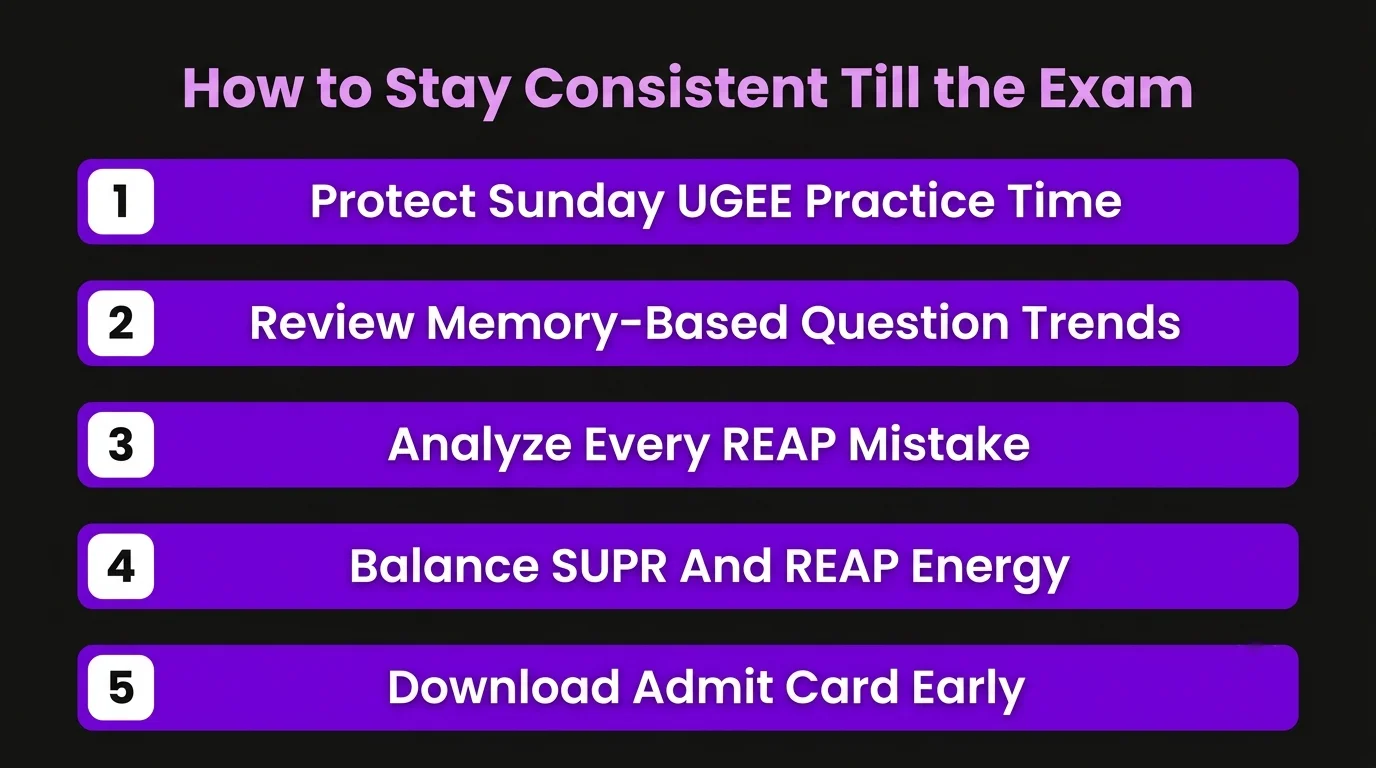
How to Stay Consistent Till the Exam
The gap between the application deadline in April and the entrance exam in May is a highly critical window. It is also the most chaotic time in a student's life.
We see this pattern again and again: students get overwhelmed by their Class 12 board exams, or the intense pressure of JEE Main Session 2, and they decide to pause their IIITH prep entirely. They tell themselves they will catch up later. Then, late April arrives, they download their admit card, and realize they have exactly 10 days to figure out Linguistics and Research Aptitude before the actual exam. It usually ends in panic and a sub-par performance.
Here is the Phodu Club strategy our top scorers use to stay consistent without burning out:
- Weekend Isolation: You do not need to study for UGEE 10 hours a day. Dedicate just 3 hours every Sunday morning strictly to UGEE patterns. Treat this time as sacred. Do not mix it with your chemistry board prep or standard physics mock tests.
- Focus on Previous Trends: While official, standardized past papers aren't explicitly released by IIITH in a massive booklet, memory-based questions from past test-takers are absolute gold. We compile these rigorously for our students. Reviewing these trends helps you understand the flavor of the exam. You can access these resources through our UGEE Previous Year Papers section.
- Deep Mock Analysis: Do not just take mocks for the sake of feeling productive. At Phodu Club, we force our students to analyze why they got a REAP question wrong. Was it a logic failure? Did you misinterpret the data table? Or was it a reading comprehension failure where you skimmed the passage too fast? Understanding the root cause of your error is the only way to fix it.
- Mastering the Interplay: Understand how SUPR and REAP connect. You need to manage your energy. If you burn all your mental stamina rushing through SUPR, you will have a headache by the time the heavy logic puzzles of REAP begin. Learn more about this balance in our guide on How SUPR and REAP Work Together in the UGEE Exam .
Exactly 10 days prior to the exam, students are required to log back into the portal to download their hall tickets. Ensure you know the login credentials you used in Step 1. If you want to know what the admit card process looks like and what rules are printed on it, read our guide on the UGEE Admit Card .
The Final Hurdle: The On-Campus Interview
Let’s assume you followed the strategy. You filled out the form correctly, you managed your time, you took the mocks, and you cleared the May written exam. What happens next?
You will be invited to the IIIT Hyderabad campus for an interview. In 2026, these were held from June 4 to 6. This is where the process becomes deeply personal. You will sit across from a panel of esteemed professors. They are not there to interrogate you on complex textbook definitions. They want to see how your brain works in real-time.
We train our students to think out loud. If a professor gives you a mathematical puzzle on a whiteboard, and you just stare at it in silence for five minutes trying to find the perfect answer, you will likely fail the interview. The professors want you to state your assumptions, explain your starting point, and verbally walk them through your logical progression. If you make a mistake, they will give you a hint. How quickly you adapt to that hint and self-correct is the true metric they are measuring.
If you are preparing for this crucial phase, read our breakdown on How to Answer the "Why Research" Question Honestly and Effectively .
Conclusion
We have worked with enough students preparing for competitive exams to know one thing: effort alone does not always improve scores. The right strategy, consistent execution, and proper planning make the difference.
For UGEE 2027 aspirants, success starts before the exam day. Completing the registration process carefully, verifying every detail, submitting documents correctly, and staying organised throughout the admission timeline gives you the peace of mind to focus completely on preparation.
A delayed application or small administrative mistake should never become the reason you miss an opportunity at one of India’s leading coding and research institutes. Students who handle the process properly can dedicate their full attention to what actually matters: mastering the SUPR and REAP sections and building strong problem-solving skills.
If you are struggling with average mock scores, feeling overwhelmed by UGEE’s unique pattern, or looking for a structured approach to improve your preparation, that is exactly what we focus on at Phodu Club. We provide the roadmap, concept training, and guidance needed to help students prepare with clarity and confidence.
Take control of your preparation today with our intensive, highly targeted UGEE Crash Course . We will show you exactly how to think. We will see you on the inside.
Frequently Asked Questions (FAQ)
1) How long does the UGEE registration process typically take?
For students who sit down with their Class 10 marksheet, Aadhar card details, and a pre-resized photograph/signature ready on their desktop, the entire process takes less than 20 minutes from start to payment confirmation.
2) When did the application portal officially open and close for 2026?
The application portal for the 2026 admissions cycle officially opened on February 11, 2026. The final deadline to submit the form and pay the fee was April 5, 2026.
3) When were the 2026 Entrance Exam and Interviews conducted?
The written entrance exam (comprising both SUPR and REAP sections) took place on May 2, 2026. Students who successfully cleared the cutoffs were called for mandatory on-campus interviews from June 4 to June 6, 2026.
4) What is the application fee for this exam in 2026?
The fee for all general applicants is ₹3,100. However, in an effort to promote gender diversity within the institute, female applicants have a reduced application fee of ₹1,550. Please note that this fee is strictly non-refundable.
5) Are there any category reservations (SC/ST/OBC) in the UGEE process?
No. IIIT Hyderabad operates differently than NITs and IITs. They do not offer category-based seat reservations for admissions through this specific channel. Admissions are strictly based on merit, determined by your performance in the written exam and the subsequent interview.
6) I am a dropper. Can I still apply for this exam?
Yes, absolutely. Students who completed their Class 12 board exams in the previous year are completely eligible to apply for the exam, provided they meet the aggregate requirement of 60% in Physics, Chemistry, and Mathematics.
7) How exactly are students shortlisted for the interview stage?
It is a two-step filtration process. First, you must score above a specific cutoff in the SUPR (Subject Proficiency) section. If you clear that hurdle, you are then ranked strictly based on your score in the REAP (Research Aptitude) section. Only the top-ranked candidates based on REAP scores are called for the interview.
8) How does Phodu Club actually help with preparation?
At Phodu Club, we don't just give you a PDF of generic formulas and wish you luck. We provide highly structured mock tests designed to mimic the exact difficulty of the exam, REAP-specific logic and linguistics training, and personalized mentorship to identify exactly where you are losing marks. We help you untrain bad habits and think the way IIITH interviewers want you to think. Start your journey with our detailed How to Prepare for UGEE guide.
Want to crack your exam with mentors who did?
Get test series, crash courses and free mentorship from students at IITs, NITs and BITS.