How SUPR and REAP Work Together in the UGEEE Exam

At Phodu Club, we get this exact message every single year: "My JEE Mains score is great, but I couldn't clear the IIIT Hyderabad entrance." Why does this happen so often? We have noticed that most students treat this specific test like just another generic engineering entrance exam. They study hard, they solve thousands of questions, but they completely misunderstand the UGEE Exam Pattern. They assume it is just a mini-JEE. It is not. If you do not understand how the two distinct sections function together, your preparation will hit a wall.
Quick Answer / TL;DR
- SUPR (Subject Proficiency Test): Acts as a strict filter. You must clear its minimum cutoff, but its score is not used for final ranking.
- REAP (Research Aptitude Test): Acts as the rank decider. If you pass SUPR, your REAP score determines your rank and interview shortlisting.
- Strategy: Secure the SUPR cutoff safely, then heavily maximize your REAP score.
What Exactly is the UGEE Exam and Why Does It Matter So Much?
Before diving into the technicalities of the sections, we need to understand what IIIT Hyderabad is actually looking for. The Undergraduate Entrance Examination (UGEE) is not designed to test how many complex formulas you can memorize. Instead, it is built specifically for dual-degree programs ( B.Tech + MS by Research).
Because these programs are research-heavy, the institution wants students who can think critically, analyze data, and solve unseen problems. This is a very different requirement compared to standard exams. We always tell our students that while standard exams test your speed and memory, IIITH tests your analytical maturity.
A student we mentored for the 2025 batch had incredible speed in solving physics numericals. However, he was struggling in our mock tests because he was rushing through logical reasoning questions without reading the given data parameters. Once we shifted his focus to understanding the core structure of the test, his scores stabilized. If you want to dive deeper into this institution's unique approach, you can read more about IIIT Hyderabad UGEE .
What is the UGEE Exam Pattern 2026? A Complete Breakdown
To crack this test, you need complete clarity on the structure. The official authorities update minor elements occasionally, but the core philosophy remains identical for 2026 and upcoming 2027 sessions. Based on recent official exam body trends and our internal analysis at Phodu Club, here is the complete breakdown.
Overall Structure Overview:
- Mode: Online Computer Based Test (CBT)
- Total Duration: 3 hours
- Section Timing: SUPR takes 60 minutes. REAP takes 120 minutes. There is no switching back and forth between sections.
- Total Marks: 150
- Question Type: Mostly Multiple Choice Questions (MCQs), though REAP may include some fill-in-the-blank style logic questions.
To get the most accurate timeline for your preparation, always keep an eye on the official UGEE exam dates .
SUPR (Subject Proficiency Test): The Gatekeeper
Key Specifications:
- Duration: 60 minutes
- Questions: 50
- Marks: 50 (1 mark per correct answer)
- Subjects: Physics, Chemistry, and Mathematics (Class 11 and 12 level)
- Negative Marking: -0.25 for every incorrect answer
- Purpose: Shortlisting based on a sectional cutoff.
We like to call SUPR the "gatekeeper." Its only job is to check if your basic engineering and science fundamentals are solid. The questions here are generally at the level of JEE Mains or sometimes slightly easier, but the time constraint is brutal. You have 60 minutes to solve 50 questions. That is barely over a minute per question.
We worked with a brilliant applicant last year who was consistently scoring in the 99th percentile in JEE mock tests. However, he ignored his NCERT Chemistry basics. During the actual test, he over-attempted the SUPR section, got hit by negative marking, and failed to clear the sectional cutoff by just one mark. His REAP score was never even evaluated.
Actionable Takeaway: Do not aim for a perfect score in SUPR. Your goal is to comfortably clear the cutoff with high accuracy. Focus on direct formula-based questions and basic concepts rather than getting stuck on lengthy calculations.
REAP (Research Aptitude Test): The Rank Maker
Key Specifications:
- Duration: 120 minutes
- Questions: 50
- Marks: 100 (2 marks per correct answer)
- Focus Areas: Critical thinking, logical reasoning, data interpretation, application in PCM contexts, and analytical skills.
- Negative Marking: -0.5 for every incorrect answer
- Purpose: Final ranking for the interview shortlist.
If SUPR checks what you know, REAP checks how you think. This section is what makes the entrance process entirely unique. You will face questions involving linguistics, pattern recognition, complex data interpretation, and unique physics or math puzzles that you have never seen in any textbook.
We see this pattern again and again: students try to apply standard coaching formulas to REAP questions and get frustrated. One of our aspirants spent 15 minutes trying to use advanced calculus on a REAP question, only to realize later that it was a simple visual pattern recognition problem hidden inside a math framework.
Actionable Takeaway: You cannot mug up for REAP. You need to practice solving unseen, unstructured problems. Read carefully, do not rush, and rely on logic over memory. For a deeper understanding, check out our guide on what REAP really tests .
How Do SUPR and REAP Work Together in the Selection Process?
Understanding the interaction between these two sections is the most vital part of the UGEE Exam Pattern. The selection process is strictly sequential.
- Step 1: The SUPR Filter. When the results are processed, the system first looks exclusively at your SUPR score. The admissions committee sets a minimum cutoff for this section based on overall applicant performance.
- Step 2: The Evaluation Gate. If your SUPR score is below this cutoff, you are instantly disqualified. Your REAP section is essentially ignored, no matter how well you did.
- Step 3: The REAP Ranking. If you clear the SUPR cutoff, you move to the next phase. Here is the big twist: your SUPR score is now irrelevant for ranking. Your final rank, which determines if you get called for an interview, is based entirely on your REAP score.
- Step 4: The Interview. Top rankers based on REAP are called for the interview round, which is the final hurdle for admission.
This creates a highly specific strategic implication. You must clear the SUPR minimum, but you must maximize REAP. At Phodu Club, we have seen strong JEE students fail simply because they under-prepared for REAP, assuming their SUPR score would carry them through. It will not.
Phodu Club's Ultimate UGEE Test Series
We built this exact resource because students were taking generic mock tests that did not reflect the true difficulty of the research aptitude section. If you are serious about cracking this exam, you need targeted practice.
Give priority to your preparation with Phodu Club's Ultimate UGEE Test Series :
- Mock tests: 10 full length mock tests exactly as per the latest syllabus and interface.
- Unlimited attempts: Practice as many times as you need for all tests.
- Detailed solutions and analysis: Understand exactly where you are losing marks and fix your strategy.
- Mentorship: Exclusive 24/7 mentorship community directly with IIIT Hyderabad students.
- Live Sessions: Live QnA and interview prep sessions.
- Complete guidance: End-to-end support for the crucial interview round.
How the Marking Scheme and Negative Marking Dictate Your Strategy
Understanding the UGEE Exam Pattern marking scheme is non-negotiable. Both sections carry negative marking, but the weightage differs significantly.
In SUPR, every correct answer gives you 1 mark, and every wrong answer deducts 0.25 marks. In REAP, the stakes are doubled. A correct answer gives you 2 marks, but a wrong answer deducts 0.5 marks.
We constantly review student mock test data. The biggest score-killer we notice is blind guessing in the REAP section. Because REAP questions are logic-based, the options are often designed as "distractors" that look correct if you make a common logical error.
A student in our community was stuck at a REAP score of 40/100. When we analyzed his attempts, we found he was attempting all 50 questions, getting 25 right and 25 wrong. The negative marking was destroying his score. We forced him to reduce his attempts to only the 35 questions he was confident about. His score instantly jumped to over 60. Accuracy matters more than the volume of attempts.
SUPR vs REAP: A Clear Comparison
To make your preparation planning easier, let us compare the two sections directly.
| Feature | SUPR Section | REAP Section |
| Core Focus | Testing theoretical knowledge in PCM | Testing logical application and analytical skills |
| Total Questions | 50 Questions | 50 Questions |
| Total Time | 60 Minutes (Speed-heavy) | 120 Minutes (Thought-heavy) |
| Marks per Question | 1 Mark | 2 Marks |
| Negative Penalty | -0.25 Marks | -0.50 Marks |
| Primary Goal | Clearing the minimum qualifying cutoff | Scoring maximum marks for a top rank |
| Difficulty Level | JEE Mains or slightly lower | Unpredictable, highly analytical |
Detailed Syllabus Breakdown for Both Sections
The syllabus inside the UGEE Exam Pattern is not just about a list of chapters. It is about how those chapters are applied.
For the Subject Proficiency Test: You must cover the standard CBSE Class 11 and 12 syllabus for Physics, Chemistry, and Mathematics. Do not skip standard chapters like Modern Physics, Chemical Bonding, or Calculus. However, unlike JEE Advanced, you do not need to dive into extreme, multi-concept depths. You need broad coverage because you have to solve 50 questions in 60 minutes.
For the Research Aptitude Test: There is no fixed textbook for this. The official authorities state it tests your critical thinking. Based on recent 2025 and 2026 trends, the syllabus includes:
- Linguistics: Decoding artificial languages, finding patterns in unfamiliar words.
- Data Interpretation: Extracting information from complex graphs, pie charts, and data tables.
- Logical Reasoning: Syllogisms, blood relations, seating arrangements, and spatial reasoning.
- Subject Application: A passage explaining a new physics concept, followed by questions asking you to apply that exact concept logically.
We highly recommend reviewing UGEE previous year papers to get a true feel for these unique question types.
Cutoff Trends and Safe Scores (Previous Years + Expected)
What score do you actually need to clear the process? Based on historical data and current competitive trends, cutoffs fluctuate based on exam difficulty. However, having a safe target is crucial for your mock tests.
- SUPR Safe Target: Typically, the cutoff hovers around 22 to 24 marks out of 50. To be completely safe and account for any difficult shifts, we tell our students to target 28 to 30 marks in their mocks.
- REAP Safe Target: This varies heavily, but generally, a score above 70 to 75 out of 100 puts you in a very strong position for an interview call.
We worked with a student who was scoring 45/50 in SUPR during mocks but only 50/100 in REAP. We had to sit her down and completely flip her study schedule. She was wasting time over-preparing for a section that only requires a passing mark. Once she hit the 75-mark threshold in REAP, she comfortably cleared the actual exam. You can use our UGEE college predictor tools to better understand ranking dynamics.
For deeper insights on safe scores, read our detailed analysis on UGEE cutoff for IIIT Hyderabad .
Smart Preparation Strategy for Success
To beat the UGEE Exam Pattern, you need a tailored approach. You cannot just rely on your generic engineering entrance preparation.
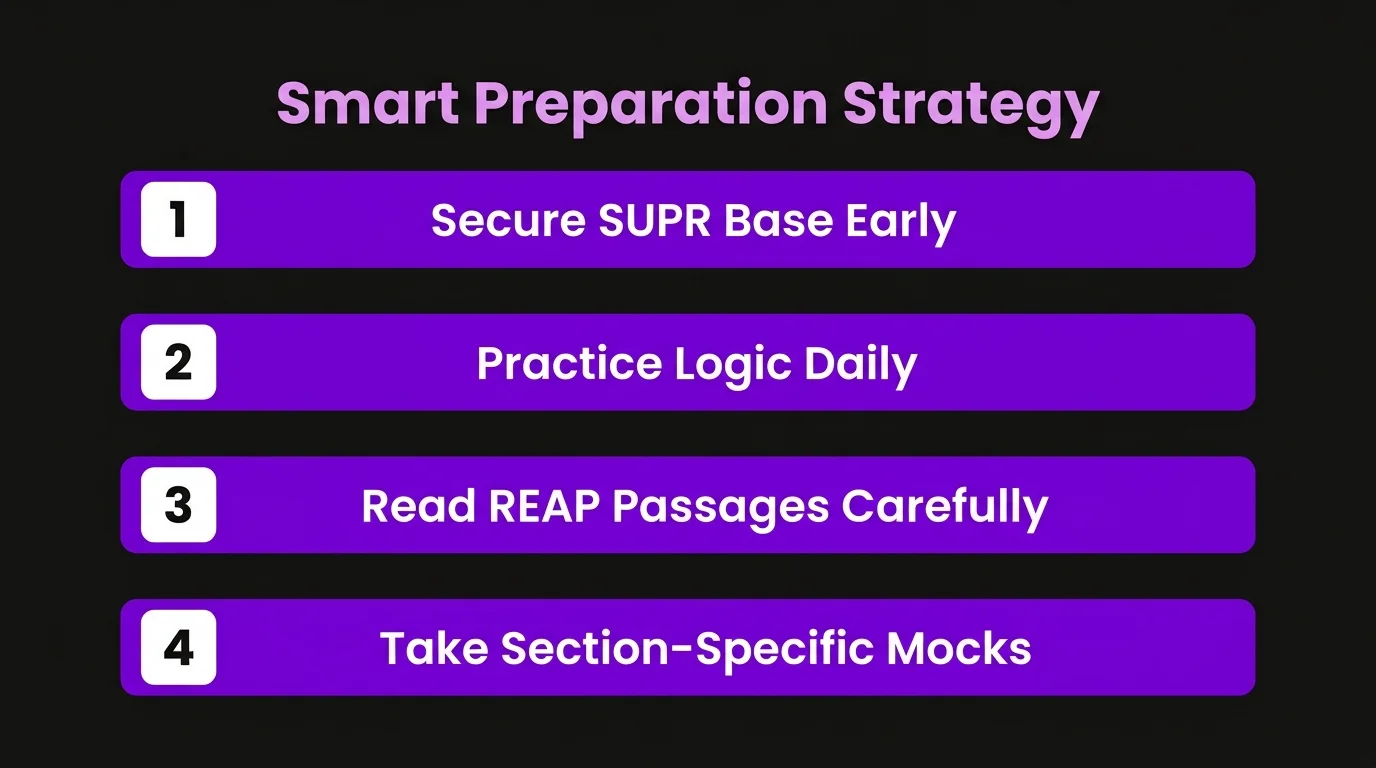
1) Secure Your SUPR Base Early: Ensure your basic formulas in Physics, Chemistry, and Math are at your fingertips. Create short notes. You do not need to solve extremely tough problems here; you need to solve moderate problems very fast. If your basics are weak, consider structured help like our UGEE crash course .
2) Dedicate Specific Time for Logic: Do not treat logical reasoning as an afterthought. Spend at least 45 minutes every single day solving puzzles, data interpretation sets, and linguistics problems. Your brain needs time to wire itself for these unstructured questions.
3) Master the Art of Reading: REAP questions often feature long passages. Most students get impatient and skip reading the parameters properly. We focus heavily on reading comprehension in our mentorship programs. You must learn to extract variables from a text paragraph quickly.
4) Take Section-Specific Mock Tests: Taking a combined mock is great, but early in your prep, take isolated 60-minute SUPR mocks to build speed, and isolated 120-minute REAP mocks to build endurance. If you are struggling with a study schedule, explore our guide on how to prepare for UGEE .
Common Mistakes We See Students Make Every Year
A major mistake regarding the UGEE Exam Pattern is neglecting time management during the transition between the two sections. Here are the top pitfalls we constantly warn our aspirants about:
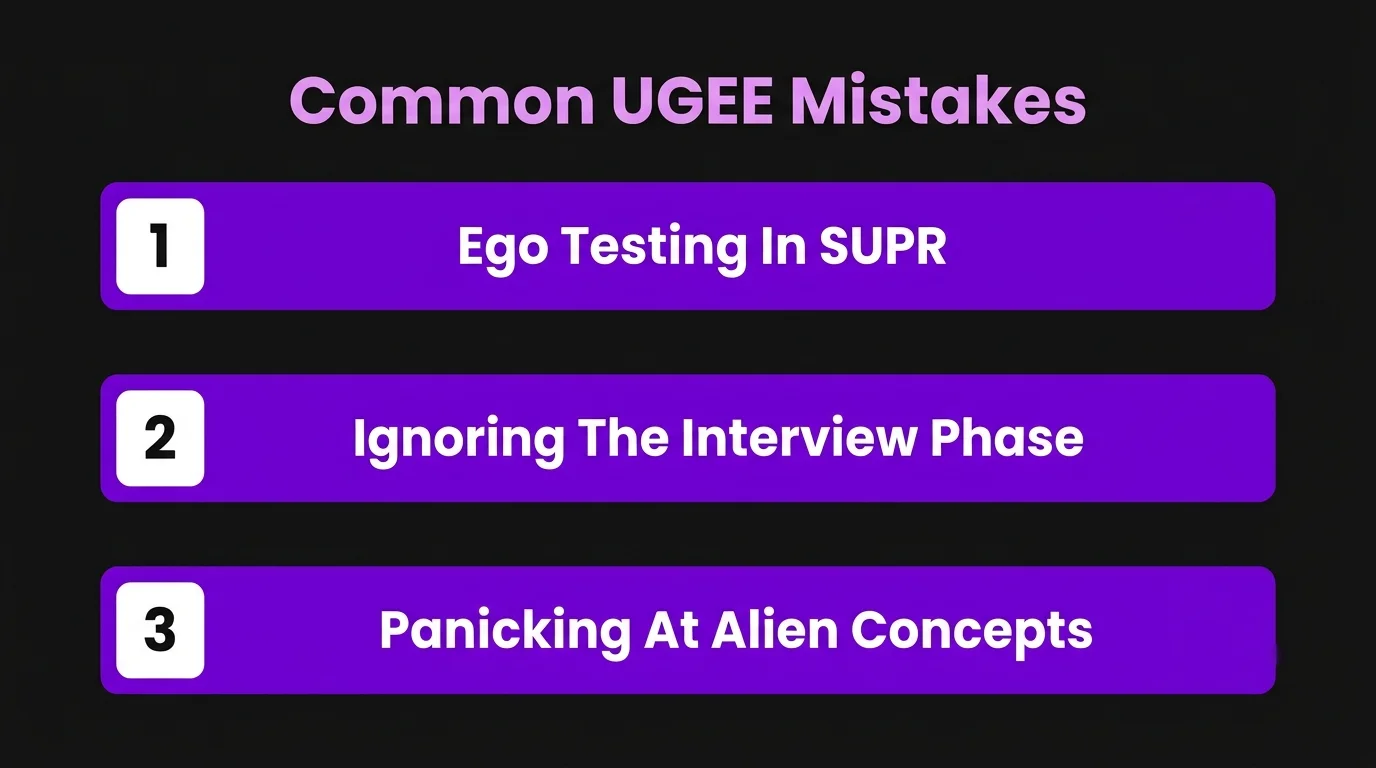
- Ego Testing in SUPR: Getting stuck on a single tough math integration problem for 5 minutes. In SUPR, every question is worth 1 mark. A hard question gives you the same reward as an easy one. Skip and move on.
- Ignoring the Interview Phase: Many students think the written test is the only hurdle. The interview is highly technical and rigorous. Your REAP score gets you in the door, but your interview secures the seat. Read about why the interview can make or break your admission .
- Panic in REAP: Students often panic when they see a completely alien concept in the REAP section. We teach our students to calm down: the exam setters do not expect you to know the alien concept beforehand. All the clues to solve it are hidden in the paragraph provided.
Conclusion
Mastering the UGEE Exam Pattern isn't about working harder; it is about working smarter and understanding the rules of the game. You must treat SUPR as a speed-based qualifying round and REAP as your ultimate rank-deciding battlefield.
We’ve worked with enough students to know this: effort alone doesn’t fix your score. The right strategy does. That’s exactly what we focus on at Phodu Club. We help you identify your weak gaps, structure your mock test attempts, and build the specific analytical mindset required for IIIT Hyderabad. If you are stuck in a score plateau or confused about where to start, join our community, take our targeted test series, and let us help you clear this exam strategically.
Frequently Asked Questions (FAQ)
1) What makes the UGEE Exam Pattern different from JEE Mains?
While JEE Mains primarily tests your speed, memory, and application of known formulas across PCM, this exam is split. The first half tests basic PCM speed, but the second half (REAP) tests pure research aptitude, logical reasoning, and unseen problem-solving skills which are entirely absent in JEE.
2) Can I switch between the SUPR and REAP sections during the test?
No, you cannot. The interface is strictly timed. You will first be presented with the SUPR section for exactly 60 minutes. Once that time expires, it auto-submits, and your 120-minute timer for REAP begins immediately.
3) Is my SUPR score added to my final ranking?
No. This is the most common misconception. The SUPR score is only used as a cutoff filter. Once you clear that minimum threshold, your final rank and interview shortlisting are calculated strictly based on your REAP score.
4) How can I improve my score in the REAP section?
Improving in REAP requires a shift from formula-memorization to logical application. You need to practice linguistics, data interpretation, and reading comprehension. Taking specialized mock tests and thoroughly analyzing your logical errors is the fastest way to improve.
5) Are the chemistry questions in SUPR difficult?
Generally, they are strictly aligned with the NCERT syllabus. They are formula-based and conceptual, not highly twisted. The challenge is not the difficulty, but solving them rapidly within the time limit.
6) Does Phodu Club provide specific preparation for the interview round?
Yes, absolutely. Our test series and mentorship programs include live Q&A sessions and dedicated interview prep with actual IIIT Hyderabad students. We guide you on how to present your research mindset to the panel.
7) Is there a negative marking in both sections?
Yes. In SUPR, you lose 0.25 marks for every incorrect answer. In REAP, because each question carries 2 marks, the penalty is higher, deducting 0.50 marks for every incorrect attempt. Accuracy is highly critical.
8) How much time should I allocate daily for this specific preparation if I am also studying for JEE?
We advise our students to dedicate at least 1 to 1.5 hours daily specifically to logical reasoning and REAP-style questions. Since your JEE prep naturally covers the SUPR syllabus, your extra time must be focused entirely on building research and analytical aptitude.
Want to crack your exam with mentors who did?
Get test series, crash courses and free mentorship from students at IITs, NITs and BITS.