How to Get Ready for UGEEE’s Most Unpredictable Section

Every UGEE aspirant sails through SUPR preparation on JEE momentum, then hits REAP and freezes. Decoding fictional languages? Research-style data puzzles? That is not what any coaching module prepares you for. Learning how to get ready for UGEE's most unpredictable section is the single biggest skill gap between students who get an interview call and those who don't. This guide closes that gap with a concrete, section-specific action plan.
TL;DR
- REAP is the rank-deciding section, testing critical thinking, logical reasoning, and unconventional problem-solving, and it is significantly more difficult than SUPR because its questions are unpredictable.
- No fixed syllabus means no rote preparation, so cognitive flexibility and exam pattern analysis are your primary weapons.
- Mock tests that mirror the actual format are the only reliable method to build speed under uncertainty.
- Negative marking applies in REAP and SUPR, making accuracy-first strategy non-negotiable.
What Is the Hardest Section of UGEE and Why Does It Catch Students Off Guard?
Preparing for IIIT Hyderabad through UGEE is fundamentally different from preparing for JEE or other engineering entrance exams. UGEE is designed to identify students with deep conceptual understanding, analytical reasoning ability, and research aptitude, not just speed or memorization. The exam is 180 minutes long. SUPR runs for 60 minutes and REAP runs for 120 minutes. On paper, REAP gets more time. In practice, it earns more anxiety. Here is why REAP blindsides most students:
The REAP section tests critical thinking and research aptitude without a fixed syllabus. That is not a typo. No fixed syllabus. You might encounter linguistics questions where you decode a fictional language using logic, complex graphs and case studies for data interpretation, or research-based real-world physics and math problems. In REAP, candidates receive two marks for each correct answer but lose 0.5 marks for each incorrect answer, making guessing a dangerous strategy.
Scores of SUPR are used to shortlist candidates, and REAP scores determine the rank of the shortlisted candidates. The structural implication is critical: clearing SUPR just gets you into the room. Your final rank lives entirely in REAP. The REAP section is quite different from anything JEE-style, as it tests your ability to think, not recall.
The core trap: Students spend 80% of prep time on SUPR because it feels familiar, then walk into REAP underprepared for the section that actually determines their rank.
What Topics Usually Appear in UGEE's Most Unpredictable Section?
Knowing what REAP tests gives you a target even without a fixed syllabus.
REAP covers topics such as basic PCM and arithmetic, data interpretation and reasoning, algebra, and geometry.
Here is the practical breakdown of REAP content clusters:
| REAP Cluster | What It Actually Tests | Approximate Weight |
| Linguistics & Pattern Decoding | Decode fictional scripts or languages using internal logic | Variable, high difficulty |
| Data Interpretation | Complex graphs, case studies, multi-step inference | 15–25% |
| Logical Reasoning | Analytical puzzles, series, deductive chains | Consistent across years |
| Conceptual PCM Application | Real-world research problems using Physics/Maths | Moderate weight |
| Probability & Statistics | Decision under uncertainty, combinatorics | High frequency |
Mathematics is the backbone of UGEE. In both SUPR and REAP, probability and statistics carry 15–20% weight and are crucial for REAP. To crack REAP, you must practice logical reasoning and puzzles separately from your core PCM prep. The mindset for REAP is closer to a mix of JEE Advanced and NTSE/CAT.
The linguistics cluster is where most JEE-focused students lose marks. These questions present a constructed language with internal grammatical rules and ask you to apply those rules, not translate them. No prior linguistics knowledge helps. Systematic pattern recognition does.
Practising logical puzzles, analytical reasoning, data interpretation, and Olympiad-style questions helps significantly. Solving official sample papers is recommended. The focus should be on thinking ability rather than memorization.
How to Prepare for UGEE's Most Unpredictable Section: A Step-by-Step Strategy
Learning how to get ready for UGEE's most unpredictable section starts with restructuring your study schedule around REAP's logic. Follow this sequence:
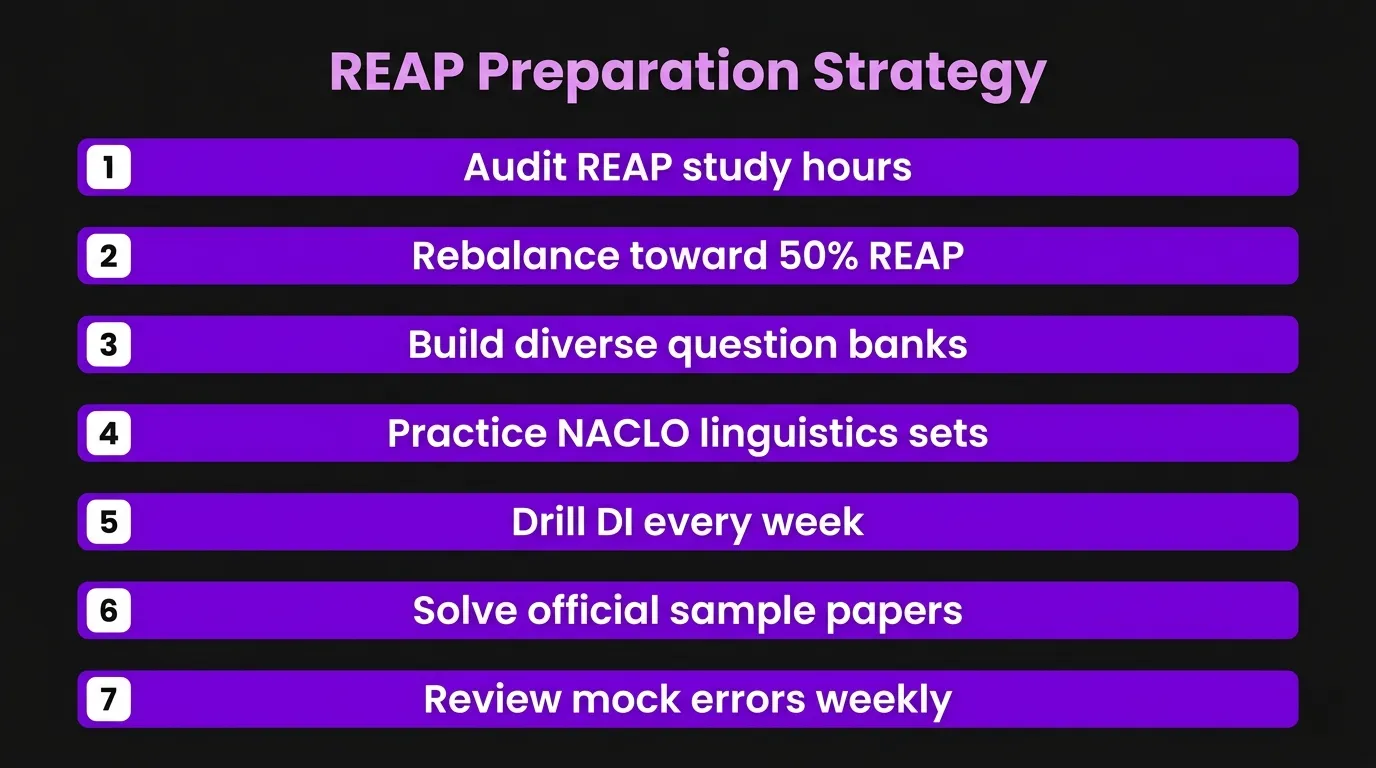
- Audit your current prep split: If REAP is getting less than 50% of your daily hours, rebalance immediately. SUPR is qualifying; REAP is ranking.
- Build a question bank from diverse sources: Use NTSE Stage 2 reasoning papers, CAT logical reasoning sets, and Olympiad problem sets. Books for NTSE Stage 2 and CAT Logical Reasoning (like Arun Sharma) are helpful. For the linguistics cluster, exploring NACLO (North American Computational Linguistics Open) past papers is highly recommended.
- Drill data interpretation weekly: Set a timer for 20 minutes per DI set. Track accuracy, not just speed.
- Solve official UGEE sample papers in timed conditions: REAP focuses on critical and creative thinking, and official sample papers for both sections are available from IIIT Hyderabad.
- Run a weekly error analysis log: Every wrong answer gets categorized: concept gap, time pressure, misread, or careless error. Fix the pattern, not just the question.
- Take full-length mock tests that mirror the exact UGEE format: 60-minute SUPR followed immediately by 120-minute REAP, with no break, to simulate real cognitive fatigue.
- Review mocks like a researcher: Analyzing UGEE mock tests like a top ranker involves a step-by-step strategy for SUPR and REAP combined with a 7-day improvement loop.
This seven-step loop is your core REAP preparation engine. Execute it weekly for at least six weeks before exam day.
Best Strategies for UGEE's Most Unpredictable Section on Exam Day
Preparation strategy and test-taking strategy are different skills. Here is how to get ready for UGEE's most unpredictable section when you are actually sitting in front of the screen.
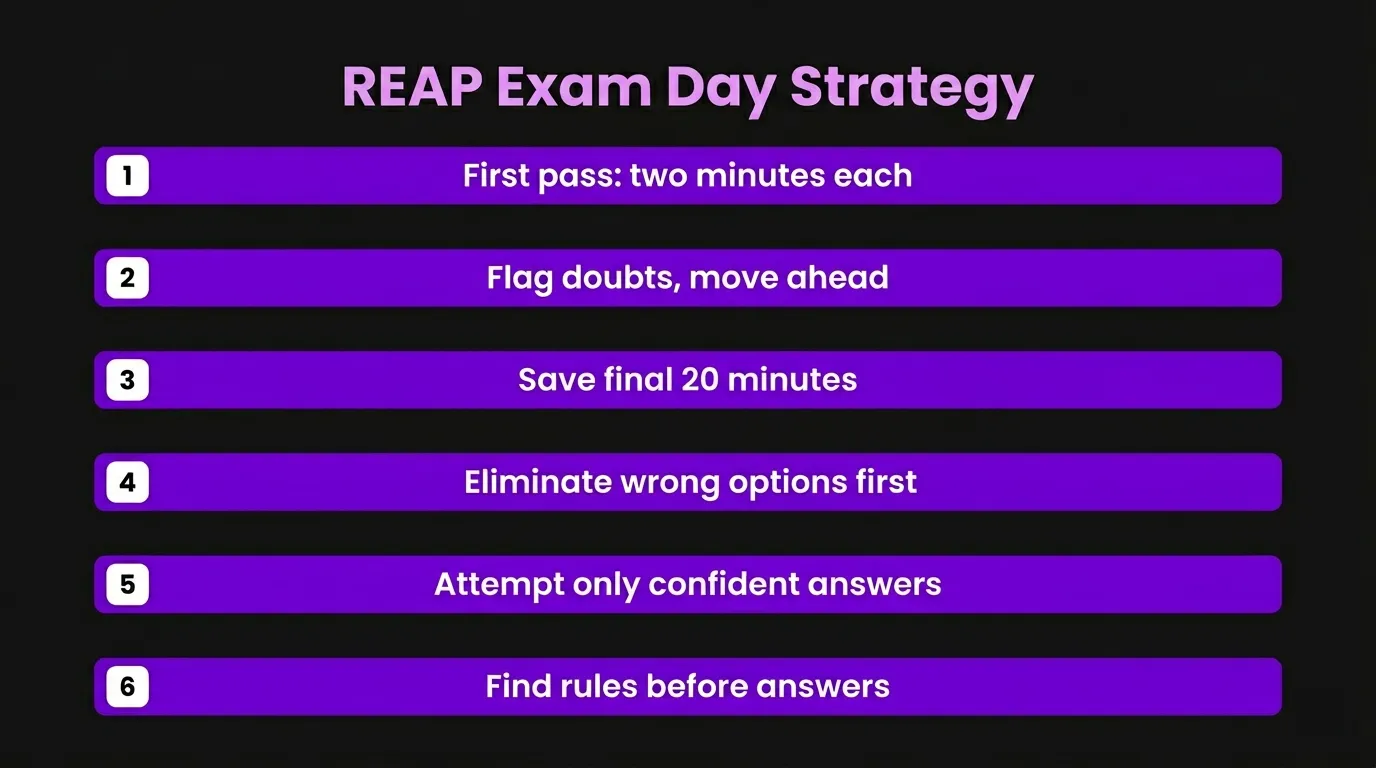
Time management inside REAP (120 minutes, 50 questions):
- Allocate a maximum of 2 minutes per question on the first pass.
- Flag uncertain questions and move on, never stall.
- Use the final 15–20 minutes exclusively for flagged questions.
UGEE has some easy questions mixed with lengthy ones. The student who identifies and skips the lengthy questions strategically wins. In IIIT Hyderabad's UGEE, the number of attempted questions matters because every question carries the same marks.
Elimination technique under uncertainty:
When a REAP question feels impossible, do not guess randomly. Instead:
- Eliminate the two most obviously wrong options first.
- Check whether the remaining options obey the internal logic pattern of the question set.
- Only mark an answer if your net confidence is positive after negative marking math: four wrong answers cancel out one correct answer.
Cognitive flexibility in the linguistics cluster:
Read all the examples given in the question before forming a hypothesis. Most fictional language questions give you three to five examples. Build the rule from those examples, test it against one more, then apply it.
Key mindset shift: Stop asking "what is the answer?" Ask "what is the rule?" REAP rewards rule-finders, not answer-guessers.
How Top Scorers Prepare for the Uncertain Parts of UGEE
Top scorers do not have a secret syllabus. They have a different relationship with uncertainty, and that relationship is built through specific habits.
Habit 1: Volume of varied practice. High scorers solve problems across at least four or five different question formats per week, including non-engineering material like NACLO, PRMO, and CAT puzzles. This builds the cognitive flexibility REAP directly tests.
Habit 2: Mock test series with exact exam pattern analysis.
IIITH UGEE includes SUPR (Subject Proficiency Test) and REAP (Research Aptitude Evaluation) followed by an interview, and top scorers run full simulations of all three stages, not just the written test. Platforms like Phodu Club's mock test series offer structured, timed practice environments that build this muscle.
Habit 3: Score-pattern tracking, not just scores. Tracking which question types drain your time reveals your specific weaknesses. A student who spends 4 minutes on data interpretation questions but only 1 minute on reasoning questions knows exactly where to recalibrate.
Habit 4: Interview-ready thinking from day one.
REAP evaluates logical reasoning, analytical skills, and creative problem-solving for 120 minutes, and final selection depends mainly on REAP score plus interview. The top scorers treat REAP as a rehearsal for the interview, where the same analytical thinking is tested verbally.
Habit 5: Targeted use of previous year papers.
Analysis of previous years with subject-wise and topic-wise data in graphical format helps students prepare perfectly for REAP. Map which REAP clusters appeared in which year and weight your practice accordingly.
Common Mistakes When Preparing for UGEE's Most Unpredictable Section
Knowing how to get ready for UGEE's most unpredictable section is only half the battle. Knowing what not to do is equally important.
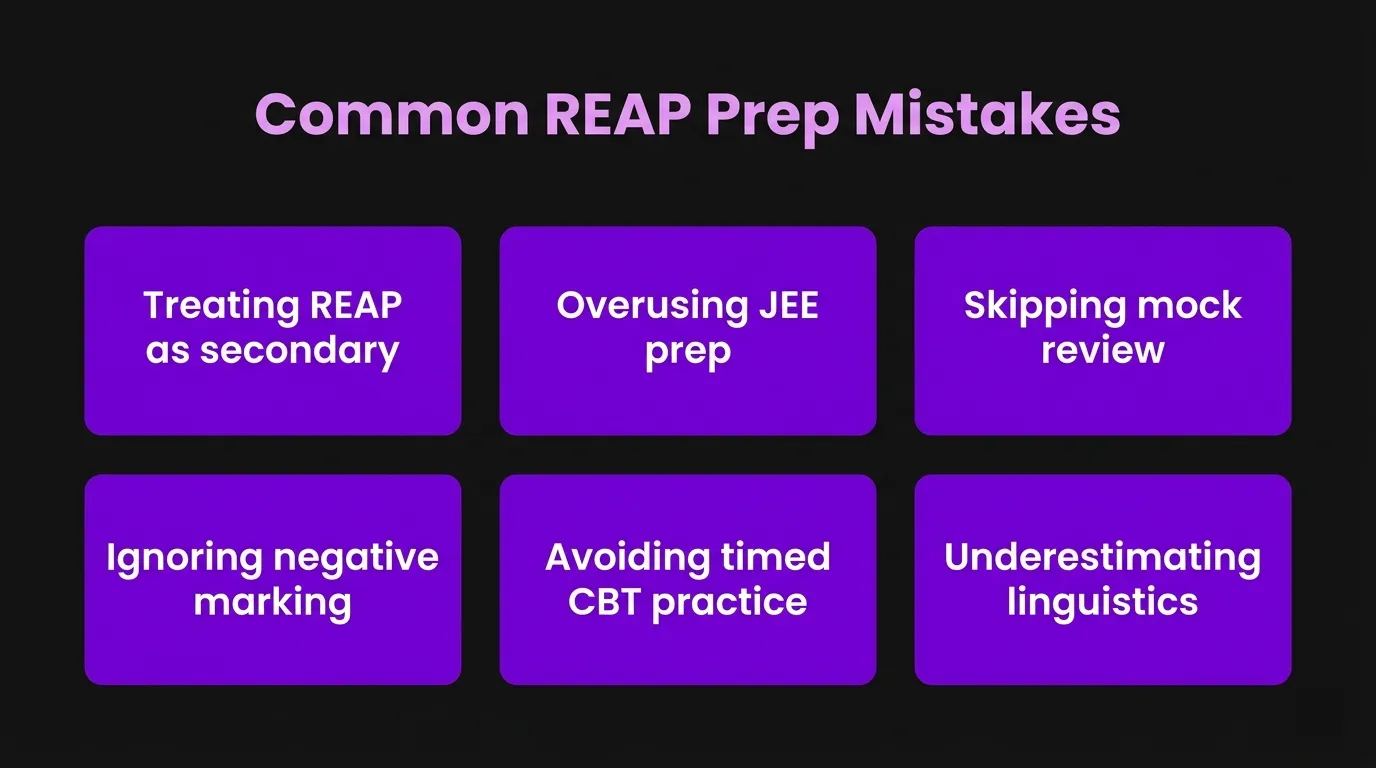
Mistake 1: Treating REAP as an afterthought.
SUPR acts as a qualifying round, and if you don't clear the SUPR cutoff, your REAP paper won't even be evaluated. Most students over-prepare for SUPR as a result, then underperform in REAP where ranks are decided.
Mistake 2: Over-relying on JEE preparation for REAP.
Since SUPR is based on the 11th and 12th CBSE/State Board syllabus, your JEE preparation covers 80% of it, but that same preparation gives you almost no direct advantage in REAP's reasoning and linguistics clusters.
Mistake 3: Skipping error analysis after mock tests. Taking five mock tests and never reviewing them systematically produces zero improvement. Every incorrect answer must be categorized and traced to a root cause.
Mistake 4: Ignoring negative marking math.
25% negative marking for wrong answers applies in both SUPR and REAP sections. Attempting a question you are genuinely uncertain about costs more than skipping it when compounded across twenty uncertain questions.
Mistake 5: Preparing in isolation from the exam pattern. Students who study reasoning from a book but never practice in a timed, computer-based format are not preparing for the right test. REAP is time-pressured and screen-based. Your preparation must be too.
Mistake 6: Underestimating the linguistics section.
The difficulty of REAP fluctuates based on the complexity of the linguistics and data interpretation sections. In high-difficulty years, the linguistics cluster alone separates the top 50 candidates from the rest.
UGEE's Most Unpredictable Section: Practice Questions and Resources
Learning how to get ready for UGEE's most unpredictable section ultimately comes down to the quality of practice material you use. Here is a resource map organized by REAP cluster:
| REAP Cluster | Recommended Resource | Why It Works |
| Logical Reasoning | NTSE Stage 2 papers, CAT Arun Sharma LR | Closest format to REAP reasoning sets |
| Linguistics / Pattern Decoding | NACLO past papers | Only direct source for fictional language puzzles |
| Data Interpretation | CAT DI sets (Arun Sharma / TIME) | Complex graphs, multi-step inference |
| Conceptual Physics/Math | S.S. Krotov "Aptitude Test Problems in Physics" | Research-style problem framing |
| Full-Length Simulation | Timed, exam-pattern-accurate practice | |
| Previous Year Papers | Official UGEE sample papers from ugadmissions.iiit.ac.in | Only source with verified question style |
For the REAP section specifically, "Aptitude Test Problems in Physics" by S.S. Krotov is a recommended resource. Beyond individual resources, the most important practice habit is integration. After building cluster-specific skills, run full-length 3-hour simulations combining SUPR and REAP back-to-back. This builds the cognitive stamina that exam day demands.
Phodu Club's structured mock test series mirrors exam patterns precisely, which is exactly the edge you need when preparing for an engineering entrance examination as unconventional as UGEE.
Conclusion
REAP is not the section to fear. It is the section to master deliberately.
- REAP determines your rank; treat it as the primary target, not the secondary one.
- Build cognitive flexibility through diverse sources: NACLO, NTSE, CAT reasoning, and Krotov physics.
- Run full-length mock tests that replicate the exact 60+120 minute format with no breaks.
- Track errors systematically and respect negative marking math on every uncertain question.
- Start REAP-specific preparation at least 8–10 weeks before exam day to build the reasoning instincts it demands.
Frequently Asked Questions
Q1: What exactly is REAP in UGEE and why is it unpredictable?
The Research Aptitude Test (REAP) focuses on critical thinking, logical reasoning, analytical ability, and creative problem-solving skills. It has no fixed syllabus, meaning question types can shift significantly each year, including linguistics puzzles, data interpretation, and research-style math problems.
Q2: How much time should I spend on REAP versus SUPR preparation?
Once your SUPR fundamentals are solid (typically 6–8 weeks into prep), shift to a 60:40 ratio favoring REAP. SUPR is a 60-minute qualifying round, and if you don't clear the SUPR cutoff, your REAP score won't be evaluated at all, so never abandon SUPR entirely.
Q3: Is there a negative marking penalty in REAP?
Yes. For REAP, candidates receive two marks for each correct answer, but lose 0.5 marks for each incorrect answer. This makes the effective penalty for a wrong answer meaningful. Never attempt a question with less than 60% confidence.
Q4: Can JEE Advanced preparation help with REAP?
Partially. JEE Main preparation is excellent for SUPR. However, to crack REAP, you must practice logical reasoning and puzzles separately. The REAP mindset is closer to a mix of JEE Advanced and NTSE/CAT.
Q5: How many seats are available through UGEE and how competitive is it?
The highly competitive IIITH UGEE 2026 exam saw over a thousand candidates competing for just 130 seats. There are 120 seats across 6 dual-degree programs, with CSD (Computer Science) having the most at 35 seats, followed by ECD at 25.
Q6: What is the best way to practice for the REAP linguistics cluster specifically?
For linguistics, exploring NACLO (North American Computational Linguistics Open) past papers is highly recommended. Combine this with practising any puzzle that requires you to derive rules from examples rather than apply memorized knowledge, as this is the exact cognitive skill the linguistics cluster tests.
Want to crack your exam with mentors who did?
Get test series, crash courses and free mentorship from students at IITs, NITs and BITS.