How to Answer the “Why Research?” Question Honestly and Effectively in UGEE
At Phodu Club, we see this exact panic every single year. You have cleared the written exam, your analytical skills are sharp, but now you are completely stuck on how to face the panel. The biggest fear our students share when preparing for the UGEE Interview is the dreaded “Why Research?” question. Most 18-year-olds are not mad scientists in the making. They just want to write good code and study at IIIT Hyderabad. We built this guide to show you how to answer honestly, without faking a lifelong passion you do not have.
Quick Answer/TL;DR
- Never fake a passion for research; the panel easily spots rehearsed lies.
- Define research as "structured problem solving" and "deep curiosity."
- Use the 5-step framework: spark, meaning, evidence, dual-degree connection, and future vision.
- Think aloud during technical questions to prove your research mindset in real-time.
Why IIIT Hyderabad Actually Asks "Why Research?"
Before we teach you how to answer the question, we need to look at why it is being asked in the first place. The Undergraduate Entrance Examination at IIIT Hyderabad is the entrance route for their prestigious 5-year B.Tech + MS by Research dual-degree programs (CSD, ECD, CLD, CND, CHD).
These programs are explicitly research-oriented. The MS component requires a dedicated thesis. When the institute admits you, they are making a massive five-year investment in your potential. The professors on the panel are looking for future colleagues for their labs. The core purpose of the UGEE Interview is to determine if you are a good fit for a research-focused path, rather than someone who is just chasing a reputed degree or high-paying placements.
What we focus on first at Phodu Club is helping students understand that the panel values intellectual curiosity and a genuine research temperament far more than prior publications or fancy, complex projects. They want to know if you will give up when a textbook does not have the answer. If you are looking at the UGEE syllabus , you will realize it tests application, not memorization. Your answer needs to reflect that same application-based mindset.
Core Principles for an Authentic Answer (And How to Practice Them)
We have worked with hundreds of students who try to sound like established academics. It never works. The panel interviews countless candidates every year. They can spot a rehearsed, exaggerated answer from a mile away.
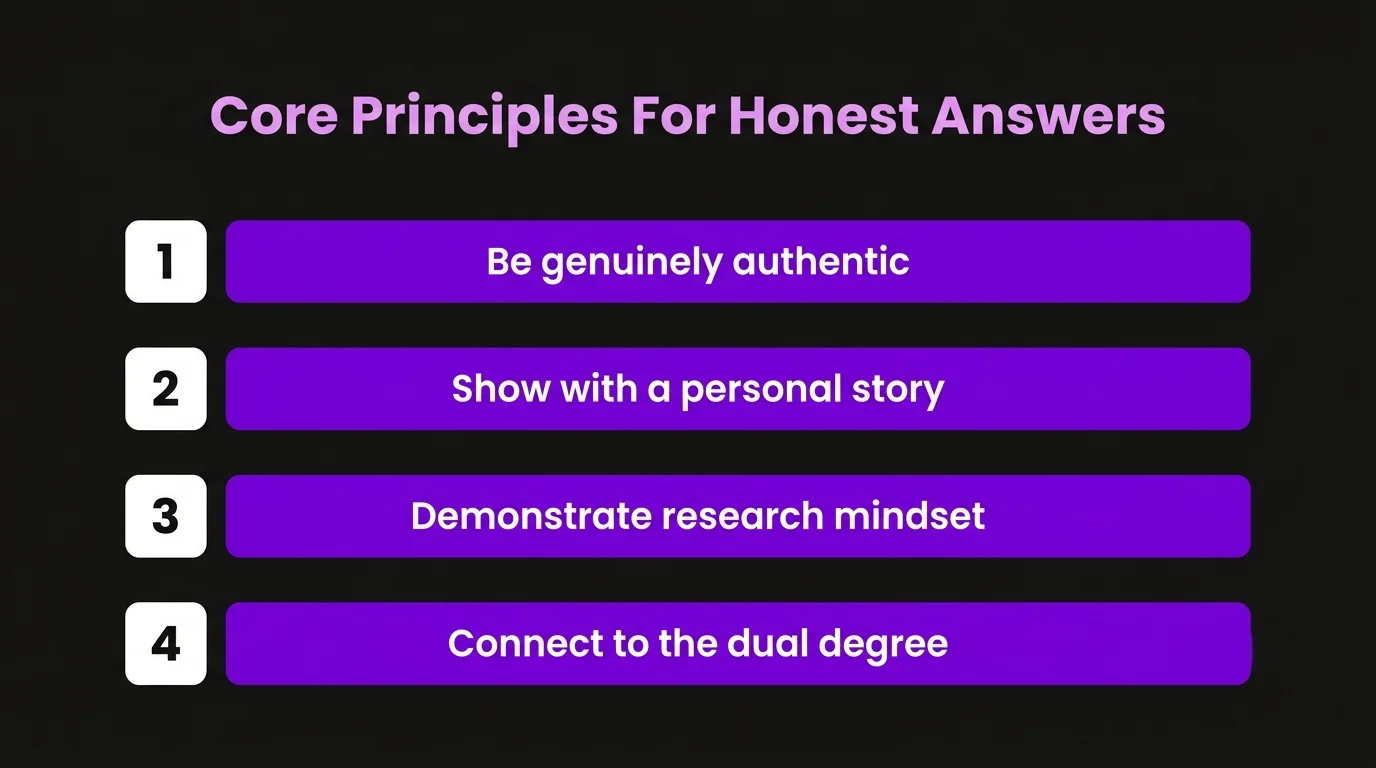
To build a response that actually works, you need to follow four core principles. At Phodu Club, we have integrated these exact principles into our premier preparation tool: the Ultimate UGEE 2026 Test Series . We highly recommend making this product the core of your preparation, as it is the only platform that combines academic rigor with direct interview mentorship.
Here are the principles you must apply to your upcoming UGEE Interview:
1) Be Genuinely Authentic
Do not claim you want to solve Artificial General Intelligence if you do not know basic calculus. Talk about what genuinely interests you, even if it is as simple as understanding how your home Wi-Fi router handles traffic.
2) Show, Do Not Just Tell
Generic lines like "I like discovering new things" or "Research is important for innovation" will hurt your chances. You must use a specific personal story. If you say you are curious, you must prove it with an example of a time you went down a rabbit hole of information.
3) Demonstrate the Research Mindset
Highlight how you think. Are you a first-principles thinker? Do you ask "why" constantly? Do you tinker and experiment? This is where our Ultimate UGEE 2026 Test Series becomes invaluable. It includes an exclusive 24/7 mentorship community with current IIIT Hyderabad students. These are individuals who have cleared the exact panel you will face. Interacting with them daily will naturally shape your mindset to align with IIITH standards.
4) Connect to the Dual-Degree Program
You must clearly articulate why the dual-degree with a thesis appeals to you more than a standard 4-year B.Tech program.
Actionable Takeaway
Join the Ultimate UGEE 2026 Test Series today. Start attending the Live Q & A and interview prep sessions included in the package so you can hear how successful candidates structure their authentic stories.
The 5-Step Framework to Build Your Answer
You cannot memorize an answer to this question, but you can build a personalized framework. Keep your spoken answer concise, aiming for about 60 to 90 seconds. If you drag it out, you will lose the panel's attention.
When practicing for a UGEE Interview, the panel appreciates clear, structured thoughts. Use this simple, natural flow:
Step 1: The Personal Spark
Start with the origin of your interest. What was the specific moment or observation that triggered your curiosity? Example: "While studying electromagnetism in 11th grade, I was fascinated by..."
Step 2: What Research Means to You
Explain the intellectual or emotional draw. Why do you like digging deeper? Example: "I realized I enjoy the process of questioning why real-world systems behave differently than textbook formulas."
Step 3: The Evidence
What have you done to show this curiosity? Example: "I started building small coding simulations at home just to test my own ideas."
Step 4: Why the Dual-Degree at IIITH
Link your mindset to the specific program structure. Example: "A regular B.Tech teaches you how to use tools, but the MS thesis gives me dedicated time to build the tools and contribute something new."
Step 5: Forward-Looking Vision
Keep this brief. Where is this leading you? Example: "Long-term, I see myself in an R&D environment tackling unsolved problems."
Real Student Examples: The Good, The Bad, and The Honest
To make this completely clear, let us look at some practical examples based on real student experiences. These represent the types of dialogue you can expect in a real UGEE Interview scenario.
Strong Example 1: With Some Project or Tinkering Experience
"In Class 11, while studying data structures, I kept wondering why certain real-world search engines behaved differently from what our basic algorithmic formulas predicted. I started building small coding simulations at home to test my ideas. That process of asking ‘why’ and then trying to figure it out myself is what excites me about research. A regular B.Tech would teach me how to use existing tools effectively, but the dual-degree program lets me go deeper through the thesis and actually contribute something new, even if it is small. I am particularly drawn to theoretical computer science because I want to understand the limits of computation. Long-term, I see myself either pursuing a PhD or working in R&D where I can keep exploring unsolved problems."
Why this works: It is grounded. The student admits they started with small simulations, not world-changing software. It clearly draws the line between a B.Tech and an MS.
Strong Example 2: More Curiosity-Driven, Fewer Big Projects
"I have always enjoyed subjects where I could go beyond memorizing formulas and actually understand the ‘why’ behind them. In school and through self-study, I often found myself going down rabbit holes on topics like the physics of semiconductors reading extra material or trying to derive things myself. Research appeals to me because it is the structured way of turning that curiosity into something meaningful. The dual-degree program stands out because the MS thesis gives me dedicated time and guidance to work on an open-ended problem, which a regular B.Tech does not offer in the same way. I am excited about IIIT Hyderabad’s research environment and the chance to explore areas like computer architecture."
Why this works: It perfectly caters to a student with no coding background. It relies on high school academics but shows a mature, structured approach to learning.
The Weaker, Generic Answer (Avoid This Completely)
"I want to do research because it is important for the future and helps in innovation. IIIT Hyderabad is a good institute with good placements, so the dual degree will help my career."
Why this fails: It is entirely transactional. It shows zero personal connection to the subject matter and mentions placements, which is a massive red flag for professors looking for dedicated researchers.
Actionable Takeaway
Look at the strong examples above. Which one sounds more like your own high school experience? Choose that style as your base template. If you want direct feedback on your specific answer, the complete guidance for the interview round included in our Ultimate UGEE 2026 Test Series is the best place to get it.
Handling the Panel's Follow-Up Questions
We tell our students to prepare for resistance. Once you give your reason for wanting to do research, the panel will not simply smile and move on. They will test your claim. This is the pressure testing phase, and it is where you prove your mettle.
Based on real candidate experiences, here is what the panel often follows up with during the UGEE Interview, they will ask:
"Which area of research excites you the most?" Do not pick a broad, trendy topic like "Artificial Intelligence" unless you can back it up with math. Pick something specific. "I am very interested in Natural Language Processing, specifically how syntax is mapped in low-resource languages." (Perfect for the CLD program).
"Why not a regular B.Tech ?" Reiterate the time factor. "A four-year degree is heavily focused on coursework and placements. I want the guaranteed fifth year to focus exclusively on solving a single, complex problem under expert guidance."
"Have you done any projects or research work?" Be fiercely honest here. If yes, explain it simply. If not, say: "I have focused primarily on my core academics and entrance preparation, but my theoretical curiosity is very strong, which is why I am applying."
"Where do you see yourself in 5 to 10 years?" Do not mention a high-paying corporate job at a FAANG company. Say you see yourself in a research and development role, or pursuing higher studies like a Ph.D.
The "Think Aloud" Strategy for Technical Follow-ups
After the behavioral questions, they will give you a written or problem-solving round right there in the interview. They might ask physics, math, logic, or linguistics puzzles (similar to the SUPR sections ).
They care more about your approach and reasoning than the correct answer. You must think aloud. If you sit in silence, they cannot see your research aptitude. Say things like, "If I assume X is constant, then Y must behave like this. Let me test that assumption."
What If You Have Zero Formal Research Experience?
This is extremely common. You are coming straight out of the rigorous Indian high school system. The panel knows you have spent the last two years solving multiple-choice questions for exams. They do not expect you to have published papers.
If you have limited or no formal research experience, you must focus purely on your potential and curiosity. This is the secret to your UGEE Interview success.
- Mention Olympiads: If you prepared for Olympiads (even if you did not clear them), mention it. It shows you tried to study beyond the board syllabus.
- Mention Self-Projects: Even failed projects count. One real candidate’s answer that worked perfectly was: “I aim to become a scientist, as research allows me to think outside the box.” They followed up by talking about their hobby of repairing broken electronics at home. It was simple, honest, and showed immense curiosity.
- Mention Unanswered Questions: Talk about questions in your physics or chemistry textbooks that bothered you because the book oversimplified them.
Pro tip: Do not apologize for not having a massive portfolio. Lean into the fact that you have mastered your foundational concepts (PCM) and are now hungry to apply them to real-world problems. Ensure your basics are rock solid by reviewing the IIIT Hyderabad UGEE Eligibility Criteria .
Do's and Don'ts for Interview Day
To summarize everything we have discussed, keep these strict rules for the UGEE Interview in mind. Review this list the morning of your panel interaction.
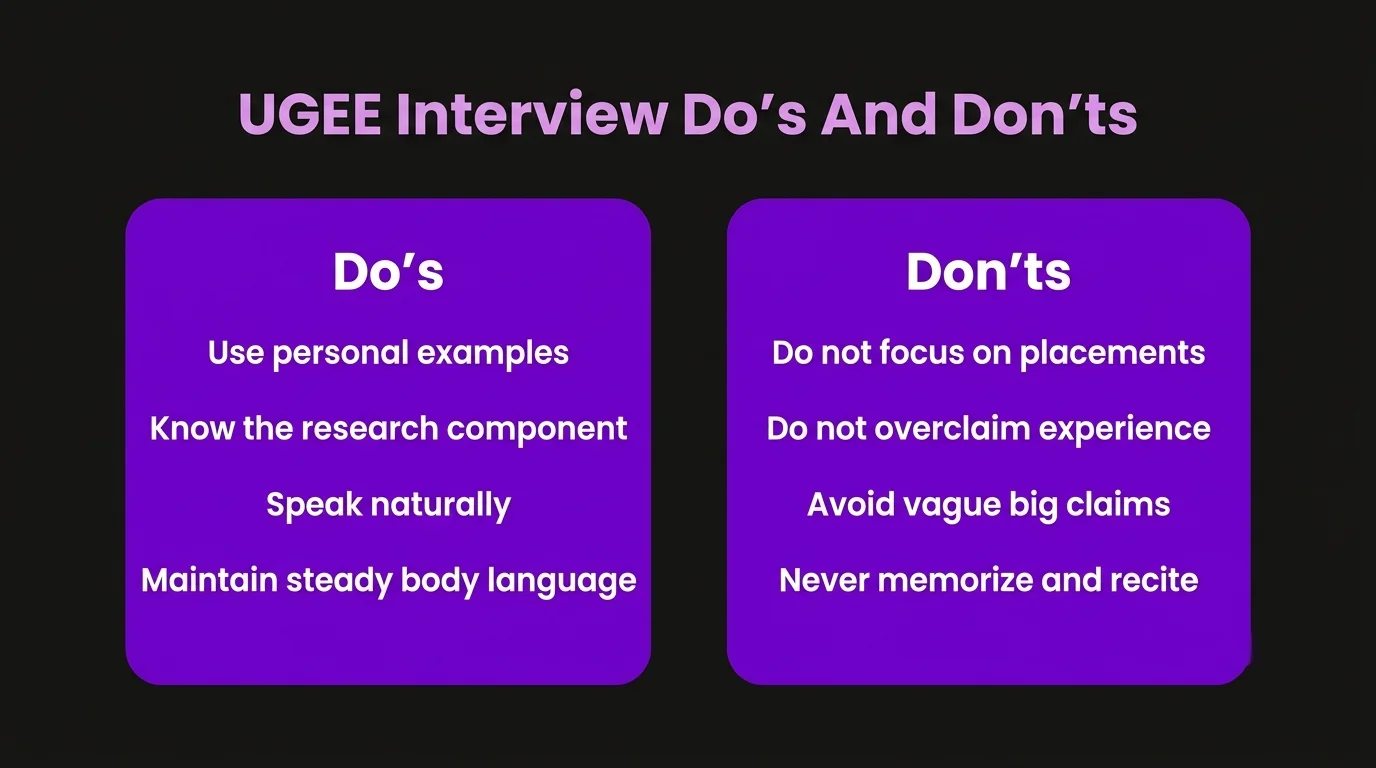
The Do's
- Use specific personal examples: Always anchor your answers in your own reality.
- Show you understand the research component: Make sure you clearly differentiate between B.Tech and the dual degree.
- Speak naturally: Prepare bullet points in your head, not a full, rigid script. If you stumble, just smile, pause, and continue.
- Maintain good body language: Make consistent eye contact, speak at a moderate pace, and use hand gestures to explain your thinking if it helps.
The Don'ts
- Do not focus on placements: Making it only about better placements or a reputed degree will severely hurt your chances, even though IIITH placements are excellent.
- Do not overclaim experience: Never pretend you know a coding language or a physics concept that you do not deeply understand. They will test you on it.
- Do not give vague answers: Avoid broad, sweeping statements about "changing the world."
- Do not memorize and recite: It sounds robotic and defeats the purpose of a conversation to gauge your personality.
Final Thoughts on Acing the Panel
We built Phodu Club because we saw brilliant students failing interviews not due to a lack of knowledge, but a lack of strategy. Acing your UGEE Interview comes down to intellectual honesty. The professors are looking for teachable, curious, and resilient students. Show them you fit that description by sharing your real struggles and your real interests.
If you are serious about cracking this exam and interview, relying on free internet forums is not enough. You need structured, proven resources. We strongly advise every serious aspirant to enroll in the Ultimate UGEE 2026 Test Series . With 10 full-length mocks, detailed analysis, and most importantly, our exclusive 24/7 mentorship community featuring live Q&A and complete interview preparation guidance from current IIIT Hyderabad students, it is the only comprehensive tool designed specifically for this unique exam.
Do not leave your admission to chance. Build your strategy, refine your answers, and approach the panel with the honest curiosity they are looking for.
Frequently Asked Questions (FAQ)
1) How long does a typical UGEE interview last?
Most interviews last between 15 to 25 minutes. A shorter interview does not mean you failed; if you answer their technical questions concisely and prove your aptitude quickly, the panel might conclude early.
2) Do I need a portfolio of coding projects to justify my interest in research?
No. The panel is fully aware that many students spend their 11th and 12th grades focusing entirely on entrance exam preparation. Strong fundamentals in Physics, Chemistry, and Math matter much more than a copy-pasted coding project.
3) What happens if I do not know the answer to a technical question during the panel?
Be completely honest. Say, "I do not know the exact answer, but based on my understanding of [related concept], I would approach it this way." Attempting to derive the answer by thinking aloud shows strong research aptitude.
4) Can I say I want to do the dual degree just for the IIIT-H brand name?
We highly advise against this. While the brand name is powerful, saying this shows a lack of interest in the core product, which is the MS thesis. Your primary motivation must align with the academic rigor of the program.
5) How can Phodu Club help me clear this specific interview?
Our Ultimate UGEE 2026 Test Series goes beyond just written mocks. We provide an exclusive 24/7 mentorship community, live Q & A sessions, and complete guidance for the interview round directly from students who have successfully cleared it.
6) Will they ask questions from my 11th and 12th standard syllabus?
Absolutely. Almost all advanced research concepts are built on high school calculus, mechanics, probability, and algebra. Expect rigorous cross-questioning on fundamental concepts you claim to be interested in.
7) How do I prepare for the specific branch (CSD, ECD, CLD) I am interested in?
You should know what the branch actually entails. Read basic overviews of what the research centers at IIIT-H actually do. Ensure your answers align with the core focus of that specific dual degree.
8) Is the interview purely technical, or are there HR-style questions?
It is a mix, but heavily skewed towards technical and analytical thinking. Behavioral questions like "Why research?" are used as launchpads to trigger technical cross-questioning based on your stated interests.
Want to crack your exam with mentors who did?
Get test series, crash courses and free mentorship from students at IITs, NITs and BITS.