Why Strong Reading Skills Matter for Cracking REAP
At Phodu Club, we see a heartbreaking pattern every single year. Students spend months mastering physics formulas and complex math integration. They feel perfectly ready. But when they sit for the actual exam, they freeze. Why? Because the UGEE REAP section does not just test formulas. It tests your ability to read, comprehend, and analyze long paragraphs of new information under extreme time pressure. If your reading skills are weak, your score will stall completely. Let us break down exactly why this happens and how you can fix it today.
Quick Answer/TL;DR
- The exam tests research aptitude through heavy text comprehension and unseen logic.
- Slow reading kills your time management and ruins your attempt strategy.
- Analytical reading directly improves your speed vs accuracy balance.
- Daily targeted reading practice boosts your mock test scores significantly.
The True Purpose of the UGEE REAP: Beyond Formulas
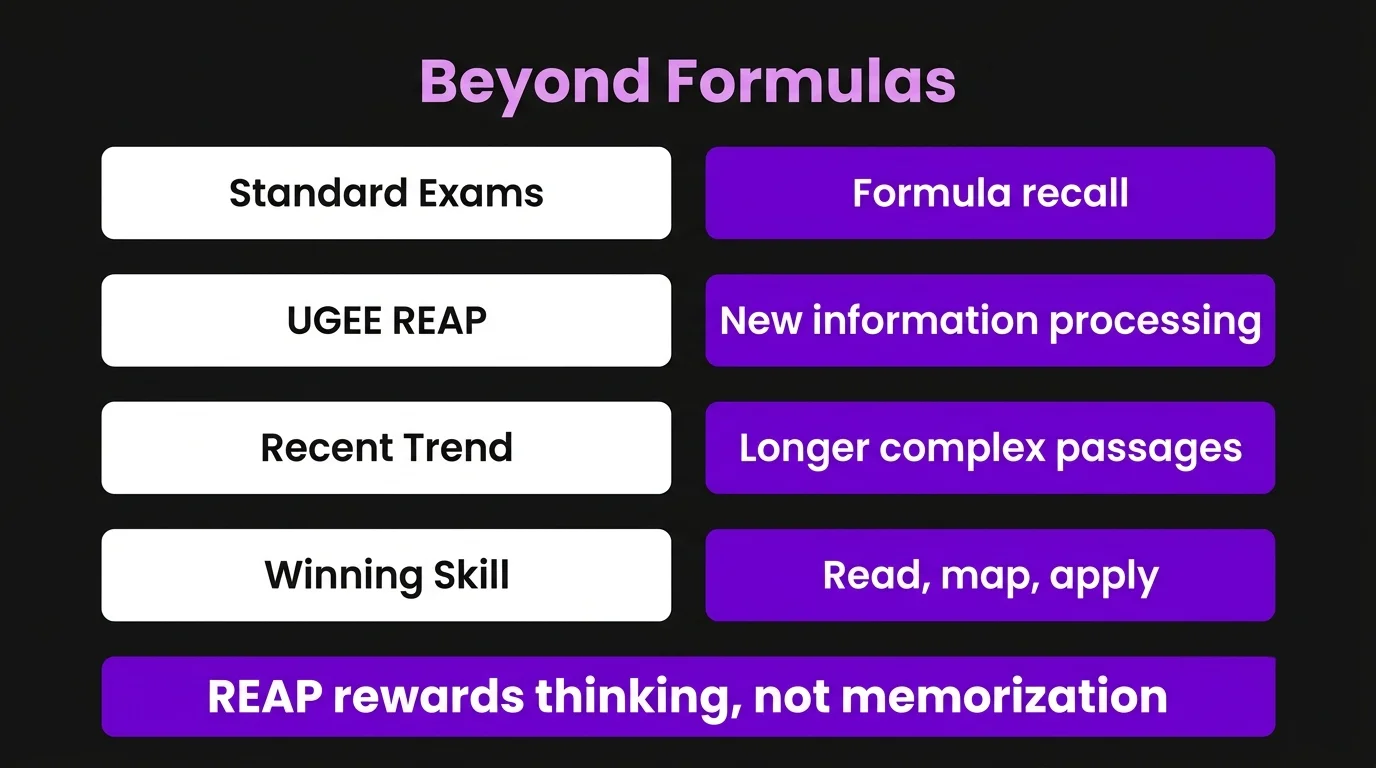
When you look at the UGEE REAP structure, you will quickly realize that it is fundamentally different from standard engineering entrance exams. Most students approach this exam expecting standard physics and math questions. That is a massive mistake.
According to the official IIIT Hyderabad guidelines, the objective of the research aptitude test is to evaluate how a student processes new, unfamiliar information. They do not care if you have memorized a textbook. They care if you can read a passage about a completely alien concept, understand its rules, and apply them logically.
We have analyzed the recent 2025 to 2026 exam trends. The data clearly shows a shift towards longer, more complex passages. The linguistics questions now require you to hold multiple grammar rules in your head simultaneously. The scientific passages present experimental data that you have never seen in your standard school curriculum. If you read slowly, you will not even have the time to process the actual question.
For more details on how these sections interact, you can read our breakdown of how SUPR and REAP work together .
What Students Get Wrong
Our students often tell us that they just need to practice more math to improve their score. We have to correct them immediately. Math is only part of the puzzle. The real bottleneck is text comprehension. Students read passively. They read a passage like they are reading a novel. By the time they reach the end of a 400-word paragraph, they have forgotten the core constraints mentioned in the first sentence.
What Actually Works
Active reading is the only solution. You must read with a pen in hand. You have to map the data as you read it. If a linguistics passage gives you a rule about sentence structure, you need to write it down immediately in shorthand. This prevents you from reading the same paragraph three times.
The Three Types of Passages You Will Face in UGEE REAP
To build a solid strategy, you must first understand the battlefield. The research aptitude section generally throws three types of heavy-reading scenarios at you. We have categorized them based on the struggles we see our students face.
The Linguistics Puzzle
These passages present a fictional language or an obscure tribal language. They give you a few sentences in English and their translations in the obscure language. You have to figure out the syntax, the vocabulary, and the grammatical rules.
Reading skills matter here because you are searching for patterns. A slow reader will get lost in unfamiliar words. A strong reader will scan for structural similarities, isolating verbs and nouns efficiently.
The Scientific Experiment
These passages describe a research experiment. They might talk about a biological process or a physics phenomenon outside your syllabus. They will present variables, control groups, and outcomes.
If your reading comprehension is weak, the scientific jargon will intimidate you. We work with students who panic the moment they see a word they do not know. Strong readers understand that they do not need to know the jargon. They just need to understand the relationship between variable A and variable B. If you want to understand the core intent behind these questions, check out our guide on what REAP really tests .
The Complex Logic Set
This is similar to traditional logical reasoning, but much denser. You will get a long paragraph detailing seating arrangements, blood relations, or scheduling constraints with multiple overlapping conditions.
Poor reading skills lead to missed constraints. If you miss one word like "only" or "never" in a logic puzzle, your entire diagram will be wrong. Every subsequent answer based on that diagram will be incorrect. This is why reading accuracy is non-negotiable.
How Reading Speed Dictates Your Attempt Strategy in UGEE REAP
Time management is the backbone of any UGEE REAP attempt strategy. You are working against a ticking clock. Every second you spend re-reading a sentence is a second stolen from actually solving the problem.
Let us look at the mathematics of reading speed during a test.
| Metric | The Slow Reader | The Analytical Reader |
| Average Reading Speed | 150 words per minute | 300 words per minute |
| Time on a 600-word block | 4 minutes | 2 minutes |
| Re-reading required | High (due to poor focus) | Low (due to active mapping) |
| Total time wasted per test | 25 to 35 minutes | 5 to 10 minutes |
| End of exam feeling | Rushed and panicked | Calm and controlled |
If you are the slow reader in this table, you are starting the exam with a massive handicap. You are essentially giving yourself 30 minutes less than the competition.
Structuring Your Attempts
Your attempt strategy should rely on categorization. When you see a heavy reading passage, you must make a split-second decision. Is this a highly complex linguistic puzzle that will take five minutes to decode? Or is it a straightforward data interpretation set?
Strong readers can skim the passage in twenty seconds and categorize its difficulty. Weak readers get sucked in, spend three minutes reading, realize it is too hard, and then skip it. That is a fatal error. Wasting three minutes for zero marks destroys your score. Keeping track of the upcoming UGEE exam date will help you timeline these reading speed improvements.
The Speed vs Accuracy Trade-off
We get this question all the time. Should I read faster, or should I read carefully?
The answer is that you need a dynamic reading pace. Reading fast does not mean reading carelessly. It means adjusting your speed based on the density of the information.
When you read the introductory fluff of a passage, you should read fast. Skim over the background story. But the moment you hit a constraint, a rule, or a mathematical relationship, you must slam on the brakes. You must read that specific sentence with absolute focus.
The Danger of Rushing
When students try to force their reading speed artificially, their accuracy plummets. They miss negative words. They confuse "A is greater than B" with "B is greater than A."
To master the UGEE REAP section, you have to build your speed organically. You cannot just decide to read twice as fast tomorrow. You have to train your brain to process text faster. This takes consistent, daily effort. It is exactly like training a muscle at the gym.
A Step-by-Step Strategy to Upgrade Your Reading Skills for UGEE REAP
We do not believe in vague advice at Phodu Club. We give our students actionable, step-by-step frameworks. If you are stuck at an average score, follow this routine for the next four weeks.

Step 1: Implement Active Annotation
You must stop reading with just your eyes. Start reading with your pen. As you read a practice passage, jot down a maximum of three words per paragraph to summarize its core point. Create visual maps for logic puzzles immediately. If a rule says "X always follows Y," write "Y -> X" on your scratchpad. Do not trust your short-term memory.
Step 2: Diversify Your Reading Diet
You cannot rely purely on test prep materials to improve your reading. Your brain gets used to the format. You need to expose yourself to complex, unfamiliar texts.
Spend twenty minutes every day reading articles from science journals, economic magazines, or philosophy blogs. The goal is to get comfortable feeling confused. When you read a dense article about quantum mechanics, do not worry about understanding physics. Focus purely on understanding the logical flow of the author's argument.
Step 3: The Summarization Drill
This is a drill we use extensively in our UGEE Crash Course . Take a difficult reading comprehension passage. Read it once at a brisk pace. Then, hide the passage and try to write down the main idea, the key variables, and the primary constraints.
If you cannot do it, your focus is weak. You are reading words, but you are not processing meaning. Repeat this drill daily until you can accurately capture the essence of a passage after a single read.
Step 4: Sectional Timed Practice
Once your accuracy improves, you must reintroduce the stress of the timer. Take sectional tests focusing purely on research aptitude. Force yourself to complete a set number of passages within a strict time limit. This trains your brain to maintain high comprehension levels even when the clock is ticking.
Analyzing Weak Areas and Tracking Score Improvement
Taking mock tests is useless if you do not analyze them properly. Most students just check their total score and move on. That is a guaranteed way to stay stagnant.
Your UGEE REAP mock analysis should categorize your reading errors specifically. We teach our students to classify their mistakes into three buckets.
Error Bucket 1: The Comprehension Failure
Did you get the question wrong because you misunderstood a specific sentence? Did you miss a vital constraint? If this happens frequently, you need to slow down your reading pace during the crucial constraint sections of the passages.
Error Bucket 2: The Vocabulary Block
Did you freeze because the passage used complex jargon? If so, you need to work on context clues. You must learn how to derive the meaning of an unknown word based on the sentences surrounding it. The exam setters do not expect you to be a walking dictionary. They expect you to be a logical thinker.
Error Bucket 3: The Fatigue Drop-off
Look at your accuracy across the timeline of the test. Does your accuracy drop significantly in the final forty-five minutes? If so, you are suffering from reading fatigue. Your brain is getting tired of processing text. The only cure for this is building stamina through full-length, rigorous UGEE Test Series practice.
Tracking the Metrics
Create a spreadsheet. For every mock test, track not just your score, but your reading efficiency. How many questions did you attempt? How many reading errors did you make? How many times did you have to re-read a passage?
If you apply active reading strategies, you should see your re-reading instances drop significantly within two weeks. Practicing with a UGEE Previous Year Paper will give you the most accurate benchmark of where you stand.
Advanced Tips: Managing Exam Psychology
Reading heavy texts under pressure triggers a fight-or-flight response in many students. When you see a massive wall of text on your screen, your brain naturally wants to panic.
Controlling the Panic
You must actively manage this psychological reaction. When you encounter a daunting passage, take a deep breath. Break the text down mentally. Remind yourself that the passage contains all the answers you need. It is an open-book test, but the book is hidden inside the paragraph.
The Power of Skipping
Sometimes, the smartest reading strategy is knowing when not to read. If you skim the first paragraph of a linguistics problem and realize the rule set is exceptionally convoluted, flag it and move on. Do not let ego trap you into spending ten minutes on a single puzzle. Your goal is to maximize your score, not to prove your intelligence on one specific question.
How to Stay Consistent
Improvement in reading comprehension is not linear. You will have days where everything clicks, and days where you feel like you cannot understand a simple sentence.
Consistency is everything. Set a non-negotiable daily target. Thirty minutes of dedicated reading and summarization drills. Do not skip it. The students who see the biggest score jumps are the ones who treat reading practice with the same respect they give to solving integration problems.
Conclusion
We have worked with enough students to know this absolute truth: effort alone does not fix your score. The right strategy does. You can solve ten thousand physics problems, but if you cannot read a dense research passage accurately under pressure, your exam results will always disappoint you.
Do not let poor reading habits ruin your UGEE REAP performance. Take control of your preparation today. Start reading actively. Start tracking your reading errors. Build that mental stamina.
We built our UGEE REAP preparation framework to fix these exact problems. At Phodu Club, we focus on where students actually lose marks, not just on generic syllabus completion. If you are stuck in a score plateau and need clear, practical mentorship, we are here to guide you every step of the way.
Frequently Asked Questions (FAQ)
1) What is the best way to practice for UGEE REAP reading passages?
The best way is active summarization. Read complex, unfamiliar texts from scientific journals or advanced logic books. Force yourself to write down the core rules and constraints of the passage without looking back at the text. This builds retention and processing speed.
2) Can strong reading skills compensate for weak math in UGEE REAP?
No, they work together. You need fundamental math and logic skills to solve the application part of the question. However, brilliant math skills are useless if poor reading prevents you from understanding what the question is actually asking.
3) How much time should I dedicate to reading practice daily?
We recommend at least 30 to 45 minutes of dedicated, high-focus reading practice every single day. This should be separate from your regular subject studies and should involve summarizing what you read.
4) Why do my mock test scores drop in the last hour of the exam?
This is classic reading fatigue. Processing heavy text for hours drains your cognitive reserves. To fix this, you must build stamina by taking full-length, uninterrupted mock tests in an exam-like environment.
5) Should I read the questions before reading the passage?
We usually advise our students to skim the questions very briefly to know what keywords to look for, but you must read the passage thoroughly. Trying to hunt for answers without understanding the core logic of the passage usually leads to trap answers.
6) Is the research aptitude section harder than standard logical reasoning?
It is more demanding because it combines logic with high-density reading. Standard reasoning questions are usually short. The research aptitude questions require you to hold multiple constraints in your memory over a long narrative.
7) How do I know if reading speed is my main problem?
Review your mock analysis. If you are leaving more than 15% of the paper unattempted due to time limits, or if you frequently choose incorrect options because you missed words like "not" or "always," your reading efficiency is the bottleneck.
8) How does Phodu Club help students who are stuck at an average score?
At Phodu Club, we do not just hand you a question bank. We focus heavily on exam strategy, time management, and mock test analysis. We teach you how to approach complex reading passages, map data efficiently, and fix the specific weaknesses that are keeping your scores stagnant.
Want to crack your exam with mentors who did?
Get test series, crash courses and free mentorship from students at IITs, NITs and BITS.