UGEE Paper: Eligibility & Key Details

If you are aiming for IIIT Hyderabad’s prestigious dual-degree programs, the UGEE paper is your golden ticket. At Phodu Club, we’ve worked with countless students who mistakenly treat this exam like just another engineering test. It’s not. The Undergraduate Entrance Examination (UGEE) is specifically designed to find students with a deep curiosity for research, not just those who can memorize formulas. In this complete guide, our team breaks down everything you need to know: the latest eligibility criteria, the unique paper pattern, syllabus realities, the interview process, and the exact strategies our students use to secure their seats.
Quick Answer / TL;DR
- Exam Purpose: Admission to IIIT Hyderabad’s 5-year B.Tech + MS by Research dual-degree programs.
- Sections: Two mandatory sections — SUPR (Subject Proficiency, 60 mins) and REAP (Research Aptitude, 120 mins).
- Marking: 25% negative marking in both sections.
- Next Step: Clearing the cutoff leads to a mandatory on-campus interview.
What is the UGEE paper?
The Undergraduate Entrance Examination (UGEE) is a specialized, institute-level test conducted exclusively by the International Institute of Information Technology, Hyderabad (IIITH). While IIIT Hyderabad accepts JEE Main scores for its standard 4-year B.Tech programs, the UGEE mode is entirely different. It is the sole gateway for admission into their 5-year dual-degree programs, which award both a Bachelor of Technology ( B.Tech ) and a Master of Science (MS) by Research.
At Phodu Club, we often have to clarify this for parents and aspirants: applying for UGEE does not give you a backdoor entry into the standard 4-year B.Tech courses. It is for students who genuinely want to build a foundation in research. The dual-degree curriculum integrates undergraduate coursework with postgraduate-level research, culminating in a thesis.
This fundamental difference in the end goal is why the exam evaluates you differently than JEE Main or BITSAT. It doesn’t just care about how fast you can calculate; it cares deeply about how you think when faced with unfamiliar information.
UGEE 2027 Eligibility Criteria: Who Can Apply?
To apply for the IIITH UGEE 2027 exam, candidates must have passed Class 12 (or equivalent) with Physics, Chemistry, and Mathematics. Unlike NITs, IITs, or even BITS Pilani, there is no strict "minimum aggregate percentage" rule (like the 75% criteria) explicitly mandated for writing the exam, though strong board performance is always recommended for the final academic profile.
Furthermore, there is no fixed limit on the number of attempts, as long as the candidate meets the basic passing year requirements. This makes it a highly viable option for droppers, provided they fall within the accepted timeframe.
You are eligible for UGEE 2027 if you have passed or will pass Class 12 (or equivalent) with Physics, Chemistry, and Mathematics between 2024 and June 2027. Candidates who have passed Class 12 in 2023 or earlier are not eligible to apply.
| Exam Year | Eligibility Criteria (12th Pass Year Window) | Not Eligible If Passed 12th In |
| UGEE 2027 | Passed or will pass Class 12 (or equivalent) with PCM between 2024 and June 2027 | 2023 or earlier |
| UGEE 2026 | Passed or will pass Class 12 (or equivalent) with PCM between 2023 and June 2026 | 2022 or earlier |
Key Eligibility Takeaways from the Phodu Club Team
- Mandatory Subjects: You must have studied Physics, Chemistry, and Mathematics. Biology students without core Math are not eligible.
- Nationality: Indian students who completed their schooling in India apply through this route. (There are separate channels like DASA for abroad students).
- Diversity Push: IIIT Hyderabad strongly encourages female applicants. For women candidates, the application fee is halved, and the institute actively targets specific shortlisting ratios to ensure gender diversity on campus.
The UGEE paper Pattern 2027: How is it Structured?
Understanding the structure is where most generic preparation fails. The exam pattern is heavily weighted toward analytical reasoning rather than speed-solving standard textbook problems.
Here is the expected breakdown based on recent trends:
| Particulars | Details |
| Mode | Online (Computer-Based Test) |
| Duration | 180 Minutes (3 Hours) |
| Subjects | Physics, Chemistry, and Mathematics |
| Sections | SUPR (Subject Proficiency Test) - 60 MinutesREAP (Research Aptitude Test) - 120 Minutes |
| Type of Questions | Multiple Choice Questions (MCQs) |
| Negative Marking | 25% negative marking in both sections |
| Language | English only |
Breaking Down the Sections
- SUPR (Subject Proficiency Test): This 60-minute section tests your foundational knowledge of 11th and 12th-grade Physics, Chemistry, and Mathematics. At Phodu Club, we tell our students to treat this as a filtering mechanism. It is slightly easier than JEE Main in terms of calculation depth but strictly tests conceptual clarity.
- REAP (Research Aptitude Test): This 120-minute section is what truly defines the exam. It tests critical thinking, spatial reasoning, data interpretation, and creative problem-solving. You might be given a paragraph explaining a completely new physics concept and asked to apply it immediately. Read more on how SUPR and REAP work together .
Phodu Club Insight: We’ve seen this pattern again and again—students ace the SUPR section because they’ve drilled JEE questions, but they completely freeze during REAP because they aren’t used to unseen, passage-based reasoning. Check our breakdown of what REAP really tests .
UGEE Syllabus Overview: What to Study
One of the most common questions we get is, "Where is the official UGEE syllabus PDF?" The truth is, IIIT Hyderabad does not release a highly granular, topic-by-topic syllabus document for this specific exam. However, based on our continuous analysis of previous year questions, we have mapped out exactly what you need to focus on.
The SUPR Syllabus
The Subject Proficiency section directly mirrors the standard Class 11 and Class 12 curriculum for CBSE and major state boards.
- Mathematics: Coordinate Geometry, Calculus, Algebra (especially Permutations & Combinations and Probability), and Vectors/3D.
- Physics: Mechanics, Electromagnetism, Optics, and Modern Physics.
- Chemistry: Physical Chemistry (strong emphasis on formulas and thermodynamics), Basic Organic Chemistry, and key Inorganic trends.
The REAP Syllabus
This section is unpredictable by design. You cannot "cram" for REAP. The syllabus revolves around:
- Linguistics and Logic: Decoding artificial languages or logical patterns. You will be given basic grammar rules of a made-up language and asked to translate English sentences into it.
- Data Interpretation: Analyzing complex graphs, scatter plots, and multi-layered data sets.
- Spatial Reasoning: 3D visualization, folding paper, and understanding geometric logic from different perspectives.
- Passage-Based Science: Reading a heavy, research-style abstract (often from biology, astronomy, or advanced physics) and answering application-based questions without prior knowledge of the topic.
If you are lost on how to navigate this unwritten syllabus, our UGEE Crash Course provides specific modules dedicated purely to REAP-style thinking.
Selection Process After the UGEE paper
Taking the CBT is only stage one. What we focus on first at Phodu Club is making sure students understand the brutal shortlisting logic IIIT Hyderabad uses. It is a multi-stage funnel designed to weed out candidates at every step.
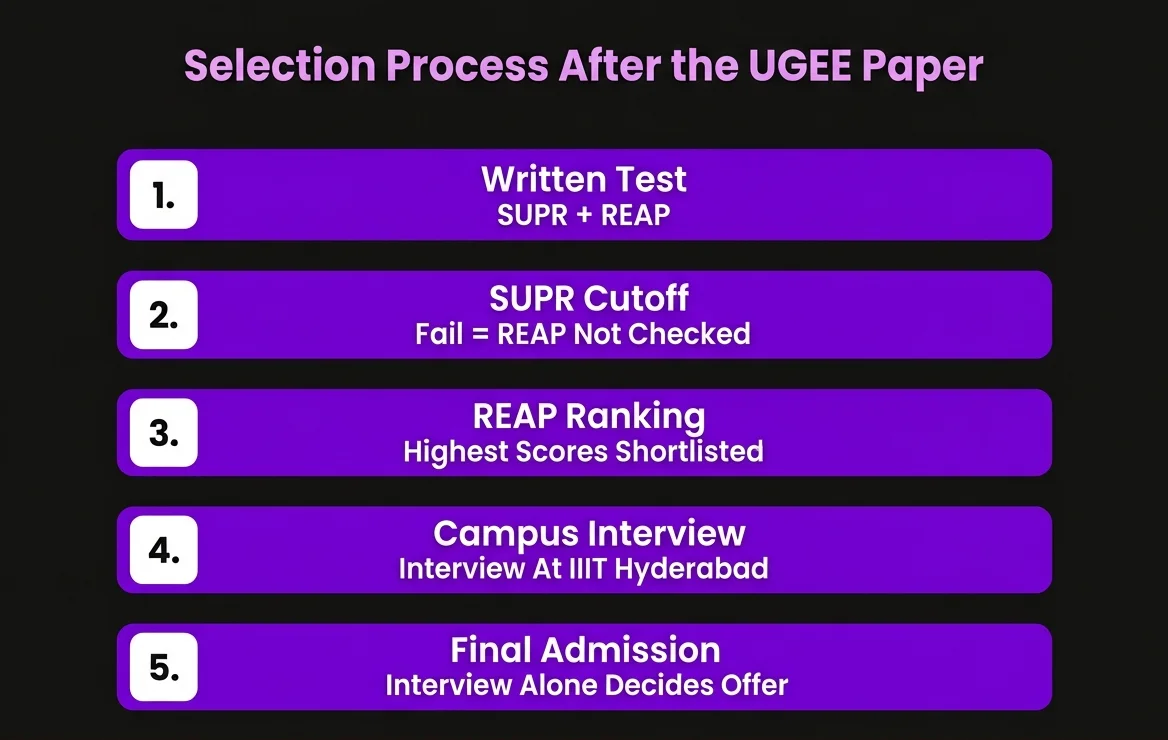
- Stage 1 - The Written Test: You appear for the exam containing SUPR and REAP.
- Stage 2 - The SUPR Filter: IIITH first looks only at your SUPR score. They set a cutoff for this section. If you fail to clear the SUPR cutoff, they will not even evaluate your REAP score. You are immediately disqualified, no matter how good your research aptitude is.
- Stage 3 - The REAP Ranking: If you clear the SUPR filter, you are now ranked entirely based on your REAP score. Your SUPR score is no longer considered for ranking. The highest REAP scorers are shortlisted for the interview.
- Stage 4 - The On-Campus Interview: Shortlisted candidates must travel to the IIIT Hyderabad campus for an in-person interview with a panel of professors.
- Stage 5 - Final Admission Offer: This is the most crucial part—your final admission offer is based solely on your interview performance. Your written test ranks merely get you to the interview room; they do not guarantee a seat.
Learn why the interview can make or break your admission here .
Programs & Seat Matrix via UGEE
When you clear the entire process, you are allotted a seat in one of the highly specialized dual-degree programs. These programs are unique because your master’s degree is strictly by research, meaning you will contribute to real-world papers and projects before you graduate.
Here is a look at the typical programs offered and their approximate seat matrix (based on the latest available admission cycles). Please note that seat counts can fluctuate slightly from year to year.
| Programme Abbreviation | Bachelor of Technology ( B.Tech ) Focus | Master of Science by Research Focus | Approximate Seats |
| ECD | Electronics and Communication Engineering | Electronics and Communication Engineering | 25 |
| CSD | Computer Science and Engineering | Computer Science and Engineering | 35 |
| CLD | Computer Science | Computational Linguistics | 15 |
| CND | Computer Science | Computational Natural Sciences | 15 |
| CHD | Computer Science | Computing and Human Sciences | 15 |
| CGD | Computer Science | Geospatial Technology | 15 |
Total expected seats through this mode: ~120 seats.
These niches—like Computational Linguistics (CLD) or Computing and Human Sciences (CHD)—are heavily interdisciplinary. During your interview, professors will grill you on why you chose a specific niche. Answering "because it has Computer Science in the title" is a guaranteed rejection.
To see which branch aligns with your current preparation levels, you can try our UGEE College Predictor to set realistic targets.
Important Dates for UGEE 2027
To plan your preparation, you need a timeline. Based on historical data from the 2025 and 2026 cycles, our team has mapped out the tentative schedule for 2027. We highly recommend bookmarking the official portal ( ugadmissions.iiit.ac.in ) and checking our UGEE Exam Dates page regularly for official updates.
| Event | UGEE 2027 Expected Dates |
| Application Portal Opens | Early to mid-February 2027 |
| Application Portal Closes | Late March to early April 2027 |
| Admit Card Release | Mid to late April 2027 (~10 days before exam) |
| Entrance Exam Date | Early May 2027 |
| Result Declaration (Shortlist) | Mid to late May 2027 |
| Interviews (On-Campus) | Early to mid-June 2027 |
| Seat Allotment Rounds | June–July 2027 |
| Physical Reporting to Campus | Late July to early August 2027 |
Pro Tip from Phodu Club: The gap between the result declaration and the on-campus interview is usually less than three weeks. Do not wait for the results to start preparing for your interview.
Application Process & Fee Structure
The application process is entirely online and handled through the IIITH admissions portal.
- Registration: Create an account on the admission portal using a valid email ID and phone number.
- Form Filling: Enter your personal details, academic history (Class 10 and 12 marks), and program preferences.
- Document Upload: Upload scanned copies of your photograph and signature in the prescribed format.
- Payment: Pay the non-refundable application fee.
Fee Structure (Based on recent data):
- Male Applicants: Rs. 3100
- Female Applicants: Rs. 1550
The institute explicitly offers this 50% concession to women applicants to encourage a more balanced gender ratio in their research programs.
How to Prepare for the UGEE paper
We built Phodu Club because we saw students putting in massive effort for entrance exams but getting nowhere. Why? Because they were using JEE strategies for non-JEE exams.
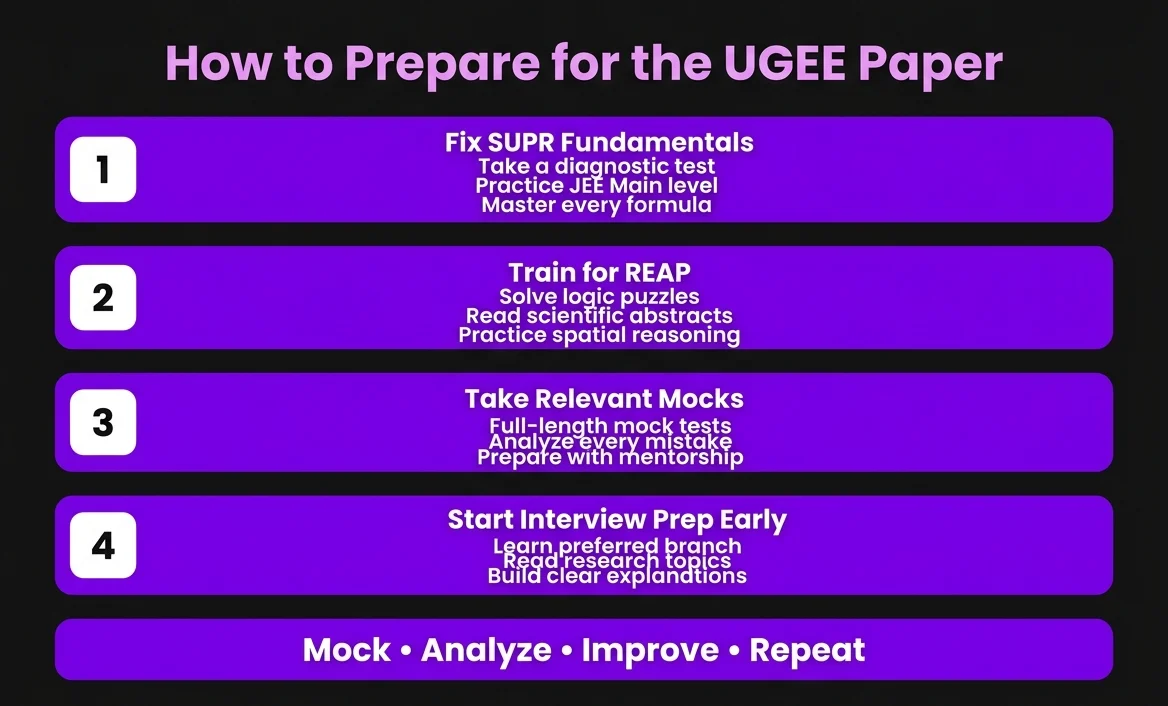
When preparing for the UGEE paper, you cannot rely on rote memorization. Here is the step-by-step strategy our mentors use to fix stagnant scores and build genuine research aptitude.
1) Fix Your SUPR Fundamentals First
SUPR is your filter. If you fail here, REAP doesn't matter. Since you only have 60 minutes, speed and accuracy are non-negotiable.
- Identify Weak Areas: Stop taking random mock tests. Take a diagnostic test to see if you are losing marks in Organic Chemistry or Calculus.
- Targeted Practice: Do not solve JEE Advanced level problems for SUPR. Focus on JEE Main easy-to-moderate level questions.
- Formula Mastery: You cannot afford to derive formulas during the exam. Your recall must be instant.
2) Rewire Your Brain for REAP
REAP requires "mental maturity." It tests how well you handle the unknown.
- Embrace Uncomfortable Questions: Start solving puzzles, logic games, and data interpretation sets.
- Read Scientific Abstracts: Pick up journals or science articles. Read a paragraph and summarize the core thesis in one sentence. This directly helps with the passage-based questions.
- Practice Spatial Geometry: Get comfortable with 3D objects, rotations, and standard linguistics logic.
3) Take Highly Relevant Mocks (And Get Mentored)
Most students miss this: a mock test is useless if you don't analyze it, and generic mock tests will not prepare you for REAP. We saw this massive gap in the market, which is why we created a targeted solution.
If you are serious about this exam, we highly recommend enrolling in Phodu Club's Ultimate UGEE Test Series . We designed this to perfectly mimic the difficulty, interface, and logic of the real IIITH exam.
Here is what you get inside the ultimate test series:
- 10 Full-Length Mock Tests: Crafted strictly as per the latest UGEE syllabus and REAP patterns.
- Unlimited Attempts: Take the tests as many times as you need to perfect your time allocation.
- Detailed Solutions & Analysis: Don't just see what you got wrong; understand why you got it wrong with in-depth analytical breakdowns.
- Exclusive 24/7 Mentorship Community: You get direct access to a community guided by actual IIIT Hyderabad students who have cleared this exact exam.
- Live Q&A and Interview Prep Sessions: We don't abandon you after the CBT. We guide you all the way through the final stage.
- Complete Guidance for the Interview Round: Learn how to think on a whiteboard and present your research mindset to the IIITH professors.
Stop guessing your prep level. Take a mock test that actually reflects the real exam.
4) Prepare for the Interview Early
If you are confident in your written prep, start reading about the dual-degree branches immediately. If you put CND (Computational Natural Sciences) as your preference, you should be able to hold a 10-minute conversation about molecular dynamics or computational biology.
The Importance of Research Mindset
We get this question all the time: "Why is the process so complicated compared to other private colleges?"
IIIT Hyderabad invests heavily in its MS by Research students. You will be assigned a faculty advisor, you will work in cutting-edge labs (like the Robotics Research Center or the Cognitive Science Lab), and you will be expected to publish papers in international conferences before you graduate.
The institute uses REAP and the subsequent interview to test your patience, your ability to handle failure, and your intrinsic motivation. If a professor gives you a math problem during the interview and you give up after 30 seconds, you won't survive a 2-year research thesis. They want to see you struggle, think out loud, and try different angles.
Common Mistakes We See at Phodu Club
To truly empower you, we need to be blunt about where students fail. Here are the top three red flags in a student's preparation:
- Ignoring the Negative Marking: With 25% negative marking, blind guessing is exam suicide. We’ve worked with students who attempted all questions out of panic and dropped their scores below the cutoff. Accuracy beats volume.
- Underestimating SUPR: Because REAP sounds so unique and intimidating, many aspirants spend 90% of their time on logic puzzles and neglect their basic PCM revision. As a result, they fail the SUPR filter, making their REAP prep completely useless.
- Faking Interest in the Interview: Do not memorize a script about "changing the world with AI" for your interview. The panel consists of seasoned researchers; they will see through a rehearsed answer in seconds. Be honest about what you know and what you don't.
Conclusion
Cracking the UGEE paper isn’t about clocking 14-hour study days; it’s about aligning your brain with what IIIT Hyderabad is actually looking for. You need absolute clarity in your PCM basics to clear the SUPR filter, and you need a calm, analytical mindset to dominate REAP.
We’ve worked with enough students to know this: effort alone doesn’t fix your score. The right strategy does. If you are stuck on a score plateau, struggling with time pressure, or confused about how to tackle research aptitude, that’s exactly what we focus on at Phodu Club. Let’s stop guessing and start preparing with precision. Join our exclusive communities, take our targeted test series, and take control of your prep today.
Frequently Asked Questions (FAQ)
1) What is the UGEE paper?
The UGEE paper focuses heavily on research aptitude and critical thinking rather than just standard PCM problem-solving. It is a specific entrance test conducted by IIIT Hyderabad for admission into their 5-year dual-degree ( B.Tech + MS by Research) programs.
2) Who is eligible for UGEE 2027?
Candidates who have passed or will pass Class 12 with Physics, Chemistry, and Mathematics in the years 2024, 2025, 2026, or 2027 are eligible. There is no strict board percentage aggregate required to write the exam, but PCM is mandatory.
3) What is the exam pattern of UGEE?
The exam is a 3-hour computer-based test split into two mandatory sections: SUPR (Subject Proficiency Test) for 60 minutes and REAP (Research Aptitude Test) for 120 minutes. Both sections consist of multiple-choice questions.
4) Is there negative marking in UGEE?
Yes, there is a 25% negative marking penalty for incorrect answers in both the SUPR and REAP sections. Accuracy is highly critical for clearing the section-wise cutoffs.
5) What is the difference between SUPR and REAP?
SUPR tests your core Class 11 and 12 Physics, Chemistry, and Mathematics concepts—it acts as a primary filter. REAP tests your analytical ability, logic, linguistics, data interpretation, and creative problem-solving skills, often using unseen passages or novel scientific concepts.
6) Is UGEE tougher than JEE Main?
It is not necessarily "tougher" but it is vastly different. While JEE Main heavily tests speed, formula recall, and complex calculations, UGEE tests your ability to comprehend new information and apply logic on the spot. A student who struggles with JEE math might excel in REAP's logical puzzles.
7) Can droppers apply for this exam?
Yes, droppers can apply. As long as you passed your Class 12 examinations within the acceptable timeframe window (e.g., between 2024 and 2027 for the 2027 exam cycle), you are fully eligible to take the test. There is no limit on the number of attempts within this window.
8) How can Phodu Club help me clear this exam?
At Phodu Club, we don't just hand you a question bank. We provide structure. Through our Ultimate UGEE Test Series , we give you 10 full-length mocks with detailed analysis, alongside 24/7 mentorship from actual IIITH students. We help identify your weak areas, teach you how to decode REAP passages, and guide you through the final on-campus interview round.
Want to crack your exam with mentors who did?
Get test series, crash courses and free mentorship from students at IITs, NITs and BITS.