IPMAT Syllabus PDF: Full Syllabus & Pattern
Every year, we see students download an IPMAT syllabus PDF from a random search result, treat it as gospel, and then get genuinely thrown off when the actual paper doesn't quite match what they prepared for. Here's something worth knowing upfront: IIM Indore and IIM Rohtak don't publish one single, exhaustive, official syllabus PDF the way some other well-known exams do. What you'll find online, including this guide, is compiled from the official exam pattern, previous year papers, and years of question analysis. That's genuinely useful, but it's worth knowing the difference between an official structure and a compiled reference before you rely on any single PDF as complete. Here's the full, accurate breakdown, section by section.
Quick Answer
IPMAT covers Quantitative Ability and Verbal Ability for IIM Indore (360 marks, 90 questions), plus Logical Reasoning for IIM Rohtak (480 marks, 120 questions), all drawn from Class 9-12 level Maths and English topics. There's no single official IPMAT syllabus PDF from either IIM, so treat compiled versions as reference material built from the actual exam pattern and past papers.
IPMAT Exam Structure at a Glance
Before the topic-wise breakdown that any IPMAT syllabus PDF should cover, here's how the three major IPM-track exams compare structurally:
| Exam | Sections | Total Questions | Total Marks | Duration | Interview? |
| IPMAT Indore | QA (MCQ), QA (Short Answer), Verbal Ability | 90 | 360 | 120 minutes | Yes |
| IPMAT Rohtak | Quantitative Ability, Logical Reasoning, Verbal Ability | 120 | 480 | 120 minutes | Yes |
| JIPMAT | Quantitative Aptitude, Logical Reasoning, Verbal Aptitude & Reading Comprehension | 100 | Varies by scheme | 150 minutes | No |
The core subject areas overlap significantly across all three, but the exact composition, question format, and marking rules differ enough that a syllabus PDF built for one exam shouldn't be treated as a complete guide for another. A student preparing only from an IPMAT Indore-focused resource, for instance, would walk into IPMAT Rohtak with zero exposure to Logical Reasoning, a full third of that paper. Our IPMAT exam pattern page covers this comparison in more depth.
IPMAT Indore Syllabus and Pattern
IIM Indore's exam has three sections, tested in a fixed 40-minute sectional time limit each.
Section-Wise Pattern
| Section | Question Type | No. of Questions | Marks per Question | Negative Marking |
| Quantitative Ability (MCQ) | Multiple Choice | 30 | +4 | -1 |
| Quantitative Ability (Short Answer) | Type-in answer, no options | 15 | +4 | None |
| Verbal Ability | Multiple Choice | 45 | +4 | -1 |
Quant carries 180 marks total (MCQ and Short Answer combined) and Verbal Ability carries the other 180, making the exam an even 50-50 split between the two subject areas overall, which is a cleaner balance than many students initially expect going in.
Quantitative Ability Syllabus (Indore)
- Arithmetic: Percentages, Profit and Loss, Ratio and Proportion, Averages, Time-Speed-Distance, Time and Work, Simple and Compound Interest.
- Algebra: Linear and Quadratic Equations, Inequalities, Functions, Logarithms, Progressions (AP, GP, HP).
- Number System: Divisibility, HCF and LCM, Factors, Remainders, Base Systems.
- Geometry and Mensuration: Lines, Triangles, Circles, Coordinate Geometry, Areas and Volumes.
- Modern Maths: Permutations and Combinations, Probability, Set Theory.
- Higher-Level Topics: Matrices, occasionally tested at a level closer to CAT-basic difficulty than typical Class 12 board exams.
Verbal Ability Syllabus (Indore)
- Reading Comprehension: Passages testing inference, main idea, tone, and vocabulary in context.
- Grammar: Sentence correction, error identification, tenses, modifiers, parallelism.
- Vocabulary: Synonyms, antonyms, word usage, one-word substitutions, idioms and phrases.
- Verbal Reasoning: Para jumbles, sentence completion, fill in the blanks, verbal analogies.
Our IPMAT Indore syllabus and IPMAT maths syllabus pages break each of these down further with topic-wise weightage based on recent papers.
IPMAT Rohtak Syllabus and Pattern
IIM Rohtak's exam is structured differently, with no sectional cutoffs and a third section, Logical Reasoning, that Indore doesn't test at all.
Section-Wise Pattern
| Section | Question Type | Approx. Questions | Marks per Question | Negative Marking |
| Quantitative Ability | Multiple Choice | 40 | +4 | -1 |
| Logical Reasoning | Multiple Choice | 40 | +4 | -1 |
| Verbal Ability | Multiple Choice | 40 | +4 | -1 |
Unlike Indore, every section here follows the same marking scheme, and only your overall score matters for shortlisting purposes, not a minimum in each section individually.
Logical Reasoning Syllabus (Rohtak-Specific)
- Non-Verbal Reasoning: Mirror images, water images, figure matrices, paper folding, arrangements.
- Verbal Reasoning: Statement and assumption, statement and conclusion, statement and course of action, statement and inference.
- Analytical Reasoning: Coding-decoding, blood relations, syllogisms, clocks and calendars, Venn diagrams, data arrangement, family tree, number and letter series, data sufficiency.
This section alone accounts for roughly a third of the Rohtak paper, and it's the section most PCM-focused students underprepare for, since it genuinely has no equivalent in Indore's pattern at all.
Quantitative Ability and Verbal Ability (Rohtak)
The core topic list closely mirrors Indore's Quant and Verbal syllabus above, arithmetic, algebra, number system, geometry, and modern maths for QA, and reading comprehension, grammar, and vocabulary for VA, though Rohtak's Quant section is entirely MCQ-based with no Short Answer component.
Our IPMAT Rohtak syllabus page covers the section-wise weightage and recent trend data in more detail.
JIPMAT Syllabus and Pattern
JIPMAT is conducted by NTA for admission to IIM Jammu and IIM Bodhgaya, and its syllabus and structure closely mirror IPMAT Rohtak's, though with a few differences worth knowing:
- 100 questions across 150 minutes, split roughly evenly across Quantitative Aptitude, Logical Reasoning, and Verbal Aptitude & Reading Comprehension.
- No interview round. JIPMAT selection is based entirely on your written exam score, which makes its overall process more predictable than either IPMAT Indore or IPMAT Rohtak, even though the syllabus itself covers similar ground.
- Considered the most accessible of the three exams by most coaching platforms, largely due to its comparatively lower difficulty level and the absence of an interview stage adding a second layer of selection pressure.
- The core topic list overlaps heavily with IPMAT Rohtak's syllabus, so students preparing seriously for Rohtak are generally well-positioned for JIPMAT with minimal additional prep, though the reverse isn't always true given Rohtak's higher difficulty ceiling.
Topic-Wise Weightage: What Actually Shows Up Most
Beyond the raw topic list, here's what recent years of question analysis suggest about where the marks concentrate:
- Arithmetic consistently carries the heaviest weightage within Quant across all three exams, so a shaky grasp of percentages, ratios, and time-speed-distance costs more marks than a gap in a rarer topic like matrices.
- Reading Comprehension and Vocabulary dominate the Verbal section, with grammar-based questions forming a smaller but still meaningful share, particularly sentence correction and error identification.
- Analytical Reasoning is the largest sub-section within Logical Reasoning for Rohtak and JIPMAT, ahead of both verbal and non-verbal reasoning individually, so puzzles, arrangements, and blood relations deserve disproportionate practice time relative to how they're often treated as an afterthought.
- Short Answer Quant questions at Indore tend to run harder than the MCQ Quant questions, since there's no option list to narrow down from, which is part of why this section alone carries no negative marking despite testing the same broad topic areas.
None of this replaces working through actual previous year papers, but it's a useful lens for deciding where to spend extra practice time when your schedule is tight and you can't cover every topic with equal depth.
Common Mistakes Students Make With the Syllabus
A few patterns repeat every cycle with students we mentor, specifically around how they approach the syllabus itself:
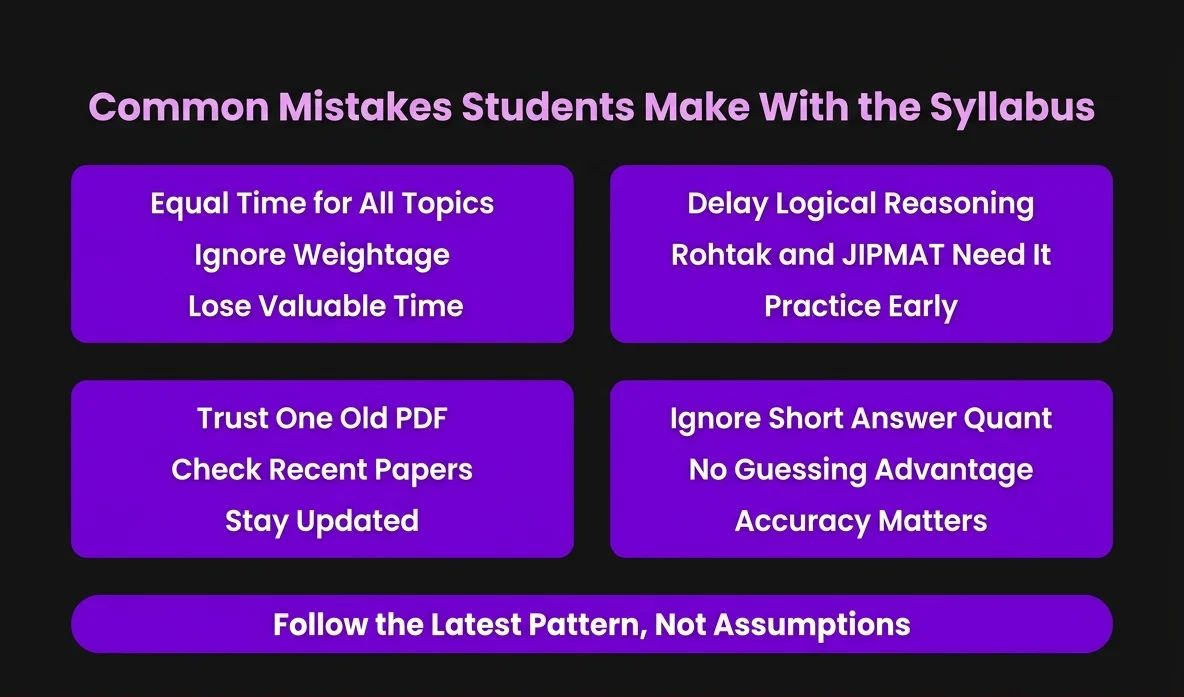
- Treating the syllabus as a checklist to cover once rather than a weighted guide. Spending equal time on every topic regardless of how frequently it's actually tested wastes preparation time that could go toward high-frequency areas like Arithmetic and Reading Comprehension.
- Ignoring Logical Reasoning until late in preparation if targeting IPMAT Rohtak or JIPMAT, since it's easy to assume PCM strength automatically covers this section when it genuinely doesn't.
- Relying on a single PDF without cross-referencing recent papers. Since no official exhaustive syllabus exists, a PDF that hasn't been updated in a few cycles can miss a genuine shift in question style or topic emphasis.
- Underestimating the Short Answer Quant section at Indore. Because there's no negative marking, students sometimes assume it's lower stakes, when in practice it's often the hardest section to score well in precisely because guessing isn't a viable strategy the way it can be, cautiously, in MCQ sections.
The IPMAT Syllabus PDF: What to Actually Trust
A few honest points worth knowing before you download any syllabus PDF:
- Neither IIM Indore nor IIM Rohtak publishes a single, formally exhaustive topic-wise syllabus document. What both institutes release is an exam pattern overview in their official notification, not a chapter-by-chapter syllabus PDF and here it is:
For IIM Indore Syllabus for IPMAT
Section 1: Quantitative Ability (MCQs) - 30 Questions
This section tests your math skills with multiple-choice questions:
- Numbers: Basic number operations and properties
- Time and Distance: Speed, time, and distance problems
- Averages: Finding average of numbers and groups
- Geometry: Shapes, angles, and area calculations
- Profit and Loss: Business math problems
- Data Interpretation: Reading charts and graphs
- Mixtures: Mixing different quantities
- Simple Equations: Solving basic math equations
- Permutation and Combination: Counting and arranging items
- Probability: Chance and likelihood problems
Section 2: Quantitative Ability (Short Answer) - 15 Questions
This section also tests math but you write short answers:
- Similar topics as Section 1 but requires detailed solutions
- No negative marking in this section
- Focus on showing your work clearly
Section 3: Verbal Ability (MCQs) - 45 Questions
This section tests your English skills:
- Reading Comprehension: Understanding passages and answering questions
- Grammar: Basic English grammar rules
- Synonyms: Words with similar meanings
- Antonyms: Words with opposite meanings
- Sentence Correction: Finding and fixing mistakes
- Fill in the Blanks: Completing sentences with right words
- Vocabulary: Learning new words and meanings
- Error Spotting: Finding mistakes in sentences
For IIM Rohtak Exam Syllabus
Section 1: Quantitative Ability - 40 Questions
Similar math topics as IIM Indore:
- Numbers, Algebra, Geometry
- Time and Work, Profit and Loss
- Data Interpretation
- Permutation and Combination
Section 2: Logical Reasoning - 40 Questions
This section tests your thinking skills:
- Seating Arrangements: Organizing people in specific orders
- Blood Relations: Family relationship problems
- Coding and Decoding: Pattern recognition in letters/numbers
- Series Completion: Finding patterns in sequences
- Puzzles: Logic-based problem solving
- Assumptions: Understanding what statements assume
- Arguments: Evaluating logical arguments
Section 3: Verbal Ability - 40 Questions
Same English topics as IIM Indore but with 40 questions.
Total Marks in IPMAT
The IPMAT total marks are different for each IIM:
IIM Indore Total Marks
- Section 1 (QA MCQs): 30 questions × 4 marks = 120 marks
- Section 2 (QA Short): 15 questions × 4 marks = 60 marks
- Section 3 (VA MCQs): 45 questions × 4 marks = 180 marks
- Total Maximum Marks: 360 marks
IIM Rohtak Total Marks
- Section 1 (QA): 40 questions × 4 marks = 160 marks
- Section 2 (LR): 40 questions × 4 marks = 160 marks
- Section 3 (VA): 40 questions × 4 marks = 160 marks
- Total Maximum Marks: 480 marks
Remember, wrong answers reduce your score, so the actual total can be less.
- Most "official syllabus PDFs" you'll find online are compiled by coaching platforms and exam-prep sites, built from analysing years of previous papers and the pattern details IIMs do release. That makes them useful, but not authoritative in the way an official government exam syllabus would be.
- The exact pattern itself is sometimes only confirmed close to the exam, so a PDF from two or three cycles ago may not reflect small shifts in question count or sectional timing.
- Cross-check any PDF against actual previous year papers, since the gap between a listed topic and how frequently it's actually tested can be significant, and a topic that appears once in five years shouldn't consume the same prep time as one tested in every single cycle.
This isn't a reason to avoid using a syllabus reference, it's a reason to treat it as a well-informed guide rather than an official rulebook, and to prioritise practicing against real past papers alongside it, rather than treating the PDF as the finish line for your preparation planning.
Selection Process Beyond the Written Exam
Since the syllabus only covers part of what actually decides your admission, it's worth knowing the full picture:
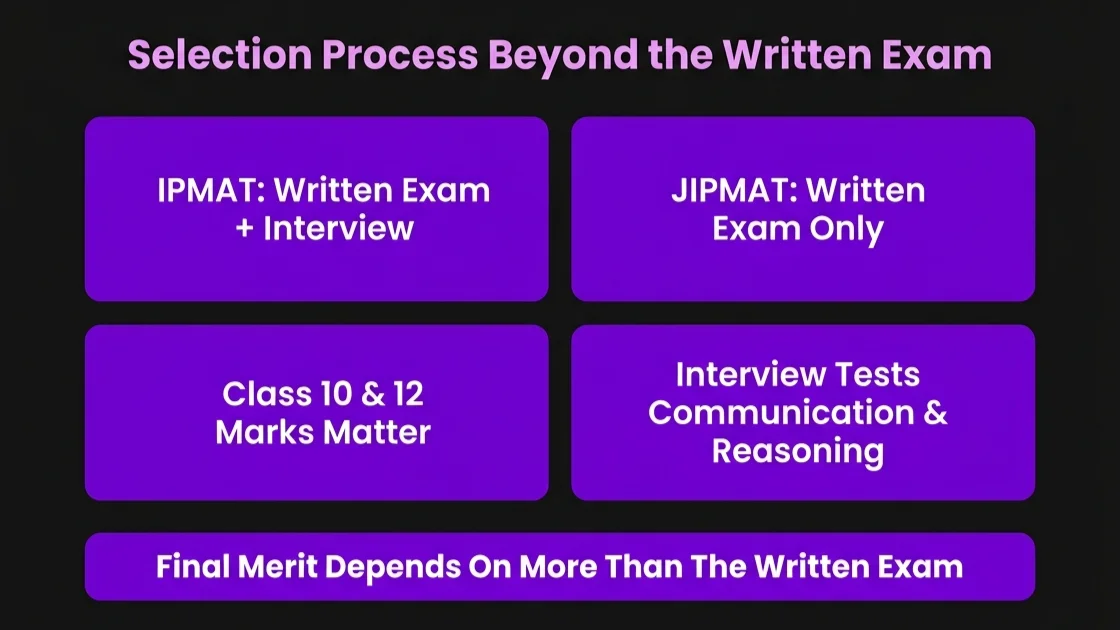
- IPMAT Indore and IPMAT Rohtak both follow a written exam plus interview process. Clearing the aptitude test only earns you a Personal Interview call, not a seat.
- JIPMAT has no interview round. Selection is based entirely on your written exam performance, which is part of why it's generally considered the most straightforward of the three exams.
- Board marks factor into the final merit at both IIM Indore and IIM Rohtak, alongside your written score and interview performance, so strong Class 10 and 12 marks continue to matter well after the syllabus-based prep phase is done.
- The interview itself often draws on the same skills tested in Verbal Ability and Logical Reasoning, since panels commonly assess communication clarity, structured thinking, and general awareness rather than syllabus recall, which means strong VARC and LR preparation pays off twice, once on the written paper and again in the room.
Our IPMAT eligibility criteria page covers the qualifying requirements you need to confirm before any of this becomes relevant.
Conclusion
The IPMAT syllabus PDF you download is only as useful as how closely it's grounded in the actual exam pattern and real past papers, and given that neither IIM publishes one definitive document, that grounding matters more than the source's design or download count. Any IPMAT syllabus PDF that skips this distinction and presents itself as an official document is worth treating with extra caution. Use the section-wise breakdown above as your working syllabus, cross-check it against previous year papers, and remember that Rohtak's Logical Reasoning section in particular needs dedicated prep time that a Quant-and-Verbal-only study plan will miss entirely.
At Phodu Club, our Ultimate IPMAT 2026 Pack is built around exactly this syllabus, covering Quant, Verbal Ability, and Logical Reasoning across 44 problem sets with over 1,700 practice questions, plus 19 mock tests spanning IPMAT Indore, IPMAT Rohtak, JIPMAT, and other BBA and management entrance exams. You also get access to a 24/7 mentorship community with IIM students for strategy sessions and interview preparation, so the syllabus coverage and the interview-round support live in the same place rather than requiring a separate resource for each. Check out our IPMAT test series page for the full breakdown, and our best books for IPMAT and how to prepare for IPMAT pages for a complete study plan built around this syllabus.
Frequently Asked Questions
1) Is there an official IPMAT syllabus PDF from IIM Indore or IIM Rohtak?
No single, exhaustive official syllabus document exists. Both institutes release an exam pattern overview in their notification, and detailed topic-wise syllabus PDFs online are compiled by coaching platforms based on that pattern and past papers.
2) What is the difference between the IPMAT Indore and IPMAT Rohtak syllabus?
IPMAT Indore covers Quantitative Ability and Verbal Ability across 360 marks, with a Short Answer Quant section that has no negative marking. IPMAT Rohtak adds a third section, Logical Reasoning, across 480 marks, with all sections fully MCQ-based and uniform negative marking.
3) Does IPMAT Rohtak have sectional cutoffs like IPMAT Indore?
No. IPMAT Rohtak only considers your overall score for shortlisting, while IPMAT Indore does apply cutoffs at the sectional level in addition to the overall score.
4) What topics are covered in the IPMAT Quantitative Ability syllabus?
Arithmetic, Algebra, Number System, Geometry and Mensuration, and Modern Maths topics like Permutations, Combinations, and Probability, largely at a Class 9-12 level with some higher-difficulty questions.
5) Is Logical Reasoning tested in IPMAT Indore?
No. Logical Reasoning is specific to IPMAT Rohtak and JIPMAT. IPMAT Indore tests only Quantitative Ability and Verbal Ability.
6) How reliable are third-party IPMAT syllabus PDFs?
They're generally reliable as a reference when built from actual past papers and the exam pattern IIMs do release, but they aren't official documents, so cross-checking against recent previous year papers is still worthwhile.
7) Does clearing the syllabus-based written exam guarantee IPMAT admission?
No. For IPMAT Indore and IPMAT Rohtak, clearing the written exam only qualifies you for a Personal Interview, and your Class 10 and 12 board marks also factor into the final merit. JIPMAT is the exception, with no interview round.
8) Where can I find structured practice covering the full IPMAT syllabus?
Phodu Club's Ultimate IPMAT Pack includes 44 problem sets, over 1,700 practice questions, and 19 mock tests across IPMAT Indore, IPMAT Rohtak, JIPMAT, and other BBA exams, built specifically around this syllabus. Visit our IPMAT test series page for details.
Want to crack your exam with mentors who did?
Get test series, crash courses and free mentorship from students at IITs, NITs and BITS.