Here is a problem that appears in every preparation cycle without fail: a student who has “covered the IPMAT Indore syllabus” arrives at a mock test and scores significantly below their preparation-time performance. The diagnosis is almost always the same. They covered the syllabus as a list of topics, not as a set of exam-specific demands. They practiced percentage problems from a textbook exercise, not percentage word problems framed the way IIM Indore frames them. They read about progressions in theory, not under 60-second time pressure in a paper where the next question is from a completely different topic. The IPMAT Indore syllabus is not just a topic list. It is a map of what IIM Indore’s specific 3-section, 120-minute exam tests, in the specific format, at the specific difficulty calibration, with the specific marking scheme that the actual paper uses. This guide covers the complete IPMAT Indore syllabus 2026, section by section — and more importantly, connects each syllabus topic to the exam pattern element where it appears, so that every hour of preparation is directed at what the actual exam demands.
IPMAT Indore Syllabus 2026 and Exam Pattern: The Integrated View
Before listing topics, the most important thing to understand is how the IPMAT Indore syllabus is distributed across the 3-section exam pattern — because the pattern determines how each syllabus topic is tested.
| Section | Questions | Time | Marking | Total Marks | Syllabus Source |
| QA MCQ | 40 | 40 min | +4 / −1 | 160 | Arithmetic, Algebra, Number Theory, Geometry, Modern Maths |
| QA Short Answer | 20 | 40 min | +4 / 0 | 80 | Arithmetic, Number Theory, Algebra (numerical-answer focused) |
| VA MCQ | 40 | 40 min | +4 / −1 | 160 | RC, Vocabulary, Grammar, Para Jumbles, Critical Reasoning |
| Total | 100 | 120 min | 400 |
The pattern-syllabus connection that most students miss:
The same QA syllabus topic — say, arithmetic — appears in both QA sections. In QA MCQ, arithmetic problems are presented as 4-option questions where elimination is possible and the correct answer can be verified against options. In QA Short Answer, arithmetic problems require deriving a specific numerical answer without any options to guide or validate reasoning.
This means effective IPMAT Indore syllabus preparation for arithmetic requires 2 distinct practice modes: option-guided MCQ solving and option-free numerical derivation. Students who only practice in MCQ format are not fully prepared for how arithmetic appears in the Short Answer section.
IPMAT Indore Syllabus 2026: Quantitative Ability
IIM Indore does not publish a formal syllabus document for the IPMAT. The QA syllabus below is derived from analysis of question papers from 2019 through 2025.
The QA syllabus covers Class 9, 10, and 11 Mathematics. Class 12 Mathematics — Calculus, advanced trigonometry, 3D geometry, differential equations — does not appear.
Topic Group 1: Arithmetic
Syllabus weight: Approximately 35–45% of all QA questions across both sections
Arithmetic is the foundation of the IPMAT Indore syllabus. No other topic cluster comes close in question frequency or marks contribution.
Complete arithmetic topic list:
Percentages
- Percentage increase and decrease
- Successive percentage changes
- Percentage of a value, expressing one quantity as a percentage of another
- Applications: price changes, population growth, exam scores
Profit, Loss, and Discount
- Cost price, selling price, marked price relationships
- Single and successive discounts
- Profit and loss percentage calculations
- Dishonest dealings (false weights, adulteration)
Ratio and Proportion
- Simple and compound ratios
- Direct and inverse proportion
- Partnership problems (profit-sharing based on investment ratio)
- Variation problems
Time, Speed, and Distance
- Relative speed (same and opposite direction)
- Trains (crossing objects, bridges, tunnels)
- Boats and streams
- Circular tracks (meeting and overtaking)
- Average speed for multi-segment journeys
Time and Work
- Work done per unit time
- Combined work rates
- Pipes and cisterns
- Work and wages
Simple and Compound Interest
- SI formula and applications
- CI formula and applications
- Difference between SI and CI
- Effective annual rate
Averages and Weighted Averages
- Simple average
- Combined average of groups
- Weighted average
- Removal/addition of elements from a set
Mixtures and Alligation
- Mixing two solutions of different concentrations
- Alligation cross-rule
- Repeated dilution and replacement
How arithmetic appears in the QA Short Answer section: Arithmetic is the dominant topic in the Short Answer section. Questions in this section typically ask for a single definite numerical answer — “Find the profit percentage,” “What is the final price after two successive discounts of 20% and 15%,” “In how many days can A and B together complete the work?” These questions reward speed and computational accuracy over option-elimination strategy.
Topic Group 2: Algebra
Syllabus weight: Approximately 20–28% of all QA questions
Complete algebra topic list:
Linear Equations
- Single variable linear equations
- System of 2 and 3 simultaneous linear equations (substitution and elimination)
- Word problem translation to linear equations
Quadratic Equations
- Factorisation, completing the square, quadratic formula
- Nature of roots (discriminant analysis)
- Sum and product of roots (Vieta’s formulas)
- Formation of quadratic equations given roots
Inequalities
- Linear inequalities on number line
- Quadratic inequalities (sign chart method)
- Modulus inequalities (|x−a| < b type)
- System of inequalities
Progressions and Series
- Arithmetic Progression: nth term, sum of n terms, properties
- Geometric Progression: nth term, sum of n terms, infinite GP sum
- Harmonic Progression: relationship with AP, harmonic mean
- AM-GM inequality and its applications
Functions and Graphs
- Domain and range of basic functions
- Linear functions (slope-intercept)
- Quadratic functions (parabola vertex, roots)
- Composite functions (simple cases)
Logarithms
- Log properties (product, quotient, power rules)
- Change of base formula
- Equations involving logarithms
- Characteristic and mantissa (conceptual)
Polynomials
- Remainder theorem
- Factor theorem
- Factorisation of polynomials using factor theorem
- Division algorithm
Exam pattern note for algebra: Algebra questions in the IPMAT Indore syllabus frequently combine sub-topics — a progressions question that requires solving a quadratic, an inequalities question that involves modulus. This combination pattern appears in the MCQ section. The Short Answer section occasionally includes algebra questions where a clean numerical answer follows from the algebraic manipulation.
Topic Group 3: Number Theory
Syllabus weight: Approximately 10–15% of all QA questions
Complete number theory topic list:
Divisibility and Basic Number Properties
- Divisibility rules for 2, 3, 4, 5, 6, 7, 8, 9, 10, 11
- Even, odd, prime, composite classifications
- Absolute value and integer properties
HCF and LCM
- Prime factorisation method
- HCF and LCM of multiple numbers
- Applications: tiling problems, traffic light problems, rope-cutting problems
- Relationship: HCF × LCM = Product of two numbers
Remainders and Cyclicity
- Remainder theorem basics
- Euler’s theorem for remainders
- Cyclicity of powers (units digit patterns)
- Chinese Remainder Theorem (conceptual, for complex remainder problems)
Prime Numbers and Factorisation
- Identifying primes, Sieve of Eratosthenes concept
- Number of factors of a number
- Sum of factors, product of factors
- Perfect numbers, abundant and deficient (awareness level)
Factorials and Special Expressions
- Trailing zeros in n!
- Highest power of a prime in n! (Legendre’s formula)
- Factorials in combination-related problems
Short Answer section and number theory: Number theory is the second most prominent topic in the QA Short Answer section after arithmetic. Remainder questions, factor-counting questions, and units-digit questions all yield clean numerical answers — making them natural candidates for the non-MCQ format. Eulerian remainder, cyclicity-of-powers, and factor-count formulas are the most formula-dependent skills in the entire IPMAT Indore syllabus and must be memorised precisely, not approximately.
Topic Group 4: Geometry and Mensuration
Syllabus weight: Approximately 8–12% of all QA questions
Complete geometry and mensuration topic list:
Triangles
- Types (equilateral, isosceles, scalene, right)
- Congruence conditions (SSS, SAS, ASA, RHS)
- Similarity and its applications (corresponding sides, areas)
- Pythagorean theorem and Pythagorean triplets
- Area formulas (base-height, Heron’s formula)
- Special triangles (30-60-90, 45-45-90)
- Angle bisector theorem, median, centroid properties
Circles
- Tangent-radius relationship (perpendicularity at point of tangency)
- Chord properties (perpendicular from centre bisects chord)
- Angles subtended at centre and circumference
- Cyclic quadrilaterals (opposite angles supplementary)
- Arc length and sector area
Quadrilaterals and Polygons
- Properties of parallelogram, rectangle, rhombus, square, trapezium
- Area formulas for each type
- Sum of interior angles of polygons
Coordinate Geometry
- Distance formula between two points
- Section formula (internal and external division)
- Midpoint formula
- Slope, slope-intercept form, point-slope form
- Equation of a line in different forms
- Parallel and perpendicular lines (slope conditions)
Mensuration — 2D
- Area and perimeter: triangle, quadrilateral, circle, semicircle, sector
- Shaded region problems (area of compound figures)
Mensuration — 3D
- Volume and surface area: cube, cuboid, cylinder, cone, sphere, hemisphere
- Combinations of 3D shapes
Exam pattern note for geometry: Geometry questions in the IPMAT Indore syllabus are almost exclusively in the MCQ section — they rarely appear as Short Answer questions because their answers frequently involve surds or π-expressions rather than clean integers. Coordinate geometry questions tend to produce the cleanest numerical answers and are therefore the most likely geometry sub-topic to appear in Short Answer format.
Topic Group 5: Modern Mathematics
Syllabus weight: Approximately 8–12% of all QA questions
Complete modern mathematics topic list:
Permutations and Combinations
- Fundamental counting principle
- Factorial notation and computation
- nPr (permutations): arrangements with and without repetition
- nCr (combinations): selections
- Circular permutations
- Arrangements with restrictions (specific items together, certain items apart)
- Distribution problems
Probability
- Classical probability (equally likely outcomes)
- Addition rule (mutually exclusive events)
- Multiplication rule (independent and dependent events)
- Conditional probability
- Complementary events
- Basic Bayes’ theorem
Sets and Venn Diagrams
- Union, intersection, complement, difference
- De Morgan’s laws
- 2-set and 3-set word problems
- Number of elements in unions and intersections
Mathematical Reasoning (awareness level)
- Truth values, logical connectives (AND, OR, NOT)
- Converse, inverse, contrapositive of statements
- If-then statements and their logical equivalents
IPMAT Indore Syllabus 2026: QA Short Answer — The Distinctive Preparation Requirement
The QA Short Answer section deserves separate treatment in any guide to the IPMAT Indore syllabus — because its no-negative-marking structure and option-free format create distinct preparation requirements.
Topics that most naturally produce Short Answer questions:
The Short Answer section draws from the same syllabus as QA MCQ, but overwhelmingly favours topics that yield clean, unambiguous numerical answers.
| Topic | Typical Short Answer Question Format |
| Arithmetic — basic | “A sells an item at 20% profit on cost price. If the cost price is ₹400, find the selling price.” |
| Remainders | “Find the remainder when 7^50 is divided by 5.” |
| Factor counting | “How many factors does 720 have?” |
| HCF/LCM | “Find the LCM of 12, 18, and 24.” |
| Time and Work | “A can do a job in 6 days, B in 8 days. In how many days can they complete it together?” |
| Progressions (sum) | “Find the sum of the first 15 terms of an AP with first term 3 and common difference 4.” |
| Coordinate geometry | “Find the distance between (3, 4) and (−1, 1).” |
Topics that are less likely to produce Short Answer questions because they yield non-integer or expression-form answers: trigonometry (not in syllabus), complex geometry with π, and many probability problems.
The Short Answer preparation discipline: Practice deriving numerical answers without options. Cover your working paper with one hand and check whether you arrived at the same answer if you repeated the calculation — this builds the verification instinct that prevents Short Answer errors.
IPMAT Indore Syllabus 2026: Verbal Ability
The VA syllabus covers 5 distinct question type families, all in MCQ format with +4/−1 marking.
Topic Group 1: Reading Comprehension
Syllabus weight: Approximately 40–50% of all VA questions (approximately 16–20 questions per paper)
What RC tests in the IPMAT Indore syllabus:
- Main idea and central argument identification
- Inference drawing (conclusions implied but not stated)
- Author tone and attitude (critical, neutral, advocating, ironic)
- Vocabulary in context (word meaning within passage)
- Specific detail retrieval
- Paragraph function (purpose of a specific paragraph within the passage)
Passage characteristics specific to IIM Indore’s IPMAT: IIM Indore consistently uses analytical and argumentative passages — economics and business commentary, social science analysis, philosophical arguments, science commentary, cultural and historical analysis. Literary or narrative prose is rare. Passages are typically 400–700 words with 4–6 questions per passage.
The exam pattern implication for RC: The VA section’s 40-minute timer means RC reading time comes directly from question-answering time. A student who reads a 550-word passage in 5 minutes has 35 minutes for 40 questions — averaging 52 seconds per question. A student who reads the same passage in 3.5 minutes has 36.5 minutes — a marginal difference. The reading must be efficient (active comprehension, not slow passive absorption) but cannot be rushed to the point of missing the argument.
Topic Group 2: Vocabulary
Syllabus weight: Approximately 20–25% of all VA questions
Complete vocabulary topic list within the IPMAT Indore syllabus:
- Synonyms (closest in meaning)
- Antonyms (most opposite in meaning)
- Word analogies (relationship mirroring)
- Contextual vocabulary (fill in the blank — selecting the most contextually appropriate word)
- Idioms and phrases (meaning of a colloquial expression in context)
- Vocabulary in RC (covered within RC questions)
Vocabulary level in the IPMAT Indore syllabus: IIM Indore tests moderately advanced vocabulary — words at the level of quality editorial English. Common examples from previous years: mitigate, ostensible, cogent, loquacious, ephemeral, diffident, circumspect, perfidious, vociferous, sanguine. Not archaic or obscure — but beyond everyday casual speech.
Topic Group 3: Grammar
Syllabus weight: Approximately 15–20% of all VA questions
Complete grammar topic list within the IPMAT Indore syllabus:
- Error spotting (identify the grammatically incorrect part of a sentence)
- Sentence correction (select the corrected version of an underlined portion)
- Fill in the blank — grammar (select the correct preposition, article, conjunction, or verb form)
Grammar rules most frequently tested: Subject-verb agreement, pronoun-antecedent agreement, tense consistency, parallel structure, misplaced and dangling modifiers, comparative and superlative forms, preposition usage, article usage (a/an/the), and conjunction usage.
Topic Group 4: Para Jumbles and Para Completion
Syllabus weight: Approximately 10–15% of all VA questions
Question types:
- Para jumbles: 5–6 scrambled sentences to be ordered into a coherent paragraph
- Odd sentence out: identify the sentence that does not belong
- Para completion: identify the best opening or closing sentence
The IPMAT Indore syllabus approach to para jumbles: IIM Indore para jumbles are analytical paragraph structures — not narrative sequences. The solving signals are: mandatory first sentence (introduces the topic, no pronoun reference to an earlier sentence), mandatory consecutive pairs (pronoun references, transitional connectors like “however,” “therefore,” “this”), and idea flow (claim → evidence → conclusion or contrast structure).
Topic Group 5: Critical Reasoning
Syllabus weight: Approximately 5–10% of all VA questions
Question types:
- Strengthen the argument
- Weaken the argument
- Find the unstated assumption
- Draw the logical conclusion
- Identify the inference
What Is NOT in the IPMAT Indore Syllabus 2026
Being clear about exclusions is as important as knowing what is included — because time spent studying content outside the syllabus is time not spent on what actually appears in the exam.
Not in the IPMAT Indore syllabus:
- Class 12 Calculus (limits, derivatives, integrals)
- Class 12 advanced trigonometry (inverse functions, complex identities)
- 3D geometry (lines and planes in space, direction cosines)
- Statistics beyond mean, median, mode (standard deviation, regression, hypothesis testing)
- Logical Reasoning (seating arrangements, blood relations, coding-decoding) — this appears in IIM Rohtak’s IPM-AT, not in IIM Indore’s IPMAT
- Data Interpretation (tables, bar graphs, pie charts) — this appears in JIPMAT, not in IIM Indore’s IPMAT
- General Knowledge and Current Affairs — not tested in the written IPMAT paper
- Business concepts (marketing, finance, strategy) — not tested in the written paper
According to the National Council of Educational Research and Training (NCERT), the Class 9–11 Mathematics curriculum encompasses precisely the quantitative topics that appear in the IPMAT Indore syllabus — making NCERT textbooks the most accurately calibrated foundation resource for the QA preparation the IPMAT demands.
IPMAT Indore Syllabus 2026: Curriculum Mapping — Which Class Maps to Which Topic
For students who want to understand exactly which part of their school curriculum covers each IPMAT Indore syllabus topic, here is the curriculum map.
Class 9 NCERT Mathematics — directly relevant topics:
- Number Systems → foundations for number theory
- Polynomials → factor theorem, remainder theorem
- Linear Equations in Two Variables → simultaneous equations
- Triangles → congruence and similarity
- Quadrilaterals, Circles → geometry properties
- Heron’s Formula → triangle area
- Surface Areas and Volumes → 3D mensuration
- Statistics (basic) → mean, median, mode
Class 10 NCERT Mathematics — directly relevant topics:
- Real Numbers → HCF, LCM, Euclid’s algorithm
- Polynomials → advanced factorisation
- Pair of Linear Equations → simultaneous equations
- Quadratic Equations → all quadratic syllabus content
- Arithmetic Progressions → AP content fully covered
- Triangles → similarity and Pythagoras
- Coordinate Geometry → distance, section formula, slope
- Introduction to Trigonometry → basic ratios (sin, cos, tan — foundational only, advanced trig not in IPMAT)
- Circles → tangent and chord properties
- Areas Related to Circles → sector, segment areas
- Surface Areas and Volumes → 3D mensuration
Class 11 NCERT Mathematics — directly relevant topics:
- Sets → sets and Venn diagrams fully covered
- Relations and Functions → functions content
- Sequences and Series → GP and HP content (AP covered in Class 10)
- Straight Lines → coordinate geometry advanced
- Conic Sections → circles in coordinate geometry
- Permutations and Combinations → P&C fully covered
- Binomial Theorem → awareness-level applications
- Mathematical Reasoning → logical connectives, if-then
- Statistics (Class 11) → variance and standard deviation (not in IPMAT, skip)
- Probability → basic probability covered
Class 11 chapters to skip for IPMAT Indore: Complex Numbers and Quadratic Equations (beyond IPMAT scope), Trigonometric Functions (beyond IPMAT scope), Linear Inequalities (partially relevant — basic application only), 3D Geometry chapter (not in IPMAT), Limits and Derivatives (not in IPMAT), Mathematical Induction (not in IPMAT).
From Syllabus to Preparation: The Pattern-Driven Priority Framework
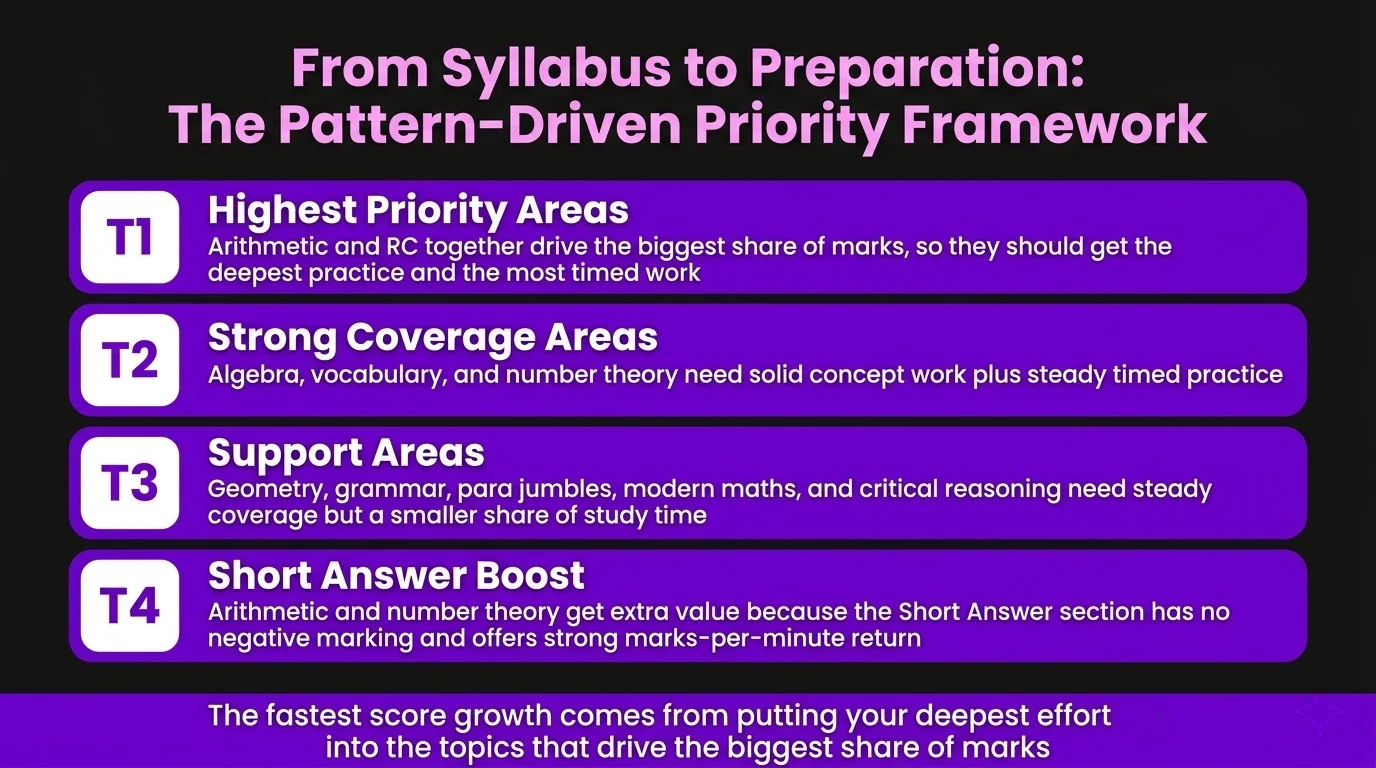
The IPMAT Indore syllabus becomes preparation-actionable when each topic is connected to the section and timing context where it appears.
Tier 1 — Exam pattern demands highest investment: Arithmetic and RC together account for approximately 55–60% of all marks in the IPMAT. No other 2-topic combination comes close. A student who masters these 2 areas to competitive speed and accuracy has addressed the majority of the exam’s marks.
Tier 2 — Exam pattern demands solid coverage: Algebra, vocabulary, and number theory together account for approximately 25–30% of all marks. These topics require thorough conceptual coverage and timed problem practice — but below the depth demanded by arithmetic.
Tier 3 — Exam pattern demands awareness and regular practice: Geometry, grammar, para jumbles, modern mathematics, and critical reasoning together account for the remaining 15–20% of marks. These topics deserve consistent coverage and regular practice, but the preparation time investment should be proportional to their contribution.
The Short Answer section modifier: Arithmetic and number theory receive an additional preparation priority boost from the Short Answer section’s no-negative-marking structure. These topics in the Short Answer section have the highest marks-per-minute return — because every correct answer earns +4 with no downside risk. Students whose arithmetic Short Answer accuracy is high capture marks that more cautious or slower students leave uncaptured.
Team Phodu Club consistently observes that students who organise IPMAT Indore syllabus preparation around this priority framework — depth in arithmetic and RC first, then algebra and vocabulary, then the remaining topics — reach their peak mock test performance faster and with more headroom than students who prepare all topics uniformly. The Phodu Club IPMAT Test Series provides full-length mock tests matched to the actual IPMAT Indore exam pattern and syllabus — ensuring that practice on these tests accurately reflects the topic distribution, difficulty calibration, and section timing of the real exam.
IPMAT Indore Syllabus 2026 vs. IIM Rohtak and JIPMAT: What’s Different
Students who are also targeting IIM Rohtak’s IPM-AT and JIPMAT should understand the syllabus extensions required.
| Syllabus Component | IPMAT Indore | IIM Rohtak IPM-AT | JIPMAT |
| Arithmetic | ✓ | ✓ | ✓ |
| Algebra | ✓ | ✓ | ✓ |
| Number Theory | ✓ | ✓ | ✓ |
| Geometry/Mensuration | ✓ | ✓ | ✓ |
| Modern Maths | ✓ | ✓ | ✓ |
| QA Short Answer | ✓ | ✗ | ✗ |
| Logical Reasoning | ✗ | ✓ | ✓ (as DILR) |
| Data Interpretation | ✗ | ✗ | ✓ (as DILR) |
| RC | ✓ | ✓ | ✓ |
| Vocabulary | ✓ | ✓ | ✓ |
| Grammar | ✓ | ✓ | ✓ |
| Para Jumbles | ✓ | ✓ | ✓ |
| Critical Reasoning | ✓ | ✓ | ✓ |
The IPMAT Indore syllabus is the narrowest of the 3 — it does not require LR or DI. Students who begin with IPMAT Indore syllabus preparation and add LR and DI as extensions are building efficiently. The QA and VA foundation transfers completely to both other exams. Verify current syllabus details for IIM Rohtak and JIPMAT from their official admissions page and NTA’s website respectively.
Conclusion
The IPMAT Indore syllabus 2026 covers 2 subjects — Quantitative Ability and Verbal Ability — across 3 independently timed sections that test the same syllabus content in different formats and with different marking scheme implications. QA topics appear in MCQ format with negative marking and in Short Answer format without it. VA appears entirely in MCQ format.
Within QA, arithmetic dominates — accounting for more than a third of all questions. Algebra, number theory, geometry, and modern mathematics fill the remaining QA syllabus. Within VA, Reading Comprehension dominates — accounting for nearly half the section. Vocabulary, grammar, para jumbles, and critical reasoning complete the VA picture.
The most important syllabus insight from 7 years of IPMAT papers: the topics that appear most frequently are consistent. Arithmetic has never not been the largest QA topic. RC has never not been the largest VA topic. Build depth here first, then breadth across the remaining topics, then simulation through full-length timed practice.
One arithmetic topic covered with full exercise sets today. One RC passage read actively and timed this evening. One mock test taken under real exam conditions this weekend. That is how the IPMAT Indore syllabus 2026 goes from a topic list to an IIM seat.
Frequently Asked Questions (FAQ)
1) What is the IPMAT Indore syllabus for 2026?
The IPMAT Indore syllabus covers 2 subjects: Quantitative Ability (arithmetic, algebra, number theory, geometry, mensuration, modern mathematics — all at Class 9–11 level) and Verbal Ability (reading comprehension, vocabulary, grammar, para jumbles, critical reasoning). There is no LR, DI, GK, or Calculus in IIM Indore’s IPMAT syllabus.
2) Does the IPMAT Indore syllabus include Calculus or Class 12 Mathematics?
No. The IPMAT Indore syllabus does not include Class 12 Mathematics topics. Calculus (limits, derivatives, integrals), advanced trigonometry, 3D geometry, and Statistics beyond mean/median/mode do not appear. The syllabus is based on Class 9, 10, and 11 Mathematics.
3) Is the IPMAT Indore syllabus the same for the MCQ and Short Answer sections?
The two QA sections draw from the same syllabus topics, but certain topics appear more frequently in Short Answer because they yield clean numerical answers — primarily arithmetic and number theory. The MCQ section tests the full QA syllabus. The Short Answer section does not provide options, so it rewards topics where a definite numerical answer can be derived without option-guidance.
4) Which topics are most important in the IPMAT Indore syllabus?
In QA: arithmetic (35–45% of questions) and algebra (20–28%) are the highest-priority topics. In VA: reading comprehension (40–50% of questions) and vocabulary (20–25%) are most heavily weighted. Together, these 4 topic areas account for approximately 75–80% of all marks in the IPMAT.
5) Does the IPMAT Indore syllabus include Logical Reasoning?
No. Logical Reasoning is part of IIM Rohtak’s IPM-AT syllabus and JIPMAT’s DILR syllabus — not IIM Indore’s IPMAT. Students preparing only for IPMAT Indore do not need to study LR.
Q6. Which NCERT classes are most relevant for the IPMAT Indore syllabus?
Class 9 NCERT Mathematics (polynomials, triangles, circles, mensuration), Class 10 NCERT Mathematics (real numbers, quadratic equations, AP, coordinate geometry, circles), and Class 11 NCERT Mathematics (sets, sequences and series, permutations and combinations, probability, straight lines) cover the IPMAT Indore QA syllabus comprehensively.
7) How is the VA syllabus different from what students learn in school?
The IPMAT Indore VA syllabus — particularly RC inference questions, vocabulary at editorial-writing level, and critical reasoning — goes beyond the English Literature or English Language curriculum of most school boards. RC passages are analytical and argumentative rather than literary. Students need active daily reading of quality newspapers and editorial writing to develop the VA skills the IPMAT specifically rewards.
8) Is the IPMAT Indore syllabus the same as JIPMAT’s?
The QA and VA topics are broadly similar, but JIPMAT has a Data Interpretation and Logical Reasoning (DILR) section that IPMAT Indore does not. IPMAT Indore has a QA Short Answer section that JIPMAT does not. The core syllabus preparation transfers between exams, but each exam has unique structural elements requiring specific preparation.
9) How many months does it take to cover the IPMAT Indore syllabus?
A student who studies consistently can cover the full IPMAT Indore syllabus in 3–4 months, leaving 2–3 months for mock testing, error analysis, and revision. Students starting 6 months before the exam have adequate time for both complete syllabus coverage and comprehensive mock test practice.
10) How can I practice the IPMAT Indore syllabus under real exam conditions?
The Phodu Club IPMAT Test Series provides full-length mock tests matched to the actual IPMAT Indore exam pattern and syllabus — including the 3-section structure, independent section timers, the Short Answer no-negative-marking format, and difficulty calibration that accurately reflects the real exam. Practicing on correctly calibrated tests is the most effective way to convert syllabus coverage into competitive exam performance.