One of the most common mistakes we see at Phodu Club is students spending the first month of their IPMAT preparation comparing books instead of actually preparing. They read 12 Quora threads, watch 6 YouTube videos about study material, and end up buying 4 books they will never fully use. Meanwhile, a student who picked up NCERT Class 10 Mathematics on Day 1 and started solving has already covered arithmetic and basic algebra before the book-comparison student has decided on their first purchase. Here is the honest truth about the IPMAT book situation: the books matter less than what you do with them. But since you are going to use books anyway, let us make sure you are using the right ones — and more importantly, using them the right way. This guide gives you our actual recommendations for the best IPMAT books for QA, VA, and LR in 2026, what each book is genuinely good for, what it is not good for, and how to combine books with mock test practice to build preparation that actually moves your score.
Best IPMAT Books: TL;DR
The best IPMAT books for 2026 are NCERT Mathematics (Class 9 to 11) for QA foundations, R.S. Aggarwal’s Quantitative Aptitude for QA practice, Word Power Made Easy for vocabulary, and Wren and Martin for grammar. No single IPMAT book covers everything — combine books with daily reading and full-length mock tests.
What IPMAT Books Actually Need to Deliver
Before listing recommendations, we want to be clear about what role books play in IPMAT preparation — because students who misunderstand this end up over-relying on books and under-practicing on timed mock tests.
Books are good for:
- Building conceptual foundations in QA topics
- Structured topic-wise problem practice
- Grammar reference and rule-based learning
- Vocabulary building through a systematic framework
Books cannot replace:
- Timed full-length mock test practice (the skill of performing under the exam’s exact conditions)
- Daily active reading for VA development (no RC book replicates the skill of reading quality editorial prose daily)
- Error analysis and pattern recognition across multiple mock attempts
- Exam-condition speed and decision-making under negative marking pressure
The students we work with who crack IPMAT are not the students who read the most books. They are the students who practiced the most problems under timed conditions, read editorials daily for 5 months, and took 15 to 20 full-length mock tests with honest post-test analysis. Books are the foundation layer. Everything above that foundation is built through practice.
With that framing clear, here are our actual IPMAT book recommendations for 2026.
Best IPMAT Books for Quantitative Ability
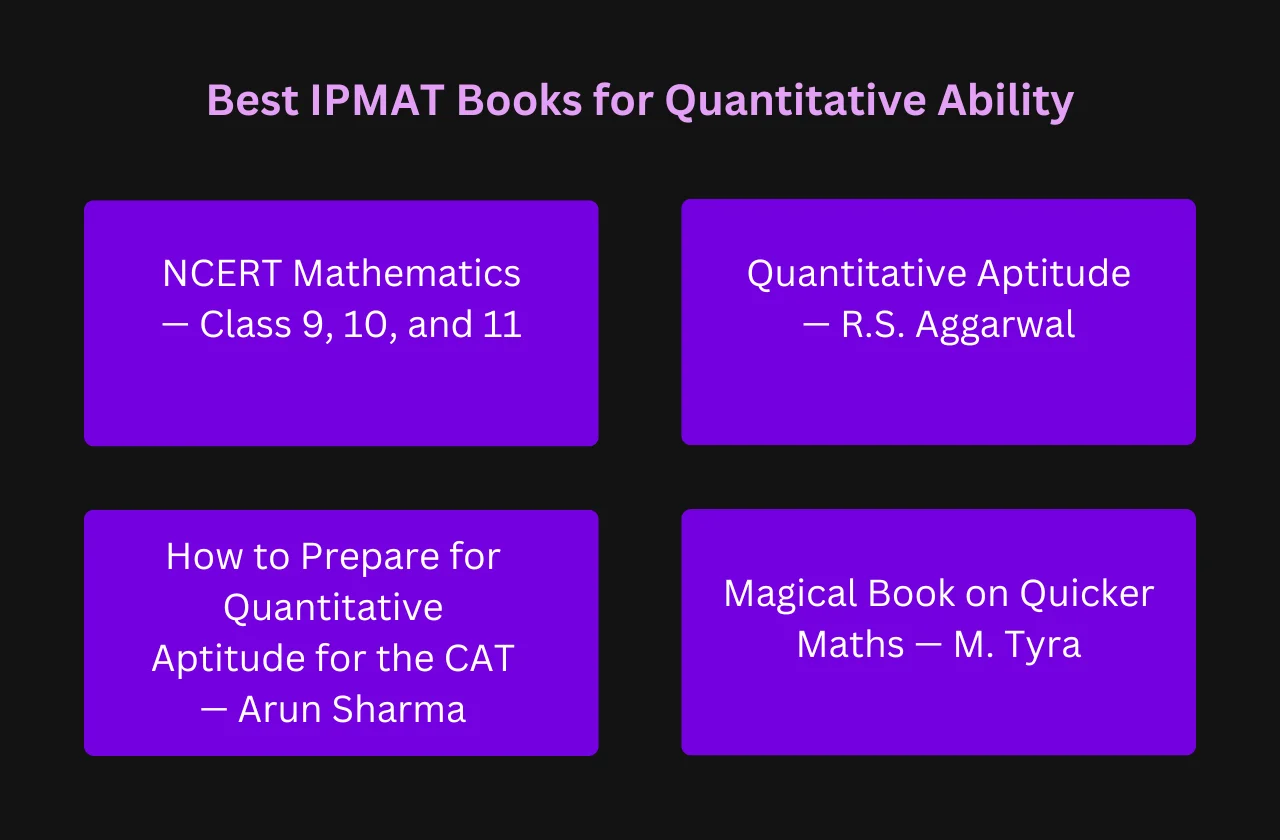
1) NCERT Mathematics — Class 9, 10, and 11
Best for: All students, especially Commerce and Arts stream students rebuilding QA foundations
Why we recommend it: The IPMAT QA syllabus is strongly rooted in Class 9, 10, and 11 Mathematics. NCERT covers the core concepts at the right foundational depth, but IPMAT questions can sometimes go slightly beyond NCERT level in application and difficulty. We see students skip NCERT because it feels too basic, then struggle with word problem framing in arithmetic and progressions in algebra because they were never comfortable with the fundamentals.
NCERT is free on the official NCERT website. There is no reason not to start here.
How to use it: Do not just read the theory. Solve every exercise problem at the end of each chapter. NCERT exercises confirm whether you have understood the concept correctly before you attempt harder problems.
Chapters to prioritise:
- Class 9: Number Systems, Polynomials, Linear Equations, Triangles, Circles, Surface Areas and Volumes
- Class 10: Real Numbers, Quadratic Equations, Arithmetic Progressions, Coordinate Geometry, Circles
- Class 11: Sets, Sequences and Series, Permutations and Combinations, Probability, Straight Lines
Chapters to skip for IPMAT:
- Class 11: Calculus chapters (Limits and Derivatives), Trigonometric Functions (beyond basic ratios), 3D Geometry, Mathematical Induction
- Class 12: Everything — Calculus, Vectors, 3D Geometry, and Statistics beyond basic level do not appear in the IPMAT.
2) Quantitative Aptitude — R.S. Aggarwal
Best for: All students who have completed NCERT foundations and need volume practice at increasing difficulty
Why we recommend it: R.S. Aggarwal is the most widely used QA practice book in competitive exam preparation in India for a reason. The arithmetic chapters — percentages, profit and loss, time-speed-distance, time and work, averages, mixtures — are structured with a clear progression from simple to medium to harder problems. This progression is exactly what IPMAT QA practice requires.
How to use it: After completing NCERT for a topic, move to R.S. Aggarwal for the same topic and work through the full exercise set under timed conditions. Do not read examples passively — attempt every example problem yourself before checking the solution.
Best chapters for IPMAT: Percentage, Profit and Loss, Ratio and Proportion, Time and Work, Time and Distance, Simple and Compound Interest, Averages, Alligation, Number Systems, HCF and LCM, Progressions.
Chapters to skip for IPMAT: Data Interpretation, Data Sufficiency, Tabulation, and advanced DI chapters are relevant for bank exams and CAT, not IPMAT. Do not spend preparation time here.
| R.S. Aggarwal Topic | IPMAT Relevance |
| Percentage | High — appears in every paper |
| Profit, Loss, and Discount | High |
| Time, Speed, Distance | High |
| Time and Work | High |
| Ratio and Proportion | High |
| Number System | High |
| Progressions (AP/GP) | High |
| Data Interpretation | None — skip entirely |
| Data Sufficiency | None — skip entirely |
3) How to Prepare for Quantitative Aptitude for the CAT — Arun Sharma
Best for: Students who have strong arithmetic foundations and need harder algebra, number theory, and modern mathematics problems
Why we recommend it: Arun Sharma’s CAT QA book goes beyond R.S. Aggarwal in difficulty — closer to what IPMAT’s harder QA questions look like, particularly in algebra, inequalities, progressions, and number theory. Students who find R.S. Aggarwal’s arithmetic chapters are too easy and want a more challenging problem set for the topics that appear in medium to hard IPMAT questions that benefit from this book.
How to use it: Use it selectively. Focus on the algebra, number theory, and modern mathematics chapters. Skip the advanced DI, complex geometry, and CAT-specific difficulty chapters that go beyond IPMAT scope.
A caution we give every student: Arun Sharma is written for CAT aspirants. Some content is beyond what IPMAT demands. Use it as a difficulty supplement for the chapters that overlap with the IPMAT syllabus, not as a cover-to-cover preparation resource.
4) Magical Book on Quicker Maths — M. Tyra
Best for: Students who are content-ready but calculation-slow, specifically for arithmetic
Why we recommend it: The IPMAT QA MCQ section demands approximately 60 seconds per question on average. A student who can solve percentage problems correctly but takes 2.5 to 3 minutes for problems that should take 60 seconds will consistently run out of time. M. Tyra’s Quicker Maths teaches Vedic maths techniques and shortcut calculation methods that reduce calculation time without sacrificing accuracy.
How to use it: This is not a cover-to-cover study book. Use it as a targeted speed supplement after R.S. Aggarwal practice has confirmed your content accuracy. Identify the 3 to 4 arithmetic sub-topics where you are consistently slow in mock tests and apply Tyra’s shortcut techniques specifically for those topics.
Best IPMAT Books for Verbal Ability
Before listing VA book recommendations, we want to say something we say to every student at Phodu Club: the single most important VA preparation resource is not a book. It is a daily habit. Reading one quality editorial from The Hindu or Indian Express every morning, actively tracking the argument, and building vocabulary through daily practice produces VA skills that no book can replicate in isolation.
Books support VA preparation. They do not replace the reading habit.
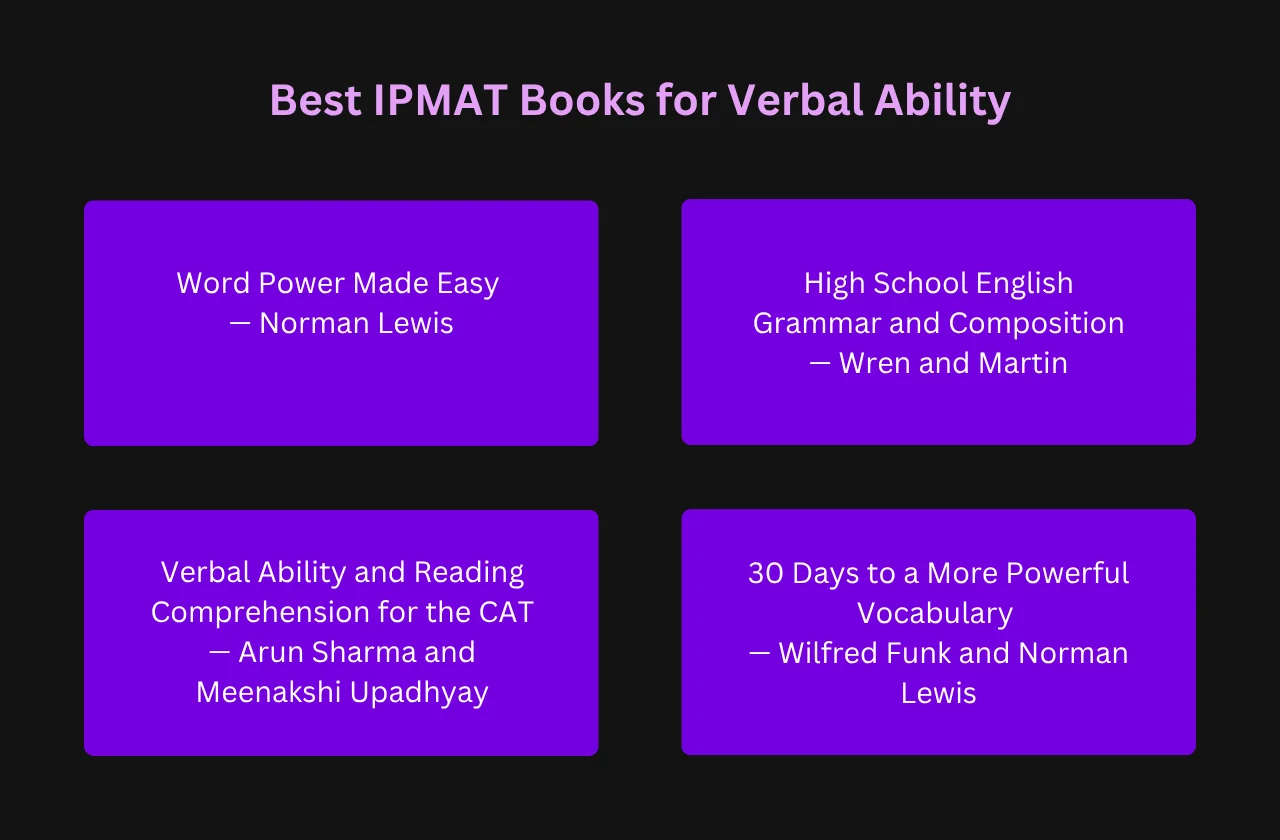
1) Word Power Made Easy — Norman Lewis
Best for: All students — vocabulary building is non-negotiable for IPMAT VA
Why we recommend it: This is our strongest IPMAT book recommendation for VA. Word Power Made Easy does not give you a list of words to memorise. It teaches you the internal structure of English vocabulary — root words, prefixes, and suffixes from Latin and Greek — which means you can make educated inferences about unfamiliar words during the exam. A student who has worked through this book can often deduce the meaning of a word they have never seen before, which is exactly the skill IPMAT vocabulary questions reward.
How to use it: Work through it systematically — one chapter per day or every alternate day. Do not skip the exercises. After completing each chapter, add the key words to a personal vocabulary journal for periodic review. After 3 to 4 months of consistent daily vocabulary work, active word bank depth increases measurably.
2) High School English Grammar and Composition — Wren and Martin
Best for: All students — grammar reference and structured practice for error spotting and sentence correction
Why we recommend it: Wren and Martin is the standard grammar reference for Indian competitive exam preparation. It covers every grammar concept tested in the IPMAT VA section — subject-verb agreement, tense, pronoun usage, prepositions, articles, modifiers, and parallel structure — with clear rule explanations and extensive exercise sets.
How to use it: Do not read Wren and Martin cover to cover. Use it as a targeted reference resource. Work through the exercise sets for the grammar topics that appear most often in IPMAT papers: subject-verb agreement, pronoun-antecedent agreement, tense consistency, misplaced modifiers, and preposition usage. Check answers against the key after every exercise.
Grammar topics most tested in IPMAT:
- Subject-verb agreement
- Pronoun-antecedent agreement
- Tense consistency
- Parallel structure
- Misplaced and dangling modifiers
- Preposition and article usage
3) Verbal Ability and Reading Comprehension for the CAT — Arun Sharma and Meenakshi Upadhyay
Best for: Students who need structured RC passage practice and a systematic approach to para jumbles and critical reasoning
Why we recommend it: This book is written for CAT VA preparation but the RC passage difficulty and question types — inference, main idea, author tone, vocabulary-in-context — are directly applicable to IPMAT. The para jumble and critical reasoning chapters are also well-structured for IPMAT-level preparation.
How to use it: Use it primarily for timed RC passage practice. Work through RC chapters under timed conditions — 6 to 8 minutes per passage with questions. Also use the para jumble and critical reasoning chapters. Skip the advanced vocabulary sections that target CAT’s higher-difficulty vocabulary level, which goes above what IPMAT tests.
4) 30 Days to a More Powerful Vocabulary — Wilfred Funk and Norman Lewis
Best for: Students with limited preparation time who need a compressed vocabulary building programme
Why we recommend it: For students who are 4 to 5 months from the exam and have not yet built vocabulary systematically, this book provides a structured 30-day programme. It is not as thorough as Word Power Made Easy but covers high-frequency words systematically in a compressed timeframe.
How to use it: Follow the daily programme exactly. Do not double up days — the spacing is intentional for retention. Use it alongside Word Power Made Easy if possible, with Word Power as the primary resource and 30 Days as a daily supplement for high-frequency words.
Best IPMAT Books for Logical Reasoning
LR preparation is specifically required for IIM Rohtak’s IPM-AT and JIPMAT, both of which test Logical Reasoning. IIM Indore’s IPMAT does not include an LR section. If you are targeting only IIM Indore, you can skip this section.
If you are targeting IIM Rohtak or JIPMAT — which we recommend for all students who want to maximise IPM opportunities — you need dedicated LR preparation.
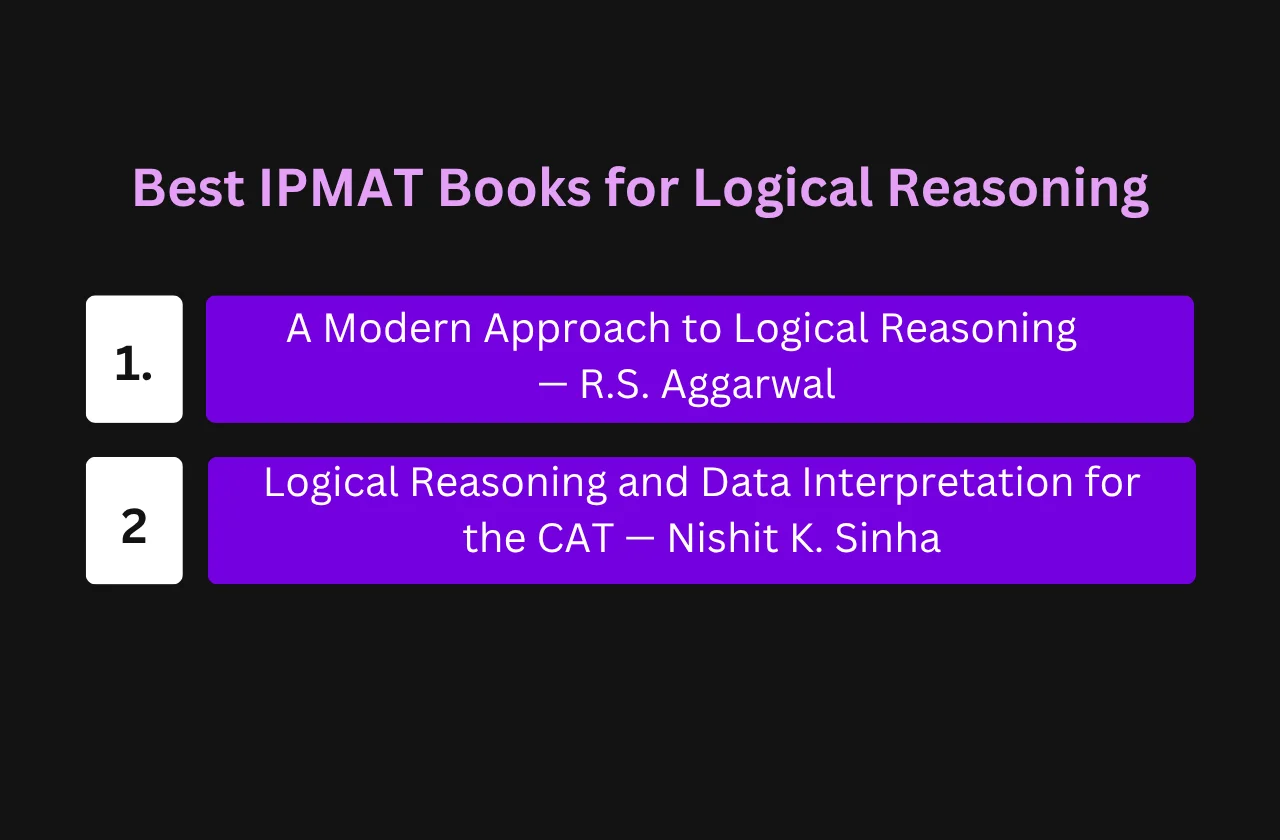
1) A Modern Approach to Logical Reasoning — R.S. Aggarwal
Best for: All students targeting IPM-AT Rohtak or JIPMAT who need to build LR from scratch
Why we recommend it: R.S. Aggarwal’s LR book covers all the question types that appear in IPM-AT Rohtak and JIPMAT: seating arrangements, syllogisms, blood relations, coding-decoding, direction and distance, and series completion. The structured chapter format with increasing difficulty makes it the clearest starting point for LR preparation.
How to use it: Build the method for each question type before attempting timed practice. For seating arrangements — always draw a grid before reading all conditions. For syllogisms — always use the Venn diagram method. For blood relations — always draw the family tree. The habit of using the right tool for each question type is more important than the speed at which you first solve them.
2) Logical Reasoning and Data Interpretation for the CAT — Nishit K. Sinha
Best: Students who have completed R.S. Aggarwal LR and need harder, more complex arrangement and puzzle sets
Why we recommend it: Once R.S. Aggarwal LR foundations are solid, the puzzle complexity in IPM-AT papers can exceed what R.S. Aggarwal provides. Nishit Sinha’s LR/DI book contains more complex arrangement sets and puzzle structures that better match the difficulty ceiling of IPM-AT Rohtak’s LR section.
How to use it: Use the Logical Reasoning chapters only — specifically the arrangement puzzle and seating sets. The Data Interpretation chapters are relevant for JIPMAT’s DILR section but not for IPM-AT Rohtak’s pure LR section. Use it after R.S. Aggarwal LR is complete, not as a starting point.
The IPMAT Book Stack We Actually Recommend
Based on everything above, here is the practical IPMAT book combination we recommend for students targeting IIM Indore’s IPMAT in 2026.
For Students Targeting IPMAT Indore Only
| Subject | Primary Book | Supplementary Book |
| QA Foundations | NCERT Class 9, 10, 11 | — |
| QA Practice (Arithmetic) | R.S. Aggarwal — Quantitative Aptitude | M. Tyra — Quicker Maths (speed only) |
| QA Practice (Algebra, Number Theory) | Arun Sharma — CAT QA (selective chapters) | — |
| VA Vocabulary | Word Power Made Easy — Norman Lewis | 30 Days to a More Powerful Vocabulary |
| VA Grammar | Wren and Martin | — |
| VA RC and Para Jumbles | Arun Sharma/Meenakshi Upadhyay — CAT VA (RC chapters) | Daily editorial reading (The Hindu / Indian Express) |
For Students Targeting IPMAT Indore + Rohtak + JIPMAT
Add to the above:
| Subject | Primary Book | Supplementary Book |
| LR Foundations | R.S. Aggarwal — Logical Reasoning | — |
| LR Advanced | Nishit K. Sinha — LR and DI for CAT (LR chapters only) | — |
How to Use IPMAT Books Without Wasting Time
At Phodu Club, we have seen students buy the right books and still not improve. Here is what they did wrong — and what to do instead.
Mistake 1: Reading examples passively without solving
Every example problem in every IPMAT preparation book should be attempted by the student before the solution is read. A student who reads “here is how to solve this percentage problem” has gained familiarity. A student who attempts it first, makes an error, and then reads the solution has gained understanding. Only understanding transfers to exam performance.
Mistake 2: Moving to the next topic before the current one is solid
We see this pattern constantly: a student covers percentages in 2 days, gets 60% accuracy, and moves to profit and loss. Six weeks later, their percentage accuracy is still 60% because they never built it to 80% before moving on. The rule at Phodu Club: do not move to the next topic until you can solve problems from the current topic at 80% accuracy under timed conditions.
Mistake 3: Using books as the only practice resource
Books provide topic-wise practice in isolation. The IPMAT exam provides 100 questions across topics in sequence, under time pressure, with negative marking, with section timers that close permanently. These are completely different conditions. A student who has only practiced from books has practiced the content but not the exam. Full-length mock tests are where book knowledge becomes exam performance.
Mistake 4: Buying too many books
The above books are sufficient. Additional books beyond this set produce diminishing returns. The same preparation time spent on a third QA book would produce better results if spent solving additional timed problems from the books already in hand.
From Books to Exam Readiness: The Missing Link
Here is something we tell every student who comes to us with a stack of IPMAT books and a preparation plan: books get you prepared. Mock tests get you ready. These are different things.
A student who has worked through NCERT, R.S. Aggarwal, and Word Power Made Easy have built preparation. They have conceptual foundations in QA, practiced problem-solving in arithmetic and algebra, and expanded their vocabulary. What they have not built is exam readiness — the ability to perform all of that under 3 independent 40-minute timers, with negative marking, in sequence, without knowing which topic comes next.
That gap between preparation and exam readiness is what full-length IPMAT mock tests close.
At Phodu Club, we built the Phodu Club IPMAT mock test specifically for this purpose. Full-length mocks calibrated to actual IIM Indore exam difficulty, with 3 independent 40-minute section timers, the Short Answer section included (zero negative marking), and section-wise analytics that show exactly where QA and VA performance stands after every attempt. The 1700+ DPP bank — handpicked by IIM seniors — gives students the topic-wise practice that connects book knowledge to mock test performance.
The right IPMAT book stack builds the foundation. The Phodu Club IPMAT mock test builds what sits on top of it.
According to research published by the American Psychological Association, students who combine structured content study with retrieval practice under test conditions consistently outperform students who rely on content study alone. For IPMAT, this means books are necessary but not sufficient. The mock test practice is what converts book knowledge into actual exam performance.
Conclusion
The best IPMAT books for 2026 are:
- QA: NCERT Class 9 to 11 (foundations), R.S. Aggarwal (practice), Arun Sharma CAT QA (harder algebra and number theory)
- VA: Word Power Made Easy (vocabulary), Wren and Martin (grammar), Arun Sharma/Meenakshi Upadhyay CAT VA (RC practice)
- LR (for Rohtak/JIPMAT): R.S. Aggarwal Logical Reasoning (foundations), Nishit Sinha LR/DI (advanced puzzles)
But the best IPMAT book combination in the world does not replace daily editorial reading, daily timed problem practice, or full-length mock tests. Books are the starting layer. The preparation discipline, the daily reading habit, and the mock test analysis are what convert a book-based foundation into a score that clears the IPMAT cutoff.
We built Phodu Club because we saw students with great books and no improvement. The missing piece was always the same: not enough timed practice, not enough mock tests, and not enough honest analysis of where the marks were being lost.
Frequently Asked Questions (FAQ)
1) Which is the best IPMAT book for Quantitative Ability?
The best combination is NCERT Class 9, 10, and 11 Mathematics for conceptual foundations, followed by R.S. Aggarwal’s Quantitative Aptitude for volume practice. Students who need harder algebra and number theory problems can add selective chapters from Arun Sharma’s CAT QA book. NCERT should always come first — even for students who feel they know the topics.
2) Which is the best IPMAT book for Verbal Ability?
Word Power Made Easy by Norman Lewis for vocabulary (the most important VA book), Wren and Martin for grammar, and Arun Sharma/Meenakshi Upadhyay’s CAT VA book for structured RC practice. These three books should be supplemented with daily editorial reading from The Hindu or Indian Express — no book replaces this daily habit for RC development.
3) Which is the best IPMAT book for Logical Reasoning?
R.S. Aggarwal’s A Modern Approach to Logical Reasoning is the strongest starting point for arrangement puzzles, syllogisms, blood relations, and coding-decoding. Students who need harder puzzle sets after completing R.S. Aggarwal can move to the LR chapters of Nishit K. Sinha’s CAT LR/DI book. LR preparation is required for IPMAT Rohtak and JIPMAT — not for IIM Indore’s IPMAT.
4) Is R.S. Aggarwal sufficient for IPMAT QA preparation?
R.S. Aggarwal is a strong practice resource for arithmetic and basic algebra, but should be used after NCERT foundations are in place. For harder algebra, number theory, and modern mathematics, selective chapters from Arun Sharma’s CAT QA book add useful difficulty. R.S. Aggarwal alone, without NCERT foundations and without timed mock test practice, is not sufficient for competitive IPMAT preparation.
5) Can I prepare for IPMAT without buying any book?
Partially. NCERT Mathematics is available free on the NCERT website. Daily editorial reading from The Hindu or Indian Express is free. IPMAT PYQs are accessible through IIM Indore’s website. What a completely book-free preparation cannot provide is structured vocabulary development and grammar practice — Word Power Made Easy and Wren and Martin are worth purchasing for these specifically.
6) How many IPMAT books should I study?
Two to three books per subject is sufficient and recommended. More books beyond that produce diminishing returns — the same time spent on additional books would be better used solving timed problems from the books already in hand. The books recommended in this guide cover the full IPMAT syllabus. Additional books are not necessary.
7) Should I buy IPMAT-specific books or general aptitude books?
The IPMAT syllabus aligns closely with standard Indian competitive exam aptitude content at Class 9 to 11 level. Well-structured general aptitude books like R.S. Aggarwal, Word Power Made Easy, and Wren and Martin are more than sufficient. “IPMAT-specific” book compilations available in the market often repackage standard aptitude content — evaluate them against the same criteria as any aptitude book before purchasing.
8) How does the Phodu Club IPMAT mock test complement book-based preparation?
Books build topic-wise foundations in QA and VA. The Phodu Club IPMAT mock test converts that foundation into exam performance through full-length timed mocks calibrated to actual IIM Indore difficulty, with 3 independent 40-minute section timers, the Short Answer section included, and section-wise analytics. The 1700+ DPP bank — handpicked by IIM seniors — bridges the gap between book exercises and exam-level timed practice. Together, books and mock tests cover everything the IPMAT demands.