
At Phodu Club, we see a frustrating pattern all the time. Students score 95 marks in their Class 12 board exams, sit for their first aptitude mock test, and fail terribly. Why does this happen? Because they approach management entrance quantitative sections like standard subjective school exams. They spend months studying every single chapter in their textbooks without knowing the actual IPMAT Maths syllabus. Effort alone does not fix your score if your direction is completely wrong. You need to know exactly what topics matter, what concepts require speed, and what you should ignore entirely.
IPMAT Maths Syllabus: Quick Answer
The official IPMAT Maths syllabus heavily prioritizes middle-school arithmetic, basic algebra, and number systems. It tests pure logic and mental speed rather than complex theorem application. Focus your preparation on percentages, profit and loss, time-speed-distance, sequences, and basic geometry to maximize your final score.
The Official IPMAT Maths syllabus Ranked by Importance
You need to know where to spend your energy. Based on official exam updates from the IIM Indore admission portal, IIM Rohtak test structures, and past paper analysis from the 2025 cycle, we have mapped out the entire testing structure. Recent trends show a massive shift towards arithmetic reasoning.
Here is the exact list of the IPMAT Maths syllabus, split by major domains and ranked by priority.
1) Arithmetic: The Make-or-Break Section You Are Ignoring
When analyzing the IPMAT Maths syllabus, Arithmetic stands out as the absolute most crucial pillar. You can not skip this. If your arithmetic is weak, your data interpretation will suffer, your speed will drop, and your overall score will remain stagnant.
| Topic | Priority | What to Focus On | Expected Questions |
| Percentages | Very High | Fraction to percentage conversions, successive changes. | 3 – 4 |
| Ratios and Proportions | Very High | Dividing quantities, combining ratios, age problems. | 2 – 3 |
| Profit and Loss | High | Successive discounts, faulty balances, markup. | 2 – 3 |
| Time, Speed, and Distance | Very High | Relative speed, trains passing objects, boats. | 3 – 4 |
| Time and Work | High | Efficiency logic, pipes and cisterns, alternate days. | 2 – 3 |
| Averages | Medium | Weighted averages, inclusion and exclusion of items. | 1 – 2 |
| Mixtures and Alligations | Medium | Liquid replacement, mixing multiple solutions. | 1 – 2 |
| Simple & Compound Interest | Medium | Difference between SI and CI, installment concepts. | 1 – 2 |
What students get wrong: Most students try to solve Arithmetic using variables. They set up long algebraic equations for simple percentage questions. This drains the clock.
Actionable Takeaway: Memorize percentage-to-fraction conversions up to 1/20. Stop using variables for arithmetic; begin assuming values like 100 or using multiples to speed up your computing process.
2) Algebra: The Differentiating Factor
The second major pillar of the IPMAT Maths syllabus is Algebra. This section separates the average scorers from the top rankers. It looks intimidating but is highly scoring once you understand the core rules.
| Topic | Priority | What to Focus On | Expected Questions |
| Linear Equations | High | Identifying unique solutions, consistent systems. | 1 – 2 |
| Quadratic Equations | High | Sum and product of roots, finding maximum/minimum. | 2 – 3 |
| Inequalities | High | Wavy curve method, modulus inequalities, basic ranges. | 2 – 3 |
| Logarithms | Medium | Properties of logs, changing bases, log equations. | 1 – 2 |
| Sequences and Series | Very High | Arithmetic Progression, Geometric Progression, infinite series. | 3 – 4 |
| Surds and Indices | Medium | Basic properties, rationalization, comparing powers. | 1 – 2 |
What students get wrong: Students spend too much time expanding algebraic expressions on paper instead of looking at the options provided.
If you are struggling to find the right material to practice these concepts, we often suggest looking at solid, well-structured books. Even resources meant for other exams can be useful for fundamental practice. For instance, some of the texts we mention in our maths book for JEE Mains guide offer fantastic fundamental algebra problems that build great mental stamina.
Actionable Takeaway: Always check the options before you begin solving an algebra question. Substitution is your best weapon.
3) Number Systems: The Test of Pure Logic
Number systems test your fundamental understanding of how numbers interact. This area requires pure, unfiltered logic.
| Topic | Priority | What to Focus On | Expected Questions |
| Divisibility Rules | High | Rules for 3, 4, 8, 9, 11, and combined divisibility like 72. | 1 – 2 |
| Remainders | High | Euler’s theorem, Fermat’s little theorem, basic cyclicity. | 2 – 3 |
| Factors and Multiples | Medium | Finding total factors, sum of factors, prime factorization. | 1 – 2 |
| Units and Tens Digit | Medium | Cyclicity of powers, basic pattern recognition. | 1 – 2 |
| Base Systems | Low | Converting from base 10 to other bases, simple arithmetic. | 0 – 1 |
What students get wrong: Aspirants try to memorize hundreds of shortcut rules for remainders without understanding the basic division logic.
Actionable Takeaway: Focus heavily on prime factorization. If you can break any number down into its prime components rapidly, you can solve eighty percent of number system questions.
4) Modern Mathematics: Stop Guessing and Begin Drawing
A heavily feared portion of the quantitative section is Modern Mathematics. However, the questions asked here are usually very straightforward if your basics are clear.
| Topic | Priority | What to Focus On | Expected Questions |
| Permutations and Combinations | High | Basic counting principles, circular arrangements, grouping. | 3 – 4 |
| Probability | High | Coins, dice, cards, conditional probability concepts. | 2 – 3 |
| Set Theory | Medium | Venn diagrams (2 and 3 variables), intersections. | 1 – 2 |
What students get wrong: Aspirants confuse when to use permutations (arrangements) and when to use combinations (selections). They rush the reading phase and apply the wrong rule.
Actionable Takeaway: Never rush through a P&C question. Read the English carefully. The phrasing of the question dictates the mathematical operation you must use.
5) Geometry and Mensuration: The Visual Section
Geometry does not carry as much priority as arithmetic, but it is highly predictable. Questions rarely try to fool you.
| Topic | Priority | What to Focus On | Expected Questions |
| Triangles | High | Properties, similarity, congruency, basic centers. | 2 – 3 |
| Circles | High | Tangents, chords, intersecting secants, inscribed angles. | 1 – 2 |
| Quadrilaterals | Medium | Parallelograms, rhombuses, trapeziums, area properties. | 1 – 2 |
| Coordinate Geometry | Low | Distance between points, slopes, basic line equations. | 0 – 1 |
| Mensuration | Medium | Volumes and surface areas of cylinders, cones, spheres. | 1 – 2 |
What students get wrong: They try to study advanced geometry theorems that are strictly meant for national olympiads.
Actionable Takeaway: Keep a sheet of basic properties for triangles and circles on your desk. Do not waste time on complex derivations or advanced coordinate geometry proofs.
IIM Indore vs IIM Rohtak: Why You Need Two Different Strategies
Knowing the topics is only half the battle. The exact testing style changes depending on which institute you are targeting. You can not use the same strategy for both exams.
The IIM Indore Short Answer (SA) Trap
IIM Indore includes a Short Answer (SA) section within the quantitative paper. In this section, there are no options provided. You have to type the exact numerical answer into a box on the screen. There is no negative marking in the SA section, but the difficulty is significantly higher because you have to be absolutely precise. You do not have the luxury of guessing, estimating, or substituting options.
The IIM Rohtak Speed Test
IIM Rohtak consists entirely of multiple-choice questions. The focus here is extreme speed. You have strict time limits to solve a large number of quantitative questions. It is a pure test of how quickly you can spot the correct path, use the options, and mark the answer.
Our Proven 120-Day Action Plan to Master Quantitative Aptitude

At Phodu Club, we enforce a strict phased approach for our students. Throwing yourself into random practice books will lead to immediate burnout. To complete the IPMAT Maths syllabus effectively, you need a realistic routine. Here is the exact plan we use to build top scorers.
Phase 1: The Foundation Phase (Days 1 to 30)
Your only goal in the first month is to understand the concepts. Go through the theory. Understand the basic rules of indices, the properties of triangles, and the logic behind profit margins.
- Focus 100% on Arithmetic and basic Algebra.
- Do not worry about a stopwatch. Take ten minutes to solve a single question if needed.
- Write every concept, rule and shortcut in a dedicated register.
Phase 2: Topic-wise Testing and Exposure (Days 31 to 60)
Now you begin building specific skills and finding your weak spots.
- Do not jump to full mock tests immediately. Give strict sectional tests.
- Test your Number Systems knowledge independently.
- Test your Geometry independently.
- Find out which specific sub-topic is draining your time. If ‘Boats and Streams’ takes you five minutes, stop doing tests and go back to the theory for that specific topic.
Phase 3: Speed, Accuracy, and Modern Math (Days 61 to 90)
This is where you push your limits and learn to handle pressure.
- Begin applying shortcuts. Use the options. Use approximation.
- Dive heavily into Permutations, Combinations, and Probability.
- Begin solving questions under strict time limits. Force yourself to move on if a question takes more than ninety seconds.
Phase 4: Full Mocks and Strategy Refinement (Days 91 to 120)
- Take full-length tests twice a week.
- Spend three hours analyzing every two-hour test.
- Build a firm strategy for skipping hard questions immediately.
Dealing with Math Phobia: Advice for Commerce and Humanities Students
Most of the applicants come from non-mathematical backgrounds in standard 12. They are terrified of the quantitative section. If you are one of them, listen closely.
You do not need to be a mathematical genius to clear this test. You just need to be strategic about what you solve and what you leave. The syllabus is vast, but you only need around fifty to sixty percent of the maximum marks to comfortably clear the quantitative cutoff in most testing cycles.
How to Actually Analyze a Mock Test
Giving a mock test is just twenty percent of the work. The real improvement happens when you sit down and see what went wrong. Many students just look at their total score, feel bad, and move on. This is a massive mistake.
When going through your test, ask yourself these exact questions for every single problem:
- Did I take too long on this?
- Did I make a silly addition or subtraction error?
- Did I completely misunderstand the concept?
- Did I miss a shortcut that was right in front of me?
- Should I have skipped this question entirely?
Actionable Takeaway: Maintain a physical error log in a register. Write down the exact reason for every mistake and read that register before your next test to prevent repeating the same errors.
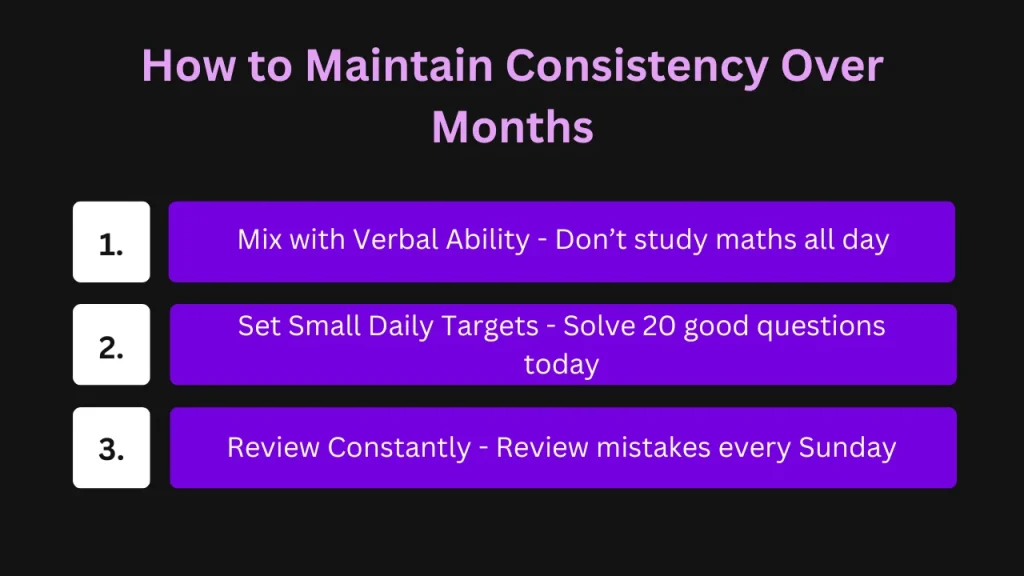
How to Maintain Consistency Over Months
Preparation fatigue is a real problem. After three months, most students stop studying properly. They just stare at their books. To finish your preparation effectively without burning out, you need a sustainable daily routine.
- Do not study maths all day: Mix it with verbal ability. If you do numbers for three hours, switch to reading comprehension or logical reasoning.
- Keep daily targets small: Tell yourself you will solve twenty good profit and loss questions today. Do not tell yourself you will “finish” the entire profit and loss chapter today.
- Review constantly: Every Sunday, do not learn anything new. Just review the questions you got wrong from Monday to Saturday.
Conclusion
Understanding the IPMAT Maths syllabus and having the correct strategy is exactly what separates the selected candidates from the rest of the crowd. It is not about how many books you finish; it is about how clearly you understand the concepts and how quickly you can apply them under strict time limits.
We have worked with enough students to know this — effort alone does not fix your score. The right strategy does. That is exactly what we focus on at Phodu Club. We give you structure, identify your exact weak points, and help you improve efficiently without wasting time on irrelevant topics. If your score is stagnant and you feel like you are working hard without seeing results, it is time to change your approach. Focus on the right topics, fix your mistakes, and stick to the plan.
Frequently Asked Questions (FAQ)
1) What is the most scoring section of the IPMAT Maths syllabus?
Arithmetic is the most crucial and highest-scoring section. Topics like Percentages, Profit and Loss, Time Speed Distance, and Ratios constitute the bulk of the questions. Mastering these will give you maximum scoring potential.
2) Is standard 12 calculus required for this exam?
No. Calculus, integration, and complex differentiation are not officially tested. You should focus your energy on middle-school mathematics and basic standard 11 topics like permutations and combinations.
3) How much time is needed to complete the quantitative topics?
If you study consistently for two to three hours a day, it takes about three to four months to comfortably cover all the concepts, followed by two months of strict mock test practice and analysis.
4) Can a non-maths commerce student crack the quantitative section?
Absolutely. The questions test logical application, not advanced derivations. By focusing purely on high-priority areas like arithmetic and basic algebra, non-maths students regularly clear the cutoffs.
5) Are the short answer questions in the Indore paper very difficult?
They are conceptually similar to multiple-choice questions, but they feel harder because you can not guess or use options to work backward. You must be completely accurate in your final computation to get the marks.
6) How many questions should I attempt to clear the cutoff?
While cutoffs change yearly based on paper difficulty, attempting around sixty to seventy percent of the questions with high accuracy usually puts you in a very safe zone for the quantitative section.
7) What is the difference between the IIM Indore and JIPMAT quantitative sections?
JIPMAT is generally much more direct and rule-based, requiring less complex logical deduction compared to IIM Indore. The difficulty tier for JIPMAT is slightly lower, making raw speed even more crucial.
8) How does Phodu Club help students improve their quantitative scores?
At Phodu Club, we focus on identifying exactly why your score is stuck. We do not just give you questions; we analyze your specific weak points, teach you time-saving methods, and provide structured mentorship to fix your approach entirely so you stop making the same mistakes.