Dreaming of a management career right after Class 12? The Integrated Programme in Management (IPM) at IIM Indore and IIM Rohtak offers a five-year integrated course that combines undergraduate and postgraduate management education. But before you start preparing, you need to know if you qualify. The IPMAT eligibility criteria determine who can appear for this prestigious entrance examination. From academic qualifications to age limits and category-specific relaxations, understanding these requirements ensures you don’t invest time in an opportunity you can’t pursue.
TL;DR
- Must have 60% aggregate in Class 10 and Class 12 (55% for SC/ST/PwD candidates)
- Maximum age: 20 years as of June 30, 2026 (relaxation of 5 years for SC/ST/PwD)
- All streams (Science, Commerce, Arts) eligible; Mathematics not mandatory
- No gap year restrictions apply
- Separate eligibility criteria for IIM Indore and IIM Rohtak with minor variations
What Are the Academic Eligibility Requirements for IPMAT 2026?
The IPMAT eligibility criteria primarily focus on your Class 10 and Class 12 academic performance. Both IIM Indore and IIM Rohtak require candidates to secure minimum percentage marks in their qualifying examinations.
General Category Requirements:
- Minimum 60% aggregate marks in Class 10 board examination
- Minimum 60% aggregate marks in Class 12 board examination (or equivalent)
Reserved Category Requirements (SC/ST/PwD):
- Minimum 55% aggregate marks in Class 10 board examination
- Minimum 55% aggregate marks in Class 12 board examination (or equivalent)
For students appearing in their Class 12 board examinations in 2026, provisional admission may be granted subject to meeting the minimum percentage criteria in the final results.
Stream Flexibility:
The aptitude test welcomes students from all streams—Science, Commerce, and Arts. Unlike many undergraduate management programs that require Mathematics as a subject, IPMAT allows commerce students without Mathematics to apply. This makes the five-year integrated course accessible to a broader range of aspirants.
Aggregate Calculation Method:
| Board Type | Calculation Method |
| CBSE/ICSE | Average of best 5 subjects including English |
| State Boards | As per board’s official aggregate calculation |
| International Boards | Equivalent percentage conversion as per university norms |
Students who have completed their qualifying examination through open schooling or distance education are also eligible, provided their board is recognized by the Association of Indian Universities (AIU).
Age Limit and Date of Birth Criteria for IPMAT
Age restrictions form a critical component of the IPMAT eligibility criteria. The entrance examination imposes an upper age limit to ensure candidates join the program at an appropriate academic stage.
General Category Age Limit:
Candidates must not have been born before July 1, 2006. In simpler terms, you must be 20 or younger as of June 30, 2026.
Age Relaxation for Reserved Categories:
| Category | Maximum Age (as of June 30, 2026) |
| General/OBC/EWS | 20 years |
| SC/ST | 25 years (5 years relaxation) |
| PwD (all categories) | 25 years (5 years relaxation) |
Calculating Your Eligibility:
- Note your date of birth from official documents
- Calculate your age as of June 30, 2026
- Check if you fall within the permissible age bracket for your category
- Factor in any applicable relaxations
The age limit ensures that students complete their five-year integrated course within an optimal timeframe, allowing them to enter the job market or pursue higher studies at a competitive age.
No Gap Year Restrictions:
Unlike some competitive examinations, there is no restriction on the number of gap years between Class 12 and appearing for IPMAT. Whether you’re a fresh Class 12 graduate or someone who took time off for other pursuits, you remain eligible as long as you meet the age and academic percentage criteria.
Subject and Stream Requirements: Can Commerce Students Without Maths Apply?
One of the most frequently asked questions concerns subject-specific requirements, particularly regarding Mathematics.
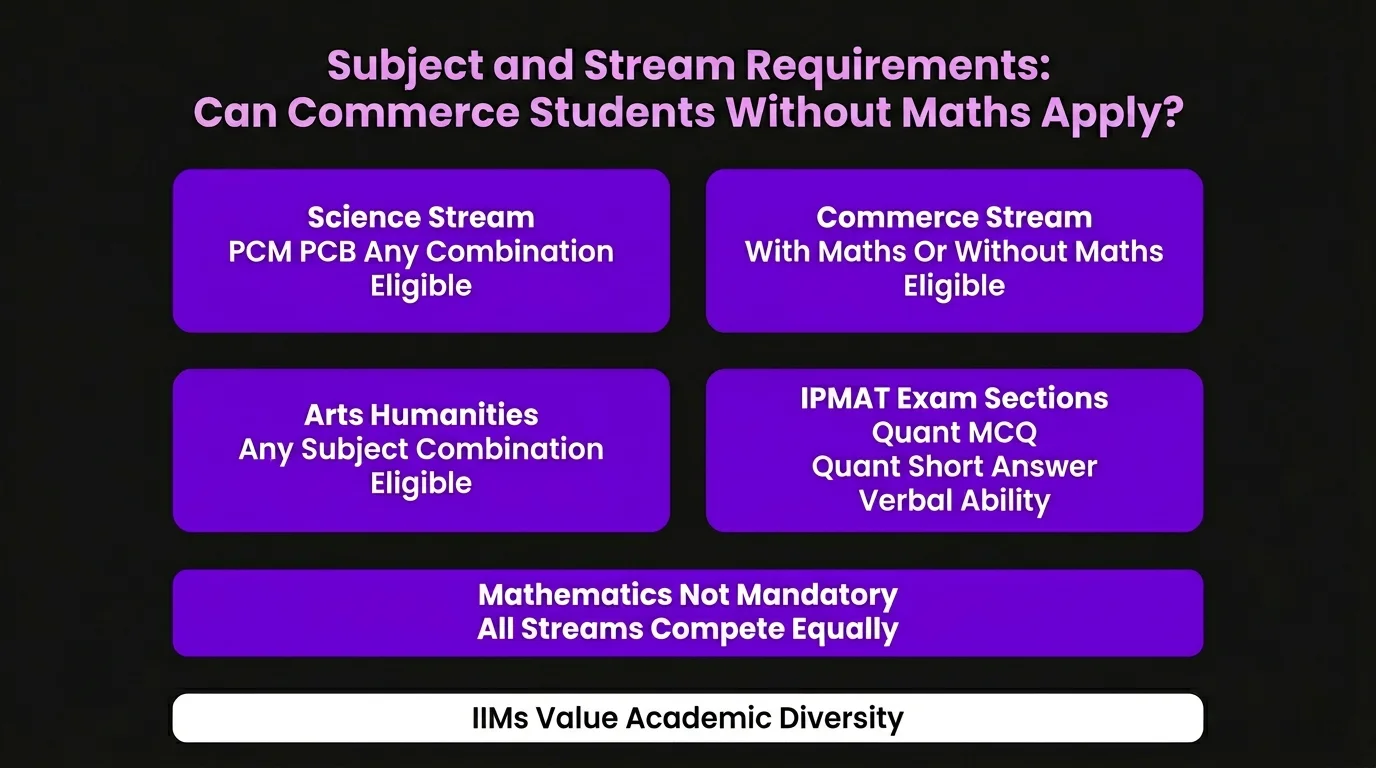
Stream Eligibility Breakdown:
- Science Stream: Eligible regardless of subject combination (PCM, PCB, or any other combination)
- Commerce Stream: Eligible with or without Mathematics
- Arts/Humanities Stream: Fully eligible with any subject combination
Why Mathematics is NOT Mandatory:
The IPMAT tests quantitative aptitude, but it doesn’t require candidates to have studied Mathematics at the Class 12 level. The entrance examination pattern includes sections on:
- Quantitative Ability (MCQ format)
- Quantitative Ability (Short Answer format)
- Verbal Ability
While having a Mathematics background may provide some advantage in preparation, it’s not a gatekeeping criterion. Commerce students without Mathematics can compete effectively with dedicated preparation focused on the exam pattern.
Subject Diversity Advantage:
IIM Indore and IIM Rohtak value diverse academic backgrounds. The integrated programme in management benefits from students bringing different perspectives—analytical skills from science, commercial awareness from commerce, and critical thinking from humanities.
If you’re worried about catching up on quantitative concepts, targeted preparation using resources like test series that mimic exam patterns can help bridge knowledge gaps effectively.
Category-Wise IPMAT Eligibility: Reservation Policy Explained
The IPMAT eligibility criteria include provisions for various reserved categories as per Government of India norms.
Category Distribution:
| Category | Minimum Percentage (Class 10 & 12) | Age Relaxation |
| General | 60% | None |
| OBC-NCL | 60% | None |
| EWS | 60% | None |
| SC | 55% | 5 years |
| ST | 55% | 5 years |
| PwD | 55% | 5 years |
OBC Non-Creamy Layer Requirements:
OBC candidates must belong to the Non-Creamy Layer (NCL) as per the latest Government of India guidelines. The income certificate must be valid and issued within the current financial year. The minimum percentage requirement for OBC-NCL candidates remains 60%, with no age relaxation.
EWS Category Specifications:
Economically Weaker Section (EWS) candidates must provide a valid EWS certificate issued by a competent authority. They need to secure 60% aggregate marks in both qualifying examinations, similar to the general category.
PwD Candidates:
Persons with Disabilities (PwD) receive:
- 5% relaxation in minimum percentage (55% instead of 60%)
- 5 years age relaxation
- Additional time during the entrance examination
- Scribe facility if required
Documentation Requirements:
- Category certificate from competent authority
- Income certificate (for OBC-NCL/EWS)
- Disability certificate (for PwD candidates)
- Documents must be in prescribed format and valid
Understanding category-specific criteria helps you prepare the correct documentation during the application process and prevents last-minute complications.
IIM Indore vs IIM Rohtak: Key Differences in Eligibility
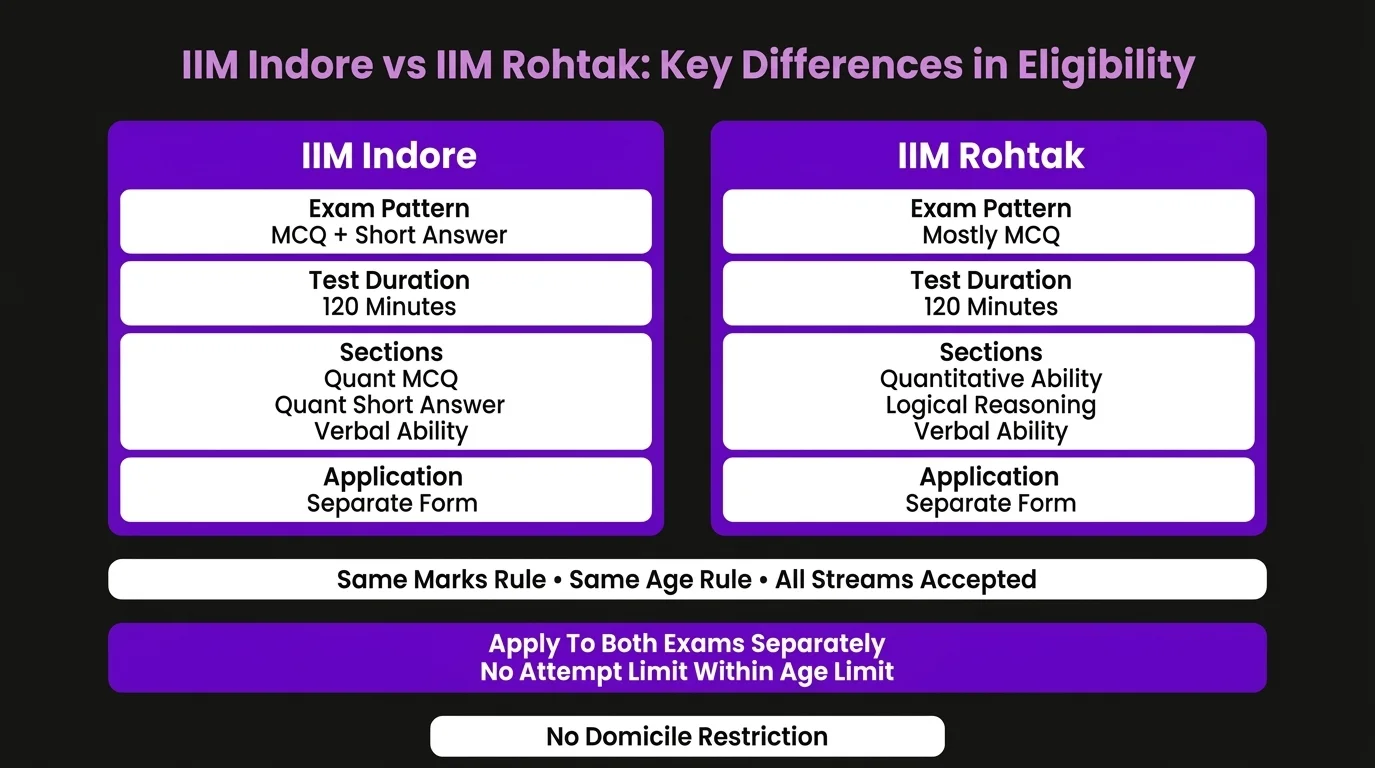
While both institutions conduct IPMAT, their IPMAT eligibility criteria have subtle variations that candidates must understand.
Core Similarities:
- Same minimum percentage requirements (60% for general, 55% for reserved)
- Identical age limit structure
- No Mathematics mandatory requirement
- All streams accepted
Distinguishing Factors:
| Aspect | IIM Indore | IIM Rohtak |
| Exam Pattern | MCQ + Short Answer (SA) format | Primarily MCQ format |
| Test Duration | 120 minutes | 120 minutes |
| Sections | Quantitative Ability (MCQ), Quantitative Ability (SA), Verbal Ability | Quantitative Ability, Logical Reasoning, Verbal Ability |
| Application Process | Separate application | Separate application |
Number of Attempts:
Neither IIM Indore nor IIM Rohtak restricts the number of attempts, provided you meet the age criteria. You can appear multiple times until you cross the maximum age limit for your category.
Application Strategy:
You can apply to both IIM Indore and IIM Rohtak simultaneously. Many candidates pursue this strategy to maximize their chances of securing admission to an Integrated Programme in Management. Each requires a separate application and exam fee.
Domicile Considerations:
Unlike some state-level examinations, IPMAT does not have domicile-based reservations. Students from any state or union territory can apply to both IIMs on equal footing, making it a truly national-level entrance examination.
The choice between IIM Indore and IIM Rohtak often comes down to personal preference regarding location, campus culture, and specific program nuances rather than eligibility differences. Understanding these distinctions helps you prepare appropriately for each exam’s pattern while meeting common eligibility standards.
Preparing for an aptitude test that determines your future requires more than just meeting minimum criteria—it demands strategic preparation. Tools like comprehensive test series help you understand the exact exam pattern and identify areas needing improvement. Just as students use targeted preparation strategies for competitive exams, IPMAT aspirants benefit from simulated testing environments that replicate actual examination conditions.
Conclusion
The IPMAT eligibility criteria are designed to identify academically capable students ready for a rigorous five-year integrated course in management. Here’s what you need to remember:
- Maintain 60% aggregate in Class 10 and Class 12 (55% for SC/ST/PwD)
- Ensure you meet age requirements: 20 years maximum for general category with 5-year relaxation for reserved categories
- All streams welcome—Mathematics not mandatory
- Prepare category-specific documents well in advance
- Consider applying to both IIM Indore and IIM Rohtak to maximize opportunities
Meeting eligibility criteria is just the first step. Success requires strategic preparation, consistent practice, and familiarity with the entrance examination pattern.
Frequently Asked Questions
1) Can I apply for IPMAT if I have a gap year after Class 12?
Yes, gap years don’t disqualify you from IPMAT. As long as you meet the age limit (20 years for general category, 25 for reserved categories as of June 30, 2026) and minimum percentage criteria in Class 10 and Class 12, you’re eligible regardless of when you completed your board examinations.
2) Is Mathematics compulsory in Class 12 to apply for IPMAT?
No, Mathematics is not compulsory. Commerce students without Mathematics, Arts students, and Science students with any subject combination can all apply. The quantitative aptitude section tests mathematical reasoning but doesn’t require Class 12 Mathematics as a prerequisite subject.
3) What is the minimum percentage required in Class 10 and Class 12 for IPMAT?
General, OBC-NCL, and EWS candidates need 60% aggregate marks in both Class 10 and Class 12 board examinations. SC, ST, and PwD candidates require 55% aggregate marks in both qualifying examinations. These percentages must be secured in the first attempt of the respective board exams.
4) Can I appear for both IIM Indore and IIM Rohtak IPMAT in the same year?
Yes, you can apply for both IIM Indore and IIM Rohtak IPMAT simultaneously. They conduct separate examinations with different application processes. Many candidates pursue this dual-application strategy to maximize their chances of admission to an Integrated Programme in Management.
5) What age relaxation is available for SC/ST candidates in IPMAT?
SC, ST, and PwD candidates receive 5 years of age relaxation. While general category candidates must not be born before July 1, 2006, reserved category candidates must not be born before July 1, 2001, giving them eligibility until age 25.
6) Are students from state boards eligible for IPMAT?
Yes, students from all recognized boards—CBSE, ICSE, state boards, and international boards—are eligible for IPMAT. The minimum percentage criteria apply uniformly, though aggregate calculation methods may vary slightly based on board-specific evaluation systems. Ensure the Association of Indian Universities recognizes your board.