We hear this from students constantly at Phodu Club: “I’ve been preparing for IPMAT Indore, so I’m basically ready for Rohtak too, right?” The answer is: mostly, but not fully — and the part that is missing is the part that trips students up most often. The IPMAT Rohtak syllabus has a third section that IIM Indore’s IPMAT does not test at all: Logical Reasoning. That one additional section changes your preparation plan, changes the exam-day experience, and changes how you need to allocate your preparation time across 6 months. Students who walk into IIM Rohtak’s IPM-AT having only prepared QA and VA consistently report that the LR section caught them off guard — and in a 3-section exam where all 3 sections have independent cutoffs, being caught off guard in one section is enough to miss the shortlist entirely. If IIM Rohtak is on your target list for 2026, this guide gives you the complete IPMAT Rohtak syllabus section by section, the full exam pattern, and exactly how to build a preparation plan around all three subjects.
IPMAT Rohtak Syllabus: TL;DR
The IPMAT Rohtak syllabus 2026 covers three sections: Quantitative Ability (QA), Logical Reasoning (LR), and Verbal Ability (VA) — 40 questions each, 120 questions total, 480 marks, 120 minutes. All sections carry negative marking. There is no Short Answer section.
IPMAT Rohtak 2026: Full Exam Pattern
Before diving into the syllabus topic by topic, here is the complete IIM Rohtak IPM-AT exam pattern for 2026. Understanding the structure is the prerequisite for building a preparation plan.
| Section | Questions | Marks Per Question | Negative Marking | Total Marks | Time |
| Quantitative Ability (QA) | 40 | +4 / -1 | Yes | 160 | 40 minutes |
| Logical Reasoning (LR) | 40 | +4 / -1 | Yes | 160 | 40 minutes |
| Verbal Ability (VA) | 40 | +4 / -1 | Yes | 160 | 40 minutes |
| Total | 120 | 480 | 120 minutes |
Mode: Computer-based test (CBT) Language: English Section timing: Each section has an independent 40-minute timer. When a section closes, it closes permanently.
5 Pattern Points Every IPM-AT Aspirant Must Know
- There is no Short Answer section. Unlike IIM Indore’s IPMAT, all 120 questions in the IPM-AT are MCQ with uniform negative marking. The zero-negative-marking “free attempt” opportunity that IIM Indore provides does not exist here. Every wrong answer in every section costs -1 mark.
- All 3 sections carry independent cutoffs. QA, LR, and VA each have their own sectional minimum. Missing any one — including LR, which many students underprepare — means no shortlist, regardless of total score or performance in the other two.
- The total is 480, not 400. Students who compare Rohtak scores against IIM Indore benchmarks without adjusting for scale are making an invalid comparison. A score of 240 at Rohtak represents 50% of the total; a score of 240 at Indore represents 60%.
- 1 minute per question across all sections. The time pressure is uniform and demanding. 40 questions in 40 minutes requires the same practiced speed across LR that most students only build in QA.
- WAT + PI follows the exam. Shortlisted students face a Written Ability Test before the Personal Interview — an additional selection stage that IIM Indore’s process does not include.
IPMAT Rohtak Syllabus 2026: Section 1 — Quantitative Ability
The QA syllabus for the IPMAT Rohtak is drawn from Class 9, 10, and 11 Mathematics — the same broad scope as IIM Indore’s IPMAT. The difficulty level and question framing are broadly comparable between the two exams.
Topic-Wise Breakdown: QA
Arithmetic (Highest Priority)
Arithmetic accounts for approximately 35 to 45% of QA questions in the IPM-AT. It is the most consistently tested topic cluster across every year’s paper.
| Topic | Key Concepts |
| Percentages | Percentage increase/decrease, successive changes, applications in profit/loss |
| Profit, Loss, and Discount | Cost price, selling price, marked price, successive discounts |
| Ratio and Proportion | Direct and inverse proportion, compound ratio, partnership problems |
| Time, Speed, and Distance | Relative speed, trains, boats and streams, circular tracks |
| Time and Work | Combined work rates, pipes and cisterns, efficiency problems |
| Simple and Compound Interest | SI and CI formulas, difference between SI and CI |
| Averages and Weighted Averages | Simple average, combined average, removal/addition problems |
| Mixtures and Alligation | Mixing solutions, repeated dilution, alligation rule |
Algebra (High Priority)
Algebra questions appear in every IPM-AT paper and frequently combine sub-topics within a single question.
| Topic | Key Concepts |
| Linear and Quadratic Equations | Single/simultaneous equations, nature of roots, sum/product of roots |
| Inequalities | Linear, quadratic, and modulus inequalities |
| Progressions | AP, GP, HP — nth term, sum formulas, properties |
| Functions and Graphs | Domain, range, composite functions |
| Logarithms | Log properties, change of base, log equations |
| Polynomials | Remainder theorem, factor theorem, factorisation |
Number Theory (Medium-High Priority)
| Topic | Key Concepts |
| Divisibility and HCF/LCM | Divisibility rules, prime factorisation method |
| Remainders and Cyclicity | Euler’s theorem, units digit patterns, cyclicity of powers |
| Primes and Factors | Number of factors, sum of factors, factor-related word problems |
| Factorials | Trailing zeros, highest power of a prime in n! |
Geometry and Mensuration (Medium Priority)
| Topic | Key Concepts |
| Triangles | Similarity, congruence, area, Pythagoras, angle bisector theorem |
| Circles | Tangent-radius, chord properties, arc length, sector area |
| Coordinate Geometry | Distance formula, slope, equation of a line, midpoint |
| Mensuration 2D | Area and perimeter of standard shapes, shaded regions |
| Mensuration 3D | Volume and surface area of cube, cylinder, cone, sphere |
Modern Mathematics (Medium Priority)
| Topic | Key Concepts |
| Permutations and Combinations | nPr, nCr, circular arrangements, restricted selections |
| Probability | Classical probability, conditional probability, independent events |
| Sets and Venn Diagrams | Union, intersection, complement, 2-set and 3-set word problems |
What Is NOT in the IPMAT Rohtak QA Syllabus
- Class 12 Calculus (derivatives, integrals, limits)
- Advanced trigonometry beyond basic ratios
- 3D Geometry (planes, direction cosines)
- Statistics beyond mean, median, mode
Students who are simultaneously preparing for boards or JEE should note that these Class 12 topics are irrelevant for the IPM-AT and should not receive IPMAT preparation time.
IPMAT Rohtak Syllabus 2026: Section 2 — Logical Reasoning
This is the section defining the IPMAT Rohtak syllabus. It does not exist in IIM Indore’s IPMAT. It does not appear in most standard aptitude preparation books. And it is the section that most students preparing for the IPM-AT underprepare — either because they started it too late, or because they assumed their general intelligence would carry them through without specific practice.
At Phodu Club, we see the LR section fail students in two consistent patterns: those who attempt it cold without preparation, and those who study LR passively — reading approaches without building the solving discipline through actual timed practice. Both patterns lead to the same outcome: a low LR score that misses the sectional cutoff regardless of QA and VA performance.
Topic-Wise Breakdown: LR
Arrangement and Ordering Puzzles (Highest Priority)
Arrangement puzzles are the highest-weightage LR topic in IPM-AT papers. They require structured, systematic grid-based solving — not mental reasoning.
| Question Type | What It Tests |
| Linear Seating Arrangement | Ordering people or objects in a line with given conditions |
| Circular Seating Arrangement | Clockwise/anti-clockwise positioning with conditions |
| Floor/Building Puzzles | Assigning people to floors with multiple attributes |
| Scheduling and Day/Time Puzzles | Assigning people to days or time slots with constraints |
| Comparison Puzzles | Ranking or ordering based on relative conditions |
Critical skill for arrangement puzzles: Every student who performs well in IPM-AT arrangement puzzles does the same thing — they draw a grid or table before reading all conditions, then populate it condition by condition. Students who attempt to hold arrangement constraints in memory consistently make errors or lose time backtracking. The grid-first habit is non-negotiable.
Syllogisms and Logical Deduction (High Priority)
| Question Type | What It Tests |
| Syllogisms (All/Some/No) | Drawing valid conclusions from 2 or 3 premise statements |
| Statements and Assumptions | Identifying the implicit assumption an argument depends on |
| Statements and Conclusions | Determining which conclusion validly follows from given statements |
| Cause and Effect | Identifying correct cause-effect relationships |
The fastest approach for syllogisms is the Venn diagram method — drawing overlapping circles for each statement and checking which conclusions are possible vs. definite. Students who try to solve syllogisms using formal logic notation consistently take longer and make more errors.
Coding-Decoding and Pattern Recognition (Medium Priority)
| Question Type | What It Tests |
| Letter Coding | Encoding letters based on a pattern (shift, substitution) |
| Number Coding | Assigning numbers to words or letters based on rules |
| Mixed Coding | Decoding sentences where individual word codes are given |
| Series Completion | Identifying the next term in letter, number, or mixed series |
Blood Relations (Medium Priority)
| Question Type | What It Tests |
| Family Tree Problems | Constructing a family structure from given relationships |
| Generation Problems | Identifying relationships across multiple generations |
| Coded Blood Relations | Blood relation problems where relationships are coded |
The critical habit for blood relations: Always draw the family tree. A student who reads a blood relations problem and tries to track “A is B’s uncle’s daughter’s father” mentally will confuse themselves by the third relationship. Draw it out — every time, without exception.
Direction and Distance (Medium Priority)
| Topic | Key Concepts |
| Compass directions | Final direction after a series of turns |
| Distance calculation | Total displacement using Pythagoras when movements are perpendicular |
| Shadow problems | Direction of shadow based on sun position and time |
Data Sufficiency (Medium Priority)
Data sufficiency questions present a question and two statements. The task is not to solve the problem but to determine whether Statement 1 alone, Statement 2 alone, both together, or neither is sufficient to answer the question.
This question type requires a completely different mindset from problem-solving. Students who attempt to actually solve the problem instead of evaluating sufficiency consistently waste time in this sub-section.
Critical Reasoning in LR Context (Lower Priority)
| Question Type | What It Tests |
| Strengthen/Weaken the Argument | Identifying what most supports or undermines a conclusion |
| Find the Assumption | Identifying the unstated assumption an argument depends on |
| Course of Action | Evaluating which actions logically follow from a situation |
IPMAT Rohtak Syllabus 2026: Section 3 — Verbal Ability
The VA syllabus for the IPMAT Rohtak is identical in topic coverage to IIM Indore’s IPMAT VA syllabus. Students who have prepared VA for IPMAT Indore have fully covered the VA component of the IPMAT Rohtak syllabus — no additional VA preparation is required.
Topic-Wise Breakdown: VA
| Topic | Approximate Weightage | Key Question Types |
| Reading Comprehension | 40 to 50% of VA questions | Main idea, inference, author tone, vocabulary-in-context, detail retrieval |
| Vocabulary | 20 to 25% of VA questions | Synonyms, antonyms, word analogies, fill in the blank, idioms |
| Grammar | 15 to 20% of VA questions | Error spotting, sentence correction, fill in the blank |
| Para Jumbles and Para Completion | 10 to 15% of VA questions | Ordering scrambled sentences, odd sentence out, best opening/closing sentence |
| Critical Reasoning | 5 to 10% of VA questions | Strengthen, weaken, assumption, conclusion |
Key note on RC passages: IIM Rohtak follows the same analytical and argument-driven passage style as IIM Indore. Passages are drawn from economics, social commentary, philosophy, science, and cultural analysis — not literary or narrative prose. Students who have been reading The Hindu or Indian Express editorials daily have been preparing the exact reading material the VA section rewards.
How the IPMAT Rohtak Syllabus Differs from IPMAT Indore
This comparison matters for students who are targeting both exams — which we strongly recommend — because understanding the differences determines how much additional preparation Rohtak actually requires.
| Component | IPMAT Indore | IPMAT Rohtak |
| QA syllabus | Class 9 to 11 Maths | Class 9 to 11 Maths (same) |
| VA syllabus | RC, Vocabulary, Grammar, Para Jumbles, CR | RC, Vocabulary, Grammar, Para Jumbles, CR (same) |
| LR section | Not present | 40 questions, full LR syllabus |
| Short Answer section | 20 questions, zero negative marking | Not present |
| Total questions | 100 | 120 |
| Total marks | 400 | 480 |
| Negative marking | MCQ sections only | All 3 sections |
| Post-exam process | PI only | WAT + PI |
The honest preparation implication: A student who has fully prepared for IPMAT Indore needs to add one thing to be prepared for IPMAT Rohtak — a dedicated LR preparation track. The QA and VA preparation transfers completely. LR is the additional investment, and it is significant enough to require 2 to 3 months of consistent daily practice to reach competitive accuracy.
How to Prepare for the IPMAT Rohtak Syllabus 2026
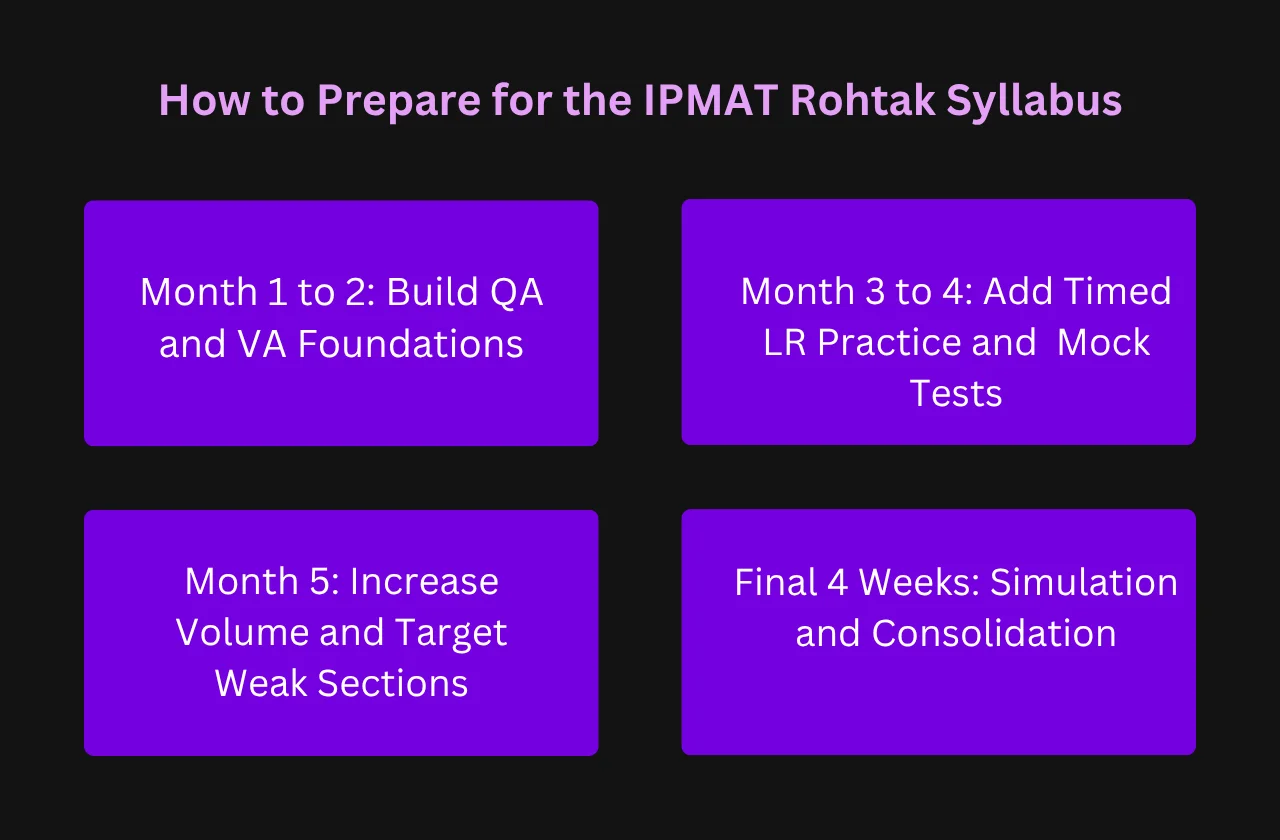
At Phodu Club, we work with many students who are targeting both IIM Indore and IIM Rohtak simultaneously. Here is the preparation framework we recommend for the full IPMAT Rohtak syllabus.
Month 1 to 2: Build QA and VA Foundations
Begin with arithmetic in QA — the highest-weightage topic in both exams. Simultaneously, establish daily VA habits from Day 1: one editorial per day, 8 to 10 vocabulary words in a journal, and grammar exercises 3 times per week. Do not defer VA.
For LR, use Month 1 to understand the question types and build basic solving frameworks — grid construction for arrangement puzzles, Venn diagram method for syllogisms, family tree drawing for blood relations. Do not attempt timed LR practice yet. Build the method first.
Month 3 to 4: Add Timed LR Practice and Begin Mock Tests
By Month 3, LR solving methods should be established enough to begin timed practice. 3 to 5 LR sets per day is a reasonable target. Start with arrangement puzzles — they carry the highest weightage and respond most visibly to systematic practice.
Begin full-length IPMAT mock tests in Month 3. The Phodu Club IPMAT mock test includes dedicated IPM-AT Rohtak mocks that replicate the exact 3-section structure with independent 40-minute timers for QA, LR, and VA. Taking your first Rohtak-specific mock in Month 3 reveals how your LR performance under time pressure compares to your untimed LR practice — a gap that is almost always larger than students expect.
Month 5: Increase Volume and Target Weak Sections
Two mock tests per week. For most students, the post-mock analysis at this stage reveals one of two patterns:
- LR is consistently the lowest-scoring section (most common for students who started LR late)
- VA is borderline relative to the sectional cutoff (most common for students who deferred VA preparation)
Both are fixable in Month 5 if identified and addressed directly. Use the DPP bank for targeted topic practice in whichever LR sub-types are producing the most errors.
Final 4 Weeks: Simulation and Consolidation
Two full-length IPMAT Rohtak mock tests per week under real exam conditions. No new content. Only revision of established methods and consolidation of weak topics identified through the error log.
Begin WAT preparation in the final 4 weeks. Write one timed essay per day (25 minutes) on a current affairs topic or general statement. Read it back and assess: is the position clear? Is the argument structured? Is the language precise? WAT is not evaluated on brilliance — it is evaluated on clarity, structure, and communication quality.
Topic Priority Summary: IPMAT Rohtak Syllabus 2026
| Section | Topic | Priority | Preparation Depth |
| QA | Arithmetic | Tier 1 | Deep — 40 to 50 problems per sub-topic, timed |
| QA | Algebra | Tier 1 | Deep — including combined sub-topic problems |
| LR | Arrangement Puzzles | Tier 1 | Deep — grid method, daily timed sets |
| VA | Reading Comprehension | Tier 1 | Deep — daily active reading, timed passages |
| QA | Number Theory | Tier 2 | Solid — theorem knowledge, applied practice |
| LR | Syllogisms | Tier 2 | Solid — Venn diagram method, regular practice |
| VA | Vocabulary | Tier 2 | Solid — daily word journal, active reading |
| QA | Geometry and Mensuration | Tier 2 | Solid — formulas and application |
| LR | Coding-Decoding, Blood Relations | Tier 2 | Solid — method-first, then timed practice |
| QA | Modern Mathematics | Tier 3 | Adequate — cover P&C, probability, sets |
| LR | Direction/Distance, Data Sufficiency | Tier 3 | Adequate — understand question type format |
| VA | Grammar, Para Jumbles, CR | Tier 3 | Adequate — regular practice, not deep drilling |
The Sectional Cutoff Reality for IPMAT Rohtak 2026
We cannot talk about the IPMAT Rohtak syllabus without addressing the 3-section cutoff structure, because it is what makes preparation balance so critical.
Based on previous year post-result analysis, approximate General category cutoffs for IIM Rohtak’s IPM-AT have been:
| Section | Approximate Cutoff Range (out of 160) |
| QA | 48 to 68 |
| LR | 44 to 65 |
| VA | 44 to 65 |
| Overall (out of 480) | 195 to 250 |
The LR and VA cutoffs are almost identical year after year — confirming that IIM Rohtak weights all 3 sections equally. A student with a strong QA performance (140) and a strong VA performance (110) but a weak LR performance (38) does not receive a shortlist. All 3 must be cleared simultaneously.
This is why we say at Phodu Club: the IPMAT Rohtak syllabus is not a QA-first document with LR and VA attached. It is 3 equal sections that must all receive genuine, sustained preparation from the beginning of the preparation cycle.
Conclusion
The IPMAT Rohtak syllabus 2026 covers three equal sections: Quantitative Ability, Logical Reasoning, and Verbal Ability. QA and VA transfer directly from IPMAT Indore preparation. LR is the addition — and it is the section that requires the most deliberate, method-driven practice to build from zero to competitive.
The students who clear IIM Rohtak’s IPM-AT cutoff are the ones who treated LR as a genuine third subject from Month 1, practiced arrangement puzzles with systematic grid methods, built syllogism speed through the Venn diagram approach, and did not assume that their QA preparation would carry them through a section that tests a completely different type of reasoning.
At Phodu Club, we built dedicated IPMAT Rohtak mocks into our IPMAT mock test specifically because students targeting Rohtak need LR-inclusive full-length practice under real exam conditions — not just IPMAT Indore mocks with a Rohtak label. Our 1700+ DPP bank includes dedicated LR practice questions handpicked by IIM seniors to give students the targeted preparation the IPMAT Rohtak syllabus specifically demands.
Frequently Asked Questions (FAQ)
1) What is the IPMAT Rohtak syllabus for 2026?
The IPMAT Rohtak syllabus 2026 covers three sections: Quantitative Ability (arithmetic, algebra, number theory, geometry, modern maths), Logical Reasoning (arrangement puzzles, syllogisms, coding-decoding, blood relations, direction/distance, data sufficiency), and Verbal Ability (RC, vocabulary, grammar, para jumbles, critical reasoning). All from Class 9 to 11 level content for QA, with LR and VA as skill-based sections.
2) How is the IPMAT Rohtak syllabus different from IPMAT Indore?
The IPMAT Rohtak syllabus includes a full Logical Reasoning section (40 questions) that IPMAT Indore does not have. IPMAT Rohtak also has no Short Answer section — all 120 questions are MCQ with negative marking. The total is 480 marks vs. 400 at Indore. QA and VA syllabi are broadly the same across both exams.
3) What are the most important topics in the IPMAT Rohtak syllabus?
In QA: arithmetic and algebra (together covering approximately 55 to 70% of QA questions). In LR: arrangement and ordering puzzles (linear, circular, floor) — the highest-weightage LR topic type. In VA: Reading Comprehension (approximately 40 to 50% of VA questions). These Tier 1 topics should receive the deepest preparation investment.
4) Does the IPMAT Rohtak syllabus include Logical Reasoning?
Yes. LR is one of 3 equal sections in IIM Rohtak’s IPM-AT, carrying 40 questions and 160 marks with -1 negative marking. It has its own independent sectional cutoff that must be cleared simultaneously with QA and VA. It is the most critical difference between the IPMAT Rohtak syllabus and IIM Indore’s IPMAT.
5) Is IPMAT Rohtak syllabus tougher than IPMAT Indore?
The IPMAT Rohtak syllabus is broader — it adds LR to the QA and VA content of IPMAT Indore. QA and VA difficulty levels are broadly comparable between the two exams. LR adds a third subject requiring distinct preparation methods. Students targeting both exams should treat the IPMAT Rohtak preparation as IPMAT Indore preparation plus a dedicated LR track.
6) How should I prepare LR for the IPMAT Rohtak syllabus?
Start by learning the solving method for each LR type before attempting timed practice: grid construction for arrangement puzzles, Venn diagram method for syllogisms, family tree drawing for blood relations. Then build timed practice with 3 to 5 LR sets per day from Month 3 onwards. Never attempt arrangement puzzles mentally — always draw the grid, every time.
7) What is the marking scheme for the IPMAT Rohtak exam?
All 120 questions across QA, LR, and VA carry +4 marks for a correct answer and -1 mark for a wrong answer. There is no zero-negative-marking section. Every section requires the same attempt discipline: attempt when confident or when meaningful elimination is possible, skip when neither condition applies.
8) How does the Phodu Club IPMAT mock test help with IPMAT Rohtak preparation?
The Phodu Club IPMAT mock test includes 10 dedicated IPMAT Rohtak full-length mocks that replicate the exact IPM-AT structure: QA, LR, and VA with 3 independent 40-minute section timers and uniform -1 negative marking. The 1700+ DPP bank includes dedicated LR practice questions for arrangement puzzles, syllogisms, coding, and blood relations — handpicked by IIM seniors for IPM-AT specific preparation.