Every Maharashtra engineering aspirant faces the same confusion after results drop. What does that percentile number actually mean, and where does it place them in the merit list? Understanding MHTCET percentile vs rank is not optional — it directly determines which CAP Round colleges open up for B.Tech admissions Maharashtra. This guide breaks down the conversion formula, historical trends, and what scores like 85, 95, or 99 percentile translate to in real candidate rank determination.
MHTCET Percentile vs Rank: TL;DR
- Percentile shows the percentage of candidates you outscored. Rank is your absolute position in the merit list.
- MHTCET percentile is calculated via score normalisation across sessions, not raw marks alone.
- A 99 percentile typically places a candidate in the top 1,500 ranks; 95 percentile puts them around rank 7,000–9,000.
- Rank matters for CAP Round allotment; percentile is the metric DTE Maharashtra publishes first.
What Is the Difference Between MHTCET Percentile and Rank?
These two numbers measure entirely different things, yet students routinely conflate them. Getting this distinction right is the first step in any realistic college prediction exercise.
Percentile score is a relative measure. It tells you what percentage of candidates scored equal to or below you. A percentile of 92 does not mean you answered 92% of questions correctly — it means you performed better than 92% of all test-takers in the Maharashtra State Common Entrance Test.
Rank is an absolute position. It answers the question: “Among all candidates who sat the exam, where do you stand numerically?” Rank 1 is the topper; rank 50,000 means 49,999 candidates scored higher.
The critical relationship between the two:
Rank ≈ (1 − Percentile ÷ 100) × Total Candidates
If 4,00,000 students appeared and your percentile is 95, your approximate rank = (1 − 0.95) × 4,00,000 = 20,000.
Key distinctions at a glance:
| Metric | What It Measures | Used For |
| Percentile Score | Relative performance vs. peers | Published in MHT CET Result |
| Rank | Absolute position in merit list | CAP Round Allotment, Cut-off Trends |
| Raw Score | Actual marks earned | Input for Normalisation Formula |
The State Common Entrance Test Cell publishes percentile scores in the result. The merit list derived for Competency-Based Admission then assigns ranks. Both numbers appear before CAP Round counselling begins. Students should bookmark the official DTE Maharashtra portal (Maharashtra CET Cell) for result updates.
For students exploring how percentile-to-rank logic works in parallel national exams, Phodu Club’s breakdown of JEE Mains marks vs percentile is a useful reference point for building intuition.
How Is MHTCET Percentile Calculated from Raw Score?
The exam is conducted in multiple sessions across two or three days. Because each session’s paper carries a slightly different difficulty level, raw scores cannot be compared directly. The State Common Entrance Test Cell applies a score normalisation process, also called the Statistical Percentile Method.
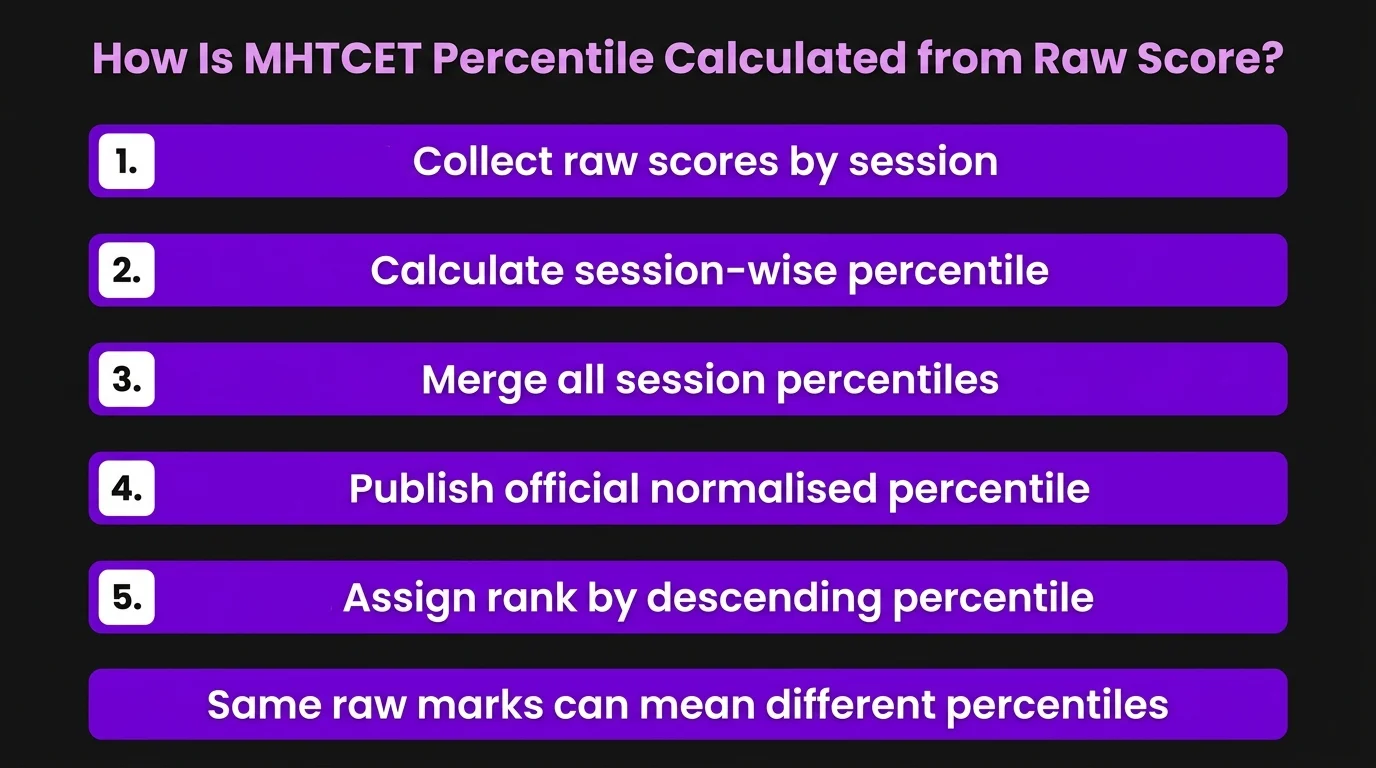
The process, step by step:
- Raw scores are collected for each session separately.
- Within each session, a percentile is computed: Percentile = (Number of candidates who scored equal to or below the candidate ÷ Total candidates in that session) × 100.
- Session-wise percentile scores are then merged into a single common merit list.
- The merged percentile score becomes the candidate’s official MHT CET Result figure.
- Ranks are assigned in descending order of percentile. Ties are broken by age (older candidate ranks higher) per the official tiebreaker rule.
This Raw Score Conversion approach means two candidates with identical raw marks in different sessions can end up with different percentiles if session difficulty varied. That is intentional — it is the fairness mechanism built into Session-wise Scoring.
The normalisation formula used by the CET Cell mirrors the approach recommended by the National Testing Agency for multi-session exams, ensuring no session cohort is disadvantaged.
What the percentile does NOT account for:
- Class 12 board marks (these are factored separately in some course-specific merit lists, particularly for Pharmacy Admissions).
- Category reservations (SC, ST, OBC, EWS) — these affect rank visibility within category merit lists, not the percentile itself.
- Domicile status — Maharashtra domicile candidates and All-India candidates appear on separate merit lists during CAP Round Allotment.
Understanding this pipeline clarifies why Marks vs Percentile discussions can be misleading without knowing the session context.
MHTCET Percentile vs Rank: Year-by-Year Trends (2023, 2024, 2025)
Tracking MHTCET percentile vs rank across years reveals how growing candidate volume shifts the rank corresponding to any given percentile. More students means the same percentile corresponds to a worse rank — a critical insight for 2026 planners.
Approximate total candidates (PCM group):
| Year | Approximate Candidates (PCM) | Source |
| 2023 | ~3.8 lakh | CollegePravesh, 2025 |
| 2024 | ~4.1 lakh | CollegePravesh, 2025 |
| 2025 | ~4.3 lakh (estimated final) | CollegePravesh, 2025 |
Percentile-to-approximate-rank mapping (PCM, General category):
| Percentile | 2023 Approx. Rank | 2024 Approx. Rank | 2025 Approx. Rank |
| 99.9 | ~380 | ~410 | ~430 |
| 99 | ~3,800 | ~4,100 | ~4,300 |
| 95 | ~19,000 | ~20,500 | ~21,500 |
| 90 | ~38,000 | ~41,000 | ~43,000 |
| 85 | ~57,000 | ~61,500 | ~64,500 |
| 80 | ~76,000 | ~82,000 | ~86,000 |
These are approximations based on total candidate counts and publicly reported cut-off trends. Actual ranks may vary by a few hundred positions depending on score clustering at specific percentile bands.
The takeaway is clear: as Engineering Admissions Maharashtra attracts more students each cycle, holding the same percentile becomes harder and yields a slightly worse rank. A student targeting a specific college should factor in this upward pressure when using any Rank Predictor tool.
If I Score 95 Percentile in MHTCET, What Will My Rank Be?
This is the most-searched variation of the MHTCET percentile vs rank question, and it deserves a direct answer with realistic ranges.
Using the formula and 2025’s estimated candidate pool of approximately 4.3 lakh for PCM:
Rank = (1 − 95/100) × 4,30,000 = 21,500 (approximate)
But rank alone does not tell the full story. Here is what a 95 percentile practically unlocks:
- Opening colleges: Mid-tier autonomous institutes in Pune, Mumbai, and Nashik; several deemed university branches.
- Likely out of reach at 95 percentile: Top-tier government colleges like COEP Technological University Pune (Computer Science typically demands 99+ percentile for General).
- Comfortably within reach: Well-regarded private engineering colleges with strong placement records in Maharashtra.
Expected rank bands at key percentile thresholds (2025 PCM, General):
| Percentile | Expected Rank Range | Typical College Tier |
| 99.5+ | Top 2,200 | Premier govt. colleges (COEP, VJTI) |
| 99 | 2,200–4,300 | Top private + second-tier govt. |
| 97 | 4,300–12,900 | Good autonomous institutes |
| 95 | 12,900–21,500 | Mid-tier autonomous colleges |
| 90 | 21,500–43,000 | State-aided private colleges |
| 85 | 43,000–64,500 | Broader private college pool |
For students also targeting private universities, understanding how rank translates to branch at other exams can calibrate expectations — see Phodu Club’s VITEEE rank vs branch guide and COMEDK rank vs colleges guide for comparison.
MHTCET 2026 Percentile vs Rank: What to Predict
Projecting the 2026 cycle requires extrapolating from established Cut-off Trends. Based on year-on-year growth of roughly 4–5% in PCM applicants, the 2026 candidate pool could approach 4.45–4.5 lakh for the PCM group.
2026 projected rank estimates (PCM, General):
| Percentile | 2026 Projected Rank |
| 99.9 | ~450 |
| 99 | ~4,500 |
| 97 | ~13,500 |
| 95 | ~22,500 |
| 90 | ~45,000 |
| 85 | ~67,500 |
These projections assume a 4.5% year-on-year candidate growth rate consistent with trends reported by the State Common Entrance Test Cell.
For 2026 aspirants, three planning actions matter most:
- Identify target colleges and look up their 2024–2025 closing percentiles from official DTE Maharashtra CAP Round data.
- Add a buffer of 1–2 percentile points to that historical closing figure, accounting for candidate volume growth.
- Validate projections using the official CET Cell rank predictor once results are published, not third-party tools with unverified databases.
Students using Phodu Club’s MHTCET mock tests benefit from score reports that benchmark their performance against a simulated candidate pool — directly replicating how Session-wise Scoring and percentile banding will work on exam day.
MHTCET Percentile vs Rank: Which One Actually Matters for Admission?
Both numbers appear in official communications, but they serve different stages of the admission pipeline.
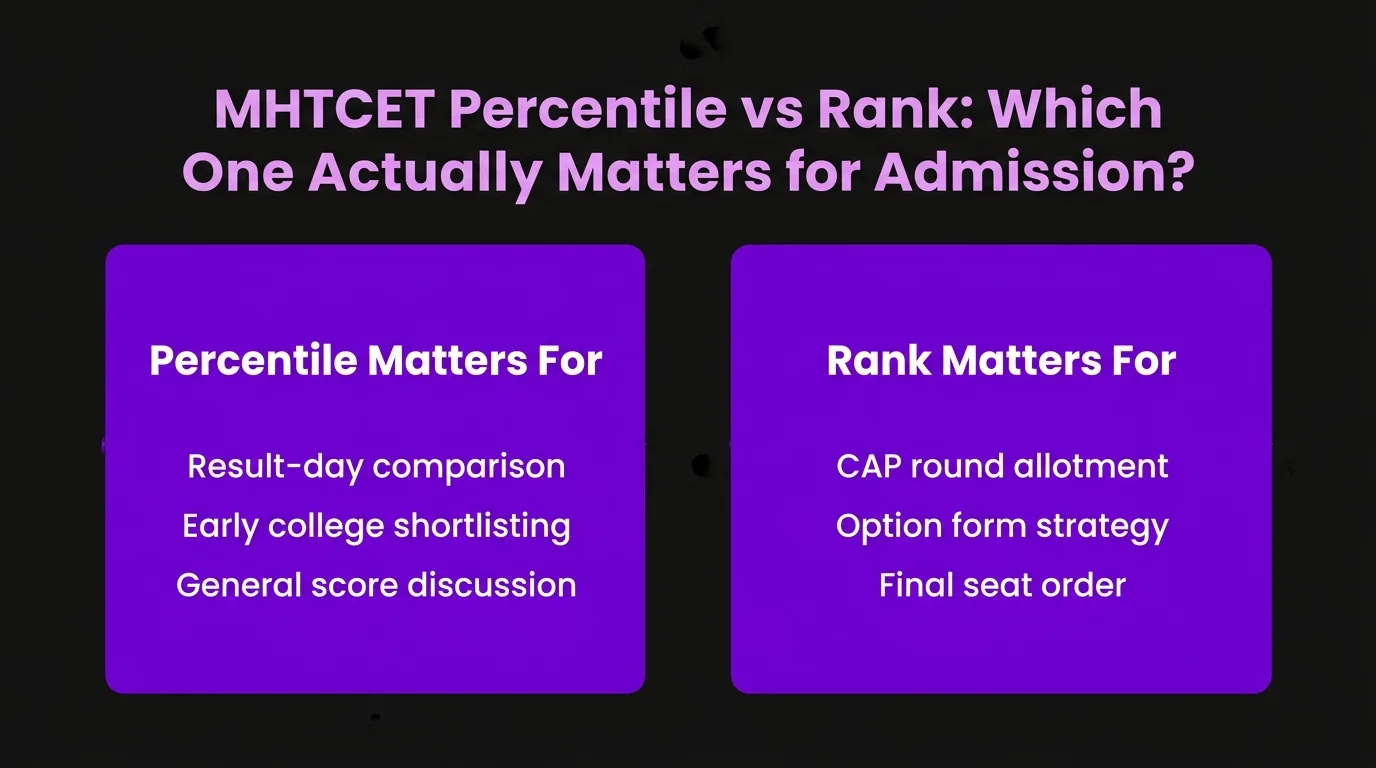
Percentile matters for:
- Initial result comparison and self-assessment after the MHT CET Result is published.
- Shortlisting colleges before counselling opens (most college cut-off data is published in percentile terms by coaching platforms and news portals).
- Communicating your score colloquially (“I scored 97 percentile”).
Rank matters for:
- CAP Round Allotment — the official online counselling portal uses rank, not percentile, to generate seat allotments.
- Filling option forms during counselling: students must understand where their rank falls within each college’s previous-year closing ranks.
- Resolving tiebreaker scenarios (same percentile, different ranks due to age-based resolution).
The Candidate Rank Determination process assigns a unique rank to every candidate after the percentile merit list is compiled. During CAP rounds conducted by DTE Maharashtra, seat matrices are filled strictly by rank. Two students with the same percentile can receive different allotments if their ranks differ by even one position and seats run out in between.
Practical rule: Use percentile to estimate your chances during preparation. Switch to rank when navigating actual CAP Round counselling. Both metrics need to be tracked.
This dual-metric approach mirrors how other competitive state exams work — as Phodu Club’s KCET marks vs rank and KCET rank predictor guides demonstrate for Karnataka admissions.
What Does 99 Percentile Mean in MHTCET and How to Get There
A 99 percentile in the Maharashtra State Common Entrance Test means that 99% of all candidates who appeared scored equal to or below the candidate’s normalised score. In a pool of 4.3 lakh students, that places the candidate among approximately the top 4,300 students — a highly competitive bracket.
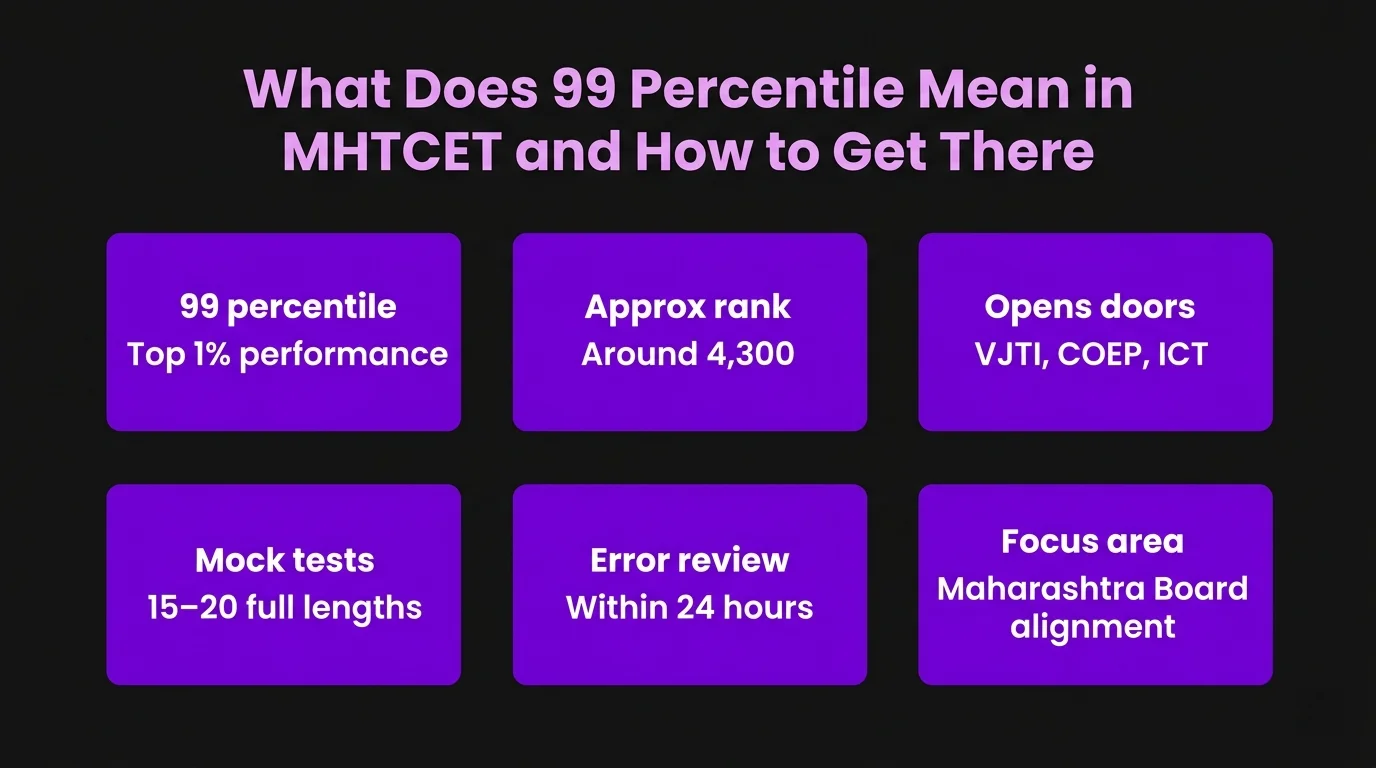
What 99 percentile typically opens:
- COEP Technological University Pune (select branches, General category — Computer Science requires 99.5+).
- Veermata Jijabai Technological Institute (VJTI) Mumbai for most engineering branches.
- Institute of Chemical Technology Mumbai for relevant disciplines.
- Top autonomous private colleges for core branches like Mechanical and Civil.
What it takes to reach 99 percentile:
Across 2023–2025, the raw score benchmarks (PCM combined, approximate) associated with 99 percentile ranged from 155–170 out of 200 for Physics and Chemistry combined, and 145–160 for Mathematics. Exact raw score thresholds shift by session difficulty, reinforcing why normalisation exists.
Key preparation habits correlated with top-percentile performance:
- Completing at least 15–20 full-length mock tests that replicate exact exam patterns (the area where Phodu Club’s test series, which mirrors the official MHT CET format precisely, provides the most targeted preparation).
- Reviewing incorrect answers within 24 hours of each mock attempt.
- Focusing on Maharashtra Board syllabus alignment, particularly for Physics topics that diverge slightly from CBSE treatment.
- Tracking session-normalised scores, not just raw marks, during mock practice.
For students benchmarking across exams, Phodu Club’s guide on what 98 percentile means in JEE Mains provides helpful cross-exam context for understanding elite percentile bands.
Conclusion
- MHTCET percentile measures relative performance; rank is the absolute merit list position used in CAP Round seat allotment.
- The Normalisation Formula across sessions ensures fair Raw Score Conversion regardless of which exam day a candidate sat.
- Candidate volume growth of roughly 4–5% per year means the same percentile yields a slightly worse rank each cycle — plan with a buffer.
- Phodu Club’s mock tests replicate the exact MHT CET exam pattern, giving students normalised score feedback that mirrors official Percentile Score Calculation methodology.
Frequently Asked Questions
1) Is MHTCET percentile the same as the percentage of marks scored?
No. Percentile reflects how many candidates scored below you, not how many questions you answered correctly. A 90 percentile means you outperformed 90% of test-takers, regardless of the actual raw marks involved.
2) Can two students with the same percentile get different ranks?
Yes. When two candidates share an identical percentile, the tiebreaker is age — the older candidate receives the better rank. This is the official Candidate Rank Determination rule applied by the State Common Entrance Test Cell.
3) How many marks are needed for 95 percentile in MHTCET 2025?
Raw score thresholds shift by session difficulty. Historically, approximately 140–155 marks out of 200 in PCM has corresponded to the 95 percentile band, but the official figure depends on the Normalisation Formula applied to each specific session cohort.
4) Does MHTCET percentile include PCB students or only PCM?
Merit lists are separate. PCM percentile ranks PCM candidates against other PCM candidates; PCB candidates are ranked on their own list. This matters for Engineering Admissions Maharashtra versus Pharmacy Admissions cutoff interpretation.
5) When does DTE Maharashtra publish the official rank after MHT CET Result?
Ranks are typically published alongside or shortly after the merit list, before CAP Round counselling begins. Candidates should monitor the official CET Cell portal at cetcell.mahacet.org for exact release timelines.
6) How reliable are third-party MHTCET Rank Predictor tools?
They provide useful estimates but carry a margin of error of several hundred ranks due to incomplete candidate data. For critical decisions, always cross-verify with official DTE Maharashtra cut-off data from the most recent CAP Round Allotment records.