We see this pattern every year. Students decide to aim for top IIMs straight after class 12, but they immediately get overwhelmed. They memorize the syllabus, take endless mocks, and still see their scores stagnate. If you are stuck in this loop, you aren’t alone. The biggest mistake we see at Phodu Club is starting prep without actually understanding the IPMAT meaning and what the exam really tests. It is not just a math and English test; it is an aptitude filter designed to find future managers. Let’s break down exactly what you need to know for 2026.
What is IPMAT: TL;DR
The IPMAT meaning refers to the Integrated Program in Management Aptitude Test. It is the official entrance exam conducted by IIM Indore and IIM Rohtak for direct admission into their 5-year integrated management programs right after Class 12.
Beyond the IPMAT Full Form: What is the Real Exam All About?
When parents and students ask us about the IPMAT meaning, we always clarify that knowing the full form is just scratching the surface. Unlike your standard Class 12 board exams, which test your memory and adherence to formulas, this entrance test evaluates your core logical thinking, reading comprehension, and numerical agility under extreme time pressure.
At Phodu Club, we worked with a student last year who scored 96% in her CBSE board exams but couldn’t clear the sectional cutoff for Quantitative Ability in her first few mocks. Why? Because she was treating the questions like board exam problems—writing down every step and trying to prove her answer.
What you need to understand:
- It is about elimination, not just selection: You do not need to solve every question. You need to know which questions to skip.
- Aptitude vs. Academics: The exam tests how quickly you can process information and apply basic concepts to complex, twisted scenarios.
- Multiple Formats: IIM Indore includes short-answer questions (where you type the answer) alongside standard Multiple Choice Questions (MCQs), eliminating the chance to guess.
Actionable Takeaway: Stop studying for this exam like a school test. Shift your focus from “How do I solve this?” to “How do I solve this in under 60 seconds?”
IPMAT Exam Pattern and Structure (2026 Updates)
To build a solid prep strategy, you must intimately know the battleground. Based on the official updates from the conducting bodies (IIM Indore and IIM Rohtak), the structure differs significantly depending on the institute you are targeting.
IIM Indore Pattern
IIM Indore is considered the gold standard and generally features a tougher Quantitative section, including higher mathematics (like Matrices, Determinants, and advanced Probability).
| Section | Format | Number of Questions | Time Limit |
| Quantitative Ability (SA) | Short Answer | 15 | 40 Minutes |
| Quantitative Ability (MCQ) | Multiple Choice | 30 | 40 Minutes |
| Verbal Ability (MCQ) | Multiple Choice | 45 | 40 Minutes |
| Total | 90 Questions | 120 Minutes |
Official Source Note: Based on the IIM Indore official admissions brochure and historical exam patterns.
IIM Rohtak Pattern
IIM Rohtak introduces Logical Reasoning into the mix and keeps the level of mathematics strictly up to Class 10 (Arithmetic and basic Algebra).
| Section | Number of Questions | Time Limit |
| Quantitative Ability | 40 | 40 Minutes |
| Logical Reasoning | 40 | 40 Minutes |
| Verbal Ability | 40 | 40 Minutes |
| Total | 120 Questions | 120 Minutes |
Official Source Note: Based on IIM Rohtak 2025 admission criteria and expected 2026 guidelines.
What we see in our students: We regularly see students who are excellent at English run out of time in the Verbal section of IIM Indore because they spend 15 minutes on a single reading comprehension passage.
Actionable Takeaway: Sectional timing is your real competitor. You must practice switching gears mentally every 40 minutes.
What Students Get Wrong About IPMAT Preparation
Failing to grasp the core IPMAT meaning leads students to use the wrong prep materials and strategies. At Phodu Club, we step in when students have spent six months solving CAT-level books and are completely burnt out, or conversely, when they have only solved basic bank clerical exam books and are underprepared.
The Myth of “Completing the Syllabus”
Many aspirants ask us for the “official syllabus.” Here is the honest truth: there is no rigidly defined official syllabus. The exam tests aptitude.
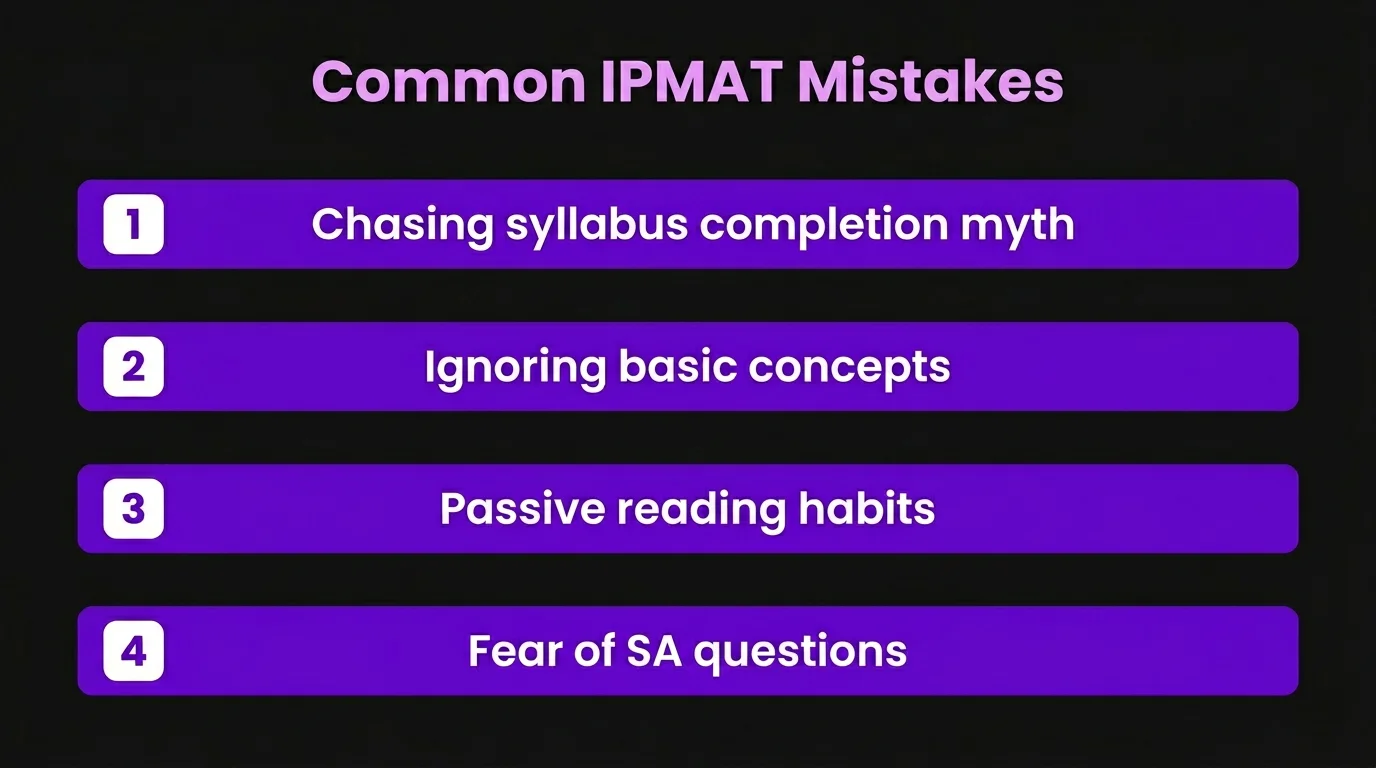
- Mistake 1: Ignoring the Basics for Tricks. We often see students searching for “Vedic math hacks” on YouTube while fundamentally failing to understand ratios or percentages. Tricks fail under exam pressure; solid concepts do not.
- Mistake 2: Reading Without Comprehending. Students read newspapers daily because someone told them to, but they don’t analyze the tone, the author’s argument, or the vocabulary. Passive reading is useless for Verbal Ability.
- Mistake 3: Fear of the Short Answer (SA) Section. Because there are no options to rely on, students panic.
Real Student Example: We mentored an aspirant who completely abandoned the SA section in mocks to focus on MCQs. We had to intervene and show him that SA questions often have a lower difficulty level precisely because there are no options, and there is no negative marking for them!
Actionable Takeaway: Build your foundation using trusted, specific materials. Focus on accuracy first; speed will naturally follow once your concepts are ironed out.
A IPMAT Step-by-Step Strategy That Actually Works
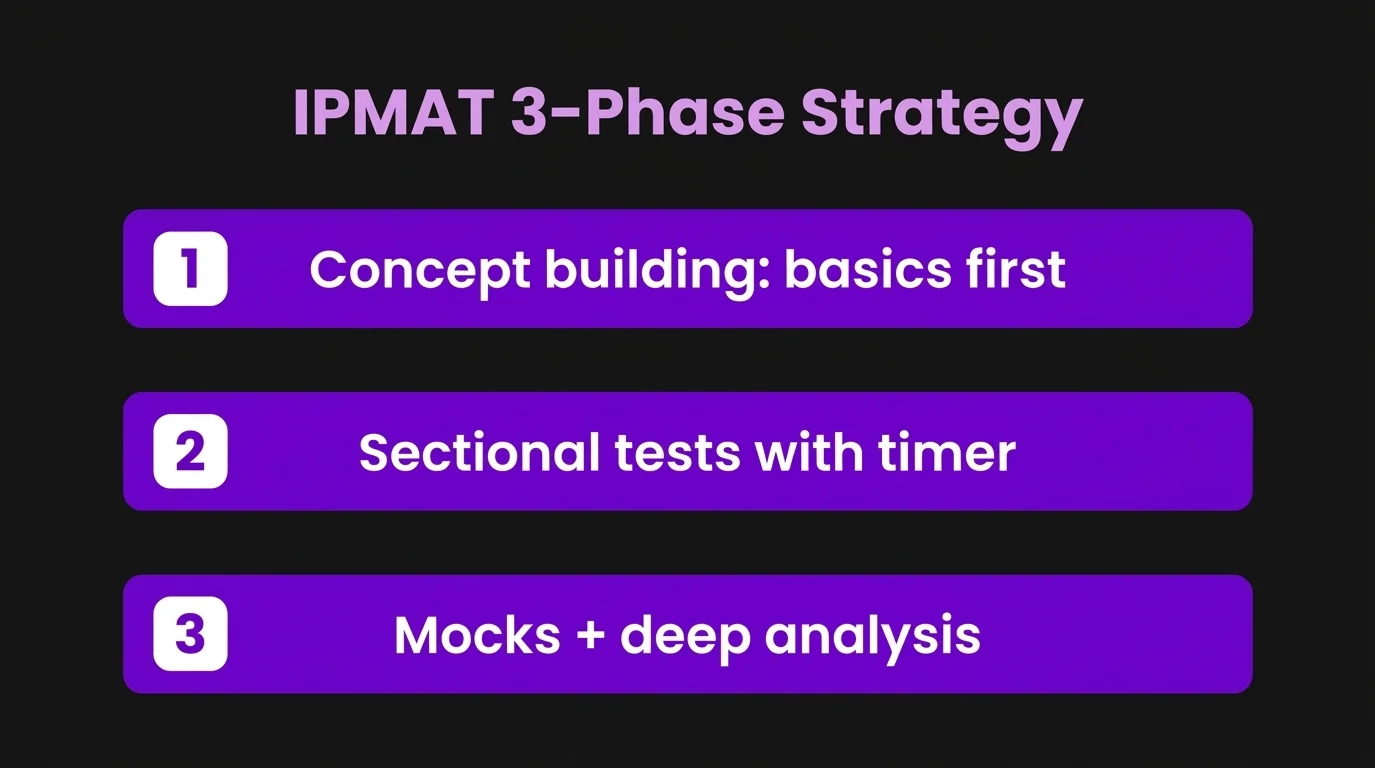
This structured approach is how you translate the basic IPMAT meaning into actual IIM admissions. We break into three distinct phases. If you are aiming for 2026, follow this timeline.
Phase 1: Concept Building (Months 1 to 3)
Do not touch full-length mocks yet. Your goal now is to understand the language of aptitude.
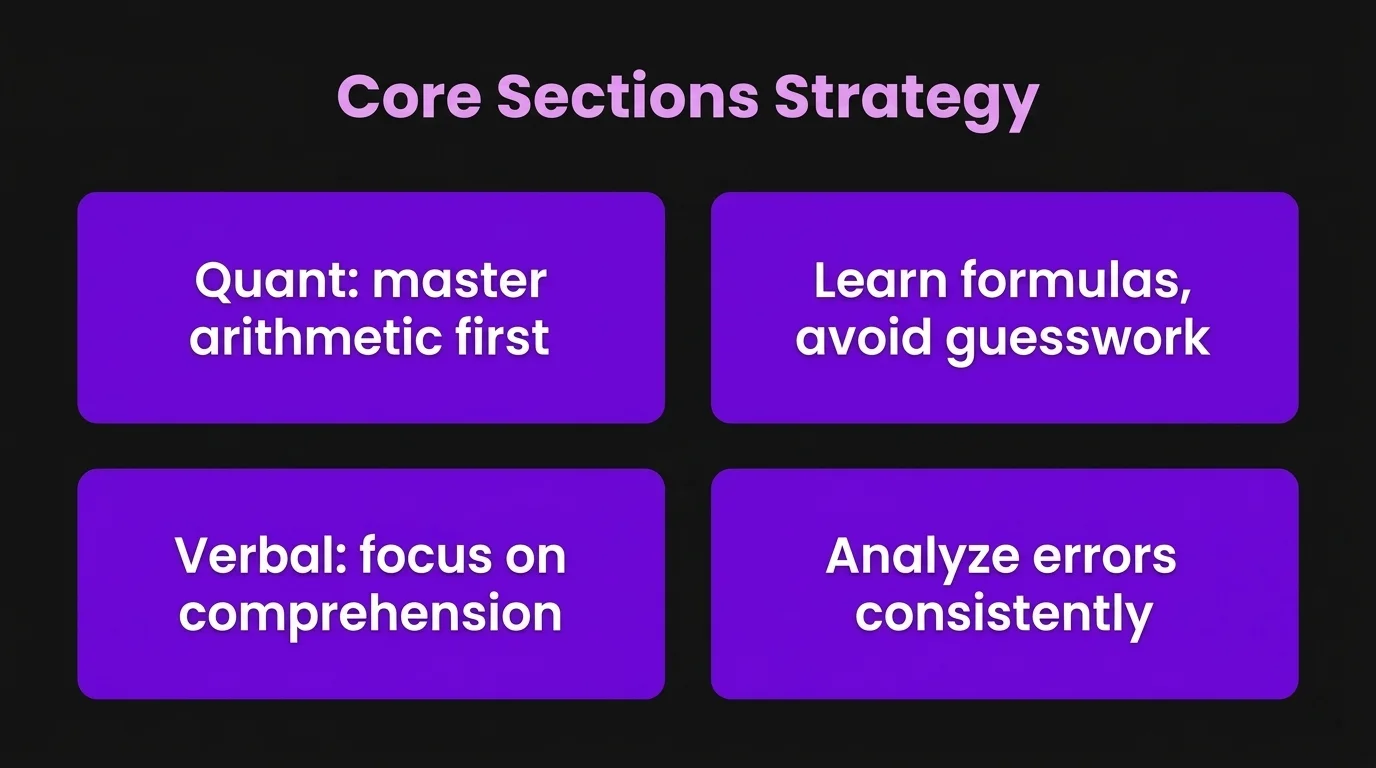
- Quant: Start with Arithmetic. Percentages, Profit & Loss, Simple/Compound Interest, Time Speed Distance, and Time & Work make up the bulk of the paper. Master these before touching Algebra or Higher Maths.
- Verbal: Start reading editorials actively. Summarize what you read in three bullet points. Work on foundational grammar rules (Subject-Verb agreement, Modifiers, Parallelism).
- LR (For Rohtak): Familiarize yourself with standard puzzles like Seating Arrangements, Blood Relations, and Syllogisms.
Phase 2: Sectional Mastery (Months 4 to 5)
Now, introduce the timer.
- Start taking 40-minute sectional tests.
- Your goal is to understand your natural speed and identify your weaknesses.
Phase 3: Full-Length Mocks & Extreme Analysis (Months 6 to Exam Day)
This is where the magic happens. Giving a mock takes 2 hours. Analyzing it should take 3 hours.
- Review every single question.
- Did you skip a question you could have solved?
- Did you spend 4 minutes on a question you should have skipped?
Actionable Takeaway: Divide your study sessions clearly into “learning time” and “testing time.” Never look at the answer key while solving practice questions—struggle with the problem first.
Tackling the Core Sections: A Deep Dive
The true IPMAT meaning revolves around testing your logic, not just your memory. Let’s break down how to conquer the specific sections.
Quantitative Ability (QA)
The QA section can be intimidating, especially the IIM Indore paper. We advise our students to categorize QA into three buckets:
- Must-Solve (Arithmetic & Basic Algebra): You cannot afford to be weak here. These questions are usually straightforward applications of formulas and logic.
- Score-Boosters (Number System & Geometry): These require specific conceptual knowledge. If you know the theorem, it takes 10 seconds. If you don’t, you can stare at it for an hour and get nowhere.
- The Traps (Higher Maths like P&C, Probability, Matrices): While important for Indore, these questions are often designed to eat your time.
Our Strategy: Use the A-B-C method.
- Attempt immediately if it takes less than 1 minute.
- Bookmark if you know how to do it but it will take 2-3 minutes.
- Completely skip if you have no idea what the question is asking.
Verbal Ability (VA)
VA is not just about having a fancy vocabulary. It tests how well you understand English in context.
- Reading Comprehension (RC): Don’t read the passage first. Read the questions first to know what you are looking for.
- Para-jumbles: Look for mandatory pairs. Find transition words like “However,” “Therefore,” or pronoun references like “He,” “This concept,” which link two sentences together.
Actionable Takeaway: Create an “Error Log” notebook. Every time you get a question wrong in practice, write down why you got it wrong. Was it a calculation error? A conceptual gap? Or a misread question?
Navigating the Personal Interview (PI) Stage
Many students think the written test is the end of the road. It isn’t. Once you clear the cutoff, you face the Personal Interview. For IIM Indore, the written test weightage is 65%, and the PI carries a massive 35% weightage.
At Phodu Club, we’ve seen brilliant test-takers freeze during the PI because they lack self-awareness. The panelists are not looking for someone who knows everything; they are looking for someone who is teachable, aware of their surroundings, and has genuine reasons for pursuing management.
What to prepare for the PI:
- Academics: You will be grilled on your favorite Class 11/12 subjects. If you are a commerce student, know your economics and accountancy inside out. If you are a science student, be prepared to explain physics concepts in simple terms.
- Current Affairs: Read the news daily. Have opinions on major geopolitical and economic events.
- HR Questions: “Why IPM?”, “Why not engineering?”, “Where do you see yourself in 5 years?” Don’t give robotic, rehearsed answers.
Actionable Takeaway: Start preparing for the interview alongside your written prep. Spend 15 minutes a day reading business news and summarizing your thoughts aloud.
How to Stay Consistent and Track Progress
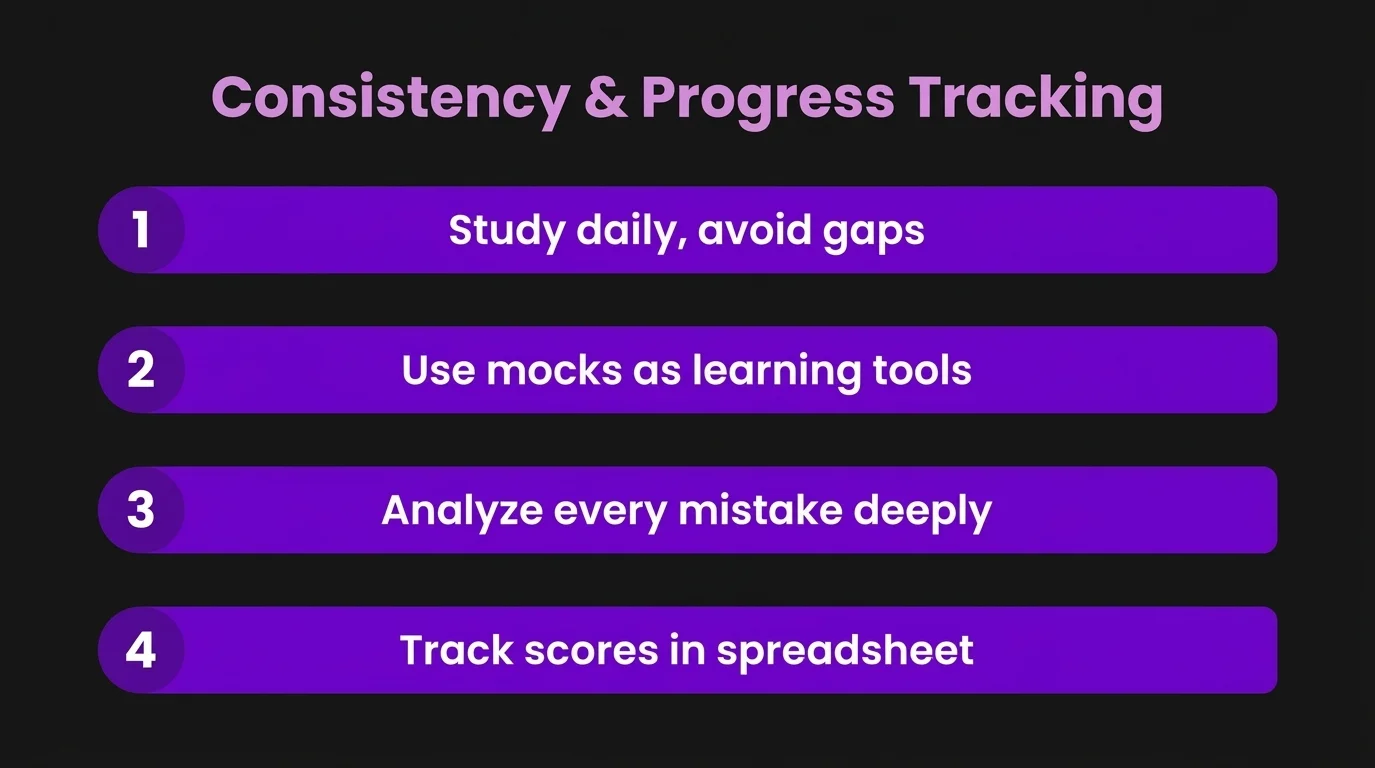
Once you internalize the IPMAT meaning, you will realize that consistency beats cramming every single time. You cannot study for 10 hours one day and then touch nothing for three days. Your brain needs daily exposure to aptitude concepts.
The Role of Mocks
Mocks are not evaluation tools; they are learning tools. If your score is stagnant around 120 marks, it means you have hit your conceptual ceiling and are likely making the same strategic mistakes repeatedly.
This is why we emphasize structured testing. To get realistic practice, you need a platform that mimics the actual exam environment, complete with the correct interface and difficulty level. We highly recommend utilizing proper mock ecosystems. You can start practicing with our structured IPMAT Test Series which is specifically designed by mentors to help you break through score plateaus.
Overcoming the “Low Score” Depression
We get messages from students breaking down after a bad mock. Here is what we tell them: A mock test is just an X-ray. It shows you where the bone is broken so you can fix it before the real race. Celebrate your mistakes in mocks, because every mistake made now is a mistake avoided on D-Day.
Actionable Takeaway: Track progress with a spreadsheet. Log your mock scores, the number of attempts, accuracy percentage, and the specific topics where you lost marks. Data doesn’t lie.
Conclusion
Preparing for this exam can feel like walking through a maze blindfolded. But once you understand what the exam demands—speed, accuracy, emotional control, and a solid conceptual base—the path becomes clear.
Ultimately, the IPMAT meaning is about opportunity—the chance to secure an IIM tag at 18, bypassing the brutal CAT rat race later in life. It is worth the grind. At Phodu Club, we’ve worked with enough students to know this: effort alone doesn’t fix your score. The right strategy does. Stop relying on random YouTube videos and generic advice. Build a schedule, take structured mocks, analyze your weak areas, and ruthlessly improve them. You have got this, and we are here to guide you every step of the way.
Frequently Asked Questions (FAQ)
1) What is the exact IPMAT meaning? Who is eligible for the exam?
It stands for Integrated Program in Management Aptitude Test. It is the entrance exam for the 5-year IPM program at IIMs. Generally, you must have passed Class 12 (or equivalent) in the year of the exam or the previous year, with a minimum of 60% aggregate (55% for SC/ST/PwD). You must also meet the age criteria (usually a maximum of 20 years of age).
2) Can an average student crack the exam with 6 months of preparation?
Yes, absolutely. We see this all the time. Aptitude is a trainable skill. An “average” student who is consistent, analyzes their mocks, and strictly follows a timeline can easily outperform a “smart” student who only relies on natural intelligence and doesn’t practice time management.
3) How much time should I dedicate daily for preparation alongside Class 12 boards?
If you are starting 8-10 months before the exam, 2 hours a day is sufficient. Dedicate 1 hour to learning new concepts (Quant/LR) and 1 hour to Verbal (reading and practice). During weekends, stretch this to 4-5 hours to include sectional tests or full mocks.
4) How does the syllabus compare with JEE or NEET exams?
They are completely different ball games. JEE/NEET are highly academic, testing deep scientific knowledge. This exam tests logical aptitude and English comprehension. Even if you are a math genius in JEE, you might struggle here if your reading speed is slow or if you cannot solve arithmetic problems quickly without calculators.
5) Do my Class 10 and Class 12 board marks matter for final selection?
Yes. While the written test is the primary filter, IIMs consider your previous academic profile during the final selection process. The exact weightage changes slightly year by year, but maintaining a good academic record (above 80-85%) significantly helps your chances during the Personal Interview round.
6) How does Phodu Club help students who are stuck at stagnant mock scores?
At Phodu Club, we focus on the strategy of test-taking, not just theory. If your score is stuck, it’s usually an attempt-strategy issue or an accuracy issue. We help you identify your weak zones through deep analysis, teach you the art of skipping questions, and provide realistic mocks to practice better time management.
7) Is there negative marking in the exam?
Yes, for all Multiple Choice Questions (MCQs), every correct answer awards you +4 marks. Every incorrect answer carries a penalty of -1 mark. However, for the Short Answer (SA) section in IIM Indore, there is no negative marking, which is why we highly encourage students to attempt all SA questions.
8) What is considered a “safe score” to get an interview call from IIM Indore?
Cutoffs vary based on the paper’s difficulty each year. Historically, clearing the sectional cutoffs is the hardest part. As a rough benchmark based on recent trends, a total score of 175-190 out of 360 is generally considered a strong zone for the General category to secure an interview call, provided all sectional cutoffs are met.