We get this question all the time: “I am scoring 110 in my mocks, which college can I get?” The truth is, many students study blindly without knowing the actual cutoffs or placement realities. When it comes to securing a seat in the top MHTCET colleges, effort alone is rarely enough. You need extreme clarity. We have seen students with average preparation grab excellent seats simply because they understood the counseling process, and we have seen 98-percentilers lose out because they didn’t. Let’s fix that clarity issue right now and build your strategy for 2026.
MHTCET Colleges: Quick Answer
The best MHTCET colleges include VJTI Mumbai, COEP Pune, SPIT Mumbai, and PICT Pune. Securing a Computer Science seat here typically requires a 99+ percentile. However, excellent Tier-2 options are available in the 90–95 percentile range if your choice-filling strategy is accurate.
Why Choosing the Right MHTCET Colleges Matters (And What Students Get Wrong)
At Phodu Club, we review hundreds of mock test scores and counseling preference lists every year. One of the most glaring mistakes we see is students chasing a specific branch (like Computer Science) in a low-tier college, rather than taking an allied branch (like Electronics or IT) in a top-tier institute.
Why does this matter? Because the college you choose dictates your ecosystem. If you choose an institute in a major IT hub like Pune or Mumbai, you get better internship opportunities, access to thriving alumni networks, and stronger campus placements. Companies do not visit random colleges just because you have a CS degree. They visit campuses that have a history of producing quality engineers.
The Real Student Scenario
We worked with a student last year—let’s call him Aditya. Aditya scored 96% in MHTCET. He was dead set on Computer Science. He rejected a solid Electronics and Telecommunication (ENTC) seat at an elite Pune college and opted for CS at a newly established, unknown college. Four years later, the elite college’s ENTC batch averaged packages of 9 LPA, while Aditya’s college struggled to bring in mass recruiters at 3.5 LPA.
Actionable Takeaway: Never compromise entirely on the college brand just for a specific tag on your degree. A core branch in an elite institute often yields better ROI than CS in a bottom-tier college.
The Elite Tier: Top Institutes You Should Target in 2026
At Phodu Club, we always tell our students that aiming for elite MHTCET colleges requires a targeted attempt strategy, not just random guessing. These are the institutes that rival the lower NITs in terms of placements, infrastructure, and alumni networks.
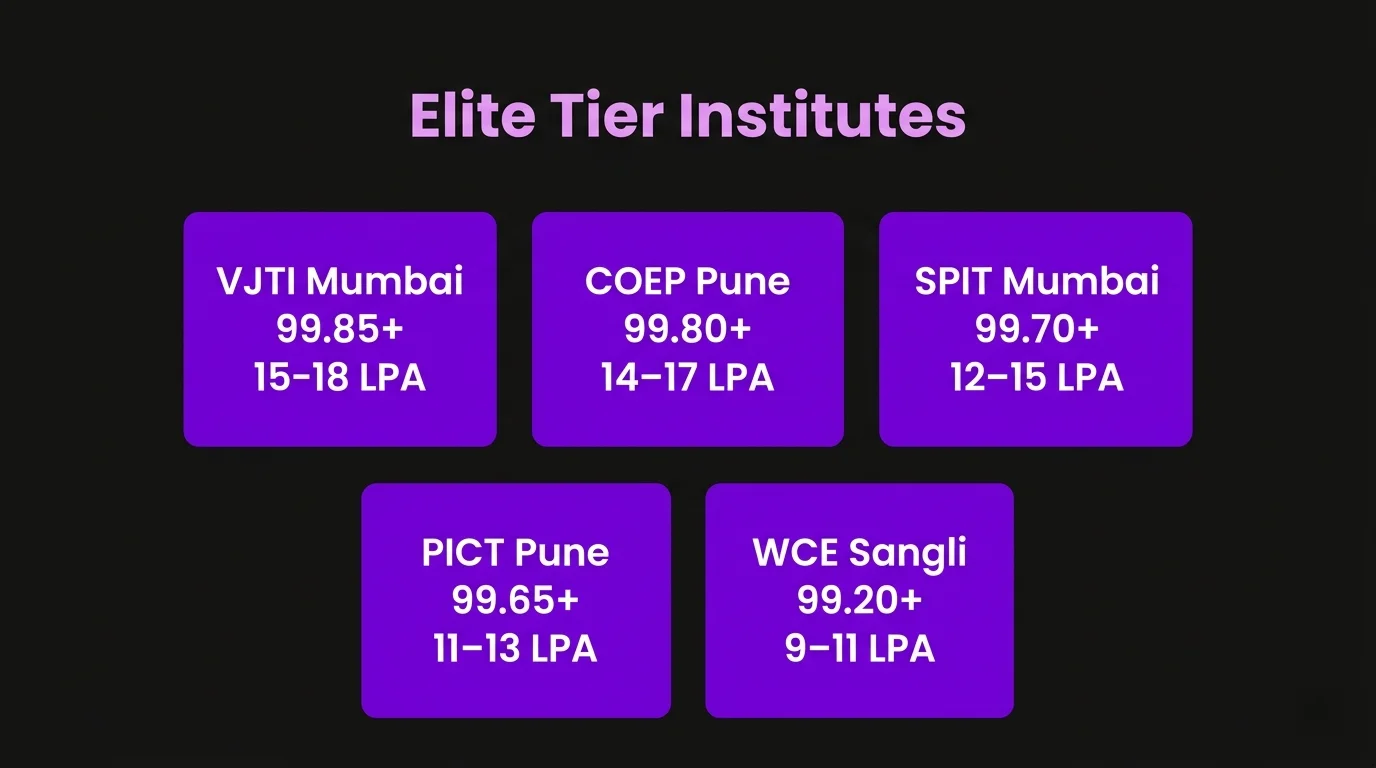
Here is the complete breakdown of the top 5 institutes you should be aiming for in 2026.
1) VJTI Mumbai (Veermata Jijabai Technological Institute)
VJTI is arguably the crown jewel of the MHTCET exam. Located in Matunga, Mumbai, it has a massive legacy and one of the most powerful alumni networks in India. The coding culture here is top-notch, and top product-based companies like Microsoft, Amazon, and Morgan Stanley are regular recruiters.
- Expected CS Cutoff (General): 99.85+ Percentile
- Average Package (IT/CS): 15 – 18 LPA
- Why students fail to get in: They underestimate the intense competition for Mumbai colleges. You need extreme accuracy in MHTCET mathematics to cross the 99.8 percentile mark.
- For a deeper dive, check out our guide to MHTCET Cutoff for VJTI.
2) COEP Technological University (Pune)
Formerly known as the College of Engineering Pune, COEP is the undisputed king of Pune. It is an autonomous university with rigorous academic standards. The highlight of COEP is its clubs—from satellite building to off-road racing, the practical exposure is unmatched.
- Expected CS Cutoff (General): 99.80+ Percentile
- Average Package (IT/CS): 14 – 17 LPA
- Phodu Club Insight: If you want core branches like Mechanical or Civil, COEP is often considered better than VJTI due to its heavy industry tie-ups in the Pune manufacturing belt.
3) SPIT Mumbai (Sardar Patel Institute of Technology)
Located in Andheri, SPIT shares a campus with SPCE. SPIT has rapidly climbed the ranks over the last decade and is now a preferred choice over many NITs. The curriculum is highly updated because of its autonomous status.
- Expected CS Cutoff (General): 99.70+ Percentile
- Average Package: 12 – 15 LPA
4) PICT Pune (Pune Institute of Computer Technology)
If you eat, sleep, and breathe coding, PICT is the place to be. It is notorious for its strict academics and smaller campus, but it makes up for it with phenomenal placement records.
- Expected CS Cutoff (General): 99.65+ Percentile
- Average Package: 11 – 13 LPA
- Phodu Club Insight: We often advise students who are confused between Tier-1 NIT core branches and PICT CS to strongly consider PICT if their end goal is purely software engineering.
5) Walchand College of Engineering, Sangli (WCE)
Do not let the location fool you. Walchand is one of the oldest and most respected engineering colleges in Maharashtra. Its placement statistics consistently beat many Pune and Mumbai colleges.
- Expected CS Cutoff (General): 99.20+ Percentile
- Average Package: 9 – 11 LPA
Elite Tier At A Glance (2026 Estimates)
| College Name | Location | Autonomous? | CS Cutoff (Approx) | Est. Fees (Per Year) |
| VJTI | Mumbai | Yes | 99.85+ | ₹85,000 |
| COEP | Pune | Yes | 99.80+ | ₹90,000 |
| SPIT | Mumbai | Yes | 99.70+ | ₹1,70,000 |
| PICT | Pune | No | 99.65+ | ₹1,00,000 |
| WCE | Sangli | Yes | 99.20+ | ₹85,000 |
Tier 2 MHTCET colleges with High ROI
If your mock scores are hovering between 90 and 96 percentile, do not panic. Maharashtra has an incredibly robust Tier-2 engineering ecosystem. These Tier 2 MHTCET colleges offer fantastic returns on investment, especially if you proactively build your skills off-campus.
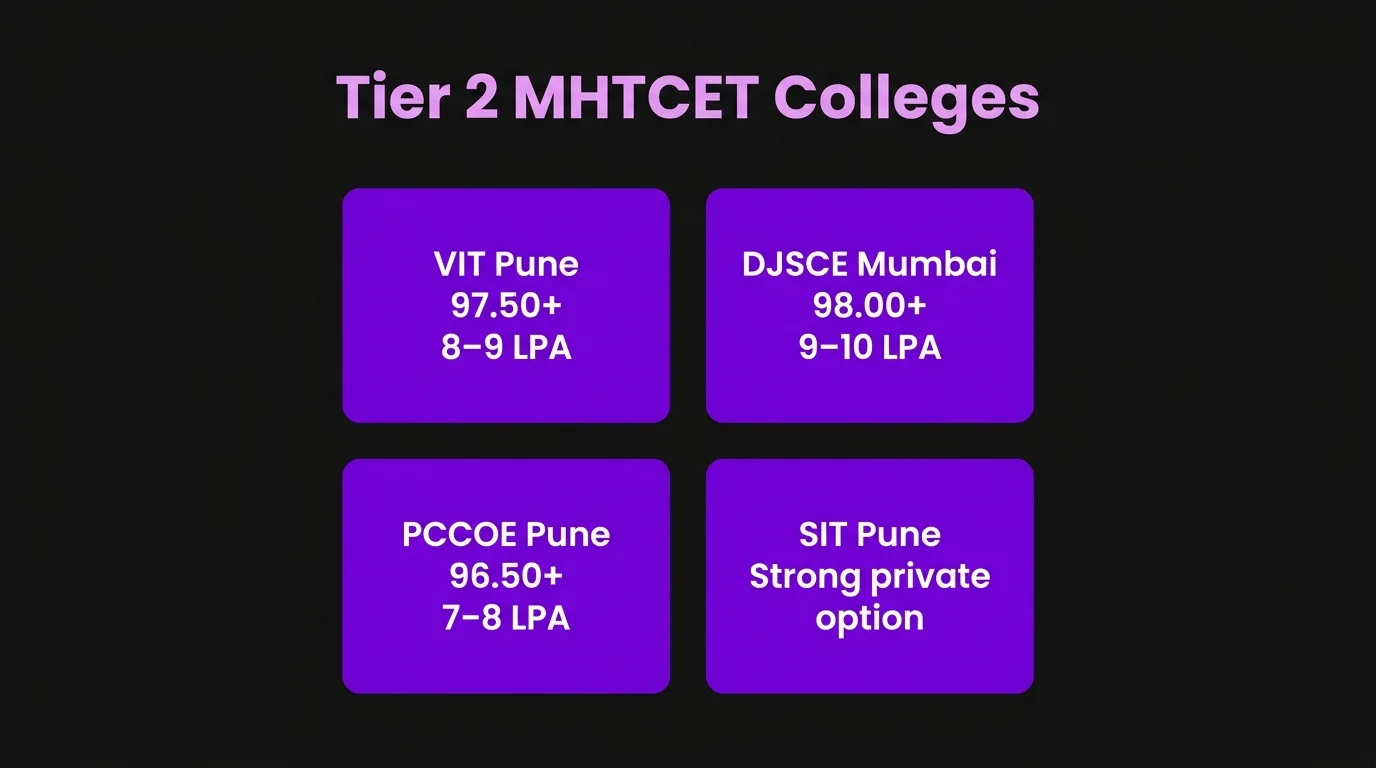
1) VIT Pune (Vishwakarma Institute of Technology)
VIT Pune offers a great balance of academics and college life. Being autonomous, their syllabus is frequently updated to match industry requirements, including AI and Data Science electives.
- Expected CS/IT Cutoff: 97.50+ Percentile
- Average Package: 8 – 9 LPA
2) D.J. Sanghvi College of Engineering (DJSCE, Mumbai)
Located in Vile Parle, DJSCE is a premium private college. The fees are on the higher side, but the crowd, the location advantage, and the placements justify the cost.
- Expected CS/IT Cutoff: 98.00+ Percentile
- Average Package: 9 – 10 LPA
3) PCCOE Pune (Pimpri Chinchwad College of Engineering)
PCCOE has built a reputation for strict discipline and massive placement drives. If you are willing to work hard and follow the rules, PCCOE guarantees a great launchpad into the IT sector.
- Expected CS/IT Cutoff: 96.50+ Percentile
- Average Package: 7 – 8 LPA
4) SIT Pune (Symbiosis Institute of Technology)
While famous for its management programs, Symbiosis has built a strong engineering foundation. It has a beautiful campus and excellent corporate connections.
- To understand their exact admission metrics, read our breakdown on the Symbiosis Pune MHTCET Cutoff.
Actionable Takeaway: If you are scoring in the 90-95 percentile range in our MHTCET Test Series, these are the colleges you should be researching extensively. Look into their ENTC, AI/ML, and Data Science branches as well, not just pure CS.
The Data Game: Marks vs Percentile for 2026 Admissions
We see students hyper-fixating on “marks.” We get messages saying, “I scored 130, is that enough?” The reality is that MHTCET is conducted across multiple shifts over two weeks. Some papers are brutal; some are easy. Therefore, your marks do not matter as much as your percentile.
Here is a realistic projection for 2026 based on the trends we analyze at Phodu Club:
| MHTCET Marks (Out of 200) | Expected Percentile (Hard Shift) | Expected Percentile (Easy Shift) | Target Tier |
| 160+ | 99.8+ | 99.5+ | Elite Tier (VJTI, COEP) |
| 145 – 159 | 99.0 – 99.7 | 98.5 – 99.2 | Elite Tier Lower Branches / Top Tier 2 CS |
| 130 – 144 | 97.5 – 98.9 | 96.0 – 98.0 | Tier 2 CS/IT |
| 110 – 129 | 94.0 – 97.4 | 92.0 – 95.9 | Tier 2 ENTC / Tier 3 CS |
| 90 – 109 | 88.0 – 93.9 | 85.0 – 91.9 | Tier 3 Colleges |
| Below 90 | Below 88.0 | Below 85.0 | Management Quota / Lower Tier |
Note: Since there is no negative marking, normalization plays a massive role. You must maximize your attempts intelligently. Read our guide to understand exactly how MHTCET Marks vs Rank works. Also, ensure you are fully aware of the exam pattern—if you are still wondering, is there negative marking in MHTCET?, the answer is no, which means attempt strategy is everything.
Government vs Private Institutes: The Autonomous Advantage
When building your preference list for MHTCET colleges, you will encounter both government (or government-aided) and private options.
The Government Advantage
The government heavily subsidizes colleges like VJTI, COEP, and WCE. Your four-year engineering degree will cost less than ₹4 Lakhs total. Furthermore, the “Government” tag carries weight when applying for higher studies abroad or appearing for PSU interviews.
The Private Autonomous Advantage
Many top private colleges (like SPIT, VIT Pune, DJSCE) are now “Autonomous.” What does this mean for you? Normally, colleges affiliated with Mumbai University or SPPU (Pune University) have to follow an outdated syllabus dictated by the university. Autonomous colleges have the power to design their own curriculum, conduct their own exams, and grade their own papers.
Phodu Club Insight: We highly recommend our students prioritize Autonomous colleges. They teach modern tech stacks (like React, Node.js, Cloud Computing) rather than outdated 1990s microprocessors, making you far more employable.
The Counseling Trap: How to Navigate CAP Rounds
One of the most common mistakes we see students making while applying for MHTCET colleges is messing up their CAP (Centralized Admission Process) round option forms. You can have a 99 percentile, but if you fill out your preference list poorly, you will end up in a mediocre college.
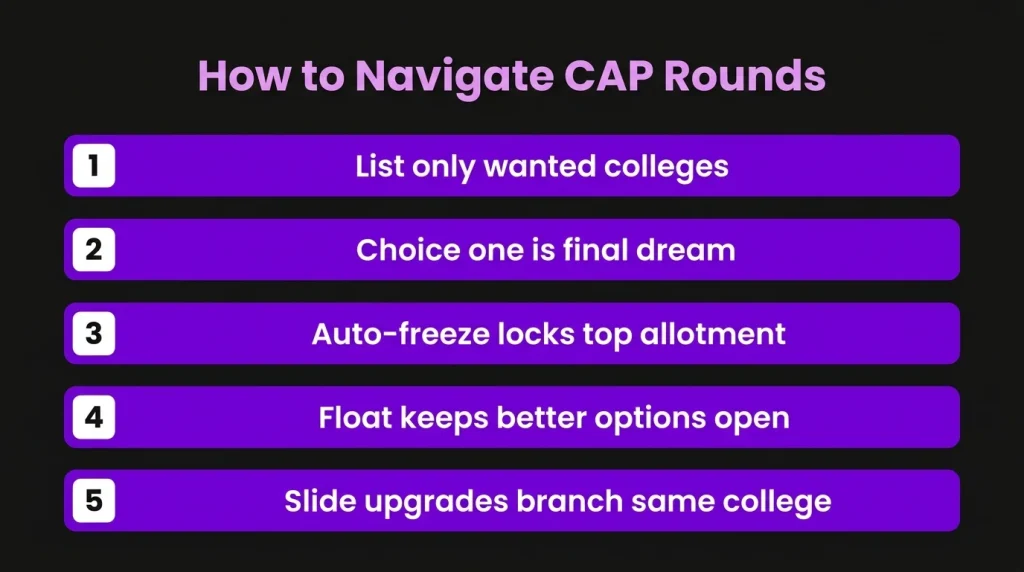
Here is the Phodu Club simplified guide to CAP Rounds:
- The Preference List: You list colleges and branches in the order you want them. Rule #1: Never put a college you DO NOT want on this list. If it gets allotted, you will be stuck dealing with it.
- Auto-Freeze: If you get your #1 choice in Round 1, it is “Auto-Freezed.” You MUST take admission. You are out of further rounds. Therefore, Choice #1 must be your absolute dream college (e.g., VJTI CS), even if you think you won’t get it.
- Float: If you get choice #5, but you want to see if you can get choice #2, #3, or #4 In the next round, you select “Float” and pay the seat acceptance fee. You keep the #5 seats safe while trying for better ones.
- Slide: If you get Mechanical at COEP (Choice #8), but you want to try for Electrical at COEP (Choice #6), you choose “Slide.” You upgrade the branch within the same college.
The TFWS Game-Changer
TFWS (Tuition Fee Waiver Scheme) gives a 100% waiver on tuition fees. It is available for students with a family income below ₹8 Lakhs. Every college has 5% extra seats for TFWS. The cutoffs are extremely high, but if you qualify, always put the TFWS code of the college above the regular code in your preference list.
How to Structure Your Preparation Right Now
If your mock scores are stagnant, doing more of the same won’t help. We built the Phodu Club because we saw aspirants solving thousands of MCQs but failing to improve their speed—which is the only thing that matters in CET.

Here is a 3-step blueprint to boost your score:
Step 1: Master the High-Weightage Chapters First
CET is highly repetitive. 60% of the paper comes from 40% of the syllabus. In Physics, optics and thermodynamics are goldmines. In Math, integration, vectors, and 3D geometry dictate your rank.
- Stop reading blindly. Check our definitive list of MHTCET Important Chapters and tackle them first.
Step 2: Fix Your Time Allocation
MHTCET gives you 90 minutes for Physics/Chemistry (100 questions) and 90 minutes for Math (50 questions).
- What students get wrong: They spend 60 minutes on Physics and panic during Chemistry.
- The Phodu Club Method: Chemistry is your savior. You must finish Chemistry in 30 minutes flat. It is mostly factual and direct formula application. This gives you a full 60 minutes for Physics calculations.
Step 3: Analyze Mocks Like a Pro
Taking a mock test is only 30% of the work. Analyzing it is the other 70%. When you take a test on the Phodu Club MHTCET Test Series, don’t just look at your final score. Look at your “Unattempted” and “Incorrect” questions. Did you skip it because you didn’t know the concept, or did you run out of time? If it’s a time issue, your strategy is broken. If it’s a concept issue, your fundamentals are weak.
If you are struggling to bridge the gap between your current score and your dream college, our MHTCET Crash Course is specifically designed to eliminate these weak points quickly and efficiently, focusing purely on CET-level speed and accuracy.
Conclusion
Getting into your dream list of MHTCET colleges is not about studying 14 hours a day with your head buried in a textbook. It is about studying the right concepts, building relentless speed, and having extreme clarity about your target scores and counseling strategy.
We have worked with enough students to know this—effort alone doesn’t fix your score. The right direction does. That is exactly what we focus on at Phodu Club. Analyze your mocks, fix your time management, research your colleges thoroughly, and don’t let a bad choice-filling form ruin a good score. Keep pushing, stay consistent, and we will see you on the other side of a great result.
Frequently Asked Questions (FAQ)
1) What are the top 5 MHTCET colleges in Maharashtra?
Based on placements, alumni networks, and cutoffs, the top 5 are generally considered to be VJTI Mumbai, COEP Pune, SPIT Mumbai, PICT Pune, and Walchand College of Engineering (Sangli).
2) How much time is needed to score a 99 percentile in MHTCET?
If your board-level fundamentals are clear, a dedicated 3 to 4 months of rigorous MCQ practice and mock test solving is sufficient to cross the 99 percentile barrier. It is a game of speed, not deep conceptual complexity.
3) Is there a management quota in top MHTCET institutes?
Government institutes like VJTI and COEP do not have a management quota; admission is purely on merit. However, private institutes (Tier 2 and Tier 3) typically reserve 20% of their seats for the institute level/management quota.
4) How many marks equal a 95 percentile?
While it varies significantly based on the difficulty of the shift, generally scoring between 115 and 125 marks out of 200 will land you around the 95 percentile mark.
5) Which is better: VJTI or COEP?
Both are elite. VJTI has a slight edge for Computer Science and IT due to its location in Mumbai and heavy recruitment by finance and software firms. COEP has the edge for core engineering branches (Mechanical, Civil, Metallurgy) due to its proximity to Pune’s manufacturing hub.
6) Are 12th board marks considered for engineering admissions in Maharashtra?
For MHTCET admissions, your board marks are only a qualifying criterion. You need a minimum of 45% (for General) or 40% (for Reserved categories) aggregate in Physics, Chemistry, and Math. The actual merit list rank is generated purely based on your MHTCET percentile.
7) Can outside Maharashtra (OMS) students get admission through MHTCET?
OMS students cannot claim seats through the MHTCET score in Maharashtra state counseling (CAP rounds). They must apply through their JEE Main All India Rank (AIR) for the 15% All India quota seats available in private colleges.
8) How does Phodu Club help me increase my MHTCET score?
At Phodu Club, we don’t just hand you a question bank. We provide structured crash courses, high-quality mock tests mirroring the exact CET interface, and mentorship that helps you identify why you are losing marks—whether it’s time mismanagement, calculation errors, or weak concepts.