Every year, we see students staring blankly at their mock test screens. They have solved hundreds of typical math problems, but the moment they face a twisted logical question, they freeze. Their verbal scores are stuck in the same range for months, and managing time across sections feels completely impossible. If your IPMAT preparation feels exactly like this—where consistent effort simply isn’t translating into better scores—you are not alone. At Phodu Club, we have worked with countless aspirants who felt completely lost before finding the right direction. Let us break down exactly how to fix your strategy, optimize your daily routine, and actually crack the exam this year.
IPMAT Preparation: TL;DR
To fix stagnant scores, stop blindly solving random questions. Build a bulletproof foundation in higher math for Indore, read complex articles daily to improve verbal comprehension naturally, and analyze mock tests deeply to fix conceptual gaps instead of just obsessing over your final marks.
The Trap of Mindless IPMAT Preparation Effort: Why Standard Methods Fail You
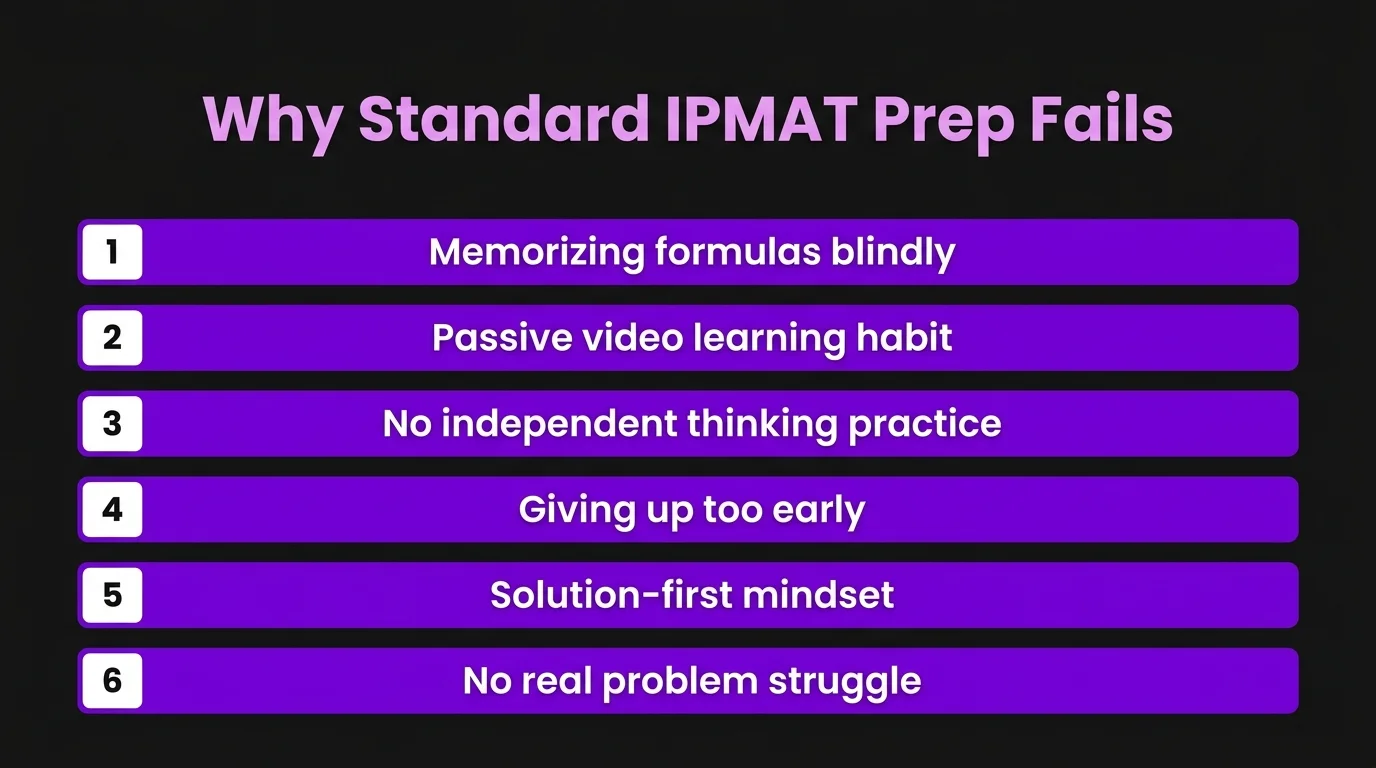
At Phodu Club, we get this question all the time: “I study for six hours a day, so why am I scoring below the 50th percentile?” The harsh truth is that most students treat aptitude exams like school board exams. They try to memorize formulas, rote-learn vocabulary lists, and passively watch hours of solution videos. We call this the “Illusion of Competence.” When a teacher solves a complex problem on the board, it makes sense. But when you face a new, unseen variation in the exam hall, your brain panics because it hasn’t been trained to think independently.
We worked with a student last year who had completed two entire prominent quantitative textbooks. Yet, his mock scores wouldn’t budge. We looked at his rough sheets and realized he was giving up on difficult questions after just two minutes and jumping straight to the solutions. He was training his brain to quit.
The Actionable Takeaway: Shift from passive consumption to active struggling. When you encounter a difficult question, give yourself 10 full minutes to wrestle with it before looking at the answer. This struggle is where actual learning happens.
Decoding the 2026 Testing Landscape of IPMAT: Know Your Battlefield
A major mistake in IPMAT preparation is treating all these exams as identical. The IIM Indore exam tests your conceptual depth and ability to handle pressure, while the IIM Rohtak exam is a pure test of aggressive speed and accuracy.
If you apply Rohtak’s speed strategy to Indore’s paper, you will end up with massive negative marking. If you apply Indore’s deep-thinking strategy to Rohtak, you will leave half the paper unattempted.
Here is a breakdown of what we expect based on recent official patterns and trends:
| Feature | IIM Indore IPMAT | IIM Rohtak IPMAT | JIPMAT (Bodh Gaya & Jammu) |
| Core Focus | Conceptual Depth & Higher Math | Speed, Logic & Accuracy | Balanced Aptitude |
| Sections | QA (Short Answer), QA (MCQ), VA (MCQ) | QA, Logical Reasoning, VA | QA, Data Interpretation/LR, VA |
| Time Limit | 120 Minutes (Sectional timing) | 120 Minutes (Sectional timing) | 150 Minutes (No sectional timing) |
| Difficulty | High (Includes Class 11/12 Math) | Moderate (Mostly up to Class 10 Math) | Easy to Moderate |
| Unique Factor | Short Answer section has NO negative marking | Includes a dedicated Logical Reasoning section | No sectional time limits, allowing flexibility |
The Actionable Takeaway: You must align your strategy with the specific paper. During the week, dedicate specific days to “Indore-level depth” (solving 20 tough questions in an hour) and other days to “Rohtak-level speed” (solving 40 easier questions in an hour).
The Quantitative Ability Blueprint: Crossing the Math Barrier
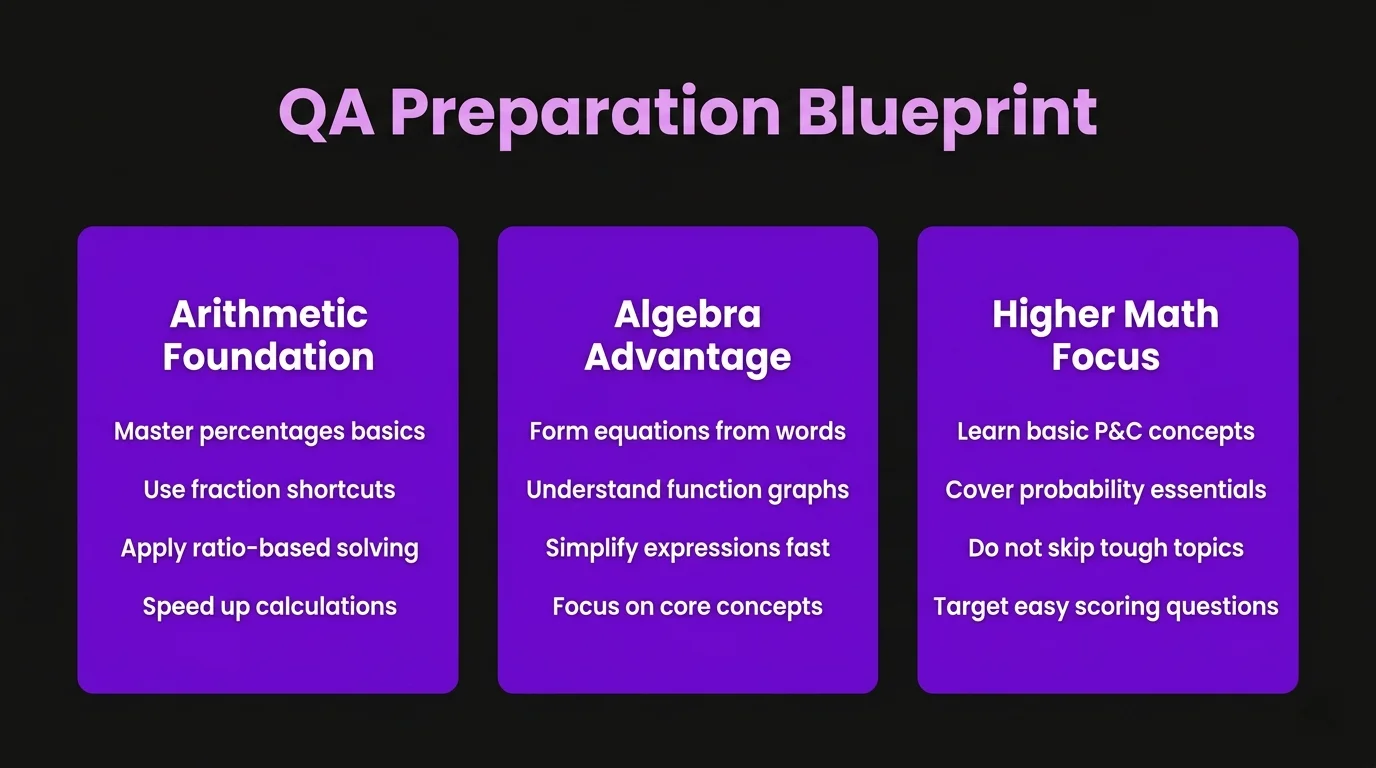
For many students, the Quantitative Ability (QA) section is terrifying. But math is predictable if you break it down into manageable phases.
When structuring your IPMAT preparation, sequence your math chapters based on logic, not just textbook order.
Phase 1: The Arithmetic Foundation
Arithmetic (Percentages, Profit & Loss, Time Speed Distance, Time & Work, Ratios) is the backbone of all management entrance exams. You cannot master advanced topics if your basic percentage calculations take too long.
- What students get wrong: Using long, formula-heavy equations instead of ratio and fraction-based shortcuts.
- What works: Memorize fraction-to-percentage conversions up to 1/20. Learn to solve Time and Work problems using the LCM/Efficiency method, not the traditional unit-work method.
Phase 2: The Algebra Advantage
Algebra usually separates the average scorers from the top percentiles.
- What students get wrong: Getting intimidated by logs, indices, and complex quadratic equations.
- What works: Focus heavily on forming equations from word problems. Understand the graphical representation of functions.
Phase 3: Higher Math & Modern Math (The Indore Special)
IIM Indore loves Permutations & Combinations (P&C), Probability, Matrices, and Set Theory.
- The Real Scenario: We often see non-math students entirely skip P&C out of fear. Last year, we mentored a commerce student who hated Modern Math. Instead of forcing her to master it, we taught her just the basic, foundational concepts. In the actual exam, she encountered three easy P&C questions that others skipped, and those extra 12 marks pushed her past the sectional cutoff.
- What works: Never leave a chapter completely blank. The examiners often set incredibly basic questions from notoriously difficult chapters just to test who was brave enough to study them.
The Actionable Takeaway: Build a “Concept Book.” Every time you learn a new shortcut, a new formula, or a new concept, write it down in a dedicated notebook. Review this book every Sunday.
Rewiring Your Approach to Verbal Ability
Most students tackle Verbal Ability (VA) like a history syllabus—trying to memorize thousands of words from heavy vocabulary books and blindly learning grammar rules. This rarely works.
We always tell our students that effective IPMAT preparation requires reading active, argumentative articles, not just rote learning. The exam tests your comprehension, tone identification, and logical flow.
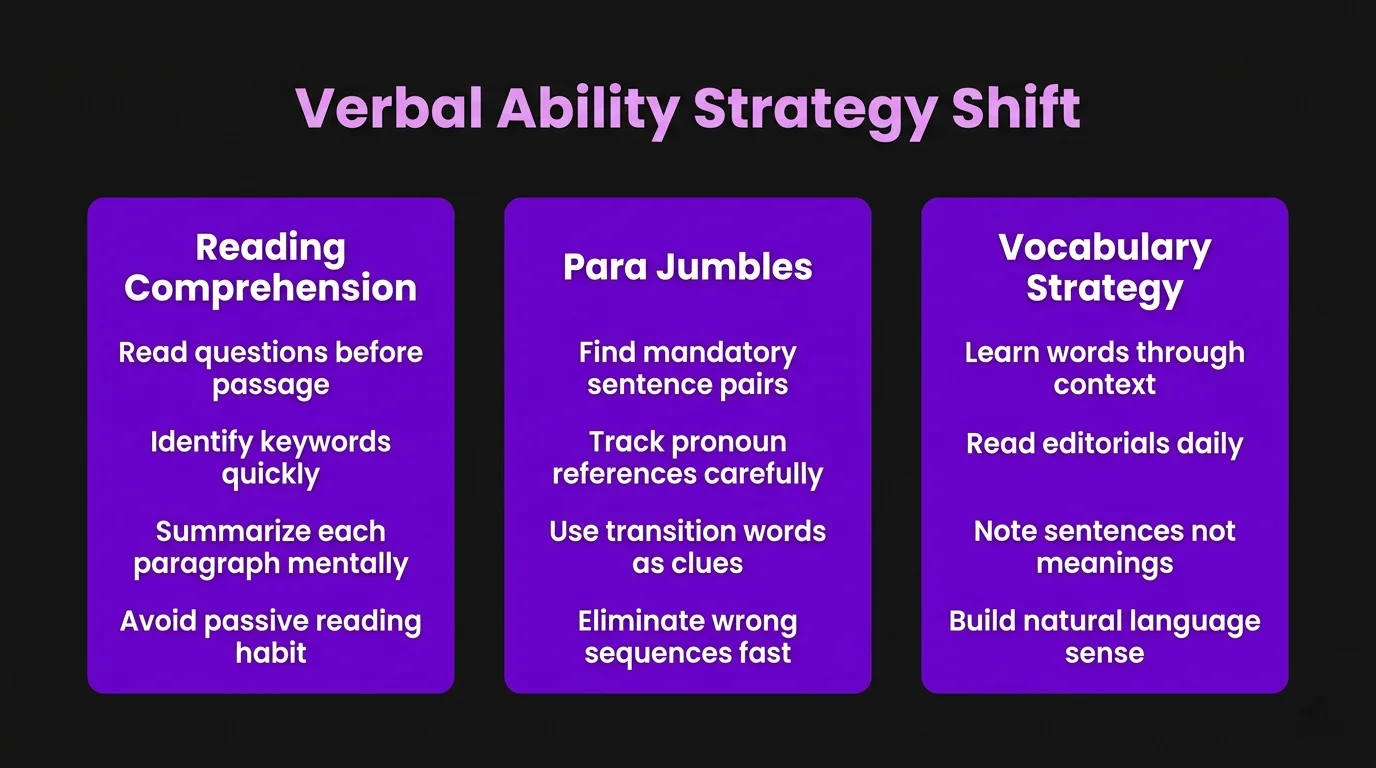
1) Reading Comprehension (RC)
RC carries the highest weightage.
- What students get wrong: Reading the passage first, slowly translating it in their heads, and then looking at the questions, only to realize they forgot what they read.
- What works: Skim the questions first to know what to look for. Then, read the passage actively. After every paragraph, pause for 3 seconds and summarize it mentally in one sentence.
2) Para Jumbles
- What students get wrong: Trying to arrange all four or five sentences at once based on “how it sounds.”
- What works: Look for mandatory pairs. Find the sentence that introduces the topic (usually an independent noun). Look for transition words (however, therefore) and pronoun references (he, it, this theory) that must follow specific nouns. If you find just one solid pair of sentences, you can usually eliminate 75% of the options.
3) Vocabulary and Grammar
- The Real Scenario: A student we worked with used flashcards for 3 months but still got vocabulary questions wrong because he didn’t understand contextual usage. We shifted him to reading daily editorials.
- What works: Read sources like The Hindu Editorial, Aeon Essays, The Guardian, and Project Syndicate for 45 minutes every day. When you find a new word, don’t just write down the meaning—write down the entire sentence so your brain remembers the context.
The Actionable Takeaway: Your daily target should be solving 3 RC passages and reading 2 high-quality editorial articles. Make reading a non-negotiable part of your morning routine.
The Diagnostic Mock Protocol: Stop Counting Your Marks
Your IPMAT preparation journey shifts drastically the moment you start treating mock tests as diagnostic tools rather than scorecards.
Most students take a mock test, look at their score, feel happy or depressed, and move on. At Phodu Club, we enforce a strict rule: A 2-hour mock test requires a 2.5-hour analysis. If you are just giving mocks and not analyzing them, you are simply practicing your mistakes. To get high-quality practice that mirrors the actual exam interface and difficulty, we highly recommend taking structured, syllabus-aligned mocks. You can explore the comprehensive IPMAT Test Series we designed specifically to expose you to real exam conditions.
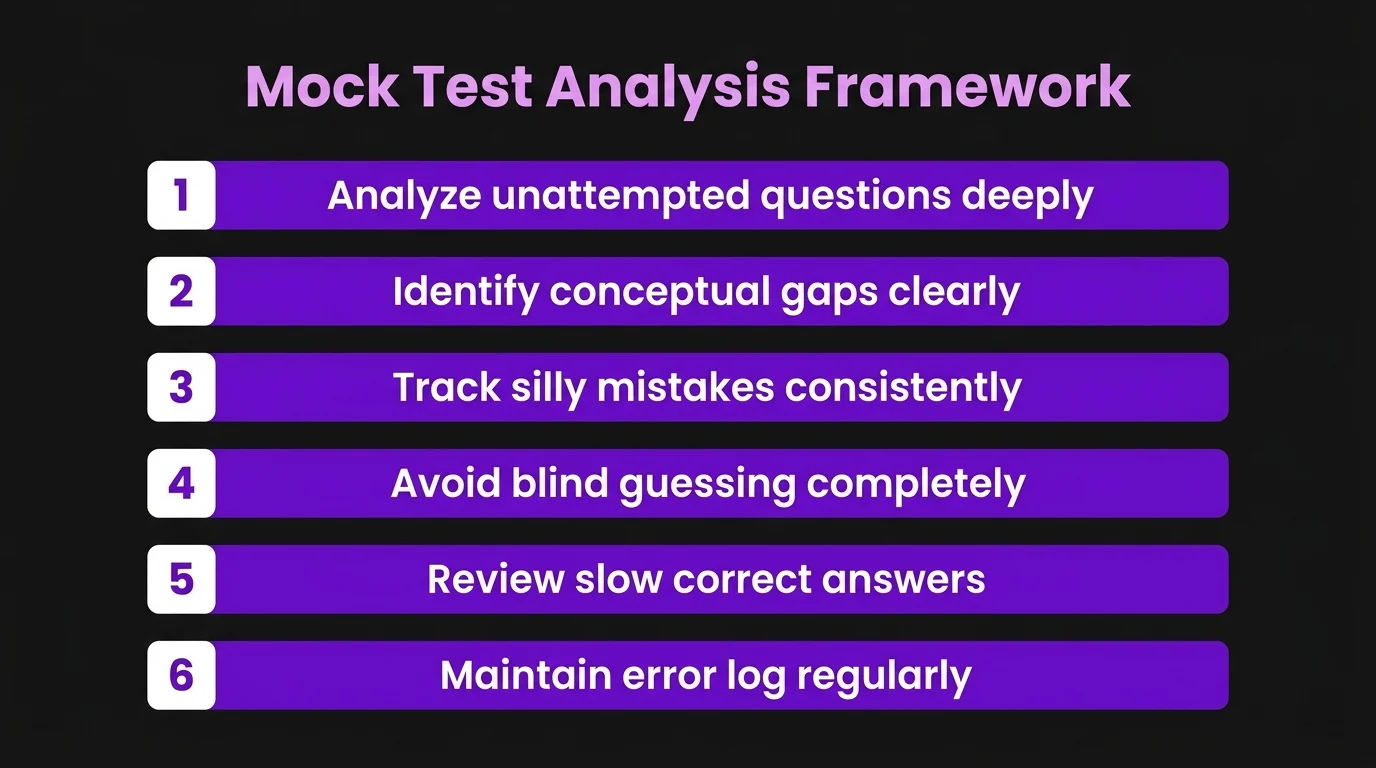
The 3-Step Analysis Framework
Step 1: The Unattempted Questions
Look at every question you skipped. Why did you skip it?
- Did you not know the concept? (Action: Go back to the textbook).
- Did it look too lengthy? (Action: Solve it now without a timer. Was it actually hard, or just scary?)
- Did you run out of time? (Action: Fix your speed strategy).
Step 2: The Incorrect Answers
Categorize your mistakes into three buckets:
- Conceptual Error: You applied the wrong formula or logic.
- Silly Mistake: You read “incorrect” as “correct”, or made a calculation error (e.g., 3×4 = 7).
- Blind Guess: You marked an option just hoping for the best. (Stop doing this immediately due to negative marking).
Step 3: The Slow Correct Answers
This is the secret sauce. Look at the questions you got right, but took 4 minutes to solve. In a competitive exam, taking 4 minutes for a 1-minute question is almost as bad as getting it wrong, because it steals time from other questions. Check the provided solution—was there a faster ratio method or an option-elimination trick you missed?
The Actionable Takeaway: Maintain an “Error Log” (a spreadsheet or notebook). Log every single mistake you make in mocks. Before your next mock, review this log. If you stop making the same mistake twice, your score will automatically increase by 20-30 marks in a month.
The Board Exam Balancing Act
Balancing board exams and IPMAT preparation is a nightmare for most Class 12 students. We see students completely abandon their aptitude prep from December to March. When they return in April, their speed has crashed, and they have forgotten formulas.
You cannot afford a 3-month gap.
What works: The “Low-Intensity Maintenance Mode.” During your heavy board exam prep, drop your aptitude study hours, but do not reduce them to zero.
- Weekdays: Dedicate just 45 minutes to aptitude. Read one editorial and solve 10 math questions. That’s it. Keep the brain muscles active.
- Weekends: Take out 2 hours to give a sectional mock or revise your concept formulas.
By maintaining a light touch with the syllabus, you ensure that when board exams finish, you can immediately hit the ground running for the final 45-day sprint, while your competitors are starting from scratch.
The Month-by-Month Execution Plan
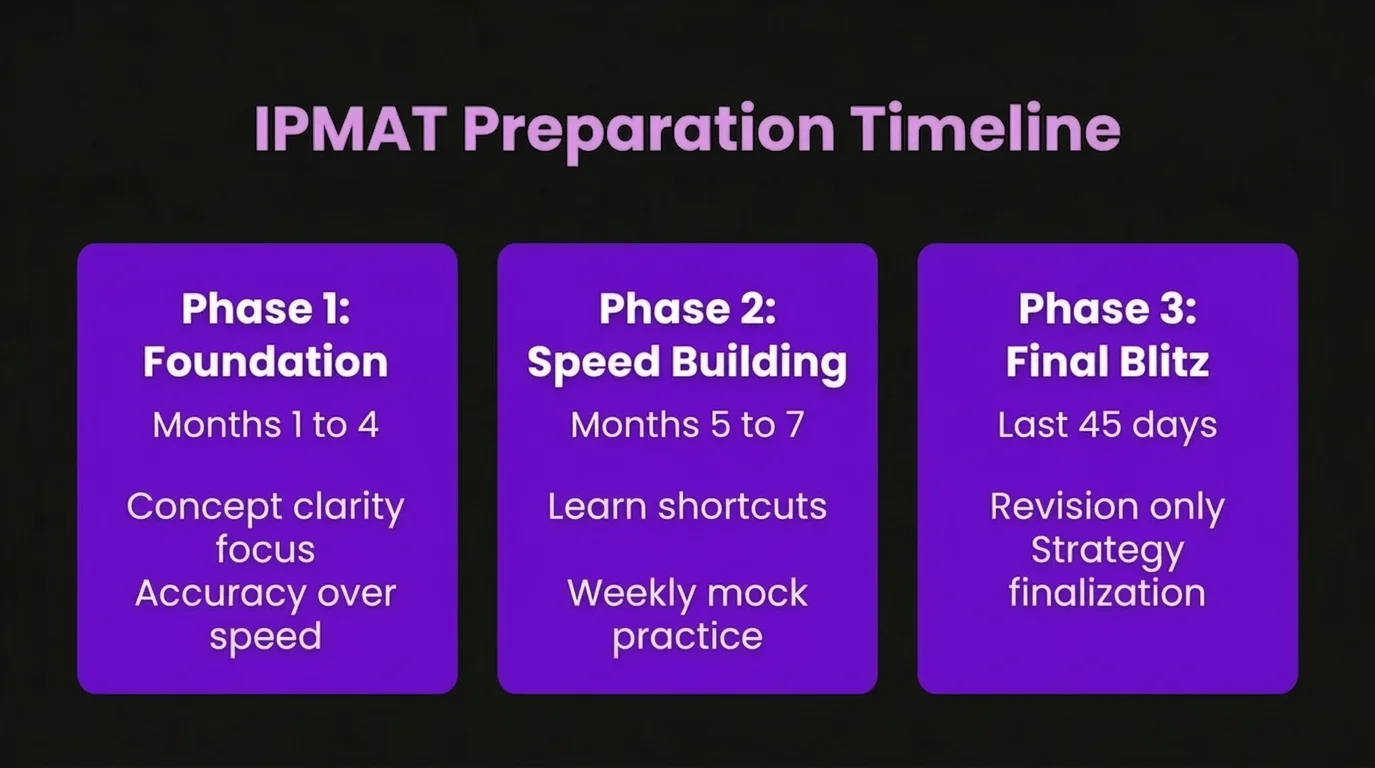
Consistency is the boring but true secret to successful IPMAT preparation. Here is a high-level roadmap of how your timeline should look if you are aiming for the 2026 exam.
Phase 1: Foundation Building (Months 1 to 4)
- Goal: Concept clarity across all chapters.
- Action: Do not worry about speed. Focus entirely on accuracy. Go through every math chapter, understand the theory, and solve 50-75 basic to moderate questions per chapter. Read daily to build reading stamina.
- Mocks: Take one full-length mock every two weeks just to get comfortable with sitting in one place for two hours.
Phase 2: Pattern Recognition & Speed (Months 5 to 7)
- Goal: Learning shortcuts and identifying question types.
- Action: Start using a timer. Practice solving questions using option elimination, approximation, and unit digit methods. Start doing sectional tests to build sectional time management.
- Mocks: One full-length mock every week. Deep analysis is mandatory.
Phase 3: The Final Blitz (Last 45 Days)
- Goal: Peak performance and strategy finalization.
- Action: Stop reading new theories. Switch entirely to revision and testing.
- Mocks: Two to three mocks per week. Finalize your attempt strategy. (e.g., Round 1: Scan the paper and do all 30-second questions. Round 2: Tackle the 2-minute questions. Round 3: Attempt the challenging ones).
The Actionable Takeaway: Never study based on “mood.” Create a strict weekly schedule. For example: Monday (Arithmetic), Tuesday (RC & Grammar), Wednesday (Algebra), Thursday (Para Jumbles & Vocab), Friday (Higher Math), Saturday (Mock Test), Sunday (Mock Analysis & Revision).
The Interview and WAT Phase: Do Not Wait Until Results
A critical mistake students make is ignoring the Personal Interview (PI) and Written Ability Test (WAT) until the written exam results are declared. By then, you only have a week or two to prepare.
At Phodu Club, we advise students to start passively preparing for the interview months in advance.
- Current Affairs: Your daily reading habit for Verbal Ability will naturally build your general knowledge. Start forming opinions on major economic and social issues.
- Self-Reflection: The interview panel wants to know why you want to pursue management right after Class 12. Be ready to answer questions about your strengths, your academic background, and your long-term goals.
- Subject Knowledge: If you are a commerce student, ensure your accountancy and economics fundamentals are strong. If you are a science student, be prepared to answer basic physics or math questions. The panel will test your 12th-grade knowledge.
Conclusion
We have worked with enough students to know this absolute truth: sheer effort alone does not fix your score. The right strategy does. Spending five hours staring at a textbook won’t get you into IIM Indore, but spending two hours actively solving, analyzing, and fixing your weak areas absolutely will.
If you are tired of doing random IPMAT preparation without seeing real score improvements, it’s time to change your approach. Stop memorizing, start analyzing, and focus on building logical problem-solving skills. That is exactly what we focus on at Phodu Club—giving you the clarity, the strategy, and the exact roadmap to move from average scores to top-tier percentiles.
Keep pushing, stay consistent, and trust the process. You’ve got this.
Frequently Asked Questions (FAQ)
1) What is the ideal timeline to start IPMAT preparation?
Ideally, students should start their prep 10 to 12 months before the exam. This allows ample time to build foundational math skills, develop a strong reading habit, and balance Class 12 board exams without burning out. However, even if you have 6 months left, a highly structured, intensive routine can still yield excellent results if you avoid distractions.
2) Can an average math student or non-math student crack the exam?
Absolutely. We see this all the time. While IIM Indore does test higher math, a large portion of the paper is standard Arithmetic and Algebra (up to Class 10 level). Non-math students can clear the cutoffs by mastering basic arithmetic, maximizing their score in the Verbal section, and picking only the easiest questions in the higher math sections.
3) How many mock tests should I take before the actual exam?
Quantity does not beat quality. We recommend anywhere between 25 to 35 full-length mocks. Taking 60 mocks without analysis is useless. Taking 30 mocks, analyzing every single mistake, and logging them in an error book will guarantee a massive score boost.
4) How is IIM Indore different from IIM Rohtak in terms of strategy?
Indore requires deep conceptual thinking and patience. You might only solve 15 math questions, but they must be accurate. Rohtak is a speed game. The questions are significantly easier, but you must race against the clock. Your strategy for Rohtak should focus on quick option-elimination, while your strategy for Indore should focus on selecting the right questions to attempt.
5) How do I improve my Reading Comprehension speed?
Stop trying to read faster; try to comprehend better. Speed is a byproduct of understanding. Read complex articles daily. Do not regress (re-read the same line multiple times). Try to read in “chunks” of words rather than word-by-word. Over time, your brain will naturally process information faster.
6) Do Class 10 and 12 board marks matter for final selection?
Yes, they do. Different IIMs assign different weightages to past academic records during the final composite score calculation (which includes the aptitude test, interview, and past academics). This is why you cannot ignore your board exams. Aim to maximize your board percentages while keeping your aptitude prep consistent.
7) How does Phodu Club help students who are stuck at a specific score?
At Phodu Club, we don’t just hand you a textbook and leave you alone. We focus on identifying why your score is stuck. We help you build a personalized attempt strategy, provide realistic mock tests, teach you how to analyze your weak areas, and offer mentorship that prevents burnout. We focus on the exact strategies that push students from average to elite percentiles.
8) What is a safe score for IIM Indore? Your target in IPMAT preparation
should focus on percentiles rather than absolute raw scores, because the difficulty level fluctuates wildly every year. However, historically, clearing cutoffs is the biggest hurdle. Once you clear the individual cutoffs for QA (SA), QA (MCQ), and VA, a composite score that sits in the top 5-7% of all test-takers usually secures an interview call. Always aim to maximize your Verbal score to boost your overall total.