EAPCET: Eligibility & Key Details
At Phodu Club, we see this all the time. Students study for months, memorize every complex formula, and still walk out of the exam hall feeling completely defeated. They did not lack knowledge. They lacked the right approach. When it comes to the EAPCET, treating it like just another mock test is a massive mistake. We recently worked with a student who was scoring brilliantly in advanced problem-solving but struggled to finish this specific state exam on time. This happens because the speed-to-accuracy ratio required here is completely different from national-level tests.
Quick Answer/TL;DR
- Eligibility: Pass 10+2 with Math, Physics, and Chemistry. Minimum 45% marks (40% for reserved categories).
- Format: 160 questions in 180 minutes. Zero negative marking.
- Key Focus: Speed, memory-based state textbook recall, and balancing your board exam weightage.
EAPCET: Why This State Entrance Exam Matters (And the Core Details)
Many aspirants treat state-level engineering exams as mere backups. They toss them into their schedule without a dedicated plan. But we know that securing a top rank here opens doors to some of the absolute best colleges in Andhra Pradesh and Telangana. Understanding the core details is your first step to taking control of your prep.
To sit for the EAPCET, you must meet specific local or non-local status requirements defined by the state governments. You need to have passed your Intermediate examination with Mathematics, Physics, and Chemistry as your main subjects. The minimum marks requirement is generally 45 percent for open category students and 40 percent for reserved categories. Age is also a crucial factor. Candidates should have completed 16 years of age as of December 31 of the year of admission.
Knowing the EAPCET local versus non-local rules can save you from heartbreak during counselling. The states divide regions into Andhra University (AU), Sri Venkateswara University (SVU), and Osmania University (OU) areas. Local students get a massive 85 percent reservation in their respective regional colleges. Non-local students compete for the remaining 15 percent unreserved seats. We have seen students ignore these regional definitions and build completely unrealistic college target lists.
Actionable Takeaway: Dedicate one afternoon this week to check the official state exam websites. Verify your eligibility category and document requirements right now. Gather your study certificates from class 6 to 12. You will need them to prove your local status. For more foundational details, check our guide on the exam full form and details .
Eligibility Criteria at a Glance
| Parameter | Requirement |
| Nationality | Indian Nationals, PIO, or OCI Card Holders |
| Domicile | Must satisfy Local/Non-Local status of AP/TG |
| Age Limit | Engineering and Pharmacy Courses: Minimum age 16 years as of December 31 of the admission year; no upper age limit.Specialized Agriculture and Allied Courses ( B.Tech Dairy Technology, Agricultural Engineering, Food Science/Technology): Minimum age 17 years as of December 31 of the admission year; upper age limit 22 years for General category and 25 years for Reserved (SC/ST) category. |
| Academics | 10+2 passed with Physics, Chemistry, and Mathematics |
| Min Marks | 45% (Open Category) / 40% (Reserved Category) |
The Board Marks Trap in EAPCET: What Students Get Wrong
One of the most common mistakes we see is students isolating their entrance prep from their board exams. In some years and specific states, your Intermediate Public Examination (IPE) marks carry a massive 25 percent weightage in determining your final rank. The trend changes year by year. Andhra Pradesh usually retains this weightage, while Telangana recently removed it for 2025 and 2026. However, students targeting 2027 must stay alert for new official notifications.
Students often assume that cracking tough physics problems is enough. They neglect their board exams and score an average percentage. Then they watch their final EAPCET rank plummet despite a decent score in the entrance test itself. You cannot afford to lose easy rank-boosting points because you did not practice writing step-by-step board answers. The boards require neat presentation, labeled diagrams, and step-by-step derivations. The entrance test requires mental math and rapid option elimination. You have to master both formats.
Actionable Takeaway: Balance your schedule to include dedicated board exam writing practice at least twice a week. Read our deep dive on how your intermediate marks quietly decide your rank . Do not ignore your language subjects and practicals, as they heavily influence your overall board percentage.
Decoding the Pattern: Speed Over Depth in EAPCET
If national exams test how deep you can think, the EAPCET tests how fast you can react. You have 160 questions to solve in 180 minutes. That is roughly one minute per question. The paper is heavily skewed towards Mathematics, which carries 80 questions. Physics and Chemistry carry 40 questions each.
What students get wrong is their attempt strategy. They get stuck on a difficult math problem out of pure ego. They spend four minutes on it and end up missing five easy chemistry questions at the very end of the paper. There is absolutely no negative marking in this exam. Yet, we still see students leaving questions blank because they panicked and simply ran out of time. This is a purely strategic failure, not a knowledge failure.
Actionable Takeaway: Implement the "Sweep Strategy" immediately. Go through the paper in three rounds. Round one is for instant answers and theory questions. Round two is for calculations taking less than a minute. Round three is for guessing the rest. Since there is no penalty, attempt all 160 questions without fail.
Ideal Time Allocation Strategy
| Subject | Total Questions | Suggested Time | Difficulty Profile |
| Mathematics | 80 | 80 - 90 Mins | High Calculation, Lengthy |
| Physics | 40 | 45 - 50 Mins | Formula Based, Moderate |
| Chemistry | 40 | 35 - 40 Mins | Fast Recall, Theory Heavy |
A Step-by-Step Subject Strategy That Actually Works in EAPCET
At Phodu Club, we focus on real results over endless theory. To genuinely improve your score, you need a highly structured approach. Randomly solving questions from heavy reference books will not work here.
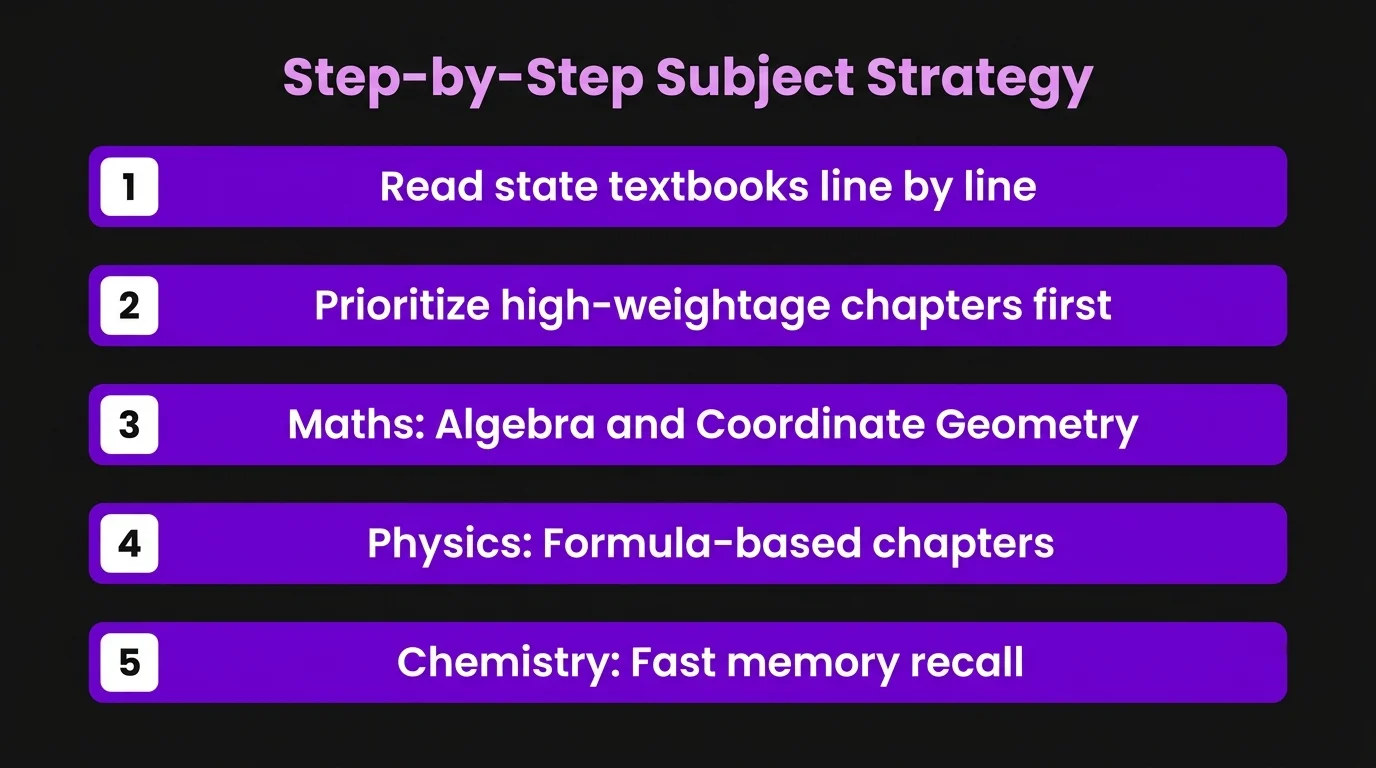
Unlike other exams that pull concepts from multiple reference books, a huge chunk of EAPCET questions here are directly adapted from the state board textbooks. The Telugu Academy books are your ultimate guide. You need to read the physics and chemistry theory line by line. Furthermore, prioritize high-weightage chapters over completing the entire syllabus poorly. You need to know what to focus on and what to ignore.
Mathematics Strategy
Mathematics is 50 percent of the paper. Focus heavily on Algebra. Topics like Matrices, Functions, and Complex Numbers are highly scoring. Coordinate Geometry is another massive chunk. Master Straight Lines and Circles thoroughly.
Physics Strategy
Physics here is mostly formula-driven. You do not need deep, multi-concept mechanics derivations. Focus on Thermodynamics, Modern Physics, and Current Electricity. These chapters consistently yield direct questions every single year.
Chemistry Strategy
Chemistry is your ultimate rank booster. Physical Chemistry requires formula application. Organic Chemistry requires knowing named reactions. Inorganic Chemistry is purely memory-based. If you memorize the state textbook for Inorganic, you can solve those questions in under 15 seconds each.
Actionable Takeaway: Make a strict priority list today. Identify chapters that guarantee two or three questions each. Master these high-yield topics before touching the obscure ones. Explore our detailed guide on how to prepare for the state exam via coaching or self-study for a comprehensive chapter breakdown.
EAPCET: Advanced Tips for the Final Months
As the EAPCET approaches, your preparation needs to shift entirely from learning to executing. Reading new theories in the last month is a recipe for disaster. This is where analyzing your performance through test series becomes critical.
Many aspirants just take mock tests, look at their score, feel sad, and move on. That is a complete waste of three hours. The real improvement happens in the post-test analysis. You need to figure out if you lost marks due to a conceptual gap, a silly calculation error, or poor time allocation. Without this reflection, you will just repeat the exact same mistakes in the actual exam.
Actionable Takeaway: Take regular timed exams using a reliable platform like our State Test Series . After every mock, spend at least one hour analyzing. Write down the formulas you forgot in a separate notebook and review them every Sunday morning.
Expected Marks vs Rank Trend (Based on 2025-2026 Data)
| Marks Range | Expected Rank Range |
| 150-160 | 1 - 1,000 |
| 140-149 | 1,001 - 1,500 |
| 130-139 | 1,501 - 2,000 |
| 120-129 | 2,001 - 4,000 |
| 110-119 | 4,001 - 6,000 |
| 100-109 | 6,001 - 8,000 |
| 90-99 | 8,001 - 10,000 |
| 80-89 | 10,001 - 15,000 |
| 70-79 | 15,001 - 20,000 |
| 60-69 | 20,001 - 25,000 |
| 50-59 | 25,001 - 30,000 |
| 40-49 | 30,001 - 40,000 |
| below 40 | above 40,000 |
(Note: Ranks vary yearly based on paper difficulty and normalization processes. Use this strictly as a benchmark target.)
How to Stay Consistent Until Exam Day
Burnout is a massive threat to your prep. We see students push too hard in February, only to lose all momentum by April. Consistency is not about studying twelve hours a day. It is about studying six hours a day, every single day, without fail.
When you lack clarity in your preparation, you naturally lose motivation. You sit at your desk wondering whether to study physics or math. Decision fatigue kicks in, and you eventually end up scrolling on your phone. You need a structured plan to eliminate this mental friction entirely.
Actionable Takeaway: Plan your entire week on Sunday evening. Know exactly what chapter you are studying on Tuesday at 4 PM. If you are aiming for specific colleges, use a State College Predictor to keep your target clear. Write that target college on a sticky note and place it right on your study desk.
What Happens After the EAPCET Exam: Understanding Counselling
Preparation does not end when you submit the paper. The counselling phase is where your rank actually converts into a seat. Understanding this process early prevents panic later.
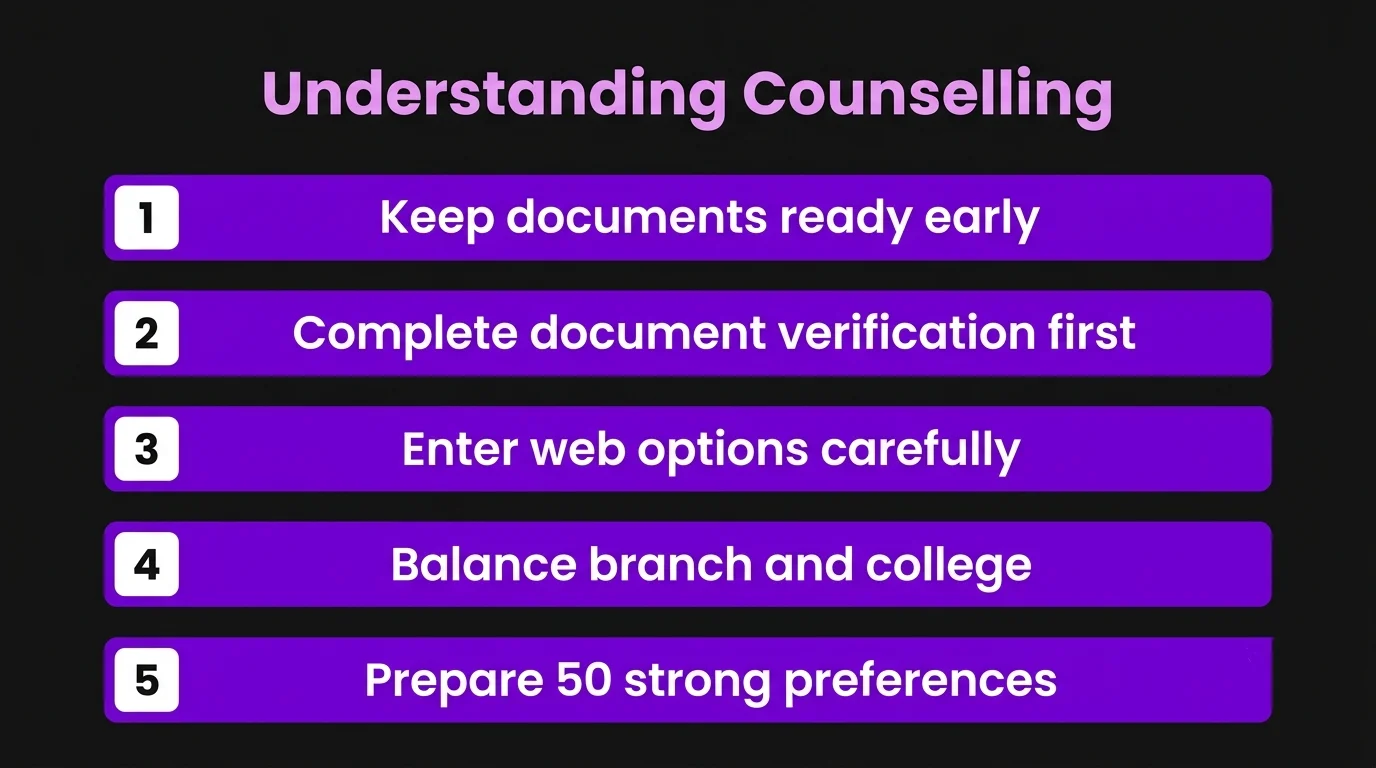
The counselling involves document verification, web options entry, and seat allotment. You must have your rank card, hall ticket, Aadhaar card, caste certificate (if applicable), and study certificates ready. During web options, students often make the mistake of choosing branches they hate just to get into a top college. We advise our students to balance college reputation with their genuine branch interest.
Actionable Takeaway: Keep your documents ready the day after your exam. Do not wait for the results. Research colleges thoroughly and create a preference list of at least 50 options before the web counselling portal even opens.
Conclusion
Cracking the EAPCET is not about being a genius; it is about playing the game right. It is about understanding the eligibility criteria early, mastering the immense speed required for 160 questions, and balancing your board prep effectively alongside your entrance goals.
We have worked with enough students to know this truth. Effort alone does not fix your score. The right strategy does. That is exactly what we focus on at Phodu Club. We are here to help you identify your weak areas, refine your exam strategy, and finally break through that stagnant score plateau. If you are tired of putting in the hours without seeing the results, check out our highly structured TG State Crash Course . Let us build a roadmap that actually works for you and gets you into the engineering college you truly deserve.
Frequently Asked Questions (FAQ)
1) What is the official website for this state exam?
The official websites change slightly each year based on the organizing university. For Telangana, it is usually hosted on http://eapcet.tgche.ac.in , and for Andhra Pradesh, it is on cets.apsche.ap.gov.in . Always verify dates and updates through official government press releases.
2) Is there any negative marking in the paper?
No, there is absolutely no negative marking. You must attempt all 160 questions. Leaving questions blank at the end of the timer is a massive strategic error.
3) How many months are required to complete the syllabus properly?
If you have a decent base from your board exam preparation, three to four months of dedicated, objective-focused study is generally sufficient. The focus should be on building speed and problem-solving techniques, not just reading theory from scratch.
4) How should I manage board exams alongside entrance prep?
Allocate your week intelligently. Spend Monday to Friday on objective entrance exam questions. Dedicate your weekends strictly to writing descriptive board answers and practicing derivations. Do not ignore your language and practical subjects.
5) What is a safe score for securing a seat in the top 10 engineering colleges?
While cutoffs vary yearly based on paper difficulty and normalization, scoring 100 plus out of 160 generally places you in a very strong, safe position for top-tier colleges in both states.
6) How is the final rank calculated if board marks have weightage?
When applicable (primarily in AP), the final rank is calculated giving 75 percent weightage to your entrance test score and 25 percent weightage to your Intermediate Public Examination marks specifically in Mathematics, Physics, and Chemistry.
7) Is this state entrance exam easier than JEE Mains?
The questions are generally more straightforward and heavily formula-based compared to the deep analytical problems in JEE Mains. However, the time pressure is much higher here. You have to solve 160 questions in 180 minutes, making it a severe test of speed and rapid recall.
8) How does Phodu Club help me improve my stagnant mock scores?
At Phodu Club, we look way beyond generic advice. We analyze your specific attempt strategy, identify your exact weak chapters, and build a personalized roadmap. We teach you exactly what to skip, what to attempt first, and how to maximize your score through targeted, realistic mentoring.
Want to crack your exam with mentors who did?
Get test series, crash courses and free mentorship from students at IITs, NITs and BITS.