EAPCET Key: Eligibility & Key Details
Every year, right after the exam, we get the same rushed messages from students: "the EAPCET answer key is out, how do I actually read it?" Most have never seen a master question paper or a response sheet before, and the two-step process, provisional answer key first, objections next, final answer key last, catches people off guard when they're already anxious about their score. This guide covers exactly how the process works, what eligibility you need before you even get to that stage, and what to expect for 2027.
Quick Answer
The EAPCET answer key refers to the answer key TGCHE releases after the exam, first as a provisional answer key open to objections, then as a final answer key used for results. Eligibility requires Intermediate with PCM (or PCB for pharmacy tracks), a minimum 45% aggregate (40% for reserved categories), and a minimum age of 16 for most B.Tech courses.
What "EAPCET Answer Key" Actually Refers To
TGCHE and JNTU Hyderabad use "answer key" as shorthand for the official answer key released after the exam, alongside your individual response sheet and the master question paper. A few basics before anything else:
- There are two versions: a provisional (preliminary) answer key released first, and a final answer key released afterward once all objections are reviewed.
- The final answer key is the only one that matters for your result. TG EAPCET results are prepared strictly from the final answer key, not the provisional one.
- You can't challenge the final answer key. Once it's published, there's no further objection window, so the provisional answer key stage is your only real opportunity to flag an error.
- Engineering and Agriculture & Pharmacy streams get separate answer keys, released on different timelines since the exams themselves run on different dates.
Our EAPCET answer key page tracks the live release dates each cycle, and our EAPCET results page picks up from there once the final answer key is out.
TG EAPCET 2026 Answer Key Timeline (For Reference)
Here's how the 2026 cycle played out, useful as a benchmark for what 2027 will likely resemble:
| Stream | Event | Date |
| Agriculture & Pharmacy | Exam conducted | May 4-5, 2026 |
| Agriculture & Pharmacy | Response sheet, master paper, and provisional answer key released | May 11, 2026 (11:30 AM) |
| Agriculture & Pharmacy | Objection window closes | May 13, 2026 (11:30 AM) |
| Engineering | Exam conducted | May 9-11, 2026 |
| Engineering | Response sheet, master paper, and provisional answer key released | May 12, 2026 (11:00 AM) |
| Engineering | Objection window closes | May 14, 2026 (11:00 AM) |
| Both streams | Final answer key released | After objection review, ahead of results |
The gap between provisional answer key release and objection closure was under 48 hours for both streams in 2026, which doesn't leave much room for procrastination. Our EAPCET hall ticket and TG EAPCET dates pages track the full calendar leading up to this stage each cycle.
How to Download and Read the Provisional Answer Key
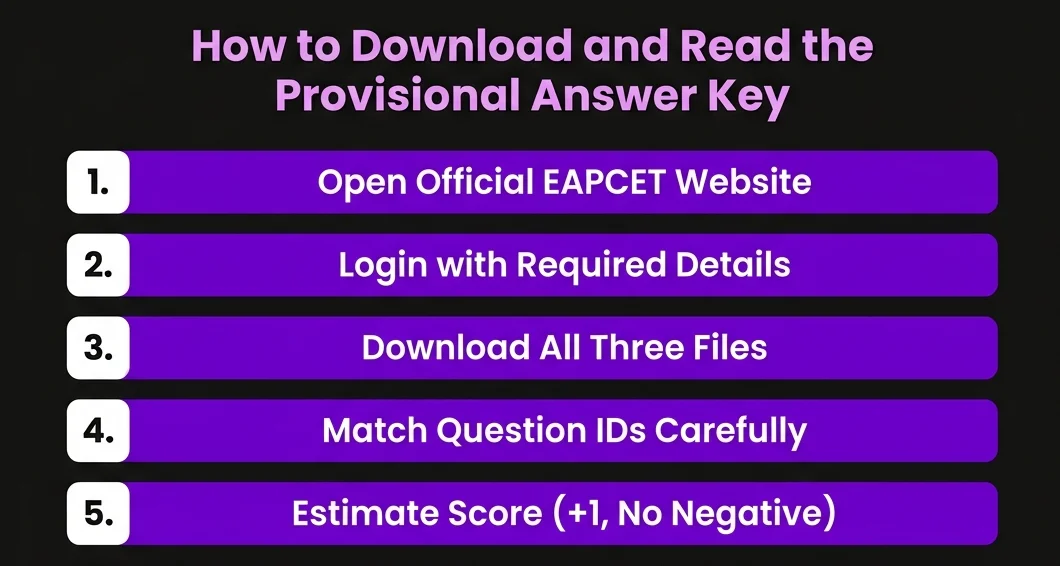
- Visit the official website, eapcet.tgche.ac.in , once the answer key is live for your stream.
- Log in using your registration number, hall ticket number, and date of birth.
- Select your exam date and shift, since the paper varies across sessions, then download the response sheet, master question paper, and provisional answer key.
- Match question IDs carefully. Compare the question ID on your response sheet against the same ID in the master question paper and answer key, not just the question number, since IDs can differ between sessions.
- Calculate your probable score using the marking scheme: +1 for every correct answer, no deduction for wrong or unattempted questions, out of a maximum of 160.
How to Raise an Objection Against the Provisional Answer Key
If you genuinely believe an answer in the provisional answer key is incorrect, here's the process:
- Log in to the official objection portal with your registration credentials during the open window.
- Identify the specific question using its ID from the master question paper, not the general topic or your memory of the question.
- Provide supporting justification for why you believe the marked answer is wrong. Vague objections without evidence are unlikely to be upheld.
- Pay the objection fee, Rs 300 per question challenged, at the time of submission.
- Submit once. Objections can only be filed a single time, so list every discrepancy you want reviewed before submitting rather than expecting a second attempt or a follow-up window.
Only objections raised during this window are considered. Once TGCHE reviews all valid challenges, the corrected final answer key is published, and that's the version your result is built from.
What Students Get Wrong at This Stage
A few patterns repeat every cycle with the students we hear from right after the answer key is released:
- Comparing question numbers instead of question IDs. Since papers vary across sessions and shifts, the same question number can correspond to a different question entirely. Matching by ID is the only reliable method, and skipping this step leads to a wildly inaccurate self-calculated score.
- Assuming the provisional answer key is final. Students sometimes calculate their score off the provisional answer key, treat it as locked, and either celebrate or panic prematurely. The final answer key can shift your score in either direction once objections are resolved.
- Missing the objection window entirely. Because the window is short, under 48 hours in recent cycles, students who wait even a day to review their paper carefully can lose their only chance to flag a genuine error.
- Filing vague objections without evidence. A challenge that just says "this answer seems wrong" without referencing an authoritative source or clear reasoning is far less likely to be upheld than one with specific, well-argued justification.
- Forgetting that objections are one-shot. Since you can only submit once, rushing through the response sheet and missing a discrepancy you'd have caught with a slower read means it goes unchallenged for the entire cycle.
None of these mistakes are about knowledge gaps. They're entirely about moving carefully during a short, high-stakes window, which is exactly the kind of thing that's easy to rush when you're anxious about your score.
Marking Scheme and Score Calculation
Understanding exactly how your score is built helps you read the answer key correctly rather than just skimming it:
- Each correct answer is worth 1 mark. There's no weighting difference between sections.
- There is no negative marking. Wrong answers and unattempted questions both score zero, with no penalty beyond the missed opportunity.
- The maximum possible score is 160, corresponding to 160 objective-type questions across the paper.
- Your final score depends entirely on the final answer key, not the provisional one, so any score you calculate before the final answer key is published should be treated as an estimate, not a confirmed number.
This structure means there's no strategic reason to leave a question blank purely to avoid a penalty, since there isn't one. A confident guess costs nothing more than an unattempted question would.
How to Verify You're on the Official Portal
Given how much anxiety surrounds this stage, it's worth repeating a basic safeguard: only use eapcet.tgche.ac.in for downloading your answer key, response sheet, or filing an objection. A few habits worth building:
- Bookmark the official URL directly rather than searching for it fresh each time, which reduces the risk of clicking a look-alike domain from a search ad or forwarded link.
- Never share your registration number, hall ticket number, or date of birth on any third-party site claiming to calculate your score or file an objection on your behalf.
- Cross-check any objection fee payment page to confirm it's routed through the official TGCHE gateway before entering payment details.
Third-party exam-prep sites can be useful for explainers and summaries, but the actual answer key download, response sheet comparison, and objection filing should only ever happen on the official portal.
Eligibility Criteria for TG EAPCET
Here's what you need to have in place well before the answer key even becomes relevant:
| Requirement | Detail |
| Nationality | Indian citizen, OCI, or PIO |
| Qualifying exam (Engineering, MPC) | Intermediate (10+2) with Physics, Mathematics, and Chemistry or an approved equivalent |
| Qualifying exam (Pharmacy/BiPC tracks) | Intermediate with Physics, Chemistry, and Biology, or a Diploma in Pharmacy |
| Minimum marks (General) | 45% aggregate in the qualifying subjects |
| Minimum marks (Reserved categories) | 40% aggregate |
| Minimum age (most B.Tech courses) | 16 years as of December 31 of the admission year |
| Minimum age ( B.Tech Dairy Technology, Agriculture Engineering, Food Technology) | 17 years as of December 31 of the admission year |
| Upper age limit | None |
A few clarifications worth knowing:
- Candidates appearing in their final year of Intermediate are eligible to apply and take the exam, but must clear the qualifying examination before counselling.
- BiPC-stream students are not eligible for engineering ( B.Tech ) courses through TG EAPCET, since the MPC subject combination is a hard requirement for that track.
- Age proof is verified specifically during the counselling stage, not at the registration stage, so an error here can still be caught before you actually take the exam.
- Students who completed a Vocational Intermediate course in Engineering and Technology are also considered eligible for engineering admission, even without the standard MPC combination, provided the vocational stream is recognised.
- Diploma in Pharmacy holders, or those appearing in the final year of that diploma, have a separate eligibility path into pharmacy courses distinct from the standard Intermediate route.
- The 45% and 40% thresholds apply to the aggregate of your qualifying subjects taken together, not to each individual subject, so a weaker performance in one subject can still be offset by stronger marks in another as long as the combined aggregate clears the bar.
Our TG EAPCET page covers the exam overview in more depth, and our best free resources for TG EAPCET page is a useful next stop once you've confirmed you qualify.
What Comes After the Final Answer Key
Once the final answer key is published, a few things happen in sequence:
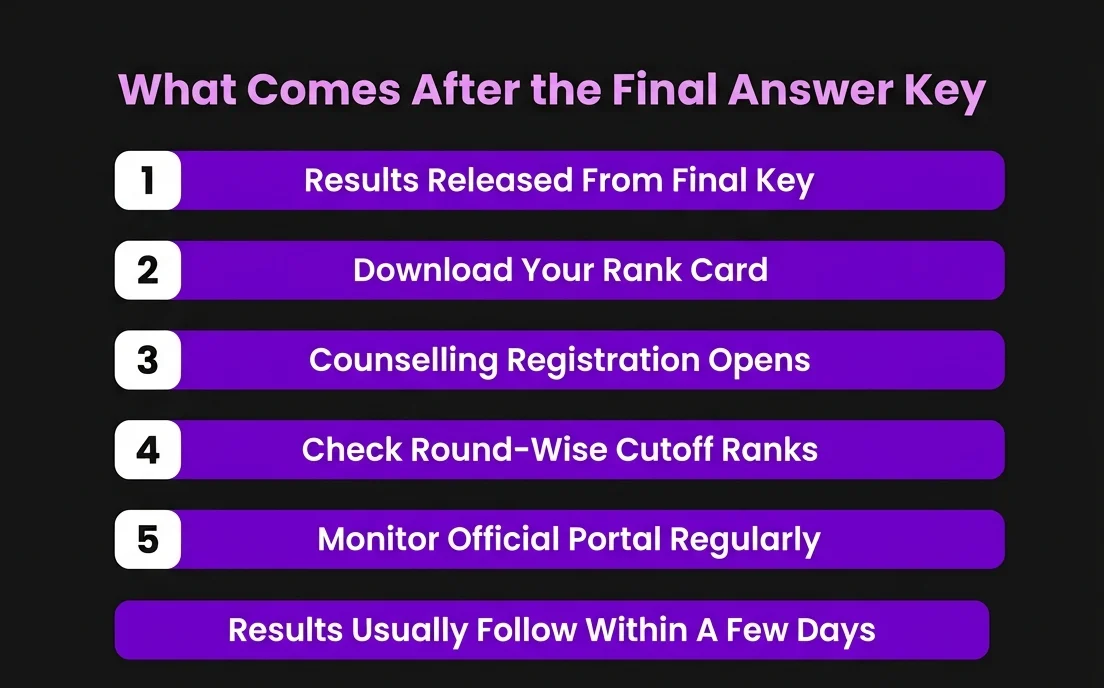
- Results are calculated and released, using only the final answer key, typically within days of its publication.
- Your rank card becomes available for download, showing your calculated score and category-wise rank.
- Counselling registration opens for candidates who cleared the exam, following the separate schedule TGCHE publishes for MPC and BiPC streams.
- Cutoff ranks are published separately, after each counselling round, and are worth checking against your own rank once you know it, rather than relying on last year's figures alone.
The gap between final answer key release and result declaration has generally been short, often just a few days, so it's worth checking the official portal regularly during this window rather than assuming results will follow the exact same timeline every cycle.
Our EAPCET rank card and TG EAPCET counselling pages pick up exactly where the answer key process leaves off.
What We Expect for TG EAPCET 2027
TGCHE hasn't released the 2027 notification yet, so treat the following as a pattern-based expectation:
- The two-stage answer key process (provisional, then final) is likely to continue, following the same structure as recent cycles.
- A short objection window, typically under 48 hours, is likely to repeat, so plan to check the answer key the moment it's released rather than waiting.
- Eligibility criteria are likely to stay consistent, based on how stable these requirements have been across recent years, though always confirmed against the live 2027 notification.
- Registration is expected to open around mid-February 2027, based on the 2026 pattern, with the exam itself likely in early May.
- The objection fee is likely to remain at Rs 300 per question, though fee structures can be revised, so confirm the exact amount once the official 2027 information bulletin is published rather than assuming it carries over unchanged.
Our TG EAPCET dates page will reflect the confirmed 2027 schedule as soon as the official notification is out.
Conclusion
The EAPCET answer key isn't just a document to glance at, it's the single source your entire result is built from, and the provisional stage is your only real window to catch and correct an error. Download it the moment it's live, match question IDs carefully against your response sheet, and use the objection window seriously if you find a genuine discrepancy, since there's no second chance once the final answer key is out.
At Phodu Club, we don't yet have a dedicated paid TG EAPCET product, but our mentorship community and preparation resources are built around exactly this kind of exam-stage guidance. How to prepare for the TG EAPCET page and TG EAPCET rank predictor tool are good next steps once your final answer key and result are out.
Frequently Asked Questions
1) What is the EAPCET answer key?
It's the official answer key TGCHE releases after the exam, first as a provisional version open to objections, then as a final version used to calculate results.
2) Can I challenge the final EAPCET answer key if I disagree with an answer?
No. Objections are only accepted during the provisional answer key window. Once the final answer key is published, no further challenges are entertained.
3) How much does it cost to raise an objection against the EAPCET answer key?
Rs 300 per question challenged, payable at the time of submission through the official objection portal.
4) How long is the objection window typically open?
In 2026, it stayed open for roughly 48 hours after the provisional answer key was released, for both the Engineering and Agriculture & Pharmacy streams.
5) What is the minimum eligibility to appear for TG EAPCET?
You need Intermediate with the relevant subject combination (PCM for engineering, PCB for pharmacy tracks), a minimum 45% aggregate (40% for reserved categories), and to meet the minimum age requirement, generally 16 years.
6) Are BiPC students eligible for engineering courses through TG EAPCET?
No. BiPC-stream students can apply for pharmacy and related BiPC-track courses, but not for B.Tech engineering admissions, which require the MPC combination.
7) When is the TG EAPCET 2027 answer key expected to be released?
TGCHE hasn't announced 2027 dates yet. Based on the 2026 pattern, expect the provisional answer key within a few days of the exam, likely in May 2027, with a short objection window to follow.
8) Where can I get help preparing for TG EAPCET before the answer key stage matters?
Phodu Club's How to Prepare for TG EAPCET page and rank prediction tools are a good starting point, even though we don't yet have a dedicated paid TG EAPCET course.
Want to crack your exam with mentors who did?
Get test series, crash courses and free mentorship from students at IITs, NITs and BITS.