AP EAPCET BiPC stream: Eligibility & Key Details
If you're a BiPC student in Andhra Pradesh weighing your options after Intermediate, MBBS isn't the only door open to you, and it isn't even the one this particular exam leads to. The AP EAPCET BiPC stream is the actual gateway into B.Pharmacy , Pharm D, B.Sc Agriculture, Horticulture, Fisheries Science, and several other genuinely solid career paths, all through a single written test with no negative marking. A lot of students only discover this stream exists once NEET doesn't go their way, when it should really be part of the plan from the very start, not treated as an afterthought once other options have already closed.
Quick Answer
- The AP EAPCET BiPC stream tests Biology (Botany + Zoology), Physics, and Chemistry, 160 questions, 160 marks, no negative marking.
- It leads to B.Pharmacy , Pharm D, B.Sc Agriculture, Horticulture, Forestry, Fisheries Science (BFSc), B.V.Sc & AH, and related B.Tech programmes like Dairy Technology and Food Science.
- It does not lead to MBBS or BDS. Those admissions run entirely through NEET, regardless of your AP EAPCET score.
What the AP EAPCET BiPC Stream Actually Tests
The subject split is fixed and worth knowing cold before you plan your revision time.
| Subject | Questions | Marks |
| Botany | 40 | 40 |
| Zoology | 40 | 40 |
| Physics | 40 | 40 |
| Chemistry | 40 | 40 |
| Total | 160 | 160 |
| Particular | Details |
| Marks per correct answer | 1 |
| Negative marking | None |
| Duration | 3 hours |
| Mode | Computer-based test (CBT) |
| Medium | English, Telugu (limited Urdu assistance at the Kurnool centre) |
| Qualifying marks | 25% for General/OBC (40 out of 160), no minimum for SC/ST |
Since there's no negative marking, attempting every question is close to always the right call. Unlike the MPC stream, where Mathematics alone carries half the paper, the BiPC stream splits its 160 questions evenly across four subjects, which changes how you should distribute revision time compared to a friend prepping for the engineering stream.
Why the BiPC Stream Deserves a Real Plan, Not a Backup Mentality
A lot of BiPC students treat this stream as a fallback in case NEET doesn't work out, which undersells what's actually on offer here.
- The competition is genuinely real. Courses like B.Sc Agriculture routinely draw serious competition for limited seats, so a casual, last-minute approach to this exam can cost you a seat you'd otherwise have qualified for with even a modest amount of structured preparation.
- Career outcomes vary widely by course, not just by rank. A strong rank in B.Pharmacy and a similar rank in B.Sc Agriculture lead to genuinely different career paths, income trajectories, and further-study options, so picking a target course early shapes how you should prepare, not just where you end up sitting once results are out.
- The exam rewards focused practice more than raw memorisation. With four subjects weighted equally and no penalty for wrong answers, consistent, well-rounded preparation across Botany, Zoology, Physics, and Chemistry beats over-investing in just one subject.
Eligibility Criteria for the BiPC Stream
Eligibility isn't uniform across every BiPC-linked course. It shifts depending on which specific programme you're eventually aiming for.
| Criteria | Details |
| Qualifying exam | Class 12 / Intermediate, passed or appearing |
| Required subjects | Biology, Physics, Chemistry (BiPC) |
| Minimum marks | 45% aggregate (General/OBC), 40% (SC/ST) |
| Nationality | Indian national, PIO, or OCI |
| Domicile | Andhra Pradesh, subject to local-status verification during counselling |
| Age ( B.Pharmacy ) | 16 years minimum as of 31 December of the admission year, no upper limit |
| Age (Agriculture, Horticulture, Dairy, Fisheries, Veterinary) | 17 years minimum, 22 years upper limit (25 for SC/ST) |
That age split matters more than it looks. A BiPC student aiming for B.Pharmacy faces a different age rule than the same student aiming for B.V.Sc & AH, even though both fall under the same exam stream and the same written test, and this distinction is easy to miss when reading generic eligibility summaries that treat the whole stream as a single uniform rule.
What Courses This Stream Actually Leads To
This is broader than most students expect going in. It isn't just "pharmacy or agriculture," and each option carries its own set of colleges, cutoffs, and career trajectory worth researching individually and in advance rather than assuming they're interchangeable once results are out.
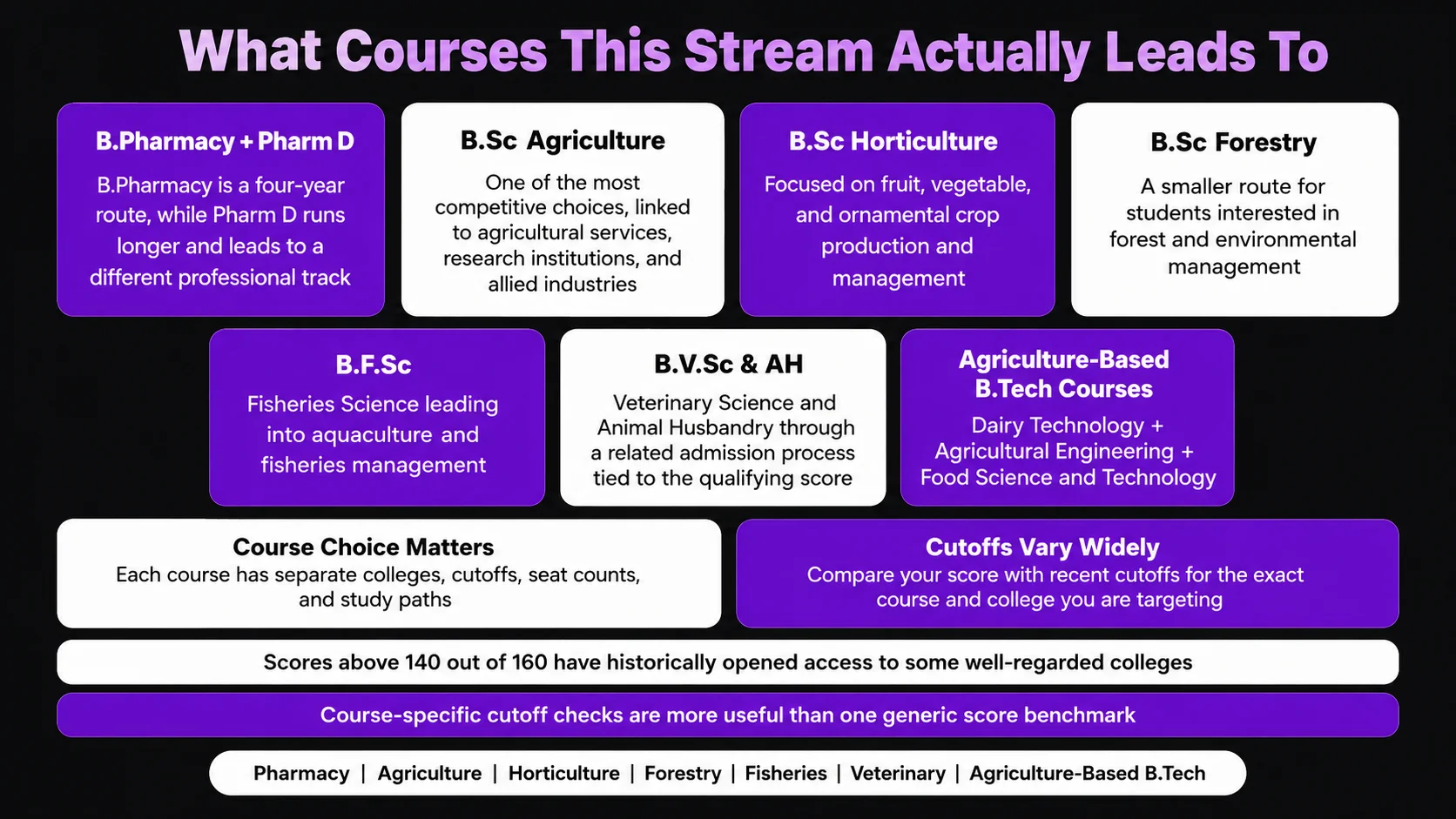
- B.Pharmacy and Pharm D, the most commonly chosen route, with a wide network of colleges across Andhra Pradesh accepting the score. Pharm D in particular runs longer and leads to a different professional track than the standard four-year B.Pharmacy .
- B.Sc Agriculture, consistently one of the most competitive options within this stream, with strong placement and government-linked career pathways through agricultural extension services, research institutions, and allied industries.
- B.Sc Horticulture, a close cousin to Agriculture with its own dedicated colleges and cutoffs, focused specifically on fruit, vegetable, and ornamental crop production and management.
- B.Sc Forestry, a smaller but genuinely viable option for students interested in environmental and forest management careers, often overlooked simply because fewer students know it's available through this exam.
- B.F.Sc (Fisheries Science), another allied-agriculture route with a smaller but stable set of seats, leading into aquaculture and fisheries management careers.
- B.V.Sc & AH (Veterinary Science and Animal Husbandry), admitted through a related process tied to the same qualifying score, and one of the more competitive options within the broader agriculture basket.
- B.Tech in Dairy Technology, Agricultural Engineering, and Food Science and Technology, technical programmes that sit under the broader agriculture umbrella despite carrying a B.Tech title, blending core engineering coursework with an agricultural application focus.
Competitive cutoffs vary a lot by course and college. As a rough reference point, scores above 140 out of 160 have historically opened doors to well-regarded colleges like JNTU Anantapur and Vignan's University, Guntur, though this shifts year to year with difficulty and applicant numbers. Once your AP EAPCET result is out, comparing your score against recent cutoffs for your specific target course is far more useful than relying on a single generic benchmark.
Key Dates: 2026 (Current) & 2027 (Expected)
Here's how the 2026 cycle actually played out, and a reasonable planning estimate for 2027 based on that pattern.
| Event | 2026 (Confirmed) | 2027 (Expected) |
| Notification released | 4 February 2026 | Early February 2027 |
| Application window | February 2026 onward | February 2027 onward |
| Engineering exam | 12, 13, 14, 15, 18 May 2026 | Mid-May 2027 |
| BiPC (Agriculture & Pharmacy) exam | 19-20 May 2026 | Mid-to-late May 2027 |
| Result | 1 July 2026 | Early July 2027 (estimated) |
| BiPC counselling begins | Mid-July 2026 | Mid-July 2027 (estimated) |
Nothing about the 2027 dates is official yet. Treat this table as a planning guide, and check the official notification once it's actually released rather than assuming this exact calendar repeats, since even a shift of a week or two can affect how you time your final revision push relative to your board exams.
BiPC Counselling: What Comes After the Exam
The exam is only the first half of getting a seat. A few things about the process are worth knowing in advance.
- Counselling runs on a separate registration, requiring your AP EAPCET hall ticket number and date of birth to log in, distinct from the exam application itself. Our AP EAPCET counselling guide covers this process step by step.
- Counselling fees are modest but real: roughly Rs. 1,200 for OC/BC candidates and Rs. 600 for SC/ST candidates, payable online.
- The process follows certificate verification, then web options entry, then seat allotment, typically compressed into a few weeks across July and early August.
- Reporting to your allotted college is mandatory within a set window, and missing it can cost you the seat entirely, so track this date as closely as the exam date itself. Check the AP EAPCET seat allotment page once results are declared to understand exactly how this timeline unfolds.
Common Points of Confusion
A few misunderstandings come up often enough among BiPC students that they're worth addressing directly.
- Assuming this stream leads to MBBS. It doesn't. MBBS and BDS admissions run entirely through NEET, regardless of your Biology, Physics, Chemistry background or your AP EAPCET score.
- Assuming the BiPC stream is only about pharmacy. Agriculture, horticulture, forestry, fisheries, veterinary science, and several allied B.Tech programmes are all genuinely part of the same stream.
- Confusing this exam with Telangana's version. Andhra Pradesh and Telangana run separate exams under similar names, with separate counselling processes and separate seat pools. A score from one doesn't carry into the other state's seat allotment, even though the subject pattern looks nearly identical on paper.
- Underestimating how much the age rule varies by course. The 16-versus-17-years split between Pharmacy and Agriculture-linked courses catches students off guard if they assumed a single uniform age rule applied to the whole stream.
- Ignoring the qualifying marks threshold. General and OBC candidates need at least 25% to be considered for the rank list at all. This is a real cutoff, not just a formality.
- Not distinguishing Class 11 and Class 12 syllabus weightage. Like most state-level entrance exams, the Class 12 portion tends to carry more direct weight in the actual paper, so revision plans that spend equal time on both years without checking this balance can leave gaps in the areas that matter most on exam day, right when there's the least time left to fix them.
Getting Ready for the AP EAPCET BiPC Stream
A few starting points help before you get deep into subject-specific revision.
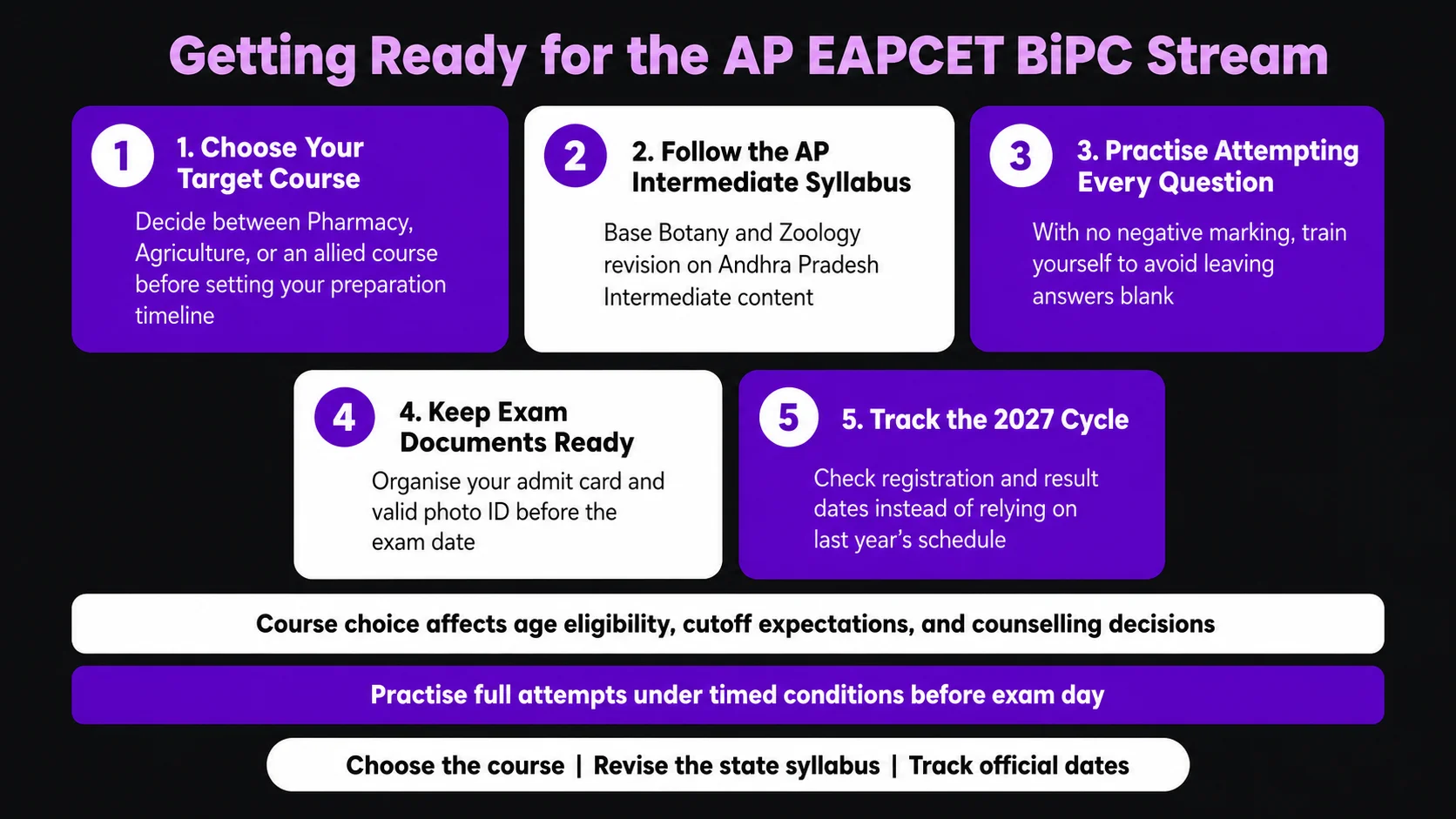
- Confirm which specific course, Pharmacy, Agriculture, or one of the allied options, you're actually targeting, since the age eligibility and competitive cutoff differ enough to shape your whole prep timeline. Deciding this early also helps you interpret your rank realistically once results land, rather than scrambling to research options during the narrow counselling window.
- Build your Botany and Zoology revision around the Andhra Pradesh Intermediate syllabus specifically, since state board content and emphasis can differ from NCERT in places, even though the broader topics overlap heavily.
- Since there's no negative marking, practice attempting every question under timed conditions rather than skipping ones you're unsure about, and build this instinct well before exam day rather than trying to unlearn a negative-marking mindset at the last minute.
- Keep your documents, admit card, and a valid photo ID organised well ahead of the exam date. Our AP EAPCET hall ticket page covers what's typically required and when it's usually released.
- Track the AP EAPCET registration and AP EAPCET result pages as the 2027 cycle approaches, since both the application and result timelines shift slightly year to year, and relying on last year's exact dates from memory is a common, avoidable mistake.
Where Phodu Club Fits In
We connect students preparing for exams across India's engineering and allied entrance landscape with mentors who understand the practical realities of decisions like stream choice and course selection, not just the textbook syllabus. If you're a BiPC student weighing Pharmacy against Agriculture, or trying to make sense of where your expected score realistically lands you, our team is a genuine resource to talk through the decision, even before you've locked in a formal prep plan. Our breakdown of how your Intermediate marks affect your final rank is worth reading early, since this detail catches a lot of BiPC students off guard later in the process, often only once counselling has already started and there's little room left to adjust.
We'd rather point you toward accurate, current information than let confusion about course options, age rules, or exam mechanics cost you time you could be spending on actual preparation.
Getting the fundamentals right, which courses this stream actually opens up, which age rule applies to your specific target, and how the exam itself is structured, is the foundation everything else gets built on.
Frequently Asked Questions
1) What subjects does the AP EAPCET BiPC stream test?
It tests Botany, Zoology, Physics, and Chemistry, 40 questions each, for a total of 160 questions and 160 marks, with no negative marking.
2) Does this stream lead to MBBS?
No. MBBS and BDS admissions in India run entirely through NEET. This stream leads to Pharmacy, Agriculture, and related allied undergraduate programmes instead.
3) What courses can I get into through this stream?
B.Pharmacy , Pharm D, B.Sc Agriculture, B.Sc Horticulture, B.Sc Forestry, B.F.Sc (Fisheries Science), B.V.Sc & AH, and B.Tech programmes in Dairy Technology, Agricultural Engineering, and Food Science and Technology, spanning a much wider set of career paths than most students assume going in.
4) What are the minimum marks required for BiPC eligibility?
45% aggregate in the qualifying exam for General and OBC candidates, and 40% for SC/ST candidates. Separately, a qualifying score of at least 25% in the exam itself is needed to be considered for the rank list, so meeting the board-marks eligibility alone doesn't guarantee you'll actually feature in the counselling process.
5) Is the age limit the same for every course under the AP EAPCET BiPC stream?
No. Pharmacy courses require a minimum age of 16 with no upper limit, while Agriculture, Horticulture, Dairy, Fisheries, and Veterinary courses require a minimum age of 17, with an upper limit of 22 (25 for SC/ST candidates). Always check the specific requirement for your target course rather than assuming one rule applies stream-wide.
6) Is AP EAPCET BiPC the same as Telangana's BiPC exam?
No. They're separate exams run by different authorities for different states, even though the subject pattern and structure are nearly identical. Scores don't transfer between the two states' counselling processes.
7) When will the AP EAPCET BiPC stream exam be held in 2027?
The official 2027 notification hasn't been released yet. Based on the 2026 pattern, expect the BiPC exam in mid-to-late May 2027, following a notification in early February and an application window opening shortly after.
8) What score is considered good for the AP EAPCET BiPC stream?
This varies significantly by target course and college. As a rough reference, scores above 140 out of 160 have historically been competitive for well-regarded colleges, though this shifts each year with difficulty level and the number of applicants, so treat any specific number as a trend indicator rather than a guarantee.
Want to crack your exam with mentors who did?
Get test series, crash courses and free mentorship from students at IITs, NITs and BITS.