How Your Intermediate Marks Quietly Decide Your EAPCET Rank

At Phodu Club, we get this question all the time: "Why did my friend get a better rank with a lower entrance score?" The answer almost always lies in their board exams. We see students putting all their energy into solving complex mock tests while completely ignoring their board preparation. This is a massive mistake. The weightage of your Intermediate Marks in EAPCET Rank is the silent factor that shifts hundreds of ranks overnight. If you are preparing for AP EAPCET 2026 or 2027, you need to understand exactly how this math works.
Quick Answer/TL;DR
- Rank calculation relies on a strict 75:25 ratio.
- 75% weightage comes from your normalized entrance exam score.
- 25% weightage comes from your core Intermediate group subjects.
- Even a small 10-mark difference in boards heavily impacts final ranks.
Understanding EAPCET Rank Calculation: The 75:25 Formula
Many students we work with at Phodu Club are completely confused by the official ranking process. They assume their raw entrance score is the only metric that matters. But the official process is far more strategic.
The ranking system uses a combined score calculated out of a total of 100 points. This is determined by a 75:25 formula. Your normalized entrance exam score accounts for 75% of your final rank. Meanwhile, your Intermediate group marks make up the remaining 25%. When we talk about these board marks, we specifically mean your core group subjects (Mathematics, Physics, and Chemistry for the engineering stream) from both your first and second years. Languages like English or Sanskrit, and practical exams outside these core subject totals, are factored differently depending on the exact board structure, but the core 600 marks are what usually drive the formula.
Here is the exact step-by-step formula we use to help our students map out their projected scores:
- Step 1: Calculate your IPE Component Take your total group marks obtained in your board exams (usually out of 600). Formula: (Your group marks / 600) x 25
- Step 2: Calculate your EAPCET Component Take your normalized entrance marks (out of 160). Formula: (Your normalized marks / 160) x 75
- Step 3: Find your Combined Score Add both components together to get your final, rank-deciding score out of 100.
Let us look at a practical example. Suppose one of our students scores 540 out of 600 in their Intermediate group subjects. They also secured 100 out of 160 in the entrance exam. Their IPE component is calculated as (540 / 600) x 25 = 22.5. Their EAPCET component is calculated as (100 / 160) x 75 = 46.87. Their total combined score is 22.5 + 46.87 = 69.37.
This combined score is what directly dictates the role of Intermediate Marks in EAPCET Rank allocation. Understanding this baseline formula is the first mandatory step to setting realistic target scores for both your final board exams and your entrance test preparation.
How Much Do Intermediate Marks Really Matter? Real Impact Analysis
We have seen this pattern again and again: students with mediocre entrance scores easily bypassing students with high entrance scores simply because of their strong board performance. To understand this real-world impact, we analyzed data patterns and real student scenarios from recent counselling sessions.
Let us compare three different student personas to see how the math plays out in real life.
Student A (The Entrance Extremist): This student focuses entirely on entrance prep. They score an impressive 110 out of 160 in the entrance exam. However, they ignored their board exams and scored just 450 out of 600 in their group subjects.
- EAPCET Component: (110 / 160) x 75 = 51.56
- IPE Component: (450 / 600) x 25 = 18.75
- Total Score: 70.31
Student B (The Balanced Performer): This student balances both exams. They score a moderate 95 out of 160 in the entrance exam, but they scored a solid 580 out of 600 in their board group subjects.
- EAPCET Component: (95 / 160) x 75 = 44.53
- IPE Component: (580 / 600) x 25 = 24.16
- Total Score: 68.69
Student C (The Board Topper): This student struggled with objective MCQs, scoring only 80 out of 160 in the entrance test. But they are a board exam topper with 595 out of 600.
- EAPCET Component: (80 / 160) x 75 = 37.50
- IPE Component: (595 / 600) x 25 = 24.79
- Total Score: 62.29
Look closely at Student A and Student B. A massive 15-mark lead in the entrance exam was almost completely erased by Student B's strong board performance. If Student A had scored just 2 or 3 marks lower in the entrance test, Student B would have taken the better rank and the better college seat. This proves how the impact of Intermediate Marks in EAPCET Rank generation acts as a massive safety net for average test-takers who put in the consistent daily work for their boards.
We also have to consider the edge cases. What happens during AP EAPCET seat allotment when two students get the exact same combined score? The tie-breaker rules are strictly defined. First, the system will prioritize the total entrance exam marks. If a tie remains, it looks at the Mathematics score in the entrance exam, followed by the Physics score. If all these numbers somehow match, the older candidate is awarded the better rank.
There are also basic eligibility nuances. Irrespective of the weightage formula, you still need a minimum passing percentage in your group subjects just to qualify for counselling. For general category students, this is typically 45% (40% for reserved categories). If you fail to meet this basic requirement, your rank becomes entirely invalid, no matter how high it is.
EAPCET Marks vs Rank with Different Intermediate Percentages
To make this abstract math easier to visualize, we built reference tables based on recent AP EAPCET results trends. These tables show exactly how varying board performances shift your expected rank range, assuming the entrance score remains the same.
Scenario 1: Average Entrance Score (75/160)
Many students land in this average bracket. Here is how your board marks decide your fate:
| EAPCET Score | Inter Group % (Marks) | Combined Score | Expected Rank Range (General) |
| 75 | 98% (588/600) | 59.65 | 30,000 to 35,000 |
| 75 | 85% (510/600) | 56.40 | 45,000 to 52,000 |
| 75 | 70% (420/600) | 52.65 | 70,000 to 80,000 |
Notice how, at the same entrance score of 75, dropping from 98% to 70% in your boards pushes you down by nearly 40,000 ranks.
Scenario 2: Good Entrance Score (100/160)
When you hit the 100-mark threshold, competition gets tighter, and decimals matter more.
| EAPCET Score | Inter Group % (Marks) | Combined Score | Expected Rank Range (General) |
| 100 | 98% (588/600) | 71.37 | 5,000 to 8,000 |
| 100 | 85% (510/600) | 68.12 | 12,000 to 16,000 |
| 100 | 70% (420/600) | 64.37 | 25,000 to 30,000 |
Scenario 3: Top-Tier Entrance Score (130/160) At the highest levels, board marks are the only thing separating the top 100 from the top 1,000.
| EAPCET Score | Inter Group % (Marks) | Combined Score | Expected Rank Range (General) |
| 130 | 98% (588/600) | 85.43 | 100 to 500 |
| 130 | 85% (510/600) | 82.18 | 1,000 to 2,000 |
| 130 | 70% (420/600) | 78.43 | 3,500 to 5,000 |
These tables clearly demonstrate that treating your boards casually is a fast way to ruin your college prospects. When you are fighting for top Computer Science seats in prime universities, cutoffs are brutal. A drop of just 1.5 combined score points can push you out of a premier government college and force you into a tier-2 backup. The substantial weightage of Intermediate Marks in EAPCET Rank calculation means your board exams are literally worth thousands of ranks.
Common Myths and Misconceptions
At Phodu Club, we spend a massive amount of our mentoring time debunking bad advice. There is a lot of dangerous misinformation floating around coaching centers about the ranking system. Let us clear up the most common myths we hear from our students.
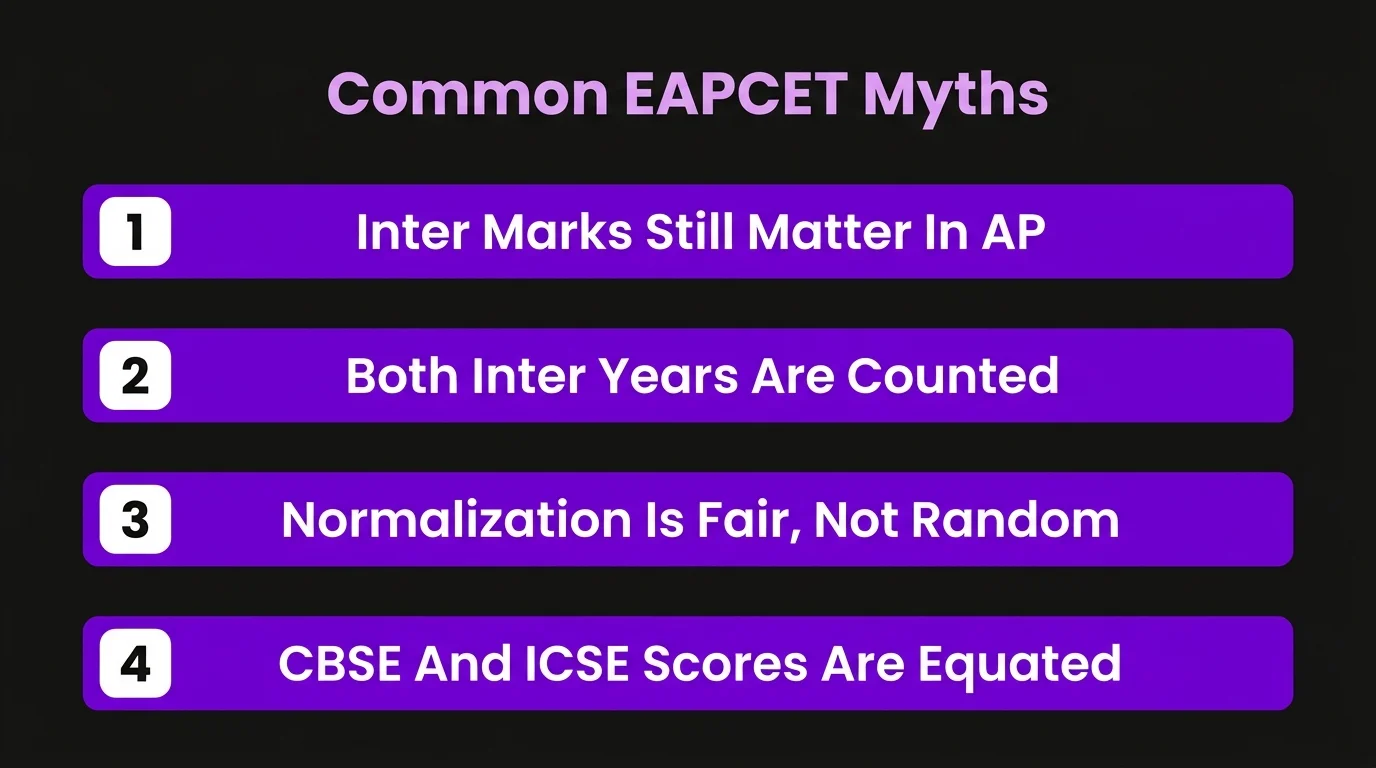
Myth 1: "Inter marks don't matter anymore."
This is the most common and dangerous myth. Many students confuse the rules across different states. While the neighboring state removed the weightage for TG EAPCET , Andhra Pradesh has historically maintained it. Unless an official APSCHE notification explicitly scraps the rule for your specific exam year, you must prepare assuming the 75:25 rule is fully active. Do not gamble your career on a rumor.
Myth 2: "Only final year Inter marks count."
This is completely false. The 25% weightage calculation includes your group subjects from both your first year (Inter 1st Year) and second year (Inter 2nd Year). If you performed poorly in your first year, you cannot just ignore it; you need to work twice as hard in your final year to balance the overall average.
Myth 3: "Normalization ruins good scores, so nothing matters."
Many students believe normalization is a randomized penalty. It is not. Normalization is a mathematical process designed to be fair, adjusting scores based on the varying difficulty levels of different exam shifts. The inclusion of your Intermediate Marks in EAPCET Rank lists actually provides a highly stable, un-normalized foundation that you have total control over. You cannot control whether you get a difficult physics section in your entrance shift, but you can entirely control how well you prepare for your board exams.
Myth 4: "CBSE or ICSE students are at a disadvantage."
The ranking algorithm normalizes board scores to ensure fairness across different educational boards. While the state board is the primary baseline, CBSE and ICSE students' marks are proportionally equated. A 95% in CBSE holds strong weight and is not inherently downgraded just because it is not the state board.
Top Colleges in EAPCET
Knowing your target score is relatively useless if you do not know which colleges are worth fighting for. Our students constantly ask us which institutions they should prioritize during EAPCET counselling . The competition for these colleges is exactly why every single fraction of your combined score matters.
Top Government / University Colleges
These colleges offer excellent return on investment, experienced faculty, and highly subsidized fee structures.
| College Name | Location | Type |
| JNTU Kakinada (JNTUK College of Engineering) | Kakinada | Government University |
| Andhra University College of Engineering (AUCE) | Visakhapatnam | Government University |
| Sri Venkateswara University College of Engineering (SVUCE) | Tirupati | Government University |
| JNTUA College of Engineering | Anantapur | Government University |
Top Private / Autonomous / Deemed Colleges
These institutions are known for strong placement cells, modern infrastructure, and robust alumni networks.
| College Name | Location | Type |
| Vignan's Foundation for Science, Technology & Research | Guntur | Deemed University |
| GMR Institute of Technology (GMRIT) | Rajam | Autonomous |
| Gayatri Vidya Parishad College of Engineering (GVPCE) | Visakhapatnam | Autonomous |
| VR Siddhartha Engineering College (VRSEC) | Vijayawada | Autonomous |
| GITAM University | Visakhapatnam | Deemed University |
| KL University (Koneru Lakshmaiah) | Vaddeswaram, Guntur | Deemed University |
| Sree Vidyanikethan Engineering College | Tirupati | Autonomous |
Strategies to Leverage or Improve Your Position
So, what should you do with all this data? We always tell our aspirants: effort alone does not fix your score. The right strategy does. Here is how you can leverage this ranking system to your absolute advantage.
Pre-exam Strategy: What we focus on first is integration. Do not separate your board prep from your entrance prep. This is a classic mistake. Over 85% of the entrance syllabus overlaps directly with your state board textbooks. When you study a chapter like Thermodynamics or Calculus for your boards, do not just stop at the subjective proofs. Immediately solve 50 objective MCQs from that same chapter. This builds your foundational base and secures your board percentage simultaneously.
Post-exam Strategy: Once your board results are out, verify them meticulously. If you feel your board marks are even slightly lower than expected due to correction errors, apply for re-verification immediately. A few extra marks gained through re-evaluation will permanently improve your Intermediate Marks in EAPCET Rank calculation. After the entrance exam, use data-driven EAPCET rank predictors that properly factor in both components to plan your next steps.
Counselling Tips: Your combined score completely dictates your position during the web options phase. If you have a lower combined score, do not lose hope. Research the cutoffs for spot admissions thoroughly. Many top-rankers drop out of state private colleges to join NITs or IITs after JOSAA counselling, opening up spot round seats for students with average ranks.
For Repeaters: If you are taking a drop year because you were stuck at a score plateau, check if you are eligible to write improvement exams for your boards. Upgrading your group subject total is the easiest, most predictable way to give your combined score a permanent boost before you even sit for the next entrance test.
Conclusion
We built Phodu Club to fix this exact problem: students putting in massive hours but failing to see results because they lack a clear direction. They study blindly without understanding the mathematical rules of the game they are playing. Now that you understand the true value of your Intermediate Marks in EAPCET Rank generation, you can stop guessing and start building a real plan.
We have worked with enough students to know this reality: just solving endless questions does not fix why your scores aren't improving. You need a strategy that balances your board exams with high-speed mock test practice. You need to know exactly which chapters yield the highest return on investment.
That is exactly what we focus on at Phodu Club. Versus generic coaching that treats everyone the same, we focus on identifying your individual gaps. If you are struggling with time pressure, poor accuracy, or confusion about how to balance your preparation, check out our intensive EAPCET Crash Course and test series. Stop leaving your rank to chance, and let us help you take control of your preparation today.
Frequently Asked Questions (FAQ)
1) Does EAPCET consider only Inter group marks?
Yes, the calculation is highly specific. The 25% weightage applies strictly to your core group subjects. For engineering aspirants, this means Mathematics, Physics, and Chemistry from both your first and second year. Languages (like English) and practicals outside these core subjects are not factored into this specific weightage calculation.
2) How to calculate the exact combined score?
You calculate it by processing the 75:25 formula. First, divide your total board group marks by 600 and multiply by 25. Next, divide your normalized entrance score by 160 and multiply by 75. Finally, add these two resulting numbers together to find your final combined score out of 100.
3) What if I have low Inter marks but a high EAPCET score?
A high entrance score can absolutely compensate for a weak board performance because the entrance test holds the majority 75% weightage. However, you must still ensure you meet the minimum qualifying board percentage (usually 45% for general category) to remain eligible for the counselling process.
4) How exactly do Intermediate Marks in EAPCET Rank calculation differ from TS EAPCET?
This is a frequent point of confusion among our students. The state of Telangana permanently removed the 25% board weightage for TS EAPCET , meaning their ranks are based 100% on the entrance score. However, Andhra Pradesh has traditionally maintained the 75:25 system, which is why Intermediate Marks in EAPCET Rank calculation remains a critical focus for AP students.
5) What is the minimum qualifying mark for the entrance exam?
For general category students, the minimum qualifying mark in the AP EAPCET exam is 25% of the maximum marks, which equals 40 out of 160. For candidates belonging to Scheduled Castes (SC) and Scheduled Tribes (ST), there is no minimum qualifying mark requirement.
6) What is the impact on specific branches and colleges?
For highly competitive branches like Computer Science (CSE) in top government colleges, cutoffs often come down to decimal points. In these high-stakes scenarios, the subtle weight of your Intermediate Marks in EAPCET Rank placement is often the exact deciding factor between securing a free government seat or paying heavy management fees at a private institution.
7) Will re-evaluation of board marks affect my rank?
Yes, it absolutely will. If you apply for board re-evaluation and your group subject marks increase, your new score will be updated in the system. This increased total will be used in the 25% weightage calculation, which can positively shift your final combined score and improve your rank.
8) Does Phodu Club offer specific mentorship for EAPCET preparation?
Yes, we do. At Phodu Club, we provide specialized crash courses, high-quality test series, and personalized mentorship designed specifically for state entrance exams like EAPCET. We help students stuck at average scores identify their weak areas, improve their speed and accuracy, and balance their board prep effectively.
Want to crack your exam with mentors who did?
Get test series, crash courses and free mentorship from students at IITs, NITs and BITS.