UGEE Paper Pattern: Full Syllabus & Pattern
Every UGEE aspirant we mentor starts prep the same way most students would: by assuming it's basically a JEE Main-style PCM paper with a different name. It isn't, not entirely. The UGEE Paper Pattern splits into two genuinely different sections, one that tests what you already know and one that tests how you actually think, and treating them the same way in your prep is the single most common reason students undersell themselves on the REAP section specifically.
That misreading is understandable. Most students walk into UGEE prep straight from a JEE-focused routine, where the entire game is subject mastery and speed on familiar problem types. UGEE keeps that expectation alive for exactly one hour, then spends the next two testing something closer to how you'd approach a genuinely unfamiliar problem under time pressure. Getting comfortable with both halves, not just the one that feels familiar, is really the whole preparation challenge here.
Quick Answer
The UGEE Paper Pattern has two sections across 3 hours: SUPR (50 questions, 50 marks, 60 minutes, PCM-based) and REAP (50 questions, 100 marks, 120 minutes, reasoning-based). Total is 100 questions for 150 marks, with 25% negative marking in both sections. SUPR qualifies you; REAP decides your rank.
UGEE Paper Pattern at a Glance
Here's the full structure in one place before we get into what each section actually tests.
| Detail | SUPR | REAP |
| Full name | Subject Proficiency Test | Research Aptitude Test |
| Duration | 60 minutes | 120 minutes |
| Number of questions | 50 | 50 |
| Total marks | 50 (1 mark per question) | 100 (2 marks per question) |
| Negative marking | 0.25 per wrong answer | 0.5 per wrong answer |
| What it covers | Physics, Chemistry, Mathematics (Class 11-12 level) | Logical reasoning, data interpretation, research-oriented thinking |
| Role in selection | Qualifying, filters applicants for REAP evaluation | Rank-deciding, determines interview shortlist order |
| Overall | Detail |
| Total duration | 3 hours |
| Total questions | 100 |
| Total marks | 150 |
| Question type | MCQ, 4 options per question |
| Mode | Computer-based test (CBT) |
| Medium | English only |
This structure is intentionally lopsided in how it weighs the two sections. SUPR carries fewer marks per question and functions mainly as a filter, while REAP is worth double per question and is the section that actually separates candidates for the interview shortlist. If you're prepping for UGEE the same way you'd prep for a pure PCM exam, you're under-investing in exactly the half that decides your outcome.
For the full breakdown of how many questions come from where, our how many questions in UGEE page has the section-wise numbers, and our UGEE marking scheme page covers the negative marking math in more detail.
SUPR: What It Actually Tests
SUPR is the section most students recognise instantly, since it plays out like a compressed, PCM-only aptitude round.
- It's genuinely fast-paced. 50 questions in 60 minutes gives you just over a minute per question, so speed and accuracy both matter, not just conceptual clarity.
- The level is broadly comparable to JEE Main, drawing from Class 11 and 12 Physics, Chemistry, and Mathematics, though IIIT Hyderabad's own sample questions lean toward direct concept application rather than the multi-step layering JEE Advanced tests.
- Physics and Mathematics carry more weight than Chemistry. This shows up consistently across past papers and IIIT Hyderabad's own sample sets, even though there's no official percentage breakdown published.
- It's a qualifying filter, not a scoring goal in itself. You need to clear SUPR's sectional cutoff for your REAP answers to even be evaluated, but beyond that threshold, chasing a very high SUPR score doesn't add proportional value to your final rank.
Our SUPR UGEE page goes deeper into section-specific strategy, and our UGEE syllabus page covers preparation resources for the PCM portion specifically.
REAP: What It Actually Tests
REAP is where this exam genuinely diverges from a standard engineering entrance test, and it's the section most students underprepare for.
- It has no fixed syllabus in the traditional sense. REAP is built around reasoning, data interpretation, arithmetic applied in unfamiliar ways, and critical or creative thinking, not a memorisable chapter list.
- Question styles include logical reasoning, data interpretation, algebra and geometry applied to novel situations, and sometimes puzzle or pattern-recognition style problems. These test how you approach an unfamiliar problem, not whether you've memorised a formula.
- It carries twice the marks per question of SUPR, which is IIIT Hyderabad's clearest signal that this section matters more for your final rank.
- It genuinely rewards reading and reasoning practice over rote revision. Students who do well here tend to have built comfort with case-study style questions and multi-step logical deduction, not just more hours of PCM formula drilling.
If you want a closer look at what this section is really evaluating, our pieces on what REAP really tests , why strong reading skills matter for cracking REAP , and UGEE tests how you think, not what you memorised go well beyond what a pattern table alone can tell you.
Full Syllabus: What's Actually Official, and What Isn't
This is the part most UGEE guides gloss over, and it matters for how you plan your prep. IIIT Hyderabad's own UGEE notification does not publish a detailed, chapter-by-chapter syllabus the way JEE Main or VITEEE do. The official guidance is genuinely brief: SUPR and REAP are based on Class 11 and 12 level Physics, Mathematics, and Chemistry, with REAP additionally emphasising critical and creative thinking. That's it. There's no official topic list beyond that.
What circulates online as a "detailed UGEE syllabus" is almost always a third-party reconstruction, built from analysing past papers and sample questions, not an IIIT Hyderabad document. It's still useful, since these patterns are reasonably consistent year to year, but treat it as informed guidance rather than an official checklist.
| Section | Commonly Cited High-Weightage Areas (Not an Official List) |
| Physics | Mechanics, Electromagnetic Induction and AC, Waves and Oscillations, Thermodynamics, Optics |
| Mathematics | Calculus, Probability, Permutations and Combinations, Coordinate Geometry, Sequences and Series, Algebra |
| Chemistry | Physical Chemistry, Thermodynamics, Chemical Bonding, Electrochemistry (generally lower weightage than Physics and Maths) |
| REAP | Data interpretation and logical reasoning, arithmetic and basic PCM applied to novel problems, algebra and geometry-based reasoning |
Given this, the most reliable prep strategy is to cover the full Class 11-12 PCM syllabus properly, since IIIT Hyderabad hasn't ruled out any part of it, and then use official sample questions and past papers to understand UGEE's specific question style rather than hunting for a definitive chapter list that doesn't exist. This matters more than it might sound like, since a student who skips a topic purely because it wasn't on someone's unofficial list can be caught out by a question that official guidance never excluded in the first place. Our UGEE syllabus PDF and is UGEE syllabus the same as JEE pages address this overlap in more detail.
How SUPR and REAP Work Together in Your Final Rank
The two-section structure isn't just an administrative split, it's the actual selection logic.
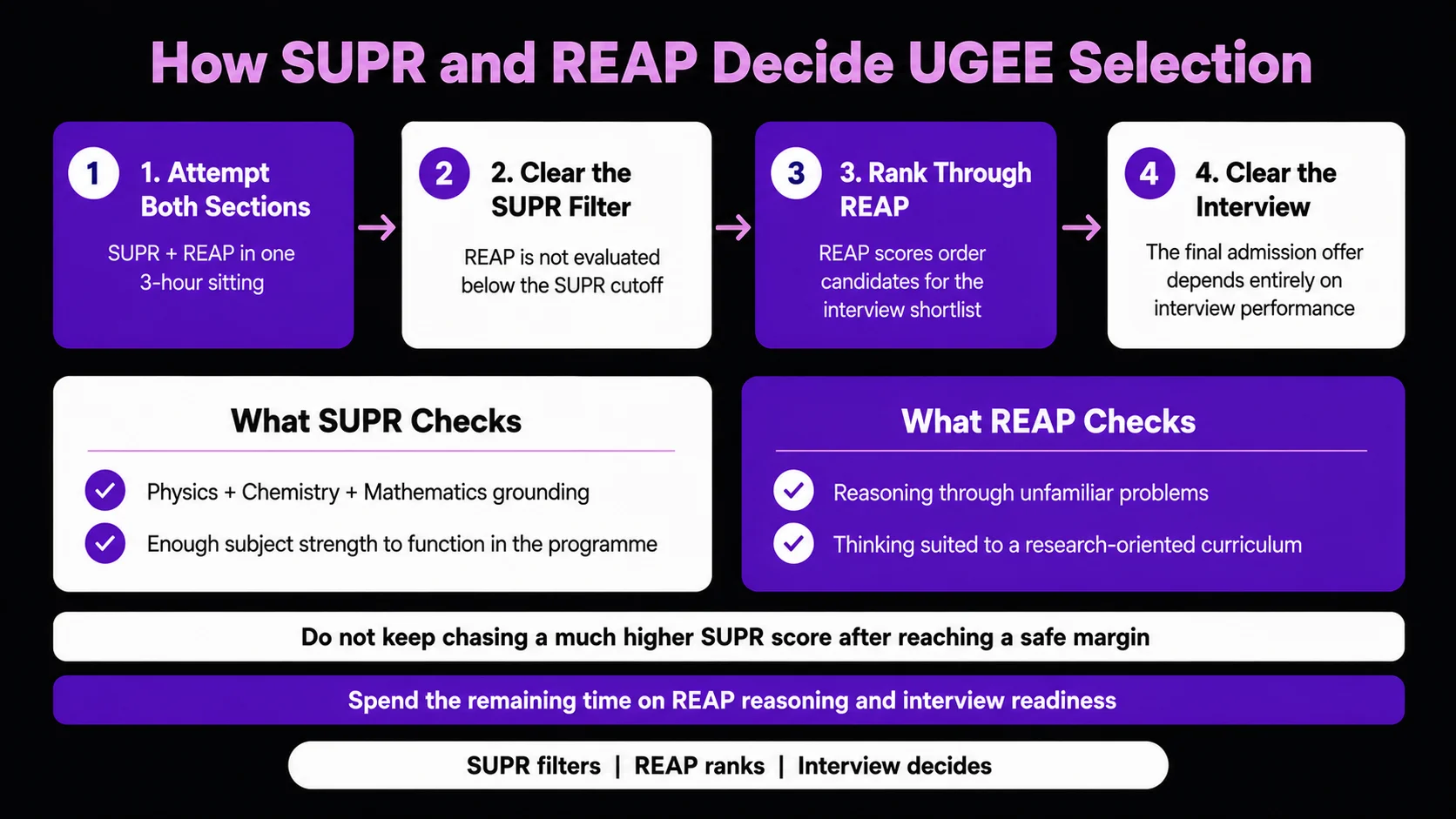
- Every applicant attempts both sections in one 3-hour sitting. There's no separate scheduling.
- SUPR scores are used first, as a filter. Applicants below the SUPR cutoff don't have their REAP answers evaluated at all, regardless of how well they might have done there.
- REAP scores rank everyone who clears the SUPR filter. This ranking is what determines your interview shortlist position.
- The interview is the final, decisive stage. Even a strong SUPR and REAP combination only gets you an interview call. IIIT Hyderabad's own admission page is explicit that the final offer rests entirely on interview performance.
This structure is exactly why we tell students not to over-invest in SUPR beyond a comfortable margin above the cutoff. Every additional hour spent pushing an already-safe SUPR score higher is an hour not spent on REAP's reasoning practice or interview preparation, both of which carry more weight in what actually decides your seat.
It's also worth understanding what this two-stage filter is actually designed to select for. IIIT Hyderabad's dual-degree programmes end in a research thesis, not just a technical degree, so the institute is deliberately screening for candidates who can think through unfamiliar, open-ended problems, not just candidates who are fast and accurate on known question types. SUPR confirms you have the subject grounding to function in the programme. REAP is IIIT Hyderabad's attempt to see, within the constraints of a timed written test, whether you approach problems the way their research-oriented curriculum expects. Keeping that intent in mind while you prepare tends to produce better REAP practice than treating it as just another scoring section to grind through.
What Students Get Wrong About the UGEE Paper Pattern
We've mentored enough UGEE aspirants to see the same misreadings of this exam come up repeatedly.
- Treating REAP like a second PCM section. It isn't testing formulas, it's testing how you reason through something you haven't seen before. Preparing for it with more PCM revision doesn't transfer the way students expect.
- Chasing a maximum SUPR score. Once you're safely past the cutoff, additional SUPR marks don't compound your rank the way REAP marks do, since REAP alone determines ranking among qualified candidates.
- Assuming a published "syllabus PDF" is official. Most of what's online is a reasonable third-party reconstruction based on past papers, not an IIIT Hyderabad document. Useful for planning, not a guarantee of coverage.
- Ignoring negative marking asymmetry. REAP's penalty per wrong answer is double SUPR's in absolute terms, since each REAP question is worth twice as much. A careless guess costs more there than in SUPR.
- Forgetting the interview is the actual deciding stage. A strong written score gets you a seat at the table, not the seat itself. Students who stop preparing the moment SUPR and REAP are done are underprepared for what actually finalises admission.
What to Expect for UGEE 2027
IIIT Hyderabad hasn't released its UGEE 2027 notification at the time of writing, so treat the current structure as the best available reference, not a locked-in guarantee. That said, the UGEE Paper Pattern has stayed structurally stable across recent cycles, with the same 100-question, 150-mark, SUPR-then-REAP format holding through 2025 and 2026. Barring an official announcement to the contrary, students preparing for 2027 should build their plan around this exact structure.
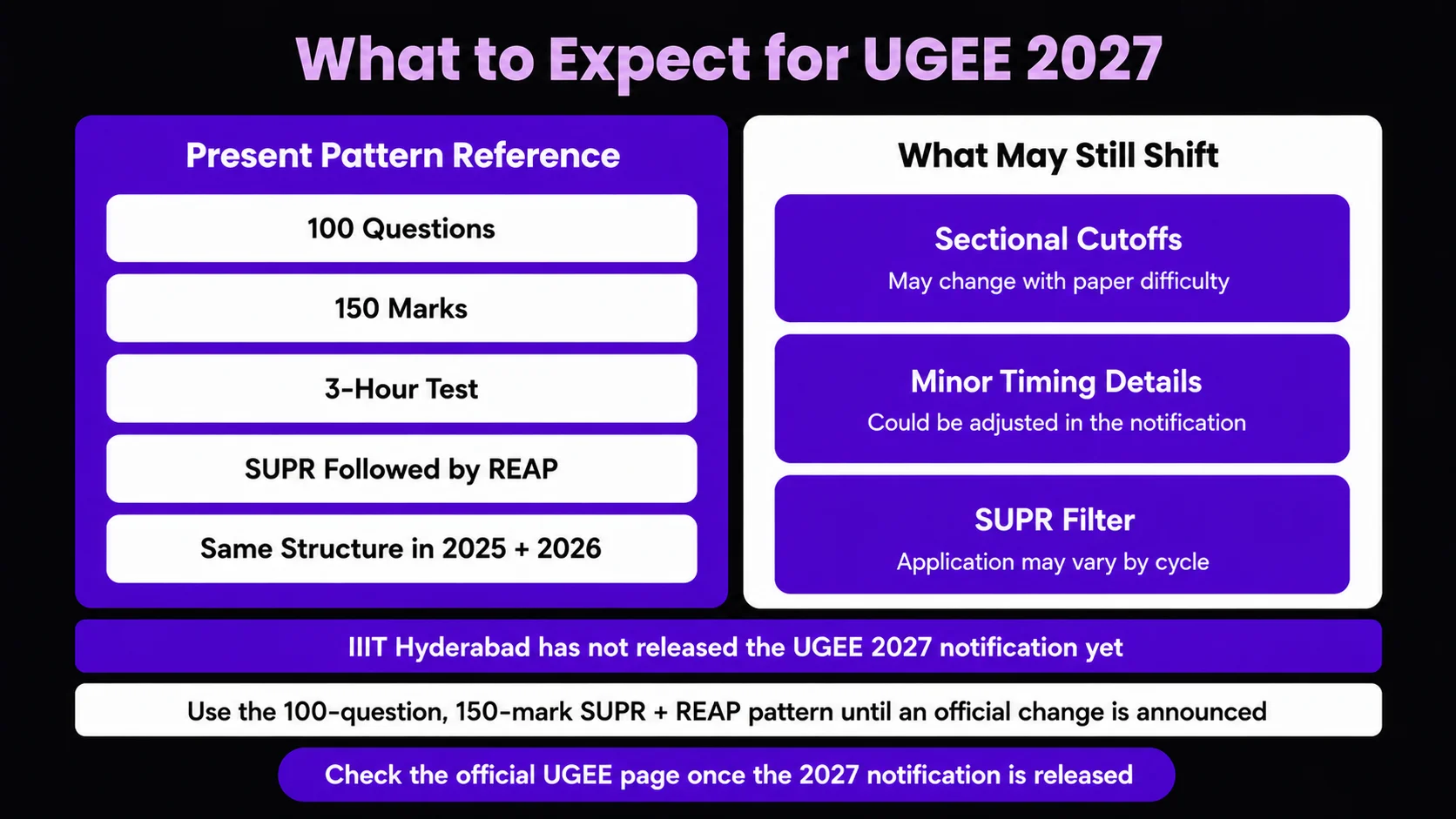
What's genuinely worth tracking each year is smaller shifts, exact cutoff trends, minor timing adjustments, or how strictly the SUPR filter is applied, rather than expecting a structural overhaul. Confirm the specifics directly on IIIT Hyderabad's official UGEE page once the 2027 notification is out, and treat everything here as the current pattern to prepare against until then. Given how consistent the last two cycles have been, that's a reasonably safe bet to build a full prep timeline around, rather than waiting for confirmation before you start.
Where Phodu Club Fits In
Understanding this structure on paper is one thing. Building the actual speed for SUPR and the reasoning instincts for REAP under real time pressure is a different challenge entirely, and it's where most self-study plans quietly fall short.
Our Ultimate UGEE Test Series is built specifically around this exact split. It includes 10 full-length mock tests built to the UGEE syllabus and pattern, with unlimited attempts so you can keep sharpening both your SUPR speed and your REAP reasoning separately. Every mock comes with detailed solutions and analysis, so you can see precisely where SUPR cutoff safety ends and where REAP marks are genuinely being won or lost. It also includes an exclusive 24/7 mentorship community with current IIIT Hyderabad students, live QnA sessions, and complete guidance for the interview round, the stage that most prep plans stop short of covering. You can check what's currently included on the UGEE test series page.
Frequently Asked Questions
1) What is the UGEE Paper Pattern for SUPR and REAP?
SUPR has 50 questions worth 50 marks in 60 minutes, covering Physics, Chemistry, and Mathematics. REAP has 50 questions worth 100 marks in 120 minutes, covering reasoning and research aptitude. Together, that's 100 questions for 150 marks across 3 hours, with 25% negative marking in both sections.
2) Is the UGEE syllabus the same as JEE Main?
SUPR's PCM content is broadly comparable to JEE Main's syllabus and difficulty level, drawing from the same Class 11-12 curriculum. REAP has no equivalent in JEE Main at all, since it tests reasoning and research aptitude rather than subject knowledge.
3) Does IIIT Hyderabad publish an official UGEE syllabus PDF?
Not a detailed, chapter-wise one. The official notification states that SUPR and REAP are based on Class 11-12 Physics, Mathematics, and Chemistry, with REAP emphasising critical and creative thinking, but there's no exhaustive topic list beyond that. Detailed "syllabus PDFs" online are third-party reconstructions.
4) Which section matters more, SUPR or REAP?
REAP, for your final rank specifically. SUPR is a qualifying filter, once you clear its cutoff, your REAP score alone determines your rank among qualified applicants. That said, you still need to clear the SUPR cutoff to have any REAP score counted at all.
5) How is negative marking calculated in the UGEE Paper Pattern?
It's 25% of each question's value in both sections. Since SUPR questions are worth 1 mark, a wrong answer costs 0.25 marks. Since REAP questions are worth 2 marks, a wrong answer costs 0.5 marks.
6) Is REAP purely reasoning, or does it include Physics and Chemistry questions too?
REAP doesn't test Physics, Chemistry, or Mathematics as standalone subjects the way SUPR does. It focuses on logical reasoning, data interpretation, and applying basic arithmetic or reasoning skills to unfamiliar problems, testing how you think rather than what you've memorised.
7) Will the UGEE Paper Pattern change for 2027?
There's no official confirmation either way yet, since IIIT Hyderabad hasn't released the 2027 notification. The pattern has held steady across the last two cycles, so the current 100-question, 150-mark, SUPR-then-REAP structure is the most reliable basis for 2027 prep until an official update says otherwise.
8) How does Phodu Club help with UGEE preparation specifically?
Our Ultimate UGEE Test Series covers both sections with 10 full-length mocks built to the current pattern, unlimited attempts, detailed solutions and analysis, a mentorship community with current IIIT Hyderabad students, and dedicated interview round guidance, since the written exam is only part of what decides admission.
Want to crack your exam with mentors who did?
Get test series, crash courses and free mentorship from students at IITs, NITs and BITS.