UGEE Exam Pattern: Full Syllabus & Pattern
At Phodu Club, we see this all the time: students study non-stop for JEE, assume they are ready for IIIT Hyderabad, and completely bomb their UGEE attempt. Why? Because they simply do not understand the UGEE exam pattern. They treat it like just another standard entrance test. But IIIT Hyderabad does not want standard problem solvers. They want researchers. If you are stuck at average mock scores, feeling confused about how to prepare, or struggling with time pressure, you are not alone. We are going to break down exactly what you need to focus on to clear this unique test.
Quick Answer/TL;DR
- The UGEE exam pattern has two sections: SUPR (60 mins) and REAP (120 mins).
- SUPR acts as a filter. REAP decides your rank.
- Both sections have a 25% negative marking scheme.
- Final admission depends purely on your campus interview performance.
What is UGEE? Programs, Seats, and Why It Matters
When we talk to aspirants we have helped, many think UGEE is just a backdoor entry to a standard B.Tech at IIIT Hyderabad. This is a massive misconception. The UGEE (Undergraduate Entrance Examination) mode is strictly for admission to dual degree programmes.
Graduates of these programmes earn two degrees over 5 years: a Bachelor of Technology ( B.Tech ) and a Master of Science (MS) by Research. To get the Masters degree, you have to complete a research thesis. This programme is intentionally designed to prepare students for research-oriented jobs and higher studies.
We always tell our students: do not apply for UGEE if you hate reading, analyzing, and writing. But if you love diving deep into subjects, this is one of the best programs in the country.
Here is the exact breakdown of the dual degree branches and the seats available for 2027. Notice how specialized these fields are.
| Programme Abbreviation | Bachelor of Technology ( B.Tech ) | Master of Science by Research | Total Seats |
| ECD | Electronics and Communication Engineering | Electronics and Communication Engineering | 25 |
| CSD | Computer Science and Engineering | Computer Science and Engineering | 35 |
| CLD | Computer Science | Computational Linguistics | 15 |
| CND | Computer Science | Computational Natural Sciences | 15 |
| CHD | Computer Science | Computing and Human Sciences | 15 |
| CGD | Computer Science | Geospatial Technology | 15 |
A major push from the Institute recently is diversity. IIITH actively values diversity among its student population. They have set a target to have at least 25% women among the candidates shortlisted for interviews this year. Because of this, the application fee for female applicants is reduced to Rs. 1550, while the fee for all other applicants is Rs. 3100.
Strategic Insight: Before you start preparing, look at the CLD, CND, and CHD programs. These interdisciplinary fields (like Computational Linguistics) are incredibly unique. Research these branches to see if they align with your actual career interests. If you want to know more about the exam itself, check out our guide on what UGEE exam is all about.
Are You Eligible for UGEE 2027?
We get this question all the time from drop years students who are confused about their eligibility. IIIT Hyderabad has very strict passing year windows.
You are eligible for UGEE 2027 if you have passed or will pass Class 12 (or equivalent) with Physics, Chemistry and Mathematics between 2024 and June 2027. If you passed Class 12 in 2023 or earlier, you are completely ineligible to apply.
| Exam Year | Eligibility Criteria (12th Pass Year Window) | Not Eligible If Passed 12th In |
| UGEE 2027 | Passed or will pass Class 12 (or equivalent) with PCM between 2024 and June 2027 | 2023 or earlier |
| UGEE 2026 | Passed or will pass Class 12 (or equivalent) with PCM between 2023 and June 2026 | 2022 or earlier |
Preparation Tip: Double-check your passing certificate year right now. If you are a second dropper, ensure your 12th passing year falls exactly within this window. To read more about the requirements, visit our UGEE eligibility criteria page.
Important Dates for UGEE 2027 (Tentative Schedule)
One of the most common mistakes we see is students missing the application deadline because UGEE forms close earlier than many other private exams. Do not rely on last-minute notifications. Here is the expected schedule based on official trends.
| Event | Expected Dates (2027) |
| Application Portal Opens | Early to mid-February 2027 |
| Application Portal Closes | Late March to early April 2027 |
| Admit Card Release | Mid to late April 2027 (about 10 days before exam) |
| Entrance Exam Date | Early May 2027 |
| Result Declaration | Mid to late May 2027 |
| Interviews | Early to mid-June 2027 |
| Seat Allotment Rounds | June to July 2027 |
| Physical Reporting to Campus | Late July to early August 2027 |
Action Item: Put a reminder on your phone for the first week of February to check the official IIITH portal. The non-refundable application fee is INR 3100 for males and INR 1550 for females. Keep your documents and payment methods ready. You can track all date updates on our UGEE dates tracker.
UGEE Exam Pattern 2027: Complete Overview
Understanding the complete UGEE exam pattern 2027 is your first step to building a realistic strategy. Applicants need to appear for a computer-based test conducted across multiple centers in India.
The exam lasts for exactly three hours and is broken down into two very distinct sections. You cannot carry forward time from one section to the other.
| Particulars | Details |
| Mode | Online (Computer-Based Test) |
| Duration | 180 Minutes (Total) |
| Subjects Tested | Physics, Chemistry, Maths, Logic, Linguistics |
| Sections | SUPR (60 Minutes) and REAP (120 Minutes) |
| Type of Questions | Multiple Choice Questions (MCQs) |
| Negative Marking | 25% negative marking in both sections |
Exam Strategy: Stop practicing standard 3-hour mock tests that do not have a hard section switch. You need to train your brain to stop doing intense physics and math after 60 minutes and instantly pivot to logical reasoning for the next 120 minutes. If you want to practice this precise environment, Phodu Club's Ultimate UGEE Test Series offers 10 full-length mocks that replicate this exact structural shift.
SUPR Section: Subject Proficiency Test (Detailed Analysis)
The first 60 minutes of the exam belong to SUPR. This stands for Subject Proficiency test.
Here is what most students miss about SUPR: it is just a filter. IIIT Hyderabad uses the SUPR score to weed out students who do not have basic 11th and 12th-grade fundamentals in Physics, Chemistry, and Mathematics. If you do not clear the SUPR cutoff, your REAP score is not even evaluated.
The questions here are typically of JEE Main level, sometimes even slightly easier, but the time pressure is intense. You have to solve a high volume of questions in just one hour. We have seen brilliant students fail UGEE simply because they got stuck on an ego-driven math problem in SUPR, wasted 10 minutes, and missed the cutoff.
Pro Tip: Treat SUPR like a T20 cricket match. Do not fall in love with any question. If a question takes more than 90 seconds, skip it immediately. Your goal is to cross the cutoff, not to score 100%. Read our deep dive into SUPR UGEE strategies to learn how to pick the right questions.
REAP Section: Research Aptitude Test (The Game Changer)
Once the 60 minutes are up, your screen switches to REAP for the next 120 minutes. REAP stands for Research Aptitude test.
This is where the magic happens. Candidates are shortlisted for interviews based purely on their REAP rank. SUPR gets you in the door; REAP gets you the interview call.
REAP does not test your ability to recall formulas. It tests your critical thinking, data interpretation, and logical deduction. You will see questions based on linguistics (decoding an unknown artificial language), spatial geometry, complex data charts, and paragraph-based logic puzzles.
At Phodu Club, we focus heavily on REAP because this is where traditional coaching fails. You cannot memorize your way through a linguistics puzzle. You have to think.
Critical Thinking Exercise: Start reading complex science articles and solving puzzles. When you look at a graph, train yourself to extract three different data points in under 30 seconds. To understand the exact flavor of these questions, check out our guide on what REAP really tests . This is also a critical area where analyzing detailed solutions helps immensely, which is a core feature of the Phodu Club UGEE Test Series .
UGEE Marking Scheme & Smart Scoring Strategy
A unique feature of the UGEE exam pattern is the strict 25% negative marking applied across both the SUPR and REAP sections.
In many exams with no negative marking, we advise students to guess everything at the end. You cannot do that here. If you blind guess in REAP, you will destroy your rank. A 25% penalty means every four wrong answers wipe out one perfectly good correct answer. Given how tight the cutoffs are, a single negative mark can push you out of the interview shortlist.
Scoring Strategy: Implement a two-round attempt strategy. In round one, only mark answers you are 100% sure about. In round two, only attempt questions where you have successfully eliminated two out of the four options. Leave the rest blank. Accuracy is far more important than your total number of attempts.
UGEE Syllabus 2027: Official and Practical Breakdown
You cannot separate the syllabus from the UGEE exam pattern. While IIITH does not release a highly granular syllabus document like JEE Advanced, the official stance is that it covers the CBSE/State Board 11th and 12th standard syllabus for Physics, Chemistry, and Mathematics.
However, the practical syllabus looks a bit different based on what we have observed over the last few years.
For SUPR (PCM):
- Physics: Mechanics, Electrodynamics, Modern Physics, and Thermodynamics carry heavy weightage.
- Chemistry: Physical chemistry formulas and basic Organic reaction mechanisms. Inorganic is usually lighter.
- Maths: Calculus, Vector 3D, Probability, and Coordinate Geometry.
For REAP:
- Linguistics: Finding patterns in foreign or made-up words and their English translations.
- Logic: Syllogisms, blood relations, seating arrangements, and coding-decoding.
- Data Interpretation: Pie charts, line graphs, and complex tables testing your calculation speed and observation.
Study Guideline: Do not read new theory books for UGEE. Your JEE notes for PCM are more than enough. Instead, spend your time finding resources for linguistics and logical reasoning. You can find a detailed chapter-wise breakdown on our UGEE syllabus page.
UGEE vs JEE Main: An Honest Comparison
We work with many students who score 98 percentile in JEE Main but fail UGEE. We also see students with 92 percentile in JEE Main clear UGEE and get into IIIT Hyderabad. How is this possible?
It comes down to the core philosophy of the exams. JEE Main is a test of speed, memory, and vast formula application. It rewards students who have solved thousands of standard templates.
When comparing the two, the UGEE exam pattern prioritizes logic over memory. REAP will literally give you the formula or the data required within a long paragraph. Your job is not to remember the formula, but to understand how to apply it to a completely new situation. JEE wants you to know the answer; UGEE wants to see how you find the answer.
Mindset Shift: If your JEE Main scores are stagnant because you struggle to memorize vast amounts of Inorganic Chemistry, UGEE is a fantastic opportunity for you. Shift your focus toward analytical thinking. Read our article on how SUPR and REAP work together to understand this dynamic.
Previous Year Cutoffs & Expected Safe Scores for 2027
To build a prep strategy, you need a target. Official cutoffs fluctuate based on paper difficulty, but analyzing recent years gives us a very clear picture.
The SUPR cutoff is generally low. Out of 50 marks, the cutoff usually hovers between 18 to 22 marks. Remember, getting 45 in SUPR does not give you an advantage over someone who got 25. Both of you just pass the filter.
The REAP cutoff is where the bloodbath happens. Out of 100 marks, the cutoff usually lands between 70 to 75 marks. This is exceptionally high for a reasoning paper with negative marking.
Expected Safe Score for 2027:
- SUPR Target: Aim for 25+ marks to be completely safe from any unexpected difficulty spikes.
- REAP Target: Aim for 80+ marks. This gives you a solid buffer for negative marking errors.
Mock Strategy: When taking mocks, calculate your SUPR score first. If you are scoring below 20 consistently, stop practicing REAP and go fix your basic PCM formulas. If your SUPR is stable around 30, dedicate 90% of your remaining prep time to REAP. You can check historic trends on our UGEE cutoff tracker.
Complete Preparation Strategy for UGEE 2027
Mastering the UGEE exam pattern requires a completely different mindset. Effort alone does not fix a low score; the right strategy does. Here is the exact blueprint we use with our students at Phodu Club.
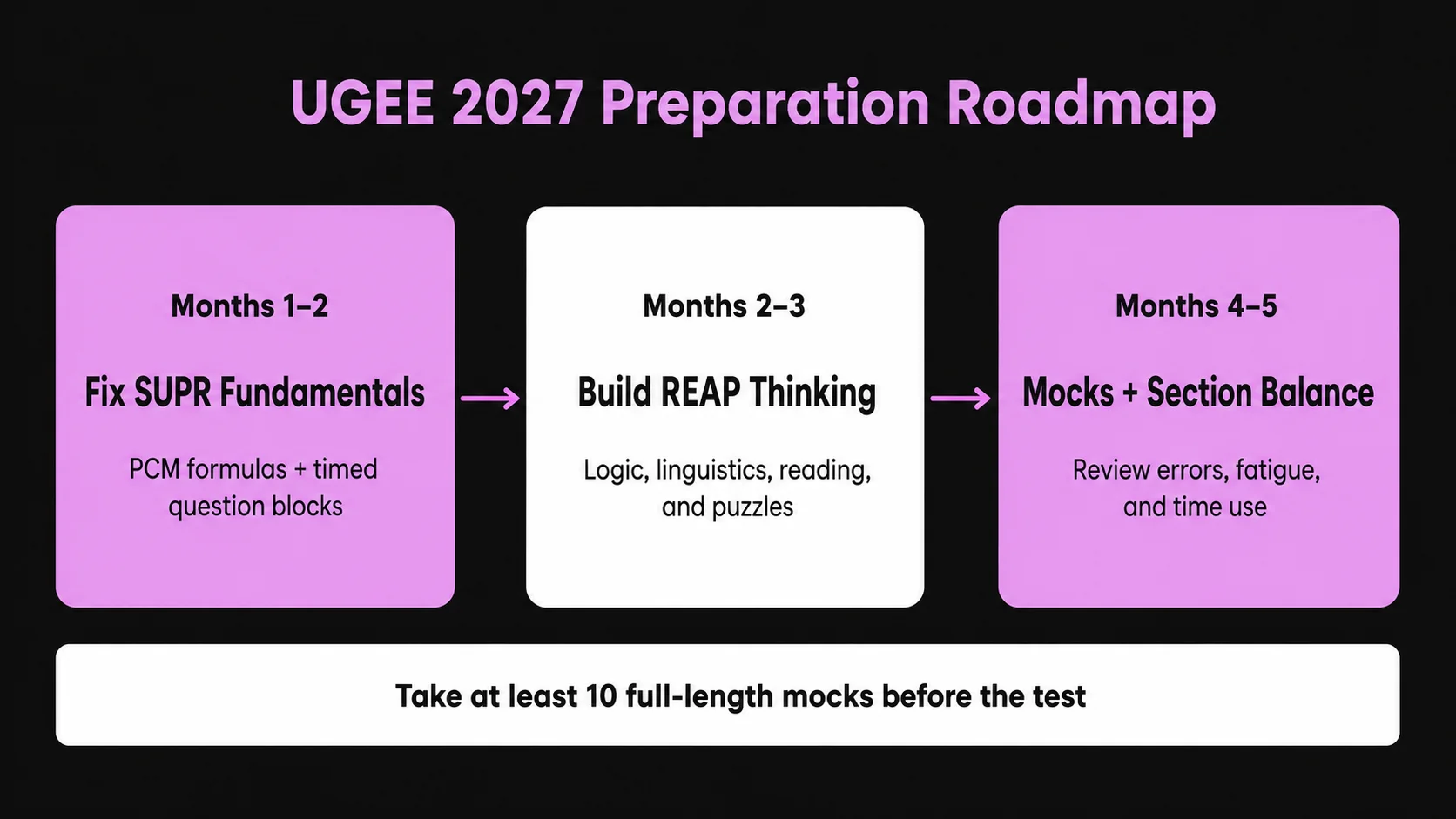
Step 1: Fix the SUPR Fundamentals (Months 1-2)
You do not need to solve Irodov for Physics or MS Chouhan for Chemistry. Pick up your standard NCERT and JEE Main previous year questions. Focus on formula sheets. Practice solving 50 questions in 60 minutes. Get your brain used to the speed.
Step 2: Introduction to REAP (Months 2-3)
Start treating REAP like a completely new subject. Allocate at least one hour daily to solving puzzles. Look up basic linguistics Olympiad questions online. Practice reading large paragraphs of text and summarizing them in one sentence.
Step 3: Sectional Balancing and Mocks (Months 4-5)
This is where most students fail. They take a mock test, look at the final score, and move on. We tell our students to do a deep mock analysis. Did you lose marks because of a lack of knowledge, or a lack of time? Did you get fatigued in the last 40 minutes of REAP?
Final Prep Tip: Take at least 10 full-length mocks before the real exam. Make sure the interface matches the actual exam. To implement this step effectively, we strongly recommend Phodu Club's Ultimate UGEE Test Series . It provides 10 full-length mock tests aligned with the actual UGEE syllabus, allowing unlimited attempts so you can refine your sectional balancing strategy.
Best Books & Resources for UGEE
Do not buy 15 different books. Keep your resources minimal and revise them constantly.
- For SUPR (PCM): NCERT books for Chemistry and Physics are mandatory. Use standard JEE Main PYQ books (like Disha or Arihant 43 years) to practice speed.
- For REAP (Logic & DI): RS Aggarwal for Verbal and Non-Verbal Reasoning is a solid foundation. For linguistics, search for past papers of the Panini Linguistics Olympiad.
- Mock Tests: Reliable mock tests are your best resource. Previous year memory-based papers are gold.
Resource Tip: Download the past memory-based papers immediately and attempt one as a diagnostic test this weekend. You can find a curated list of study materials on our best books for UGEE page. For comprehensive practice with detailed solutions and analysis, check out Phodu Club's Ultimate UGEE Test Series .
UGEE Interview Round: What to Expect & How to Prepare
If you clear the REAP cutoff, you will be invited to the IIIT Hyderabad campus for a personal interview. This is not a formality. The decision on the final offer of admission is solely based on your interview performance. The committee's decision is final.
The professors want to see how you think when you are stuck. They will give you a math or physics problem on a whiteboard. They do not care if you get the final answer instantly. They care about your approach. If you make a mistake, they will give you a hint. Do you take the hint and pivot, or do you stubbornly stick to your wrong method?
Interview Prep Tip: Practice speaking your thoughts out loud while solving math problems at home. Explain the steps to an imaginary person in the room. This builds the exact muscle memory you need for the interview panel. Because this round is so crucial, Phodu Club's Ultimate UGEE Test Series goes beyond just mocks; it includes complete guidance for the interview round, live Q&A sessions, and access to an exclusive 24/7 mentorship community with current IIIT Hyderabad students. Read more about the interview in our guide on why the UGEEe interview can make or break your admission .
Why Choose UGEE for IIIT Hyderabad in 2027
IIIT Hyderabad is widely considered to have one of the best coding cultures in the world, often outperforming top IITs in global coding competitions like Google Summer of Code (GSoC) and ACM ICPC.
But beyond standard coding, the UGEE route puts you directly into research labs from your second year. You will be working on AI, Natural Language Processing, and robotics long before students at other colleges even learn the basics. The dual degree makes your profile incredibly strong for MS or PhD applications at top Ivy League universities later.
The placements are staggering, but the true value is the depth of knowledge you acquire. It is a tough, rigorous 5-year journey, but the outcome is unparalleled.
Conclusion
We have worked with enough students to know this: effort alone does not fix your score. The right strategy does. You can solve a thousand math problems, but if you do not understand how to pace yourself between SUPR and REAP, you will struggle on exam day.
Stop treating UGEE like a backup exam and start preparing for its unique demands. Focus on your logical reasoning, respect the negative marking, and build your 3-hour stamina. That is exactly what we focus on at Phodu Club. If you are feeling stuck and need structured guidance, comprehensive mocks, and interview support to clear this exam, Phodu Club's Ultimate UGEE Test Series is designed to provide everything you need to succeed.
Frequently Asked Questions (FAQ)
1) What is the official UGEE exam pattern for this year?
The exam consists of a 3-hour computer-based test split into two sections: SUPR (Subject Proficiency, 60 minutes) and REAP (Research Aptitude, 120 minutes). Both have a 25% negative marking penalty.
2) Is the UGEE exam pattern similar to JEE Advanced?
No. While JEE Advanced tests extreme depth in standard Physics, Chemistry, and Math problems, REAP tests your logical reasoning, data interpretation, and linguistics skills. The format and required mindset are very different.
3) How much time should I dedicate to SUPR vs REAP during preparation?
If your JEE Main preparation is decent, you only need to dedicate 20% of your time to SUPR (mostly giving speed mocks). Dedicate the remaining 80% of your prep time to mastering the unique logic and linguistics puzzles found in REAP.
4) How can I improve my REAP score quickly?
Stop trying to memorize patterns. To improve in REAP, you need to practice active reading. Solve puzzles from linguistics Olympiads and practice extracting data from complex tables under strict time limits. Regular mock analysis is critical here, which is why detailed solutions are a core part of Phodu Club's UGEE Test Series .
5) Are calculators allowed in the UGEE exam?
No, physical calculators are not allowed. You must rely on your mental math and manual calculation skills. Ensure you practice basic approximations to save time during the Data Interpretation questions.
6) How is UGEE different from BITSAT?
BITSAT is an extreme speed test across 130 questions, including English and Logic. UGEE is heavily focused on research aptitude and complex problem-solving through its 120-minute REAP section. BITSAT requires broad surface-level knowledge; UGEE requires deep analytical thinking.
7) What is the application fee for female candidates?
As part of IIIT Hyderabad's initiative to have at least 25% women among shortlisted candidates, the application fee for female applicants is reduced to Rs. 1550. For male applicants, the fee is Rs. 3100.
8) How does Phodu Club help with UGEE preparation?
At Phodu Club, we focus on strategy and identifying exactly why your scores are stagnant. Instead of just giving you endless theory, our mentors help you analyze your mocks, fix your weak areas in REAP, and provide a clear, structured prep direction designed specifically for exams like UGEE. Our Ultimate UGEE Test Series provides 10 full-length mocks, detailed analysis, and a 24/7 mentorship community with IIIT Hyderabad students to guide you through the exam and interview process.
Want to crack your exam with mentors who did?
Get test series, crash courses and free mentorship from students at IITs, NITs and BITS.