TG EAPCET vs JEE Main: Which Is Worth It?
Every year we meet Telangana students stuck on the same question: should they pour their energy into TG EAPCET, JEE Main, or both? The honest answer to the TG EAPCET vs JEE Main question isn't about which exam is harder. It's about a genuinely different trade-off: one is a state exam that gives Telangana residents a real, local-status-backed shot at strong colleges close to home, the other is a national exam that opens a much wider net but puts you in a far bigger, more competitive pool. Treating them as interchangeable is how students end up either missing a genuine home-state advantage or under-hedging their national options.
Quick Answer
- TG EAPCET gets Telangana residents into engineering, agriculture, and pharmacy colleges within the state, with 85% of seats reserved for local-status candidates.
- JEE Main opens 31 NITs, 26 IIITs, 50+ GFTIs nationally, plus a shot at the IITs, but draws from a national applicant pool many times larger.
- TG EAPCET gives you one attempt per admission cycle; JEE Main gives you two sessions with your better score counted.
TG EAPCET vs JEE Main at a Glance
Here's the side-by-side that actually matters when you're deciding where to focus your prep time.
| Factor | TG EAPCET | JEE Main |
| Conducted by | JNTUH on behalf of TGCHE | National Testing Agency (NTA) |
| Gets you into | Engineering, agriculture, and pharmacy colleges within Telangana | 31 NITs, 26 IIITs, 50+ GFTIs, plus a shot at the IITs via JEE Advanced |
| Exam structure | 160 questions, 160 marks, 3 hours | 75 questions, 300 marks, 3 hours |
| Attempts per cycle | 1 | 2 (January and April sessions, best score counted) |
| Negative marking | None | -1 for wrong answer |
| Local reservation | 85% for Telangana local-status candidates, 15% open | NITs reserve 50% of seats for Home State candidates and 50% for Other State candidates. |
| Typical applicant pool | Roughly 3 lakh (engineering + agriculture/pharmacy combined) | 15,00,000+ combined across sessions |
| Seats on offer | Roughly 1.3 lakh B.Tech seats across 175+ colleges | 67,323 JoSAA seats (2026, across all institutes) |
| Fee range (4-year B.Tech ) | Roughly Rs. 40,000 (government colleges) to Rs. 9 lakh+ (top private colleges) | Roughly Rs. 5 lakh tuition (NITs, uniform), income-based waivers available |
What Each Exam Actually Tests
The core PCM content overlaps meaningfully, but the format and pressure points differ.
- JEE Main covers Physics, Chemistry, and Mathematics across 75 questions in 3 hours, mixing MCQs with numerical-value questions, built for speed and depth across a genuinely large syllabus.
- TG EAPCET's MPC stream covers the same three subjects across 160 questions in the same 3 hours, but Mathematics alone carries 80 of those 160 questions, roughly half the paper, which changes how you should weight your revision time.
- Neither has negative marking risk the same way. TG EAPCET has none at all, so attempting every question is close to always correct. JEE Main penalises wrong MCQ answers but not wrong numerical entries, so the calculus differs by question type.
- Neither exam includes an interview. Both are purely written, with admission decided by score and rank rather than a follow-up conversation.
Since the underlying syllabus overlaps so much, a student deep into JEE Main prep isn't starting from zero for TG EAPCET's MPC stream. The real adjustment is pacing, since 160 questions with heavier Mathematics weighting rewards a different time-management instinct than JEE Main's format. Our full TG EAPCET exam pattern breakdown covers the section-wise details if you want to dig deeper.
Where Each Score Actually Gets You
This is where the comparison stops being about exam mechanics and starts being about real outcomes.
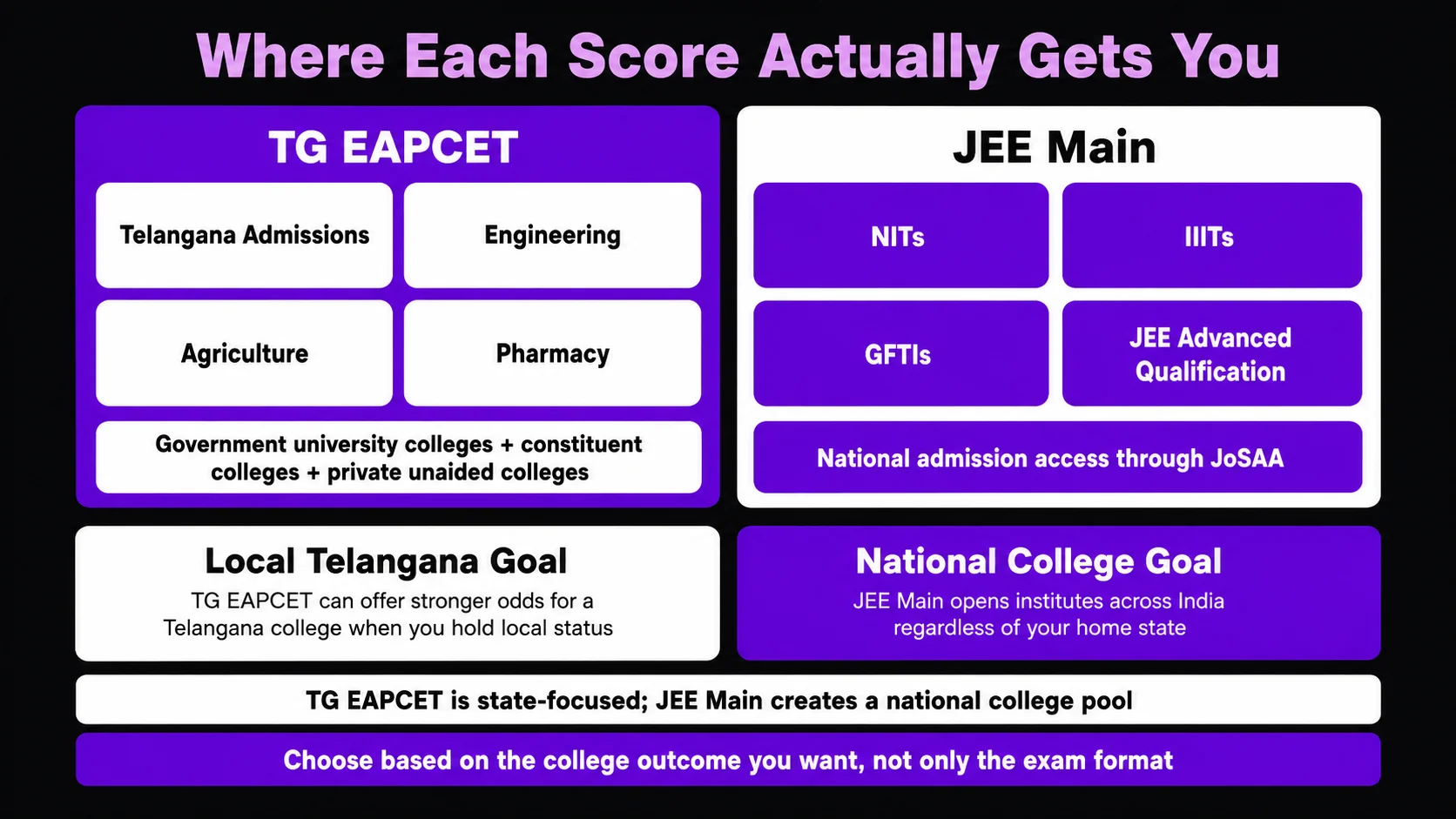
- TG EAPCET leads to engineering, agriculture, and pharmacy admissions specifically within Telangana, spanning government university colleges, constituent colleges of the conducting university, and a large network of private unaided colleges across the state. Our full list of participating colleges is worth a look once you have a sense of your likely score range.
- JEE Main opens a genuinely national net: NITs, most IIITs, and GFTIs through JoSAA counselling, plus a shot at the IITs for those who clear the JEE Advanced qualifying cutoff, regardless of which state they're from.
- A detail that matters more than it seems: if your goal is specifically a strong Telangana college, and you have local status, TG EAPCET can be the higher-odds route to that exact outcome compared to competing nationally through JEE Main for a limited number of NIT or GFTI seats in the state.
The Local Status Advantage
This is the single biggest thing a generic exam comparison misses, and it's specific to how Telangana's own exam works.
- 85% of seats are reserved for local-status candidates, generally determined by where you studied for the four consecutive years leading up to your qualifying exam. If you meet this criteria, you're competing within a meaningfully smaller pool than the raw applicant numbers suggest.
- JEE Main does have a Home State quota for NIT seats, where approximately 50% of seats are reserved for candidates from the state in which the NIT is located. The remaining seats are filled under the All India quota. However, this Home State quota is different from Telangana's local-status reservation system, which is based on educational local area eligibility rather than simply the institute's state.
Cost Comparison
Most comparisons skip this, but it genuinely shapes what "worth it" means for a lot of families.
| Cost Component | TG EAPCET Route | JEE Main Route (NIT, typical) |
| Government/university colleges | As low as roughly Rs. 40,000 for the full 4-year programme | Not applicable, NITs aren't state-government colleges |
| Private colleges (typical range) | Roughly Rs. 4-9 lakh for the full 4-year programme, some top-tier colleges higher after recent fee revisions | Rs. 1.25 lakh/year tuition, uniform across NITs, roughly Rs. 5 lakh total |
| Fee waivers | Government fee reimbursement schemes for eligible categories and income brackets | Income-based tuition waivers, full waiver under Rs. 1 lakh family income |
The range for TG EAPCET colleges is genuinely wide. A government or university college through this exam can be cheaper than an NIT, while a top private college can cost meaningfully more, so the honest answer to "which is cheaper" depends entirely on which specific college you're actually comparing.
Competition & Odds
| Metric | TG EAPCET | JEE Main |
| Reported applicants (2026) | Roughly 3 lakh combined, about 2.1 lakh for engineering | 15,00,000+ combined sessions |
| Seats on offer | Roughly 1.3 lakh B.Tech seats | 67,323 (JoSAA, 2026, all institutes) |
| Selection method | Rank-based, no interview, local-status reservation applies | Percentile-based rank, no interview, no reservation by domicile |
The applicant pool for TG EAPCET is a fraction of JEE Main's national scale, and combined with the local-status reservation, this genuinely does make top in-state colleges more reachable for eligible local candidates than the equivalent NIT seat would be through the much larger national pool.
Attempts & Logistics
A few practical differences worth knowing before you plan your year.
- TG EAPCET runs once per admission cycle. You sit one shift on one day within the exam window, and there's no second attempt within that same year's cycle, though there's no cap on reapplying in a future year if you're still eligible.
- JEE Main runs twice per cycle, January and April sessions, and your better score across the two counts toward your final percentile.
- Both exams work off a normalisation process across shifts and sessions, so a harder day or session doesn't structurally disadvantage the students who happened to sit it.
- Eligibility windows differ slightly. TG EAPCET ties eligibility to your qualifying exam and age limits rather than a fixed number of attempts, while JEE Main is generally attempted within a recent-passing-year window.
2027 Expected Dates for Both
Neither exam's 2027 notification was out at the time of writing, so treat everything here as a planning estimate based on how recent cycles have moved.
| Event | TG EAPCET 2027 (expected) | JEE Main 2027 (expected) |
| Registration opens | Mid-February 2027 | October-November 2026 (Session 1), late January 2027 (Session 2) |
| Exam date(s) | Early-mid May 2027 | Last week of January 2027 (Session 1), first week of April 2027 (Session 2) |
| Result | Within 1-2 weeks of the exam | ~10 days after each session |
| Counselling | June through August 2027 | JEE Advanced (May) and JoSAA counselling (June onward) |
Check our TG EAPCET dates page as the actual 2027 schedule lands, since both exams' registration windows move fast once they open.
So Which One Is Actually Worth It?
There's no single right answer to the TG EAPCET vs JEE Main question, it depends on your domicile, your goals, and your family's budget conversation.
- If you have Telangana local status and want to stay close to home, TG EAPCET is genuinely the higher-odds route into a strong in-state college, and skipping it to bet everything on the far more competitive national JEE Main pool would be a real missed advantage.
- If you want maximum national reach, or you're not domiciled in Telangana, JEE Main is essentially non-negotiable, since TG EAPCET's local-status structure specifically favours in-state candidates.
- If cost is the deciding factor, compare specific colleges rather than the exams in the abstract, since both routes span everything from very affordable government options to genuinely expensive private ones. Our TG EAPCET college predictor is a useful starting point for that comparison.
- If you're undecided, prepare for JEE Main as your base given the syllabus overlap, and layer in TG EAPCET-specific practice, heavier on Mathematics pacing, closer to exam season, especially if you have local status worth using.
Mistakes Students Make in the TG EAPCET vs JEE Main Decision
We see the same handful of miscalculations every cycle.
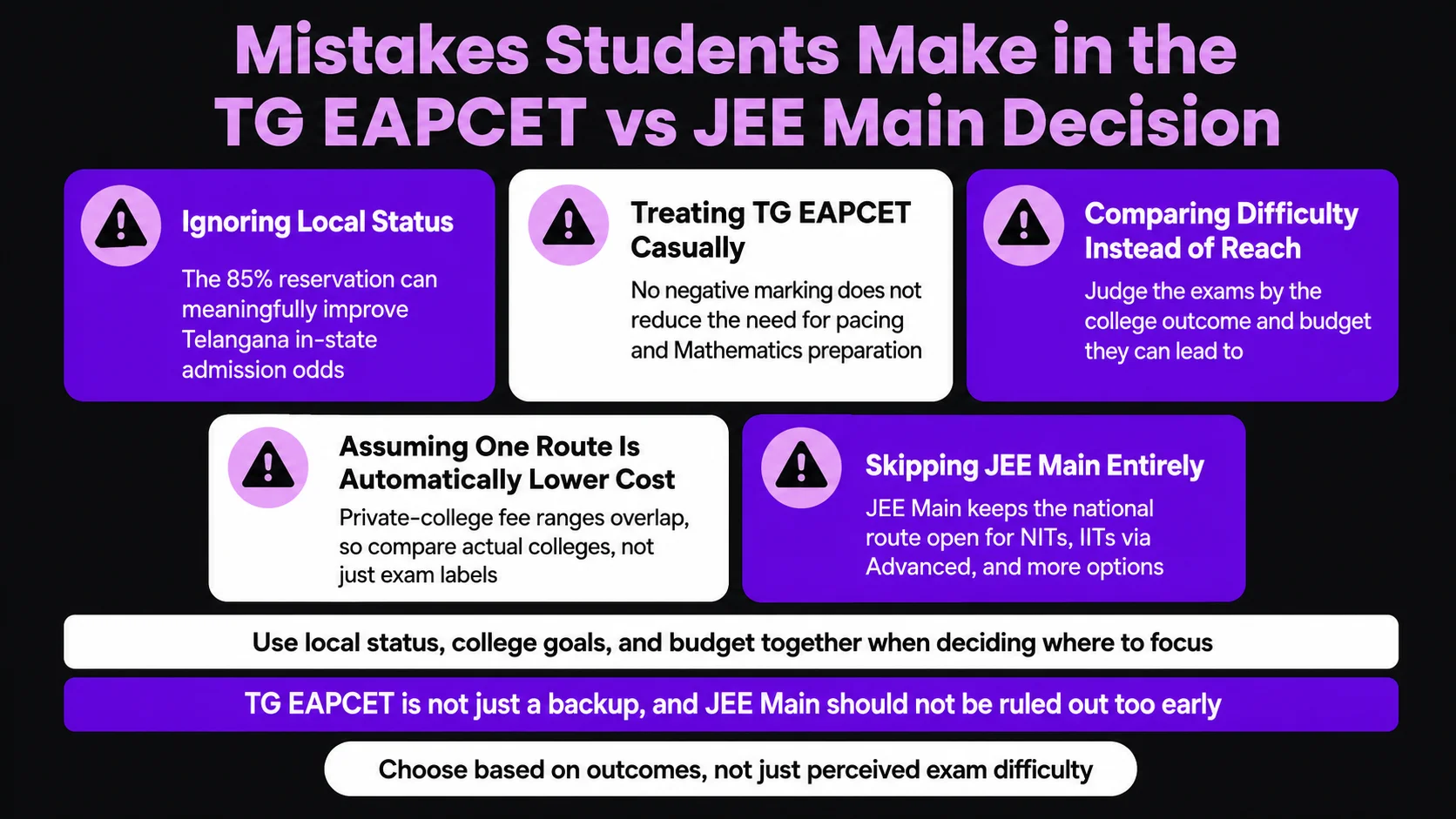
- Ignoring local status as a real advantage. Students with Telangana local status sometimes discount TG EAPCET as a "backup" without realising how much the 85% reservation actually shifts their odds at strong in-state colleges.
- Assuming TG EAPCET is a lower-stakes single attempt. Since there's no second sitting within the same cycle, treating exam day casually because "there's no negative marking anyway" ignores that pacing and Mathematics-heavy weighting still require real preparation. Our best books and resources list is worth checking well before exam season, not the week before.
- Comparing raw difficulty instead of comparing actual reach. The better question isn't which exam is harder, it's which one gets you to the outcome, and the budget, you're actually aiming for.
- Assuming private colleges under one exam are automatically cheaper than the other. Fee ranges overlap significantly, so specific college comparisons matter more than exam-level assumptions.
- Skipping JEE Main entirely to focus only on the state exam. Even for Telangana-domiciled students, JEE Main keeps the national door open, NITs, IITs via Advanced, and a broader set of options if plans change.
Getting Ready for Both
Once you've worked through the TG EAPCET vs JEE Main trade-off for your own situation, the practical next step is a prep plan that doesn't force unnecessary duplication. If you're preparing for JEE Main and want to add TG EAPCET into your plan without duplicating effort, a few things help.
- Keep your JEE Main-level PCM revision as your foundation, since it covers most of what TG EAPCET's MPC stream needs.
- Give Mathematics extra attention specifically for the state exam, since it carries roughly half the total paper there, more than its relative weight in JEE Main.
- Confirm your local status early and understand exactly how the reservation works, since it directly shapes your realistic college expectations. Our local status and rank breakdown is worth a read if this is new territory for you.
- Check the current eligibility criteria for the state exam if you're still confirming which stream and requirements apply to you.
- Once you have a rough score in mind, our rank predictor tool can help translate it into a clearer sense of which colleges are realistically within reach.
Where Phodu Club Fits In
We connect students preparing for exams across India's engineering entrance landscape with mentors who understand the practical realities, not just the textbook syllabus, of decisions like this one. If you're weighing a national push through JEE Main against a home-state advantage through Telangana's own exam, our team is a genuine resource to talk through the trade-offs before you commit your prep calendar to one plan.
Whichever way you land on the TG EAPCET vs JEE Main decision, base it on your domicile, your actual goals, and your family's budget conversation, not just which exam feels more familiar to prepare for.
Frequently Asked Questions
1) TG EAPCET vs JEE Main: is one easier than the other?
The core PCM content is comparable, though TG EAPCET has no negative marking and a heavier Mathematics weighting, while JEE Main covers more ground with sharper time pressure per question. Difficulty is relative to your own strengths and which format suits your pacing.
2) Can I prepare for both TG EAPCET and JEE Main at the same time?
Yes, and it's a common strategy for Telangana students. Since the syllabus overlaps heavily, your JEE Main preparation covers most of what the state exam needs, with the main adjustment being extra Mathematics focus and getting comfortable with the no-negative-marking format.
3) Does local status really make a big difference?
Yes. With 85% of seats reserved for local-status candidates, eligible Telangana residents compete within a meaningfully smaller effective pool for those seats, which is a structural advantage JEE Main simply doesn't offer through its purely national merit process.
4) Which exam should I prioritise if I can only prepare for one?
If you have Telangana local status and want to study in-state, the state exam is worth prioritising for that specific goal. If you want national reach or aren't domiciled in the state, JEE Main is the stronger default, since it's your only route into NITs, IIITs, GFTIs, and the IITs.
5) Is a TG EAPCET seat cheaper than an NIT seat through JEE Main?
It depends entirely on which specific college you're comparing. Government and university colleges in Telangana can be cheaper than an NIT, while top private colleges can cost considerably more, so compare actual institutions rather than assuming one exam route is uniformly cheaper.
6) How many attempts do I get at each exam?
JEE Main gives you two sessions within the same admission cycle, with your better score counted. TG EAPCET gives you one attempt per cycle, though there's no cap on reapplying in a future year if you're still eligible.
7) Does clearing JEE Main help with TG EAPCET or vice versa?
Not directly in terms of scores, since they're separate exams with separate results. But the PCM preparation for JEE Main directly strengthens your performance on the state exam's MPC stream, and the reverse holds true for shared topics as well.
8) Does Phodu Club help with preparation for Telangana's engineering entrance exam?
Yes, our mentors help students structure preparation across exams, including working through the TG EAPCET vs JEE Main decision itself, though we don't currently offer a dedicated packaged course for the state exam. We can still help you think through your local status, stream choice, and overall prep strategy.
Want to crack your exam with mentors who did?
Get test series, crash courses and free mentorship from students at IITs, NITs and BITS.