Best Books & Study Material for TG EAPCET
At Phodu Club, we see this all the time: students buy a massive pile of reference materials, study for 10 hours a day, but their mock scores simply refuse to go up. It’s frustrating. The truth is, cracking the Telangana State Engineering, Agriculture and Pharmacy Common Entrance Test isn't about how many resources you hoard; it's about studying the right ones repeatedly. If you are stuck at average scores or just starting your 2027 prep, you need clarity. In this guide, we will break down the absolute best books for TG EAPCET so you can stop guessing and start improving.
Quick Answer/TL;DR
- Primary Source (All Subjects): TS Intermediate Textbooks (Vol 1 & 2) – do not skip these.
- Math (MPC): Deepthi Publications Objective Mathematics for speed.
- Physics (MPC & BiPC): H.C. Verma (concepts) + D.C. Pandey (objective).
- Chemistry (MPC & BiPC): NCERT (Inorganic) + O.P. Tandon (Physical).
- Biology (BiPC): TS IPE Textbooks + Deepthi Objective Biology.
Why Your Current Study Material Might Be Failing You
Before we dive into the book recommendations, we need to address a harsh reality. We’ve worked with enough students to know that simply opening a textbook doesn't guarantee a good rank.
One of the most common mistakes we see is students preparing for TG EAPCET using exclusively JEE Advanced or NEET level materials. While having a high conceptual baseline is great, TG EAPCET is a completely different ballgame. It is a speed-based exam. You have 160 questions and 180 minutes. That leaves you with roughly 1 minute and 7 seconds per question. If your books are training you to spend 5 minutes solving a deeply complex multi-concept problem, you are building the wrong muscle memory.
You need study material that drills speed, formula application, and direct conceptual recall. The materials we recommend below are specifically chosen to align with the state board syllabus and the objective nature of the exam.
TG EAPCET 2027 Exam Pattern and Syllabus Overview
To understand why certain books are recommended, you first need to understand the exam you are walking into. According to the guidelines set by TSCHE and JNTUH, the exam pattern heavily favors speed and accuracy without the penalty of negative marking.
| Particulars | Details |
| Examination Mode | Computer-Based Exam (Online) |
| TS EAMCET exam time duration | 3 Hours (180 minutes) |
| Medium of Exam | English, Telugu, and Urdu |
| Sections (MPC) | Physics - 40 QuestionsChemistry - 40 QuestionsMathematics - 80 Questions |
| Sections (BiPC) | Physics - 40 QuestionsChemistry - 40 QuestionsBotany - 40 QuestionsZoology - 40 Questions |
| Total Number of Questions | 160 Questions |
| Type of Questions | Multiple Choice Questions (Objective) |
| TS EAMCET Total Marks | 160 |
| Marking Scheme | For every correct answer, 1 mark will be given |
| TS EAMCET Negative Marking | There is no negative marking. |
Because there is no negative marking, your attempt strategy changes entirely. You must attempt all 160 questions. However, to get a top rank (below 5000), your genuine accuracy rate on attempted known questions must be incredibly high.
How to Choose the Right Mathematics Material (MPC Stream)
Mathematics carries 50% of the total weightage in the engineering stream (80 out of 160 marks). If your math is weak, your rank will suffer. When our students ask us for the best books for TG EAPCET to master mathematics, we always emphasize one thing: standard state board books first, objective speed-drills second.
Goal: Speed, accuracy, and objective MCQ patterns.
| Priority | Book Title | Author/Publication | Notes |
| Primary | TS Intermediate Mathematics Textbooks (Vol 1A, 1B, 2A, 2B) | Telangana Board / Telugu Academy | Core syllabus – master fully. Direct questions often appear from the solved examples. |
| Reference | Objective Mathematics Vol 1 & 2 | R.D. Sharma | Strong conceptual practice for algebra and calculus. |
| Objective Practice | EAMCET/EAPCET Mathematics (Chapter-wise / Vol 1A, 2A, 1B, 2B) | Deepthi Publications | Exam-style questions and solutions. Critical for speed-building. |
| Quick Revision | Complete Mathematics | TMH (Tata McGraw Hill) | Comprehensive coverage and short tricks. |
| Additional | Mathematics Handbooks / Solutions | Various (Deepthi or similar) | For formulae and quick recap before mocks. |
How to Use These Math Books Actionably
Don't just read math; solve it with a stopwatch.
- Phase 1: Start with the TS Intermediate textbook. Solve the examples. EAPCET examiners love pulling direct models from the Telugu Academy books.
- Phase 2: Move to Deepthi Publications. Set a timer. Can you solve 40 questions in 45 minutes? If not, identify which steps took too long. Are you writing down too many calculation steps instead of doing mental math?
- Takeaway: Prioritize one good objective book + extensive PYQ practice over juggling multiple heavy reference books.
Mastering Physics for TG EAPCET (MPC & BiPC Streams)
Physics is often the section where students lose their confidence and their rank. It requires a mix of theory comprehension and rapid numerical solving. To conquer this, it’s vital to have the best books for TG EAPCET physics on your desk.
Goal: Conceptual clarity + formula application + quick solving. (Common to both streams.)
| Priority | Book Title | Author/Publication | Notes |
| Primary | TS Intermediate Physics Textbooks (Vol 1 & 2) | Telangana Board / Telugu Academy | Foundation. Essential for assertion-reasoning and direct theory MCQs. |
| Concepts | Concepts of Physics Vol 1 & 2 | H.C. Verma | Select chapters for depth (Mechanics, Electromagnetism). |
| Objective | Understanding Physics / Objective Physics | D.C. Pandey | Targeted objective practice with level-wise difficulty. |
| EAPCET-Specific | EAMCET/EAPCET Physics (Andhra & Telangana) | Deepthi Publications | Pattern-aligned questions and previous year models. |
| Additional | Fundamentals of Physics | Halliday & Resnick | Reference for tough topics (optional - strictly for top 1000 rank targeters). |
Actionable Takeaway for Physics
At Phodu Club, we advise students to create a "Formula and Application" diary. When you read H.C. Verma, you are building the concept. But EAPCET will test if you can apply a derived formula in 60 seconds.
- Use H.C. Verma for concepts.
- Extract the final formulas and write them down.
- Immediately move to Deepthi Publications or D.C. Pandey (Level 1) to build speed. Ignore Level 2/Level 3 subjective questions—they will waste your EAPCET prep time.
The Ultimate Chemistry Stack (MPC & BiPC Streams)
Chemistry is the scoring savior of TG EAPCET. If you structure your prep correctly, you can finish the 40 Chemistry questions in under 35 minutes, saving precious time for Mathematics or Physics. For this reason, we consider the following to be the best books for TG EAPCET chemistry preparation.
Goal: Theory (Inorganic/Organic) + numericals (Physical). (Common to both streams.)
| Priority | Book Title | Author/Publication | Notes |
| Primary | TS Intermediate Chemistry Textbooks (Vol 1 & 2) | Telangana Board / Telugu Academy | Core base. Read line-by-line for Inorganic. |
| Concepts | NCERT Chemistry (Class 11 & 12) | NCERT | The absolute bible for Organic & Inorganic basics. |
| Physical Chemistry | A Textbook of Physical Chemistry / Essential Physical Chemistry | O.P. Tandon / Ranjeet Shahi | Best for numericals and physical concepts. |
| Objective/EAPCET | EAMCET/EAPCET Chemistry (VOL I & II / Chapter-wise) | Deepthi Publications | Objective drills and pattern-based practice. |
| Inorganic/Organic | A Textbook of Inorganic / Organic Chemistry | O.P. Tandon | Selective depth as needed (mainly for named reactions and exceptions). |
How to Tackle Chemistry Effectively
Chemistry must be split into three distinct study methods:
- Inorganic Chemistry: Treat the TS Board book and NCERT like a history book. Read it line by line. Highlight exceptions (trends in p-block, d-block). Questions here take 10 seconds to answer if you know the facts.
- Organic Chemistry: Do not memorize. Understand the mechanisms first using NCERT, then create reaction maps. Stick them on your wall.
- Physical Chemistry: Treat this like Physics. Formula → Application → Timed numericals using O.P. Tandon.
Biology Resources for Pharmacy & Agriculture Aspirants (BiPC Stream)
For BiPC students, Botany and Zoology make up 80 questions. This is your high-scoring zone. However, curating the best books for TG EAPCET biology is all about finding resources that aid in multiple revision cycles rather than offering PhD-level depth.
Goal: Memorization + repeated revision + MCQ accuracy.
| Priority | Book Title | Author/Publication | Notes |
| Primary | TS Intermediate Biology Textbooks (Vol 1 & 2) / IPE Textbook | Telangana Board / Telugu Academy | Must-read for Botany + Zoology. Diagrams are crucial. |
| Objective | EAPCET Biology Objective (Chapter-wise) | Deepthi / VGS or similar | MCQ-focused practice mapped to the state syllabus. |
| Reference (Selective) | Pradeep’s Biology | Pradeep Publications | Deeper clarity if required (use sparingly). |
| Support | NCERT Biology (Class 11 & 12) | NCERT | Strong conceptual foundation, especially for Genetics and Ecology. |
| Additional | ABC of Biology | A.K. Sabharwal & B.B. Arora | Good reference for complex physiological processes. |
The Biology Strategy
Biology improves significantly with multiple revision cycles. Reading a chapter once from a thick reference book like Pradeep’s will not help you recall specific enzymes in the exam hall.
- Read the TS IPE Textbook chapter.
- Solve 100 MCQs from Deepthi/VGS immediately.
- Mark the questions you got wrong. These become your revision notes.
- Practice labeling diagrams—exam questions often ask you to identify part "A" or "B" from a textbook diagram. Avoid over-relying on thick references; stick to the syllabus boundaries.
Additional Study Materials and Resources for TG EAPCET
Books alone will not get you across the finish line. At Phodu Club, we emphasize that testing is just as important as studying.
1) Previous Year Questions (PYQs)
You must solve the last 10–17 years’ papers. The EAPCET exam has a tendency to repeat question models, if not the exact questions. Use compilations like Deepthi Chapter-wise PYQs or Spectrum All-in-One. By looking at PYQs, you understand the weightage of chapters. (For instance, you'll notice Matrices and Probability carry heavy weightage in Math).
2) High-Quality Mock Tests
You cannot simulate the pressure of 160 questions in 180 minutes by just reading. You need a dedicated test series. Taking mocks helps you identify your baseline, test your time allocation, and build exam stamina.
- Action: Enroll in a structured test series. You can check out our TG EAPCET Test Series which is designed exactly on the latest exam interface and difficulty.
3) Crash Courses for Revision
If you have 2-3 months left and feel overwhelmed by the sheer volume of the syllabus, a structured revision plan is better than self-study chaos. Platforms that offer targeted mentorship can save you hundreds of hours. For rapid, focused revision, explore the TG EAPCET Crash Course to streamline your final months.
Proven Preparation Strategy Using These Books
Having the books is 10% of the battle. How you use them is the other 90%. Here is a structured strategy our students use to break past score plateaus:
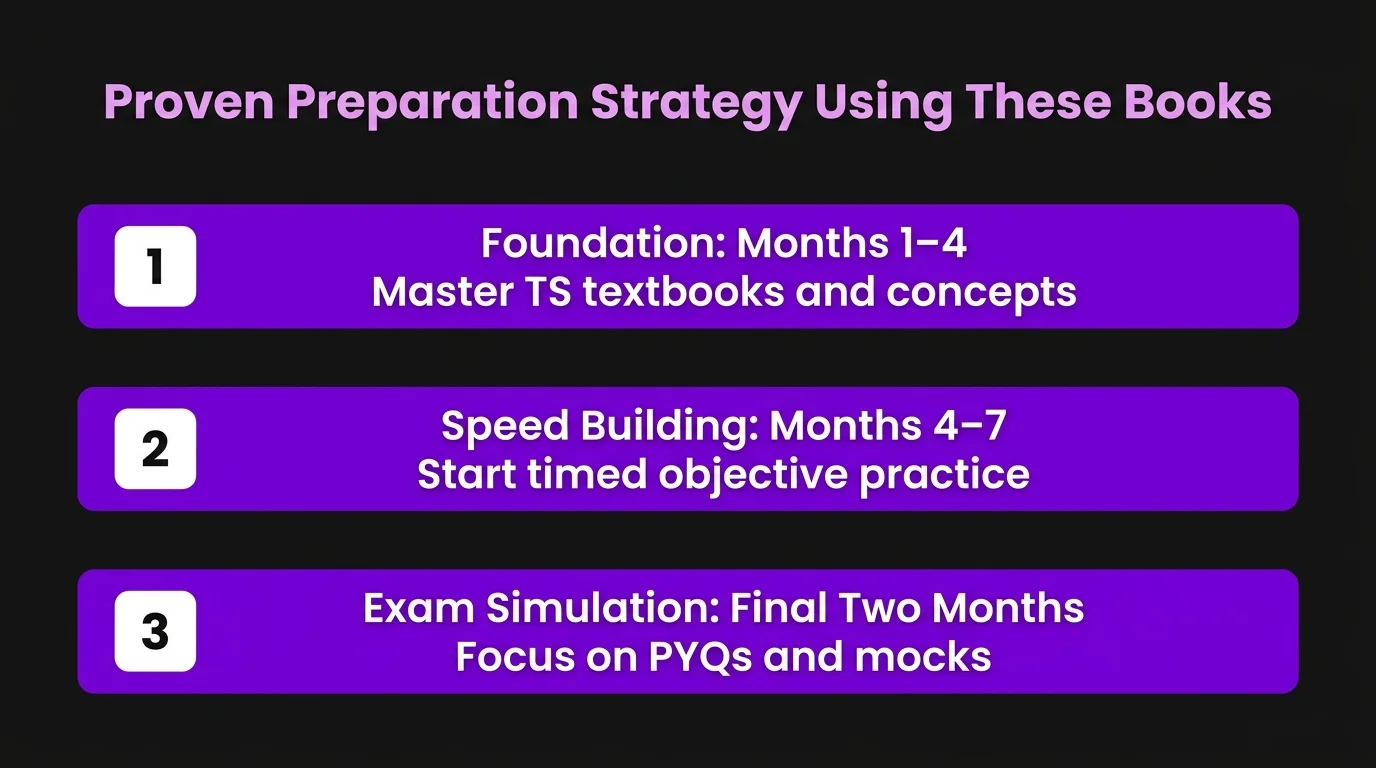
Phase 1: Foundation (Months 1-4)
- Focus: TS Intermediate Textbooks (Telugu Academy).
- Action: Go chapter by chapter. Do not touch advanced objective books yet. Clear your basic concepts. If you don't understand why a formula works, EAPCET application questions will trap you.
- Tip: Align your EAPCET prep with your board exam prep. Your IPE marks give you a solid foundation.
Phase 2: Pattern Recognition & Speed (Months 4-7)
- Focus: Objective books (Deepthi, D.C. Pandey, R.D. Sharma).
- Action: Start chapter-wise objective solving. Set a timer. If you are doing Math, give yourself 60 minutes for 50 questions.
- Analysis: If you get a question wrong, don't just look at the solution and move on. Ask: Did I not know the concept? Did I make a calculation error? Did I misread the question?
Phase 3: Exam Simulation (Last 2 Months)
- Focus: PYQs and Mock Tests.
- Action: Take at least 2 full-length mock tests a week. Spend more time analyzing the mock than giving it. Use the TG EAPCET Rank Predictor to see where you stand competitively.
- Adjustment: Based on mock analysis, go back to your short notes or reference books only for the specific sub-topics you are repeatedly failing.
If you need to know exactly when to shift these phases, keep an eye on the official TG EAPCET Dates so you can schedule your prep timeline accurately.
Common Mistakes to Avoid While Choosing Books
We’ve seen this pattern again and again: students sabotage their own prep by making these crucial material-selection mistakes.
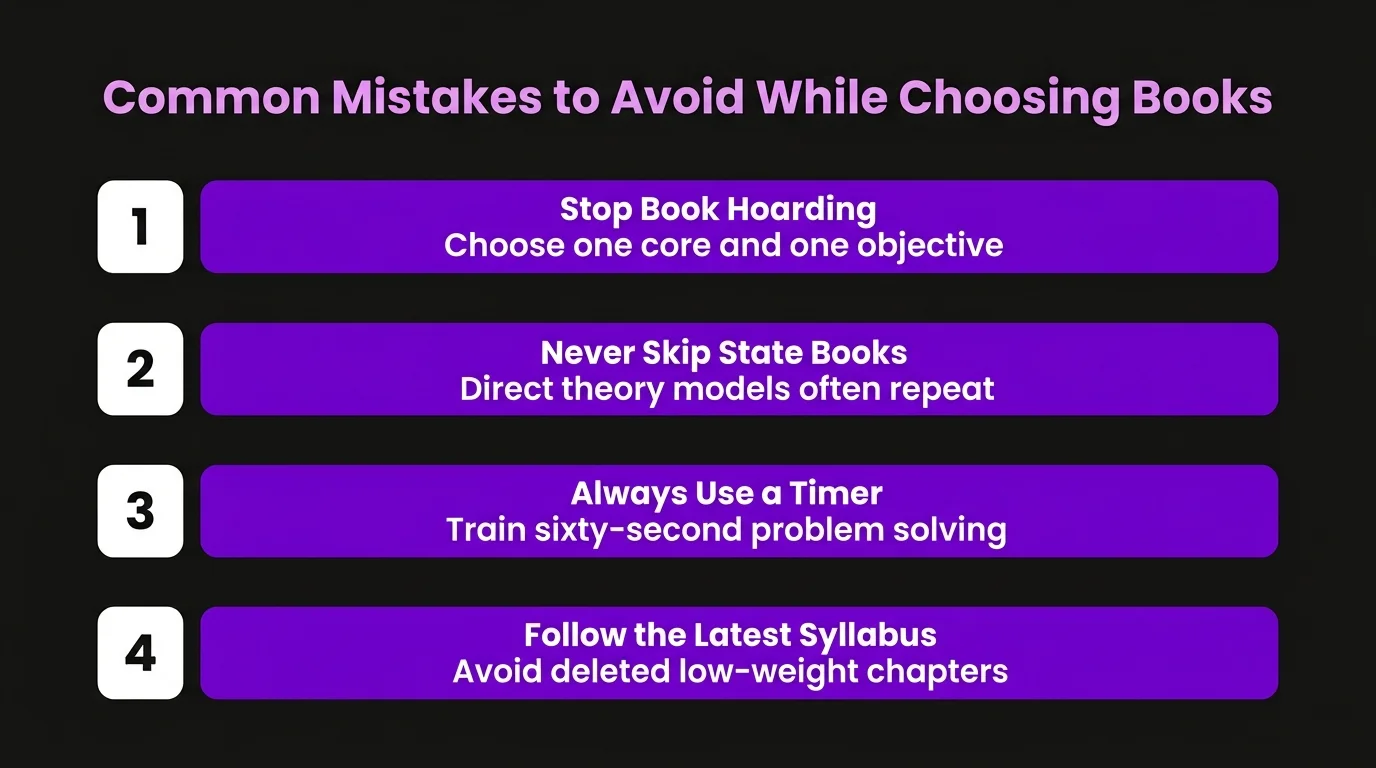
- The Hoarding Trap: Buying 5 different authors for Physics. You only need one core textbook and one objective book. Mastering two books 100% is infinitely better than reading 10% of ten different books. Even if you have the best books for TG EAPCET stacked on your desk, you will not succeed if you don't stick to one primary resource.
- Ignoring State Board Books: Telangana State board (Telugu Academy) books are the holy grail for this exam. Many students obsessed with national-level exams entirely ignore state board books. The TG EAPCET paper setters directly reference these books, especially for theoretical questions in Chemistry and Physics.
- Practicing Without a Timer: Deepthi publications are great, but if you take 10 minutes to solve one objective math question, you are failing the requirements of the exam. Speed is the name of the game.
- Skipping Syllabus Analysis: Don't read chapters that have been deleted or have practically zero weightage just because they are in the book. Always keep a printed copy of the latest official syllabus next to your study desk.
Beyond the Books: The Normalisation Factor
One crucial thing to remember about TG EAPCET is that it is conducted over multiple sessions, which means the difficulty varies. To make things fair, the authorities use a normalisation process.
Why does this matter for your study material? Because you need to prepare for both "easy-but-lengthy" papers and "tough-but-conceptual" papers. Your study material should allow you to practice both extremes. When taking mocks, don't just focus on the raw score; focus on your accuracy and percentile. Learn more about how the exam is structured by checking our comprehensive guide on How to prepare for TG EAPCET (Coaching or Self Study) .
Conclusion
Finding the best books for TG EAPCET is just step one. Books are tools; they won't build the house for you. You have to put in the hours, track your mistakes, and constantly refine your approach.
Start with your Telugu Academy textbooks to build an unshakable foundation. Layer that with objective speed practice using Deepthi or D.C. Pandey. Finally, cement your prep with rigorous PYQ solving and mock tests.
We’ve worked with enough students to know this: effort alone doesn’t fix your score. The right strategy does. That’s exactly what we focus on at Phodu Club. If you are tired of stagnant scores and want clear, actionable mentorship and structured resources, you don't have to do it alone. Check out our TG EAPCET Online Coaching to get the guidance you need to crack a top rank and secure a seat in colleges like JNTUH, OU, or CBIT.
Frequently Asked Questions (FAQ)
1) What are the overall best books for TG EAPCET for a beginner?
For a complete beginner, the absolute best starting point is the TS Intermediate textbooks (Telugu Academy) for all subjects. Once you are thorough with those, transition to Deepthi Publications for chapter-wise objective MCQ practice.
2) Is NCERT enough for TG EAPCET Chemistry?
For Inorganic and Organic chemistry, NCERT is exceptionally good and covers about 85-90% of what you need. However, for Physical Chemistry, you will need a book like O.P. Tandon or Deepthi to practice the fast-paced numericals required for EAPCET.
3) Should I buy JEE Mains books to prepare for the TG EAPCET?
We do not recommend relying only on JEE Mains books. While the syllabus overlaps, EAPCET requires solving 160 questions in 180 minutes (focus on speed), whereas JEE Mains is 75 questions in 180 minutes (focus on depth). Using EAPCET-specific books like Deepthi ensures you practice the right pattern.
4) Can I crack the exam using only the best books for TG EAPCET without joining a coaching institute?
Yes, self-study is entirely possible if you are highly disciplined. If you use the right books, strictly analyze previous year papers, and take regular mock tests, you can get a great rank. However, if you struggle with consistency or understanding complex topics, structured guidance helps.
5) How much time should I allocate to mock tests versus reading textbooks?
In your final 2-3 months, your ratio should be 30% reading/revising and 70% testing/analyzing. In the earlier stages of your prep, it should be reversed (70% concept building, 30% objective practice). Check out the best free resources for TG EAPCET to supplement your mock practice.
6) How can Phodu Club help me if I already have all the recommended books?
At Phodu Club, we focus on how you use those books. We provide the strategy, the mock testing environment, and the mentorship to identify why your scores aren't improving despite reading the material. We help you fix your weak areas, manage your time better, and offer high-quality test series to simulate the real exam.
7) Will the TG EAPCET 2027 syllabus change significantly?
Typically, the syllabus remains aligned with the standard 11th and 12th TS board curriculum. Minor deletions or additions happen based on board changes. Always refer to the official TSCHE notification when it releases, but starting your prep with the core intermediate textbooks is a safe and necessary strategy.
Want to crack your exam with mentors who did?
Get test series, crash courses and free mentorship from students at IITs, NITs and BITS.