Every year, students ask us if they should repeat a year for engineering or try something completely different. At Phodu Club, we see a familiar pattern. Students score ninety percent in their board tests but struggle with traditional science entrances. They feel stuck. They want corporate paths but assume they must wait until graduation to start working towards them. That is exactly where the IPMAT exam steps in. If you want to study management at an IIM right after your 12th grade, you must understand this test. Let’s see exactly what it takes to crack it.
What is the IPMAT exam?
The IPMAT exam is a national-scale entrance test conducted by specific IIMs (like Indore and Rohtak). It secures admission to their five-year Integrated Programme in Management (IPM), letting students earn a BBA and MBA directly after the 12th grade without giving the CAT later.
Why The IPMAT exam Is A Smarter Bet Than Traditional Engineering
At Phodu Club, we talk to hundreds of aspirants every month. Many are completely burnt out from solving advanced physics equations. They want a path that leads to top-tier business management, but they assume they have to do a regular BTech first, work for a few years, and then fight hundreds of thousands of people in the CAT.
When you choose this five-year integrated management program, you bypass the brutal CAT competition entirely. You secure your master’s degree seat at age eighteen. This is a massive advantage. You get five full years to build your professional profile, intern at top companies, and develop a strong corporate network. For students heavily researching professional paths outside the regular science track, this path offers incredible returns.
Let us look at the specific colleges that accept these scores based on recent 2025–2026 admission data and official announcements.
Top Institutes and Seat Intake
| Institute | Program Name | Approximate Seats | Selection Process |
| IIM Indore | Five-Year IPM | 150 | Aptitude Test (IPMAT) + Personal Interview |
| IIM Rohtak | Five-Year IPM | 198 | Aptitude Test (IPM AT) + Personal Interview + Academics |
| IIM Ranchi | Five-Year IPM | 120 | IPMAT Indore Score + Personal Interview + Academics |
| IIFT Kakinada | Five-Year IPM | 60 | IPMAT Indore Score + Academics (No Interview) |
| TAPMI Bengaluru | BBA (Honors) | Varies | Entrance Score (IPMAT/MET/SAT/etc.) + Interview + Micro-presentation |
The Biggest Mistakes Students Make During IPM Preparation
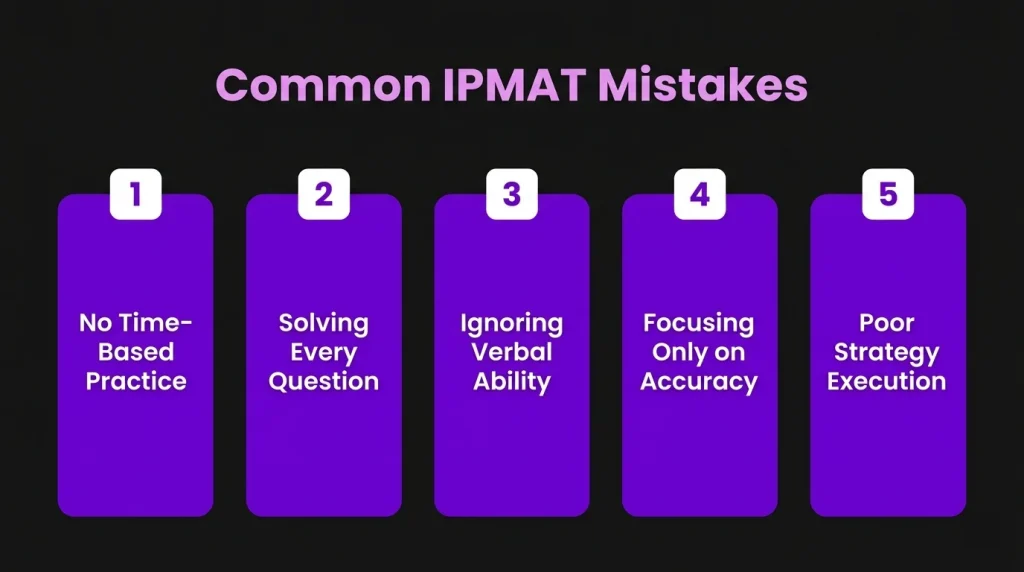
One of the most common mistakes we see is handling this preparation like standard board tests. Students think that if they solve a lot of math textbook problems, they will easily clear the cutoffs.
We worked with an aspirant named Rohan last year. Rohan was brilliant at standard mathematics. He would take ten minutes to solve a complex probability question perfectly on paper. But in a timed competitive test, taking ten minutes for one single question destroys your entire section. Rohan was getting terrible mock test scores because he lacked speed and strategy. He tried to attempt every single question sequentially.
What actually works is understanding the difference between accuracy and speed. At Phodu Club, we force our students to practice skipping questions. You read a question. If you do not see the solution path within twenty seconds, you leave it and move forward. You can always come back later.
Another massive mistake is ignoring the Verbal Ability section. Many science-focused students assume their English is “good enough” because they watch English movies or read fiction. This test checks critical reasoning, reading comprehension under extreme time pressure, and precise vocabulary usage. “Good enough” English will fail to get you an interview call.
Actionable Takeaways: Stop practicing without a timer. From day one, every practice session must have a strict time limit.
- Learn the skill of leaving difficult questions to protect your overall time.
- Do not trust your natural English speaking skills to carry you through the Verbal Ability section. You must study formal sentence structure rules.
Decoding The IPMAT exam Syllabus And Sectional Timers
To beat the competition, you must know exactly what you are facing. The pattern varies slightly between the institutes, but the core subjects remain the same.
Let us decode the IIM Indore pattern, as it serves as the benchmark for difficulty across all management entrances at this age stage.
IIM Indore Test Structure
| Section | Number of Questions | Time Limit | Marking Scheme |
| QA (Short Answer) | 15 | 40 Minutes | +4 for correct, 0 for incorrect |
| QA (MCQ) | 30 | 40 Minutes | +4 for correct, -1 for incorrect |
| Verbal Ability | 45 | 40 Minutes | +4 for correct, -1 for incorrect |
Understanding this structure is mandatory before you sit for the actual paper. The test is completely computer-based.
The Quantitative Aptitude (QA) section tests topics you studied in grades 9 through 12. You will see arithmetic, algebra, geometry, number systems, and modern math like permutations and combinations. The Short Answer section is unique because it has no negative marking, but you must type in the exact answer without any multiple-choice options to help you guess. This tests your pure solving ability.
The Verbal Ability (VA) section tests reading comprehension, sentence rearrangement (para jumbles), vocabulary, and sentence correction. The passages are often dense, pulled from economics, sociology, or science journals. If you want to understand the intense difficulty of post-graduation entrances, looking at this specific Verbal section gives you a very clear preview.
We constantly hear students say, “I will just guess the MCQs if I run out of time.” We strongly advise against this. Negative marking will destroy your chances. We have seen students drop from a top percentile to a failing percentile simply because they guessed blindly on the last five questions.
IIM Indore vs IIM Rohtak: Which IPMAT exam Should You Target?
While people refer to it as one single process, there are actually two distinct papers you need to prepare for. IIM Indore and IIM Rohtak conduct separate tests with different structures.
The Indore Variant
This is considered the gold standard. It places a massive emphasis on higher-tier mathematics. You will see questions from probability, permutations and combinations, logarithms, and advanced algebra. The inclusion of the Short Answer section makes it uniquely challenging because you are unable to use option-elimination tricks.
The Rohtak Variant
The Rohtak paper introduces a third section entirely: Logical Reasoning.
The structure is:
- Quantitative Ability (40 Questions)
- Logical Reasoning (40 Questions)
- Verbal Ability (40 Questions)
Total time is 120 minutes (40 minutes per section). The math in the Rohtak paper is generally considered slightly easier than Indore, focusing more on basic arithmetic and data interpretation. However, the speed requirement is much higher because you have to solve 40 questions in 40 minutes.
We constantly remind our students that preparing for Indore automatically covers eighty percent of the Rohtak syllabus. The only extra effort required is practicing Logical Reasoning puzzles like seating arrangements, blood relations, and syllogisms. We always urge our students to apply for both institutes. A bad day at the test center should not ruin your entire year.
Our Step-By-Step Strategy To Clear The IPMAT exam
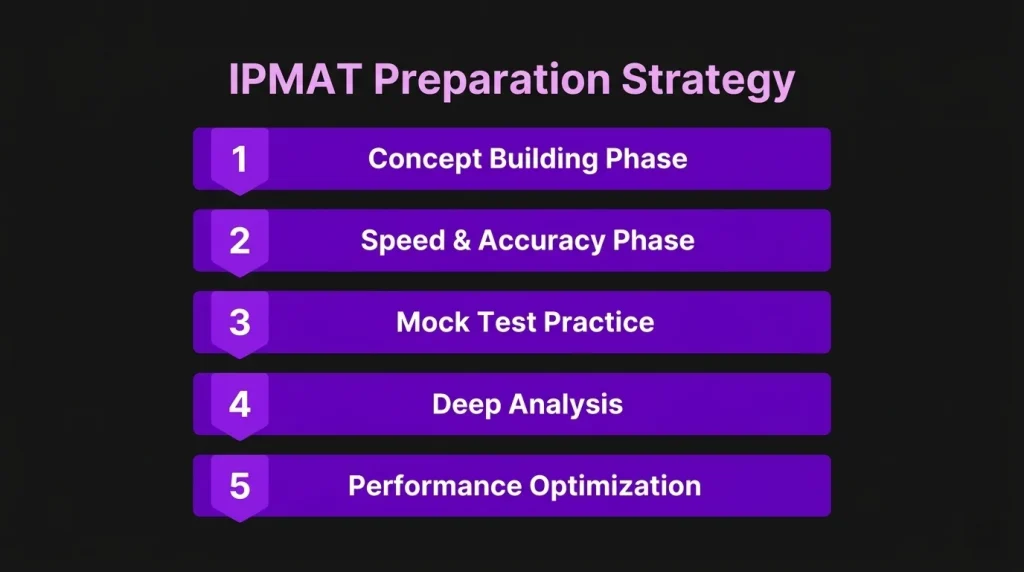
At Phodu Club, we do not believe in random preparation. Effort alone does not fix your score. The right strategy does. Here is the exact phased approach we use with the aspirants we work with.
Phase 1: Concept Building (Months 1 to 3)
During this phase, forget the clock. Your only goal is to understand the core concepts deeply.
- Math: Start with arithmetic. Percentages, ratios, profit and loss, and time-speed-distance create the foundation. Clear your basics using standard textbooks before moving to advanced material. Do not rush to solve complex probability if your percentage concepts are weak.
- Verbal: Start reading daily. Read editorials from recognized newspapers like The Hindu or The Indian Express. Do not just read to finish; read to understand the author’s argument. Start building a vocabulary notebook. Write down unknown words, their meanings, and a sentence using them.
Phase 2: Speed and Accuracy Balancing (Months 4 to 5)
Once your concepts are clear, introduce the timer. This is the stage where most students drop out because it becomes uncomfortable.
- Math: Try to solve arithmetic questions in under sixty seconds. Learn mental math tricks. Memorize squares up to thirty, cubes up to fifteen, and fractional values of percentages (like knowing that 1/8 is 12.5%).
- Verbal: Time your reading comprehension. You should be able to read a 500-word passage and answer five questions in under eight minutes. Practice identifying the main idea of a paragraph within the first two sentences.
Phase 3: The Mock Test Grind (Month 6)
This is where real improvement happens. Taking mock tests is only twenty percent of the work. Analyzing them is the remaining eighty percent. When you give a mock, you must spend at least three hours reviewing it afterward.
- Look at the questions you got wrong. Did you not know the concept, or did you make a silly computation error?
- Look at the questions you left. Could you have solved them if you had more time?
- Look at the questions you got right. Did you take too long to solve them? Is there a faster method?
Why High Overall Scores Fail: The Trap Of Sectional Cutoffs
Another critical aspect we must discuss is the sectional cutoff rule. Many students assume that getting a high overall score guarantees an interview call. This is factually incorrect.
IIM Indore enforces strict sectional cutoffs. This means you must achieve a minimum score in all three sections individually: QA Short Answer, QA MCQ, and Verbal Ability.
We had an extremely bright student two years ago who scored exceptionally high in both Math sections. His total score was well above the general cutoff. However, he ignored the Verbal section entirely during his prep phase and missed the English sectional cutoff by just two marks. He did not get an interview call. At Phodu Club, we see this tragedy frequently. You are unable to rely on just your strong subjects.
You must adopt a balanced approach. If math is your strong suit, use it to boost your overall total. But you must put in enough work to clear the minimum threshold in English.
Actionable Takeaways: When analyzing your mock tests, never just look at the total score. Check if you cleared the simulated cutoffs for every individual section.
- If one section is consistently falling short, pause your overall prep and dedicate a full week exclusively to that weak section.
How To Fix Stagnant Mock Scores And Speed Issues
This is a phase every serious aspirant goes through. You study hard, you give a mock, and your score is terrible. You study even harder, give another mock, and the score stays exactly the same. This is called a score plateau.
When students hit a plateau, they usually panic and buy five new reference books. That is the wrong approach. A stagnant score means your current strategy has reached its limit. You do not need more material; you need a different angle of attack.
At Phodu Club, what we focus on first is identifying the blind spots. We had a student whose overall score was stagnant for four weeks. When we reviewed his attempts, we realized he was taking four minutes per reading comprehension question. He was reading the entire passage twice. We changed his strategy to read the questions first, then scan the passage for the answers. His verbal score jumped by twenty marks in one week.
You must track your time-per-question metrics. Sometimes, skipping a topic you are bad at is the smartest way to increase your overall score, because it frees up time for the topics you are actually good at. If you are struggling with finding good private colleges because of low scores, fixing your time management will change your entire trajectory.
Scope After IPM: Management Roles, Salaries, And The IIM Tag
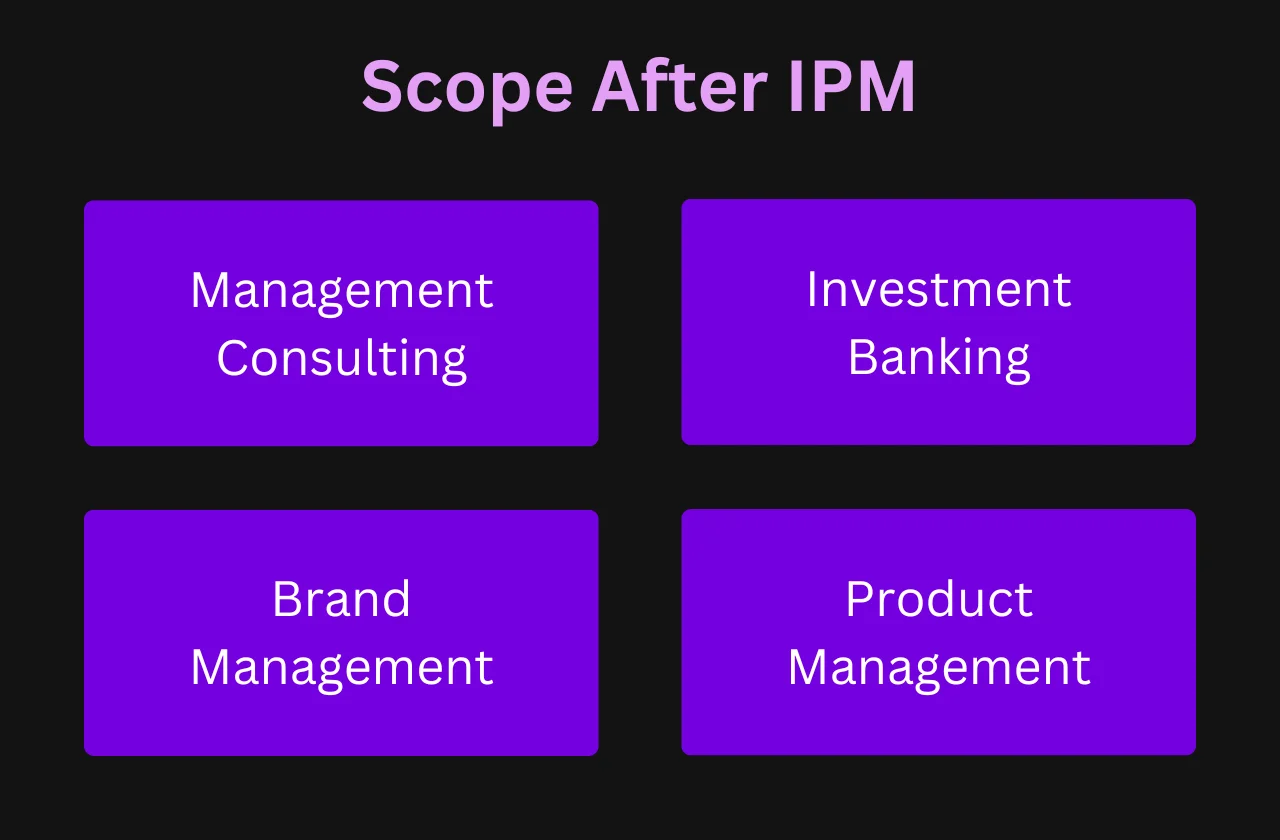
If you commit to this five-year path, what exactly is waiting for you at the finish line? Parents always ask us this. They want to know if skipping traditional engineering or medicine is safe.
The short answer is: it is highly rewarding.
When you complete the five-year program, you are awarded an MBA (or PGDM) from an IIM. You sit for the exact same placement drives as the students who entered through the traditional post-graduation route. There is zero discrimination between the two groups during placements.
Let us look at the professional paths open to you:
- Management Consulting: Companies hire consultants to solve complex business problems. You might spend three months helping a hospital optimize its patient intake, and the next three months helping a retail brand launch a new product line.
- Investment Banking and Finance: If you excel in quantitative subjects, finance is highly lucrative. You could work on mergers and acquisitions or help companies issue stock.
- Brand Management and Marketing: If you understand consumer psychology, marketing is an excellent fit. You decide how a brand communicates with the public.
- Product Management: You decide what features a new software or physical product should have, based on customer needs and business budgets.
We have seen students worry that if they choose management at eighteen, they will be trapped in one industry forever. That is completely false. An MBA from an IIM gives you a highly flexible skill set. We know alumni who started in finance and transitioned to marketing three years later. The scope is incredibly wide.
The Benefit of the IIM Tag
Having an IIM brand name on your resume opens doors for the rest of your professional life. It gives you instant credibility. It provides an alumni network that spans the globe, offering mentorship and opportunities you will not find elsewhere.
Why Mentorship Is Essential To Crack The IPMAT exam
Preparing for an aptitude test is a lonely process. Unlike board exams, where your entire class is studying the exact same textbook, competitive prep is highly individualized. What works for your friend might destroy your score.
You need someone who has seen the patterns, someone who can look at your mock test execution and immediately tell you what you are doing wrong.
We built Phodu Club to fix this exact problem. We saw bright, hardworking students failing simply because they lacked direction. They were solving the wrong books, attempting questions in the wrong order, and panicking when they saw low scores. We step in to provide clarity. We look at your specific strengths and build a plan around them.
The mental pressure is immense. Having a mentor means you do not have to carry that pressure alone. You have someone to tell you when to push harder and when to take a break to avoid burnout. We focus on results, not just theory.
Conclusion
Clearing this specific aptitude test is not about being a born genius. It is about discipline, smart time management, and recognizing patterns under pressure. If you are serious about securing a seat at an IIM right after your 12th grade, you must start building those habits today.
The IPMAT exam rewards those who stay calm and execute their strategy flawlessly.
We have worked with enough students to know this — effort alone does not fix your score. The right strategy does. If you are tired of stagnant mock scores, confused about how to balance your boards, or just need a clear, actionable study plan, that is exactly what we focus on at Phodu Club. Do not let lack of direction cost you an IIM seat. Fix your preparation strategy together. Reach out to our team at Phodu Club, and let us get to work.
Frequently Asked Questions (FAQ)
1) What is the basic eligibility to write the IPMAT exam?
You must have passed your 12th-grade board exams (or equivalent) with a minimum of sixty percent aggregate marks. There is a relaxation for reserved categories (typically fifty-five percent). You must also meet the age criteria, which generally requires you to be a maximum of twenty years old in the year of the test.
2) How long does it take to prepare from scratch?
If you are starting with zero aptitude background, you need at least four to six months of dedicated preparation. This allows you to spend three months clearing fundamental math and English usage concepts, and two months strictly practicing speed and mock tests.
3) Can an average student clear this entrance test?
Yes. This test does not require advanced calculus or college-tier physics. It tests 10th-grade math and general English comprehension. An average student who practices consistently, analyzes their mistakes deeply, and develops a strong time management strategy can absolutely secure a seat.
4) How can I improve my stagnant mock test scores?
Stop taking new tests immediately. Go back and review your last three attempts. Identify which topics are consuming too much time. Focus on improving your question selection. Often, scores improve not by solving more questions, but by skipping the time-wasting traps faster.
5) Is this test tougher than traditional engineering entrances?
It is entirely different. Engineering tests focus heavily on deep conceptual knowledge of Physics, Chemistry, and Math. This test focuses on logic, reading speed, and quick decision-making under severe time pressure. It is not about knowing complex equations; it is about thinking quickly.
6) Which IIMs currently accept these scores?
Currently, IIM Indore and IIM Rohtak conduct their own versions of this test. IIM Ranchi and IIFT Kakinada accept the scores from the Indore test. Other institutes like TAPMI and Nirma University also accept these scores for their management programs.
7) What if I fail the personal interview?
The final selection is a composite score of your written test marks and your interview execution. If your interview goes poorly, your overall composite score will drop, and you may not make the final merit list, even if your written test score was exceptionally high. Both stages are equally critical.
8) How does Phodu Club help students prepare for this?
At Phodu Club, we do not just hand you a textbook and leave you alone. We provide structured mentorship. We help you identify your weak areas, teach you exact strategies to handle time pressure, and review your mock test executions. We guide you from the first day of prep all the way through the personal interview stage, ensuring you always know exactly what to focus on next.