VITEEE Sample Paper: Previous Year Papers (PDF)

Every VITEEE season, we watch students download a folder full of PDFs labeled "sample paper," "previous year paper," and "mock test," and then treat all three the same way, solving whichever one loads first with no real plan. That's a mistake, because a VITEEE Sample Paper isn't the same thing as a real exam paper from a past sitting, and neither is the same as VIT's own official mock test. Knowing which one you're actually holding, and what it's good for, matters more than how many of them you solve.
Quick Answer
- A sample paper is a pattern-matched practice set, not a verbatim past exam paper. VIT itself doesn't release official downloadable sample papers or past question papers.
- The one genuinely official resource is VIT's free, login-less Mock Test on viteee.vit.ac.in , released a few weeks before the exam each year.
- Use sample papers for volume practice, previous year papers for real exam-day insight, and the official mock test to get the interface and timing right.
VITEEE Sample Paper vs Previous Year Paper vs Official Mock Test
This distinction gets glossed over constantly, so it's worth being precise about it before anything else.
| Resource | What it actually is | Who makes it | Best used for |
| Sample Paper | A newly created practice set built to match VITEEE's syllabus, section split, and difficulty level | Coaching platforms and prep websites | Extra practice volume once you've covered a topic |
| VITEEE Previous Year Paper (PYQ) | A reconstruction of questions actually asked in a past VITEEE sitting, based on student memory | Coaching platforms and prep websites (VIT doesn't release these officially) | Understanding real question phrasing and past difficulty trends |
| VITEEE Official Mock Test | VIT's own practice test on the exam's real interface | VIT itself | Getting comfortable with the actual exam-day interface and timing, no login required |
None of these is a substitute for the other two. A well-built sample paper won't show you exactly what VIT asked in a real sitting, but it will give you more reps on the current pattern than the limited pool of real previous year papers ever could. That's the whole point of practicing with one.
VITEEE Sample Paper by Year (2023-2026)
Here's what each recent year's pattern actually looked like, so any sample paper you pick up is at least dated to the right marking scheme. Since VIT doesn't officially publish past papers, treat the "View" column below as a placeholder for what we're building out, not a working download link yet.
| Year | Exam Dates | Total Questions | Total Marks | Marking Scheme | View |
| 2026 | 28 Apr - 3 May 2026 | 125 | 500 (4 marks/question) | +4 correct, -1 incorrect | Coming Soon |
| 2025 | 20 - 27 Apr 2025 | 125 | 125 (1 mark/question) | +1 correct, no negative marking | Coming Soon |
| 2024 | 19 - 30 Apr 2024 | 125 | 125 (1 mark/question) | +1 correct, no negative marking | Coming Soon |
| 2023 | 17 - 23 Apr 2023 | 125 | 125 (1 mark/question) | +1 correct, no negative marking | Coming Soon |
The 2026 row is the one to pay closest attention to. If a sample paper you've downloaded doesn't carry negative marking and scores each question out of 1 mark, it's built for the 2023-2025 pattern, not the one you'll actually sit for. It's still useful for topic coverage, just not for practicing your final attempt strategy, so don't throw it out, just don't treat its raw score as a preview of how you'd do under the real 2026 rules.
The Pattern You're Actually Practicing For
VITEEE's marking scheme changed completely starting 2026, and it's the single most important thing to check before trusting any sample paper you find online.
| Particular | 2023-2025 Pattern | 2026 Pattern (current) |
| Total questions | 125 | 125 |
| Marks per correct answer | 1 | 4 |
| Total marks | 125 | 500 |
| Negative marking | None | -1 for each incorrect answer |
| Exam duration | 2 hours 30 minutes | 2 hours 30 minutes |
| Sections | Mathematics/Biology (40), Physics (35), Chemistry (35), Aptitude (10), English (5) | Mathematics/Biology (40), Physics (35), Chemistry (35), Aptitude (10), English (5) |
The section split and question count haven't moved. What changed is what a wrong guess costs you. Under the old pattern, attempting every question was always correct, since there was nothing to lose. Under the current VITEEE exam pattern , a shaky guess can cost you a net swing of 5 marks compared to leaving it blank, out of a VITEEE total marks pool that's four times bigger than it used to be. A VITEEE sample paper built before this change will teach you the wrong instinct on attempt strategy, even if the actual PCM content is still useful.
How to Use a Sample Paper the Right Way
Solving papers randomly is close to a waste of the time you put into it. A structured approach gets you far more out of the same number of hours.
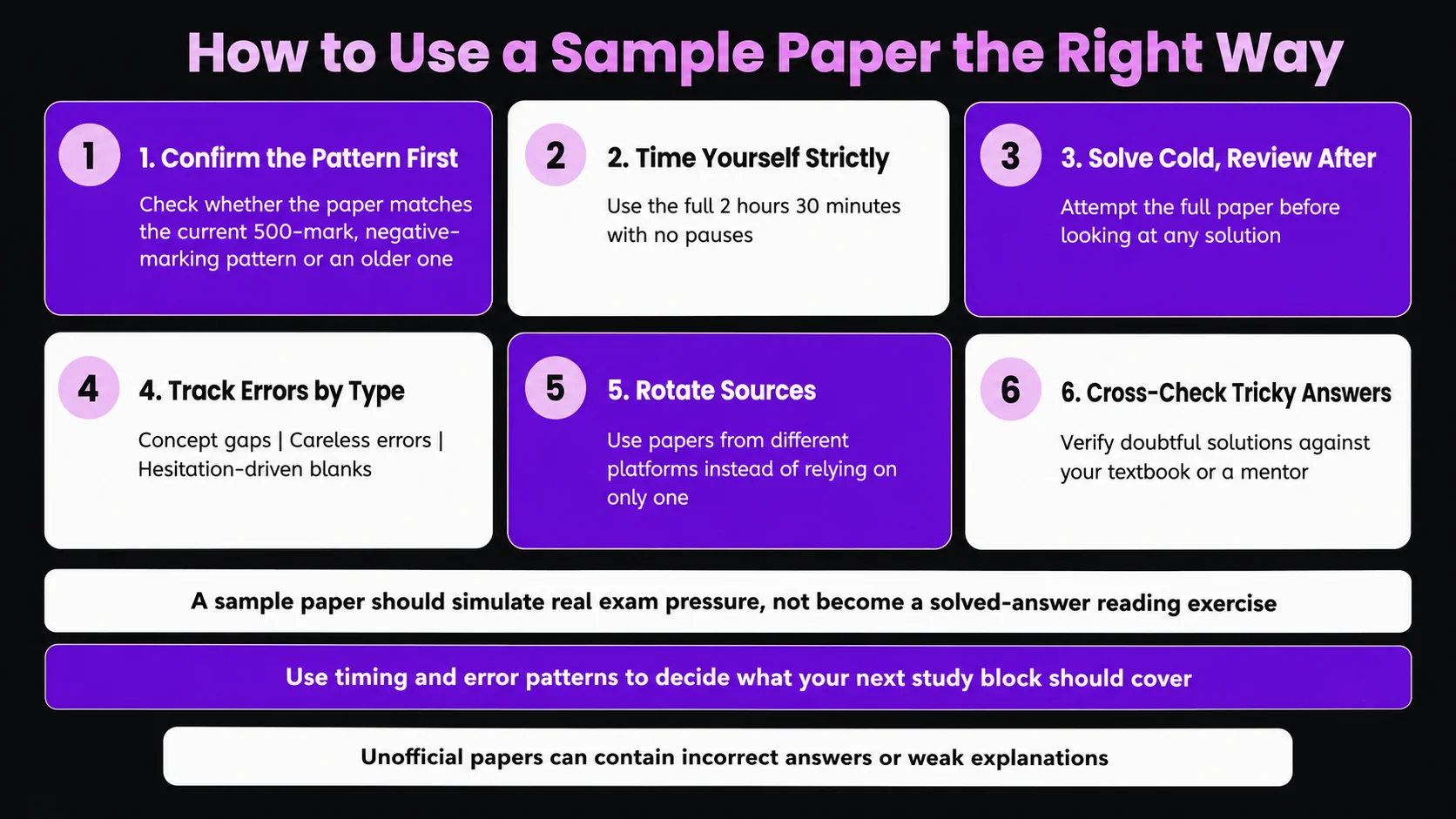
- Confirm the pattern first. Before solving anything, check whether the paper you're holding matches the current 500-mark, negative-marking pattern or an older one. This changes how you should approach borderline questions.
- Time yourself strictly. Give yourself the full 2 hours 30 minutes, no pauses. If you're consistently running over on Mathematics, that's a concrete signal for your next study block.
- Solve cold, review after. Attempt the full paper before looking at any solution. The value of a sample paper comes from simulating real exam pressure, not from following along with worked answers.
- Track errors by type. Split your mistakes into concept gaps, careless errors, and hesitation-driven blanks. Each needs a different fix, and lumping them together hides the pattern.
- Rotate sources. Since sample papers are created by different platforms with varying quality, solving several from different sources gives you a more honest sense of your actual level than relying on just one.
- Cross-check tricky answers. Because these are unofficial, occasionally a solution is wrong or the explanation doesn't hold up. If something doesn't make sense after a careful re-read, verify it against your textbook or a mentor rather than assuming you made the error.
What a Good Sample Paper Should Actually Cover
VIT doesn't publish an official chapter-wise weightage, so any breakdown you see, including the one below, comes from trend analysis of past papers rather than a confirmed VIT source. Use it as a checklist for whether a sample paper you're using has reasonable topic coverage, not as a guaranteed weightage.
| Subject | Topics a sample paper should include |
| Mathematics | Vector Algebra & 3D Geometry, Calculus, Matrices & Determinants, Coordinate Geometry |
| Physics | Electrostatics & Current Electricity, Magnetic Effects of Current, Electromagnetic Induction & AC, Semiconductors, Optics |
| Chemistry | Coordination Chemistry, p/d/f-block Elements, Electrochemistry, Chemical Kinetics, Atomic Structure |
| Biology (PCB stream) | Genetics & Evolution, Cell Biology, Human Physiology, Biotechnology |
| Aptitude & English | Number series, direction sense, logical reasoning, synonyms/antonyms |
If a sample paper you've downloaded is heavily skewed toward one or two chapters and skips the rest of this list, it's not giving you a realistic picture of the actual exam, no matter how many questions it has. Our full breakdown of VITEEE important chapters is worth cross-checking against whatever paper you're solving.
How to Tell a Reliable Sample Paper From a Weak One
Not every downloadable PDF labeled "VITEEE" is worth your time. A few quick checks before you commit an hour to solving one:
- Check the marking scheme stated upfront. If a paper doesn't mention whether it's following the 2026 negative-marking pattern or the older no-negative-marking one, that's a red flag, not a minor omission.
- Scan the section split. A genuine VITEEE-style paper should carry 40 Mathematics/Biology, 35 Physics, 35 Chemistry, 10 Aptitude, and 5 English questions. If the split looks noticeably different, it's likely a generic PCM paper with a VITEEE label added on.
- Look for solutions, not just answers. A bare answer key without explanations makes error analysis nearly impossible. The papers worth your time include enough working to show you where your logic went wrong.
- Notice repeated recycled questions across "different" papers. Some low-effort sources reshuffle the same question bank across multiple labeled papers. If you're seeing the same numbers and setups repeatedly, you're not getting real additional practice.
- Prefer sources that update for pattern changes. Since VITEEE's marking scheme changed in 2026, a source that's still distributing pre-2026 papers without a clear label is either outdated or not paying close attention, and either way it's worth being cautious about anything else they publish.
Mistakes Students Make With Sample Papers
We see the same handful of habits undercut otherwise solid preparation, cycle after cycle.
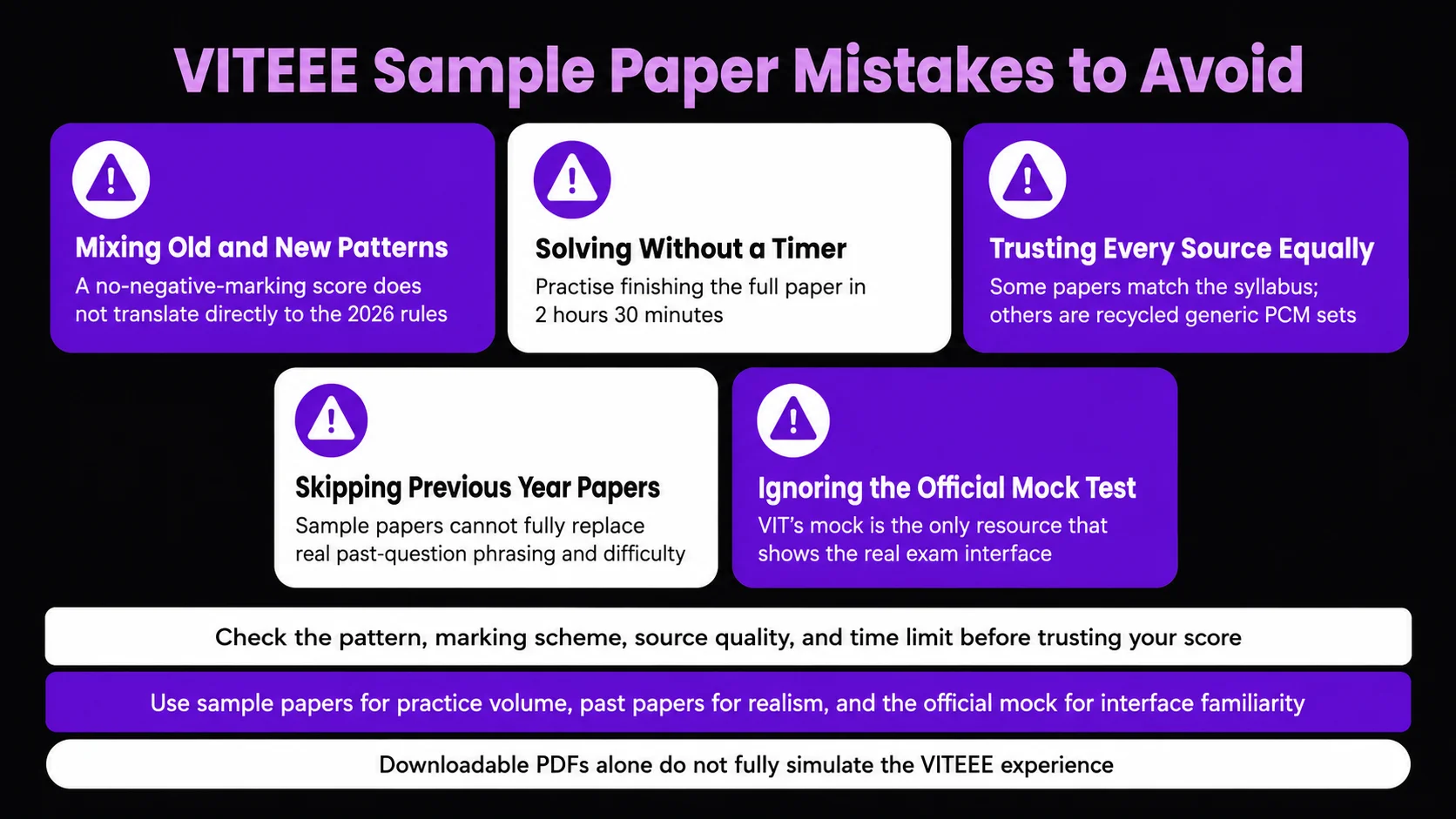
- Mixing old-pattern and new-pattern papers without noticing. A raw score from a no-negative-marking sample paper doesn't translate cleanly to how you'd score under the 2026 rules. Check the marking scheme before you trust the number.
- Solving without a timer. A sample paper solved at a relaxed pace tells you almost nothing about whether you can finish the real thing in 2 hours 30 minutes.
- Treating every source as equally reliable. Some sample papers are built carefully around the actual syllabus weightage. Others are recycled generic PCM questions with a VITEEE label slapped on. Quality varies a lot between platforms.
- Never touching a real previous year paper. Sample papers are useful for volume, but they can't fully replace solving actual VITEEE previous year question papers , which reflect real question phrasing and genuine past difficulty.
- Skipping the official mock test entirely. Downloadable PDFs are convenient, but VIT's own VITEEE mock test is the only resource that shows you the real exam interface, and that's worth a run-through regardless of how many PDFs you've solved.
Building a Practice Routine Around This
A sample paper works best as part of a layered plan rather than the whole plan. Our VITEEE preparation guide covers the full timeline this fits into, but here's the short version:
- Finish a first pass of the VITEEE syllabus before you start timed practice, so a low score reflects test-taking gaps rather than untouched topics.
- Use sample papers for weekly timed practice once your first pass is done, since they give you far more volume than the limited pool of real VITEEE PYQs available.
- Mix in actual previous year papers every couple of weeks to keep your sense of real difficulty and phrasing grounded.
- Run through VIT's official mock test at least once in the final month so exam day doesn't include any interface surprises.
- In your last two weeks, solve exclusively under the current VITEEE marking scheme , with full negative marking applied, so your attempt strategy matches what you'll actually face. Once you've got a target score in mind, our VITEEE college predictor can help you see what it might translate to.
What's Coming Next on Phodu Club
We're building out subject-wise, pattern-accurate sample paper sets for each of the years above, so keep this page bookmarked as they go live.
In the meantime, if you want practice that's already built around the current 500-mark, negative-marking pattern rather than retrofitted from older material, our Ultimate VITEEE Test Series is built for exactly that gap. It includes five full-length mock tests built to the latest VITEEE syllabus and pattern with unlimited attempts, detailed solutions and performance analysis after every test, and handwritten Ultimate Revision Notes covering the PCM chapters that show up across years. It's the same idea behind a good sample paper, realistic, pattern-accurate practice, just built specifically for the rules you'll actually be graded under.
A good sample paper earns its place in your prep plan when you know exactly what it is, and isn't, giving you. Use it for volume, lean on real previous year papers for authenticity, and don't skip VIT's own mock test before exam day. None of the three replaces the other two, and treating them as interchangeable is how students end up with plenty of solved papers but no real sense of where they actually stand.
Frequently Asked Questions
1) What is a VITEEE Sample Paper?
It's a practice question set built by coaching platforms to match the VITEEE syllabus, section structure, and difficulty level. It's newly created rather than reused from an actual VIT exam sitting, which makes it distinct from a previous year paper.
2) Does VIT release official VITEEE Sample Papers for download?
No. VIT does not officially publish downloadable sample papers or actual past question papers. The one official practice resource VIT provides is a free, login-less mock test on its own website, released a few weeks before the exam.
3) Is a VITEEE Sample Paper the same as a previous year question paper?
No. A sample paper is newly written to match the pattern, while a previous year paper is a reconstruction, based on student memory, of questions actually asked in a past sitting. Both are useful, but they serve different purposes in your prep.
4) How many sample papers should I solve before the exam?
There's no fixed number, but most serious aspirants benefit from solving several per week once they've completed a first pass of the syllabus, alongside a handful of real previous year papers for authenticity. Consistency and proper timed review matter more than the raw count, and reviewing every mistake properly is worth more than rushing through an extra paper you don't actually learn from.
5) Are sample papers from 2023-2025 still useful after the 2026 pattern change?
Yes, for topic coverage and question style, since the syllabus and section split haven't changed. But don't use your raw score on an older-pattern paper to judge your readiness under the current 500-mark, negative-marking system, since the scoring math is different and a "good" raw score under the old rules doesn't map cleanly onto the new one.
6) Where can I find VIT's official VITEEE mock test?
VIT releases its official mock test on viteee.vit.ac.in a few weeks before the exam each year. It requires no login and is built on the actual exam interface, which makes it a useful final check alongside any sample papers you've solved.
7) Should I solve sample papers or focus only on previous year papers?
Both, ideally. Sample papers give you far more practice volume since real previous year papers are limited in number. Previous year papers give you a more authentic sense of actual question phrasing and difficulty. Relying on only one leaves a real gap in your prep.
8) Does Phodu Club offer VITEEE Sample Papers?
We're currently building out year-wise, pattern-accurate sets for this page. Until they're live, our Ultimate VITEEE Test Series offers full-length mock tests built to the current pattern along with revision notes, and our mentors can help you structure your practice in the meantime.
Want to crack your exam with mentors who did?
Get test series, crash courses and free mentorship from students at IITs, NITs and BITS.