VITEEE PYQ: Previous Year Papers (PDF)
Every VITEEE cycle, we get the same message: "just send me the last five years of question papers, I'll take it from there." It's a reasonable instinct, that's how most competitive exams get cracked. But VITEEE PYQ material doesn't work the way most students assume coming in from a JEE or state-CET background, and that mismatch quietly costs a lot of otherwise solid preparation.
We've guided VIT aspirants through this exact confusion every cycle at Phodu Club, and the honest picture of what's actually available isn't what most prep sites tell you. This guide lays out exactly what's officially available, what year-wise material actually exists for 2021 through 2026, and how the exam pattern itself has changed enough that older sets need to be used carefully.
Quick Answer
VIT does not officially release full VITEEE question papers after any exam session. What's available online as reconstructed practice material is compiled from candidate memory by coaching platforms, useful for practice but not verbatim official papers. VIT does release an official mock test each year, which is your most reliable pattern reference.
Why VITEEE PYQ Searches Rarely Turn Up What Students Expect
We see this every cycle: a student searches "VITEEE 2023 question paper PDF" or "VITEEE 2021 previous year paper download," expecting the exact experience of downloading a JEE Main shift paper with an official answer key. VITEEE doesn't work that way, and that gap in expectations wastes real prep time chasing PDFs that were never officially published.
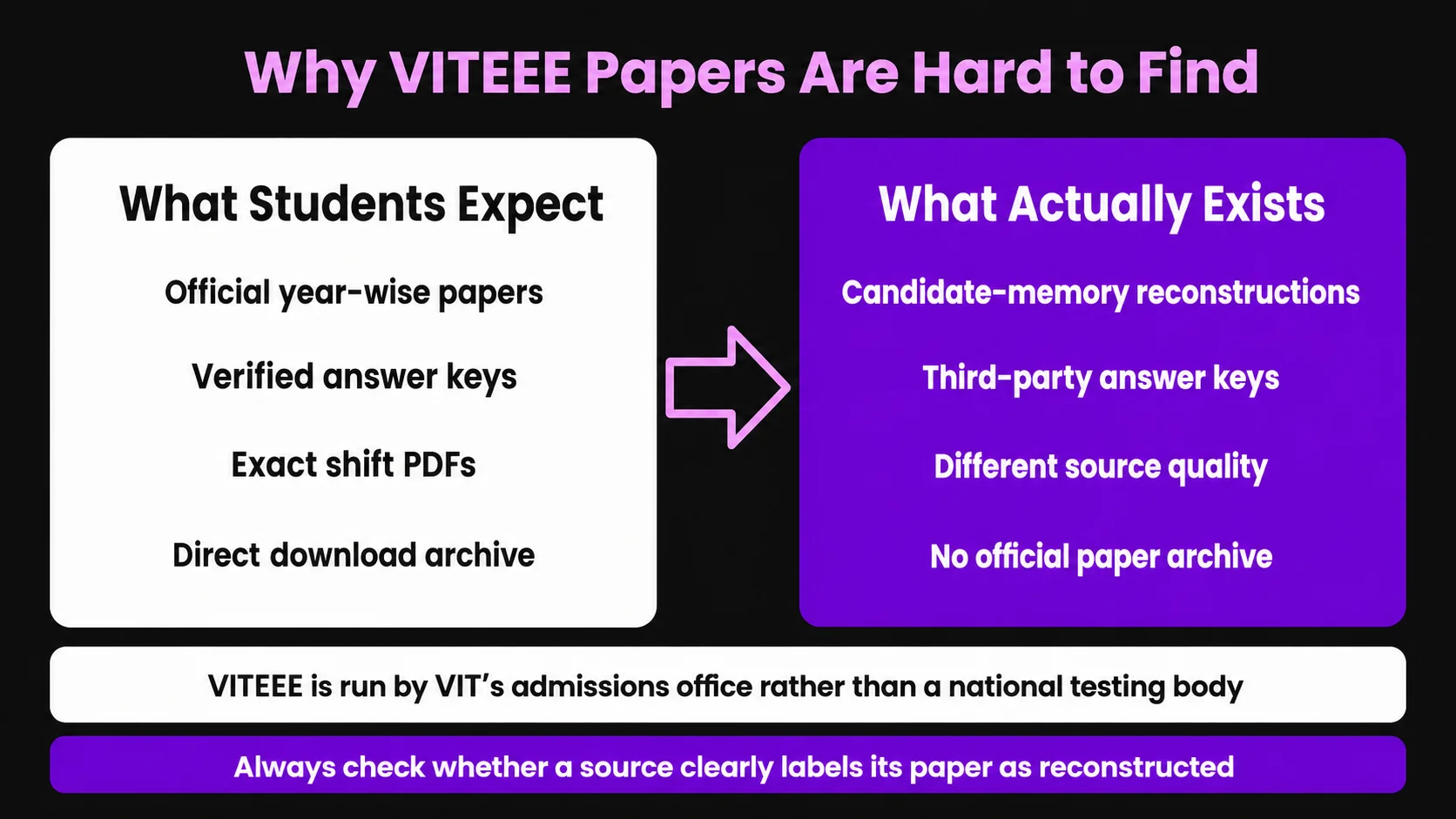
Two independent facts confirm this, not just one prep site's claim: VIT does not officially release the actual VITEEE question paper after any exam session, and this has been true across every recent cycle. What circulates online as this kind of material is reconstructed from candidates' memory after the exam, verified and compiled by coaching platforms and student communities. These reconstructions are widely considered accurate for topic distribution and question style, but they are not verbatim official papers with a verified answer key, and treating them as one can quietly mislead your prep, especially around exact difficulty and marks distribution.
This isn't unique to VITEEE among private university exams, MET and UGEE follow the same pattern, but it's still worth stating plainly since so much prep content online implies otherwise by calling reconstructed sets "official question papers." A source that never distinguishes between the two is a source worth being cautious about more broadly, since it suggests the compiler either doesn't know the distinction matters or isn't being upfront about it.
It's also worth understanding why VIT doesn't publish official papers at all, unlike NTA-conducted exams such as JEE Main. VITEEE is a university-level exam run entirely by VIT's own admissions office, without the kind of statutory transparency requirements that apply to a government-conducted national exam. That's not a criticism, it's simply a structural difference in how these two categories of exams operate, and it means the burden of verifying practice material quality shifts more heavily onto the student and whichever platform compiled it.
This distinction matters even more for the 2026 cycle specifically, because VIT introduced a genuinely new marking scheme this year. A set from 2022 or 2023 reflects an exam that scored very differently from what you'll actually face, so pattern-matching your expectations against older sets without adjusting for that shift is a real risk.
VITEEE PYQ: 2026, 2025, 2024, 2023, 2022, and 2021
Here's an honest, year-by-year breakdown of what exists, based on what VIT has released officially versus what's compiled by third parties from candidate memory. Our VITEEE previous year papers hub tracks this as material becomes available.
| Year | What's Available | PDF Download |
| VITEEE 2026 | Official mock test + memory-based reconstructions (new marking scheme) | Coming Soon |
| VITEEE 2025 | Memory-based reconstructions from coaching platforms | Coming Soon |
| VITEEE 2024 | Memory-based reconstructions from coaching platforms | Coming Soon |
| VITEEE 2023 | Memory-based reconstructions from coaching platforms | Coming Soon |
| VITEEE 2022 | Memory-based reconstructions from coaching platforms | Coming Soon |
| VITEEE 2021 | Memory-based reconstructions, exam held in modified pandemic-era format | Coming Soon |
We're building out our own verified VITEEE practice sets for each of these years, cross-checked against candidate reports and the official mock test's format, and will make them downloadable here as they're ready.
Why Shift-to-Shift Variation Matters for PYQ Practice
VITEEE runs across multiple days and shifts, and VIT uses a statistical equipercentile equating process to normalize scores across them before assigning your final rank. This has a direct implication for how you should read any previous year set you practice with.
A memory-based reconstruction typically comes from one specific day's shift, not the full spread of question sets used across the entire exam window. That means the exact questions in any single compilation represent a sample of what got asked, not the complete universe of that year's paper. Solving several different years' sets, rather than exhaustively working through every available compilation from a single year, generally gives you a more representative sense of topic coverage and difficulty range than obsessing over one year's set in isolation.
This also means comparing your practice score directly against a friend's practice score on a different compiled set is close to meaningless, since you may not even be working from the same shift's questions, let alone the same year's marking scheme. Use previous year practice to track your own accuracy and pacing trend over time, not as a head-to-head benchmark against someone else's numbers.
The Official VITEEE Mock Test: Your Most Reliable Reference
The one thing VIT does officially provide is a mock test released on viteee.vit.ac.in ahead of the exam, separate links for the MPCEA (PCM) and BPCEA (PCB) streams. This is worth treating as your most trustworthy reference point, since it comes directly from VIT rather than being reconstructed by a third party.
The official mock test won't replicate a full previous year's set of questions, but it will show you the current interface, question format, and section-wise flow exactly as you'll experience it on exam day. Use it to calibrate your sense of pacing and screen navigation before layering in memory-based practice sets for volume work. Doing it the other way round, treating third-party reconstructions as your primary reference for how the actual test behaves, risks anchoring your expectations to a slightly wrong picture of exam day itself.
The mock test is also where you should first encounter the new negative-marking interface if you're prepping for a 2026-or-later cycle. Screen-based negative marking changes how a lot of students instinctively behave, seeing a live score tick down after a wrong guess is a genuinely different psychological experience than reviewing a marking scheme on paper. Running through the official mock test early gives you at least one exposure to that before it matters on exam day, rather than discovering the feeling for the first time under real pressure.
VITEEE Exam Pattern: What Every PYQ Set Should Match
Before you practice any previous year set, confirm it matches the pattern you'll actually face, because 2026 brought the biggest structural change to this exam in years.
| Section | Questions | Weightage |
| Mathematics or Biology | 40 | Highest weightage |
| Physics | 35 | Core section |
| Chemistry | 35 | Core section |
| Aptitude | 10 | Scoring section |
| English | 5 | Scoring section |
| Total | 125 | 500 marks |
| Pattern Detail | 2026 Onward | Pre-2026 (2019-2025) |
| Total marks | 500 | 125 |
| Marks per correct answer | +4 | +1 |
| Negative marking | -1 per incorrect answer | None |
| Total questions | 125 | 125 |
| Duration | 2 hours 30 minutes | 2 hours 30 minutes |
This is the single most important thing to internalize before working through older sets: the question count and section structure stayed the same, but the scoring changed completely. A pre-2026 set is still genuinely useful for question style and topic weightage, but if you're using it to gauge how many marks you'd score or whether guessing is safe, you're calibrating against an exam that no longer exists in that form.
How VITEEE's Pattern Has Actually Evolved Across These Years
If you're working through practice material spanning 2021 to 2026, don't assume every year tested the same way, because the marking scheme specifically has moved more than once.
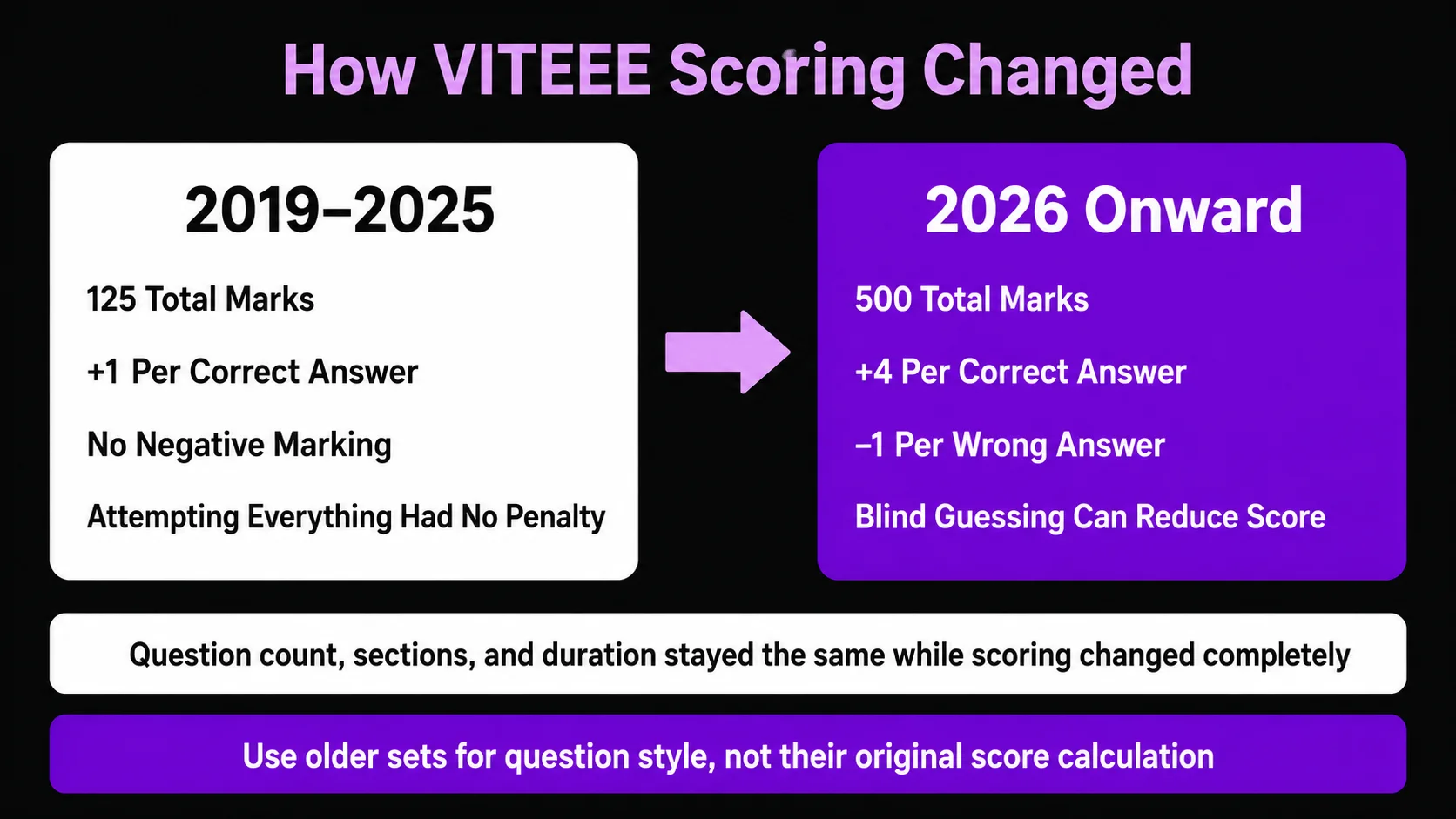
- From roughly 2019 through 2025, VITEEE had no negative marking at all, every question was worth 1 mark, and attempting all 125 questions carried zero downside.
- Starting with the 2026 cycle, VIT introduced negative marking (-1 per wrong answer) alongside a jump to 4 marks per correct answer, taking the exam from 125 total marks to 500.
- Earlier cycles, further back than 2019, are reported by some sources to have included negative marking too, suggesting VIT has moved back and forth on this policy over a longer timeframe than most current prep material accounts for.
Because of this, the most useful thing an older set gives you isn't the exact score you'd have gotten, it's the question style, topic distribution, and relative difficulty across sections. Always treat the marking scheme separately, and confirm it against the current year's official information brochure rather than assuming continuity with whatever year's set you happen to be practicing.
Getting the Most Out of VITEEE PYQ Practice
We tell every VITEEE aspirant the same thing: don't just work through a PYQ set start to finish and move on, break it down by section and analyze it. Mathematics or Biology carries the highest weightage at 40 questions, so time spent finding and fixing weak topics there, guided by the official VITEEE syllabus , moves your score more than equivalent time spent on the 5-question English section, even though English feels like an easy scoring opportunity.
A mistake we see constantly with the new marking scheme specifically: students carry over their old no-negative-marking habit of attempting every question regardless of confidence, straight into 2026-style negative marking, and it costs them real marks. If you're practicing with a pre-2026 set, deliberately re-score it using the current +4/-1 scheme rather than the original +1/0 scheme it was built for, so your practice numbers actually reflect what your strategy would net you under the real marking rules.
This re-scoring exercise is worth doing manually at least once, even though it's tedious, because it forces you to actually see which of your habitual guesses would have cost you marks under the new scheme. Students who skip this step and just solve papers under the old mental model often walk into the real exam still guessing on borderline questions out of habit, discovering the cost of that habit for the first time when it actually counts.
Getting VITEEE PYQ Prep Right With Phodu Club
Piecing together reliable practice material, understanding which years reflect the current marking scheme, and figuring out how to weight your practice time across sections is exactly the kind of groundwork most students don't have time for alongside board exams and everything else competing for their attention in the final stretch.
Our Ultimate VITEEE Test Series is built around the current pattern specifically. It includes 5 full-length mock tests matched to the latest VITEEE syllabus and the new 500-mark, negative-marking scheme, with unlimited attempts and detailed solutions and performance analysis after every test. You also get our Ultimate Revision Notes, handwritten, exam-focused short notes for every PCM chapter made by toppers, for fast, high-yield revision in the final weeks. Check the current details on the VITEEE test series page for what's included this cycle.
Chasing down old question paper PDFs from scattered sources isn't the fastest path to a strong rank, especially now that the scoring itself has changed. Understanding what's officially verified, what's memory-based, and how the pattern has actually evolved is, and that understanding costs you nothing more than the time it takes to read a page like this one carefully.
Frequently Asked Questions
1) Does VIT officially release VITEEE PYQ papers after each exam?
No. VIT does not officially publish the actual VITEEE question paper after any exam session. Most of this material online is reconstructed from candidate memory by coaching platforms and student communities, not sourced from an official archive.
2) Where can I download VITEEE PYQ PDFs for 2021 to 2026?
Coaching platforms and student communities compile memory-based practice sets for these years since VIT doesn't release official past papers. Phodu Club's verified year-wise downloads for these years are coming soon.
3) Has the VITEEE exam pattern changed recently?
Yes, significantly. From 2026 onward, VIT introduced negative marking (-1 per wrong answer) and raised the marks per correct answer from 1 to 4, taking the total from 125 to 500 marks. Question count, sections, and duration stayed the same.
4) Is a pre-2026 practice set still useful for 2027 preparation?
Yes, for question style, topic weightage, and difficulty level, but not for gauging your expected score or guessing strategy. Always re-score older PYQ attempts using the current +4/-1 marking scheme rather than the older +1/0 system they were originally built for.
5) Is the official VITEEE mock test the same as a previous year paper?
No. The official mock test, released separately for the MPCEA and BPCEA streams on viteee.vit.ac.in , shows the current interface and question format but isn't a full previous year's question set. It's still the most reliable official reference available.
6) How many previous year sets should I solve before the exam?
Most VITEEE prep guidance suggests solving at least 8 to 10 full papers if you're targeting a high score, prioritizing 2022 to 2025 sets first before moving to older years, and always practicing under the current negative-marking scheme regardless of which year's paper you're using. Spread that practice across different compiled sets rather than repeatedly working through the same one, since a single source only captures one shift's worth of questions.
7) Which section should get the most attention when practicing previous year sets?
Mathematics or Biology, since it carries the highest weightage at 40 of 125 questions. Physics and Chemistry follow at 35 questions each. Aptitude and English are smaller, faster-scoring sections worth practicing but not at the expense of the higher-weightage subjects.
8) How does Phodu Club help with VITEEE PYQ and overall preparation?
Phodu Club's Ultimate VITEEE Test Series includes 5 full-length mock tests built to the current 500-mark, negative-marking pattern, unlimited attempts with detailed solutions and performance analysis, and handwritten Ultimate Revision Notes for every PCM chapter made by toppers.
Want to crack your exam with mentors who did?
Get test series, crash courses and free mentorship from students at IITs, NITs and BITS.