The Maharashtra Health and Technical Common Entrance Test (MHT-CET) is one of the most important entrance exams in Maharashtra. The State Common Entrance Test Cell, Maharashtra conducts it, often called the Maharashtra State CET Cell. The exam is held every year for admission to undergraduate engineering, pharmacy, and agriculture courses across colleges in the state.
If you plan to appear for MHT-CET 2026, this guide covers everything you need — from the exam structure, syllabus, and previous year questions (PYQs), to preparation tips and time management strategies.
MHT-CET 2026 Exam Snapshot
| Particulars | Details |
| Exam Name | Maharashtra Health and Technical Common Entrance Test (MHT-CET) |
| Conducting Authority | State Common Entrance Test Cell, Maharashtra |
| Governing Body | Government of Maharashtra |
| Purpose | Admission to Engineering, Pharmacy, and Agriculture courses |
| Exam Type | State-Level Entrance Examination |
MHT-CET 2026 Important Dates
| Event | MHT CET 2026 Dates |
| Notification Release | January 10, 2026 |
| MHT CET 2026 Application Start Date | January 10, 2026 |
| MHT CET 2026 registration last date | February 24, 2026 |
| MHT CET 2026 Last Date with Late Fee | February 27 2026 |
| MHT CET 2026 Form Correction | March 5 to 7, 2026 |
| MHT CET 2026 Admit Card Release | March 2026 |
| MHT CET 2026 Exam Dates (PCB Group) | Session 1: April 21 to 26, 2026Session 2: May 10 and 11, 2026 |
| MHT CET 2026 Exam Dates (PCM Group) | Session 1: April 11 to 19, 2026Session 2: May 14 to 17, 2026 |
| MHT CET 2026 Answer Key Release | May 2026 (Tentative) |
| MHT CET 2026 Result Declaration | June 2026 (Tentative) |
| Counselling Process Start | June/July 2026 (Tentative) |
Note: These dates are based on previous trends. Students should visit the official CET Cell website for official updates. Students may appear for either PCM, PCB, or both, depending on their preferred field of study.
MHT-CET Mode of Exam and Other Key Details
| Feature | Details |
| Mode of Exam | Computer-Based Test (CBT) |
| Question Type | Multiple-Choice Questions (MCQs) |
| Marking Scheme | No negative marking; 1 mark per question in Physics & Chemistry, 2 marks per question in Mathematics |
| Medium of Exam | English, Marathi, and Urdu (at selected centers) |
| Duration | 180 minutes (3 hours) (90 mins each paper) |
The absence of negative marking allows students to attempt all questions without fear of losing marks, which is a major advantage over exams like JEE Main and NEET UG.
MHT-CET 2026 Exam Pattern
The exam pattern varies slightly for PCM and PCB streams.
MHT-CET Paper Pattern – PCM
| Subject | No. of Questions | Marks per Question | Total Marks | Weightage % |
| Mathematics | 50 | 2 | 100 | 50% |
| Physics | 50 | 1 | 50 | 25% |
| Chemistry | 50 | 1 | 50 | 25% |
| Total | 150 | — | 200 | 100% |
MHT-CET Paper Pattern – PCB
| Subject | No. of Questions | Marks per Question | Total Marks | Weightage % |
| Physics | 50 | 1 | 50 | 25% |
| Chemistry | 50 | 1 | 50 | 25% |
| Biology | 100 | 1 | 100 | 50% |
| Total | 200 | — | 200 | 100% |
Key Points
- The Mathematics section carries double weight compared to Physics or Chemistry in PCM.
- In PCB, Biology dominates with half the total marks.
- The paper uses the CBT format, with each subject displayed separately on the screen.
- Time management across subjects is crucial, as each section requires different solving speed and approach.
MHT-CET 2026 Exam Syllabus
The MHT-CET syllabus is based on the Maharashtra State Board syllabus for Classes 11 and 12.
Syllabus Weightage
- Class 11: Approximately 20% of questions.
- Class 12: Approximately 80% of questions.
MHT-CET 2026 Class 11 Syllabus
| Subjects | Chapters |
| Mathematics | Trigonometric functionsTrigonometric functions of Compound AnglesFactorization formulaeStraight lineCircle and ConicsSetsRelations and FunctionsProbabilitySequences and Series |
| Physics | MeasurementsScalars and VectorsForce, Friction in solids and liquidsRefraction of LightRay opticsMagnetic effect of electric currentMagnetism. |
| Chemistry | Some basic concepts of ChemistryStates of Matter (gases and liquids)Redox reactionSurface ChemistryNature of chemical bondHydrogens-Block elements (Alkali and alkaline earth metals)Basic principles and techniques in organic chemistryAlkanes. |
| Biology (Botany) | Diversity in organismsBiochemistry of cellPlant Water relations and Mineral NutritionPlant growth and development. |
| Biology (Zoology) | Organization of cellAnimal tissuesHuman NutritionHuman Respiration. |
MHT-CET 2026 Class 12 Syllabus
| Subjects | Chapters |
| Mathematics | Mathematical LogicMatricesTrigonometric functionsPair of straight linesCircleConicsVectorsThree-dimensional geometryLinePlaneLinear programming problemsContinuityDifferentiationApplication of derivativeIntegrationApplications of definite integralDifferential equationStatisticsProbability distributionBernoulli trials and Binomial distribution. |
| Physics | Circular MotionGravitationRotational motionOscillationsElasticitySurface tensionWave motionStationary wavesKinetic theoryWave theoryInterference and diffractionElectrostaticsCurrent electricityMagnetic effects of electric currentMagnetismElectromagnetic inductionsElectrons and PhotonsAtoms, Molecules and NucleiSemiconductorsCommunication systems. |
| Chemistry | Solid StateSolutions and colligative propertiesChemical Thermodynamics and energeticElectrochemistryChemical KineticsGeneral Principles and Processes of Isolation of Elementsp-Block Elements,d and f Block ElementsCoordination CompoundsHalogen derivatives of alkanes (and arenes)AlcoholsPhenols and EthersAldehydesKetones and Carboxylic AcidsOrganic Compounds Containing NitrogenBiomoleculesPolymersChemistry in Everyday Life. |
| Biology (Botany) | Genetic Basis of InheritanceGene: its nature, expression and regulationBiotechnology: Process and ApplicationEnhancement in Food ProductionMicrobes in Human WelfarePhotosynthesisRespirationReproduction in PlantsOrganisms and Environment -I. |
| Biology (Zoology) | Origin and the Evolution of LifeChromosomal Basis of InheritanceGenetic Engineering and GenomicsHuman Health and DiseasesAnimal HusbandryCirculationExcretion and osmoregulationControl and Co-ordinationHuman ReproductionOrganisms and Environment-1 |
Students should use the latest MHT-CET syllabus provided by the CET Cell and NCERT-based textbooks for accurate preparation.
MHT-CET PYQ (Previous Year Questions)
Solving PYQs is one of the most effective preparation methods. It helps students identify patterns, recurring chapters, and difficulty levels.
| Year | Free question paper download link |
| 2025 | MHT-CET 2025 Question Paper |
| 2024 | MHT-CET 2024 Question Paper |
| 2023 | MHT-CET 2023 Question Paper |
| 2022 | MHT-CET 2022 Question Paper |
| 2021 | MHT-CET 2021 Question Paper |
| 2020 | MHT-CET 2020 Question Paper |
MHT-CET Exam 2026 Weightage
MHT-CET Mathematics Weightage (PCM Group)
The highest weightage is given to Calculus and Algebra, which are crucial for scoring well. Topics like Probability, Matrices, and Vectors require less time and can help secure quick marks.
| Topic | Approx. Weightage (%) |
| Algebra | 15–20% |
| Calculus | 25–30% |
| Coordinate Geometry | 15–20% |
| Trigonometry | 10–15% |
| Probability & Statistics | 5–10% |
| Matrices & Determinants | 5–10% |
| Vectors & 3D Geometry | 5–10% |
MHT-CET Physics Weightage (PCM / PCB Group)
Mechanics and Electrodynamics are high-priority topics. Modern Physics is usually scoring but has fewer questions.
| Topic | Approx. Weightage (%) |
| Mechanics | 20–25% |
| Thermodynamics | 10–15% |
| Electrodynamics | 15–20% |
| Optics & Waves | 15–20% |
| Modern Physics | 10–15% |
| Properties of Matter | 5–10% |
| Heat & Oscillations | 5–10% |
MHT-CET Chemistry Weightage (PCM / PCB Group)
Physical and Organic Chemistry carry the most weightage. Questions from Inorganic Chemistry often follow the previous years’ pattern closely.
| Topic | Approx. Weightage (%) |
| Physical Chemistry | 35–40% |
| Organic Chemistry | 30–35% |
| Inorganic Chemistry | 25–30% |
MHT-CET Biology Weightage (PCB Group)
Human Physiology and Genetics carry the maximum weightage. Ecology and Biodiversity are easy and quick-scoring sections.
| Topic | Approx. Weightage (%) |
| Genetics & Evolution | 15–20% |
| Cell Biology | 10–15% |
| Human Physiology | 20–25% |
| Plant Physiology | 10–15% |
| Ecology & Environment | 10–15% |
| Biotechnology & Microbiology | 5–10% |
| Diversity of Life | 10–15% |
The CET Cell usually follows the Maharashtra State Board syllabus closely, so focusing on textbook examples and solved problems helps significantly.
How to Use PYQs Effectively for MHT-CET 2026 Preparation
Preparing for MHT-CET is not just about finishing the syllabus; it’s about learning to solve questions smartly. One of the most effective ways to do that is by practising Previous Year Questions (PYQs). These papers show you the actual difficulty level, question styles, and recurring topics. Solving PYQs helps bridge the gap between theory and real exam application. Below is a detailed, step-by-step method to use PYQs effectively while preparing for MHT-CET 2026.
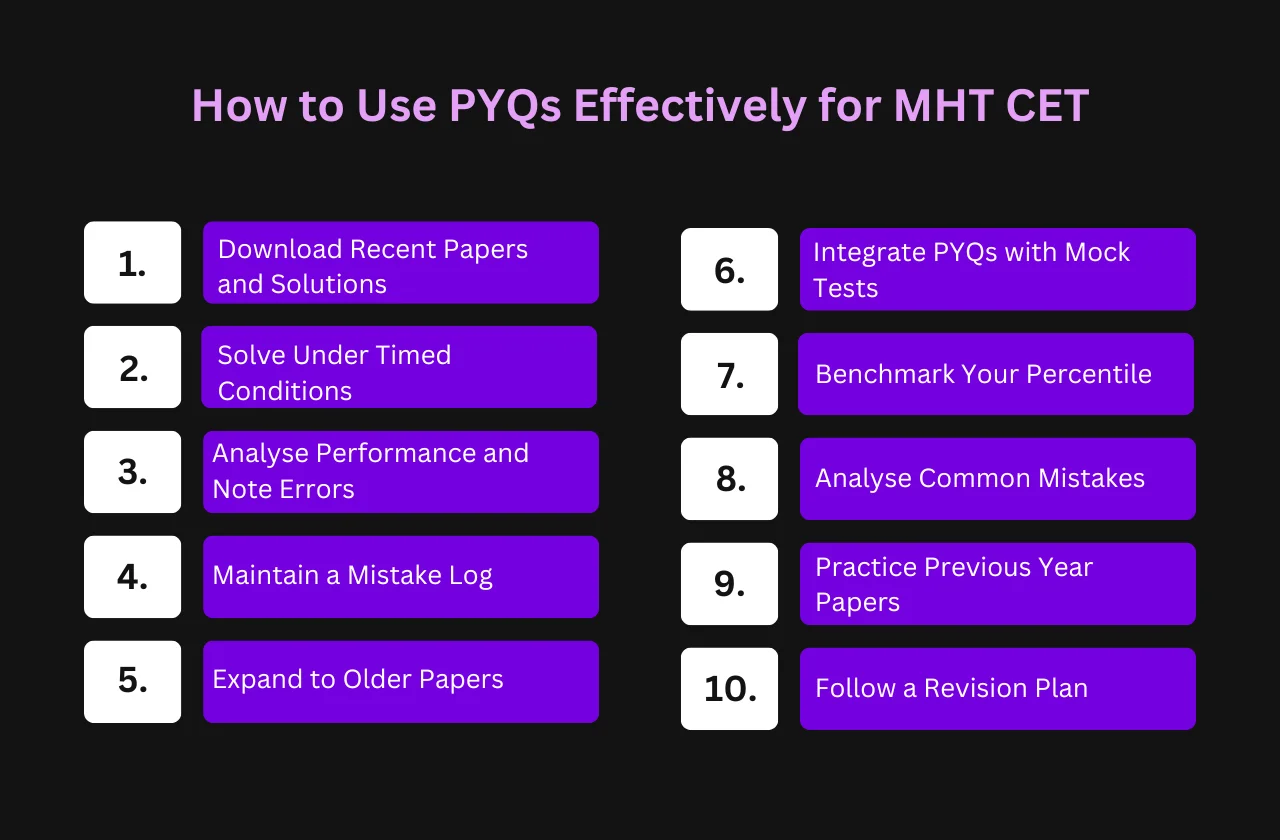
Step 1: Download Recent Papers and Solutions
Start by collecting the last three to five years of MHT-CET question papers. You can usually find them on the official Maharashtra CET Cell website or trusted educational portals. Make sure the papers are from authentic sources with accurate answer keys and verified solutions.
If you are preparing for the PCM group, download papers from engineering streams. For PCB, download papers from pharmacy and agriculture streams. If you plan to appear for both, organise them separately in folders labelled “PCM PYQs” and “PCB PYQs.”
This helps in better tracking and makes it easy to revise later. You can also print a few papers if you prefer solving offline.
Step 2: Solve Under Timed Conditions
The MHT-CET is a time-based exam, and learning to work within those limits is crucial. While practising PYQs, simulate the actual exam setting as closely as possible.
- Allocate 90 minutes for Mathematics or Biology.
- Spend 45 minutes each on Physics and Chemistry.
- Keep your mobile away and avoid checking solutions midway.
This approach builds discipline and helps you get used to managing stress during the real test. Over time, you’ll notice which subjects consume more time and where you tend to rush.
For example, many students spend too long on lengthy calculation-based Physics questions or complex integration problems in Maths. Practising under real-time limits helps you identify such patterns early and correct them.
Step 3: Analyse Performance and Note Errors
After finishing each paper, don’t rush to the next one. Take time to review your performance carefully. Compare your answers with the correct solutions and identify the type of errors you made.
Ask yourself:
- Did I misread the question?
- Did I apply the wrong concept or formula?
- Was it a silly calculation mistake?
- Did I run out of time?
- Is there any other simpler way to solve this type of problem?
Make notes on where and why you went wrong. This reflection process helps you understand your weaknesses. You’ll begin to see which chapters repeatedly cause trouble, such as motion in Physics or organic reactions in Chemistry. Treat every mistake as a learning opportunity. Correcting small recurring errors now prevents losing marks later.
Step 4: Maintain a Mistake Log
A mistake log is one of the most powerful learning tools during preparation. Take a small notebook or make a spreadsheet where you record every error you make in PYQs or mock tests.
Create columns like:
- Topic/Chapter
- Question Type
- Type of Mistake (Concept error, calculation slip, misread question, etc.)
- Correct Concept or Formula
- Date Revisited
Here are some common mistakes to track:
- Misreading numerical data or ignoring units.
- Forgetting a step in derivations.
- Mixing up similar concepts (for example, reflection vs. refraction).
- Choosing an option before checking all possibilities.
Review this log once every week. Over time, you’ll notice your errors decrease. You’ll also start identifying patterns — for instance, frequent mistakes in thermodynamics equations or confusion in organic reaction mechanisms. This gives you clear direction on where to focus.
Step 5: Expand to Older Papers
Once you’ve mastered the recent 3–5 years of papers, move to older ones. Even though the pattern evolves slightly each year, the core concepts remain the same. For example, Mechanics in Physics or Calculus in Mathematics always hold significant weightage. Older PYQs also reveal foundational ideas that continue to appear in modified forms. Solving them builds a deep understanding of how the same concept can be asked differently.
While practising older papers:
- Identify question types that repeat every few years.
- Mark frequently used formulas or common trap options.
- Compare question styles from older papers with recent ones to track changes in difficulty.
This backward-expanding method strengthens both your conceptual base and your question-solving flexibility.
Step 6: Integrate PYQs with Mock Tests
After finishing several years of PYQs, start combining them with full-length mock tests. Create hybrid tests that mix PYQ questions with new ones.
This practice gives two main benefits:
- You test your understanding in a real-exam format.
- You learn to apply old concepts to unfamiliar situations.
Attempt mock tests every weekend and analyse them in detail. For PCM students, dedicate one day for a Math-heavy test, and another for Physics-Chemistry. PCB students can do the same by alternating between Biology-focused and balanced tests. Mock tests also improve endurance. Sitting for three continuous hours and maintaining focus is a skill, and frequent practice makes it easier.
Step 7: Benchmark Your Percentile
To understand where you stand, compare your mock test or PYQ scores with previous year cut-offs. These cut-offs differ by college and category, but they give a realistic idea of the percentile range needed for your target college.
For example:
- For top institutes like COEP Technological University and VJTI Mumbai, a 160+ PCM score is generally safer for top branches.
- Pharmacy aspirants should aim for 140+ marks in PCB for top colleges.
Tracking your progress against these benchmarks helps you stay motivated and set short-term goals. If your score is below your target, revisit your weak subjects and work on them with focused PYQ practice.
Step 8: Practise Time Splits
The 90 + 90-minute split strategy works well for PCM papers. Spend the first 90 minutes on Mathematics and the next 90 minutes divided between Physics and Chemistry.
For PCB students, follow a similar approach:
- 90 minutes for Biology
- 45 minutes for Physics
- 45 minutes for Chemistry
This helps maintain subject balance and prevents over-spending time on one area. During practice sessions, experiment with different time distributions to find what suits you best. Some students may prefer finishing Chemistry first because it has shorter questions. Others may like tackling Maths early for better focus. The goal is to find a rhythm that maximises your total score.
Step 9: Analyse Common Mistakes
Many students lose marks due to avoidable errors rather than lack of knowledge. Here are some common issues seen in past MHT-CET attempts:
- Ignoring unit conversions in Physics questions (for example, cm to m).
- Skipping simple formula rearrangements.
- Rushing through easy questions without reading options carefully.
- Forgetting to apply dimensional analysis to verify derived formulas.
- Spending too much time on one difficult question.
To avoid this, train yourself to move on when stuck. Mark the question for review and return to it later. Also, get into the habit of double-checking units and significant figures while solving numericals.
These small habits save valuable marks and time during the actual exam.
Step 10: Follow a Revision Plan
Revising PYQs regularly is just as important as solving them. Questions you solved a month ago can fade from memory if not revisited. Plan a structured revision cycle:
- Week 1–4: Solve recent papers and make notes.
- Week 5–8: Re-solve previously done PYQs without looking at solutions.
- Week 9 onward: Take full mock tests using PYQs and analyse trends.
During revision, pay attention to high-weightage chapters like Calculus, Mechanics, Organic Chemistry, and Human Physiology. Also, highlight tricky questions that you got wrong earlier and attempt them again. This repetition builds confidence and ensures you retain concepts long term.
Conclusion
MHT-CET 2026 will test both speed and accuracy. A focused approach, regular PYQ practice, and smart time management will make preparation easier. Students should rely on standard textbooks, consistent practice, and mock exams that replicate the real environment.The exam rewards students who build clear concepts and practise regularly, rather than just memorizing formulas.
FAQs
1) How many years of PYQs should I solve?
Solve at least five years of previous papers. This gives a fair idea of question types and important topics.
2) Is there negative marking in MHT-CET?
No. There is no negative marking in the exam. You can attempt every question without losing marks for incorrect answers.
3) Can solving PYQs alone help achieve a top rank?
Solving PYQs helps a lot but is not enough by itself. Combine PYQs with mock tests, conceptual learning, and targeted revision.
4) Should I complete the syllabus before starting PYQs?
It’s better to complete at least 70–80% of the syllabus before starting PYQs. However, solving a few early can help identify weak topics.
5) How often should I redo PYQs?
Redo them every three to four weeks to keep concepts fresh and track progress.
6) What if the exam pattern changes in 2026?
Even if the format changes slightly, core topics and question types will remain similar. Focus on conceptual clarity and adapt your strategy once the official notification is released.