Understanding MHTCET marks vs percentile confuses thousands of Maharashtra engineering aspirants every year. A student scoring 140 out of 200 might expect a 70% score to reflect similarly in percentile, but the reality is far more nuanced. The Maharashtra State Common Entrance Test uses a normalization-based percentile system, not a simple percentage conversion. Knowing how this system works helps students set realistic targets, predict college eligibility, and plan CAP round strategies before results drop.
MHTCET Marks vs Percentile: TL;DR
- MHTCET percentile is calculated relative to all appearing candidates, not your raw score alone.
- Raw score normalization across sessions makes direct marks-to-percentile mapping an estimate, not a guarantee.
- A score of 150+ typically targets the 99th percentile range; 120+ generally lands between 95–98 percentile.
- Government engineering college admission in Maharashtra generally requires 90+ percentile for competitive branches.
What Is the Difference Between Marks and Percentile in MHTCET?
Many students treat marks and percentile as interchangeable, but they measure entirely different things. Your marks reflect how many questions you answered correctly, while your percentile reflects how you performed relative to every other candidate who appeared in the Maharashtra State Common Entrance Test that year.
The formula used by the State Common Entrance Test Cell Maharashtra is:
Percentile = (Number of candidates who scored less than you ÷ Total candidates appeared) × 100
So if 4,00,000 students appeared and 3,80,000 scored below you, your percentile is 95. Your raw score is irrelevant to this calculation once the normalization process is applied across sessions.
Here is why this distinction matters practically:
- Two candidates scoring 130 marks in different exam sessions may receive different percentiles because session difficulty varies.
- A “good” raw score in a tough paper yields a higher percentile than the same score in an easier paper.
- Merit list generation for CAP rounds uses percentile, not raw marks, as the ranking metric.
| Metric | What It Measures | Used For |
| Raw Marks | Questions answered correctly | Personal performance reference |
| Percentile | Rank relative to all candidates | College admission and merit lists |
| Percentage | Marks ÷ Total × 100 | Not used in MHTCET admission |
This is the same logic applied in JEE Main percentile correlation, where raw scores across sessions are normalized before ranking. If you want to understand how percentile thresholds work in competitive engineering exams more broadly, Phodu Club’s breakdown of what 98 percentile means in JEE Mains offers a useful parallel framework.
The core takeaway: never judge your MHTCET performance by marks alone. Percentile is what determines your seat.
How Is Percentile Calculated in MHTCET 2026?
MHTCET 2026 is conducted across multiple sessions on different days, which creates an immediate problem: paper difficulty is never perfectly identical across sessions. To make inter-session score comparison fair, the Directorate of Technical Education Maharashtra applies a raw score normalization procedure before generating percentiles.
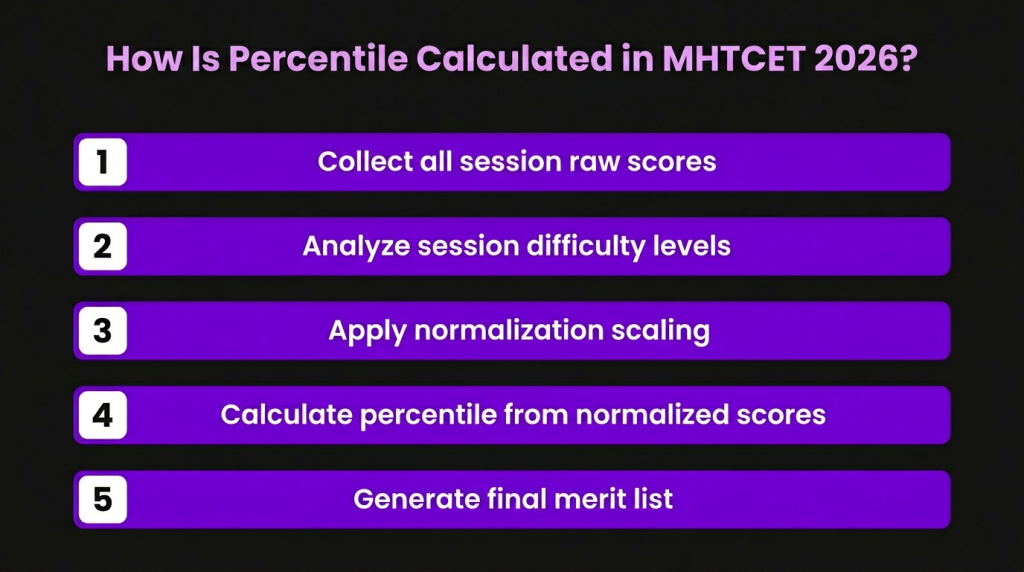
The calculation process follows these steps:
- Raw scores are compiled for every candidate across all exam sessions.
- Each session’s score distribution is analyzed to assess relative difficulty.
- A difficulty level equalization formula scales scores so that a hard-session candidate is not penalized versus an easy-session candidate.
- Normalized scores are then used to calculate the percentile for each student using the formula above.
- The State Common Entrance Test Cell generates a consolidated merit list for CAP round use.
Key facts about the subject-wise marking scheme in 2026:
- Total marks: 200
- Physics: 50 marks (50 questions, 2 marks each)
- Chemistry: 50 marks (50 questions, 2 marks each)
- Mathematics: 100 marks (50 questions, 2 marks each)
- No negative marking
Physics Chemistry Mathematics weightage is not equal: Mathematics carries 50% of total marks, making it the single most influential subject in determining your raw score and, by extension, your percentile.
The score scaling procedure ensures that a candidate who appeared in a tougher session is not ranked below someone who had an easier paper with the same actual ability level. This is identical in principle to how JEE Main normalization works across its sessions, a comparison the JEE Mains marks vs percentile analysis on Phodu Club covers in detail.
Directorate of Technical Education Maharashtra publishes the official percentile methodology post-result. Students should cross-reference official score cards before planning admissions.
MHTCET Score to Percentile Conversion Chart 2026
The table below is a reference estimate based on historical trends and candidate distribution patterns. Because raw score normalization varies by session difficulty, treat these as indicative ranges, not guaranteed conversions.
| Marks (out of 200) | 2026 Estimated Percentile | Target Range & Impact |
| 180–200 | 99.92–100 | Top 1,000 Rank; Guaranteed top branches at VJTI/COEP. |
| 160–179 | 99.50–99.91 | Safe for CS/IT at SPIT, PICT, and Walchand. |
| 150–159 | 98.80–99.49 | Competitive for Tier-1 Government and top Private autonomous. |
| 130–149 | 97.50–98.79 | Strong performance; opens most good private institutes in Mumbai/Pune. |
| 120–129 | 95.50–97.49 | Mid-to-high tier private colleges (VIT Pune, KJ Somaiya). |
| 100–119 | 92.00–95.49 | Decent private colleges; core branches in Government-aided. |
| 80–99 | 85.00–91.99 | Lower-mid tier options; better chances in non-CS branches. |
| Below 80 | Below 85.00 | Limited options in popular urban colleges. |
What Percentile Do You Need for a Good College in MHTCET?
“Good college” means different things to different students, so this section breaks eligibility down by institution category and branch, drawing on CAP rounds Maharashtra admission data patterns.
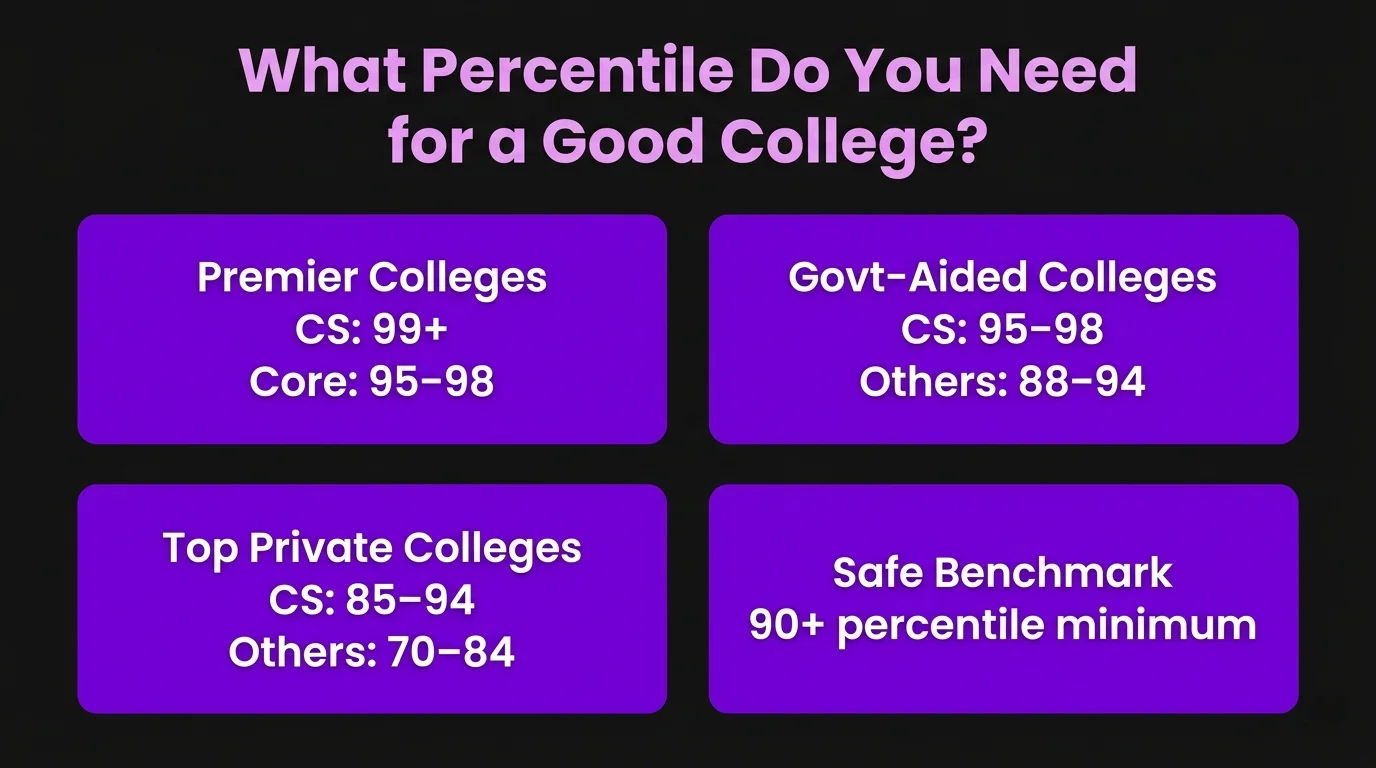
Government Premier Colleges (e.g., VJTI Mumbai, COEP Pune, PICT Pune):
- Computer Science / IT: 99+ percentile typically required
- Mechanical / Civil: 95–98 percentile range
- General category cutoffs are significantly tighter than category-wise reservation cutoffs
Autonomous Government-Aided Colleges:
- CS/IT branches: 95–98 percentile
- Other branches: 88–94 percentile
Good Private Colleges (e.g., Symbiosis, MIT Pune, DYPCOE):
- CS/IT: 85–94 percentile
- Other branches: 70–84 percentile
Category-wise reservation cutoffs shift these thresholds meaningfully. SC/ST/OBC/NT/SBC categories have lower cutoffs under Maharashtra’s reservation matrix, and candidates should check seat allocation matrix data from the official State Common Entrance Test Cell post-result.
Key benchmark: For a government engineering college in Maharashtra with a recognized branch like Computer Science, a percentile of 90+ is the practical minimum for the general category. Anything above 95 significantly expands options.
The college branch allotment process in CAP rounds Maharashtra means that even within the same percentile, students with strategic college preference lists secure better seats. Rank prediction alone is not enough; admission counselling process awareness is equally critical.
For comparison, the COMEDK rank vs colleges framework in Karnataka offers a useful parallel on how percentile thresholds translate into seat eligibility across different state exams.
Why Is Your MHTCET Percentile Lower Than Your Score Suggests?
This is one of the most common post-result frustrations. A student scores 145, assumes they are in the top 10%, but receives a 96 percentile instead of the 97+ they expected. Several factors explain this gap.
The most common reasons:
- Session difficulty was lower than average: If your session was easier, more candidates scored high, compressing the upper percentile range.
- Total candidate pool increased: More candidates appearing means each percentile point represents more people, and competition at the top thickens.
- Mathematics performance skewed the distribution: Since Math carries 100 of 200 marks, a year where candidates collectively perform better in Math pushes the entire score curve upward, reducing percentiles for moderate performers.
- Normalization correction applied: The score scaling procedure may have adjusted raw scores slightly, altering the final distribution.
Reality check: A 96 percentile with 145 marks is no failure. That means you beat 96 of 100 candidates. The problem is not your score; it is misaligned expectations from marks-to-percentile confusion.
This phenomenon is also documented in JEE Main contexts. Phodu Club’s analysis of what 85 percentile means in JEE Mains demonstrates how the same relative rank feels different depending on candidate pool size.
To avoid this surprise, students should practice under timed, full-syllabus mock tests that replicate actual exam conditions, so their expected score range is calibrated against realistic competition, not just syllabus coverage. Phodu Club’s MHTCET test series mirrors the exact exam pattern, giving students the most accurate pre-exam performance benchmark available.
MHTCET Percentile Required for Government Engineering College 2026
Government engineering college admission in Maharashtra through the CAP rounds process is the most competitive application of MHTCET percentile. The seat allocation matrix for 2026 reflects demand patterns from prior years, with some adjustments for new seat additions.
Branch-wise percentile benchmarks for government colleges (general category):
| Branch | 2026 Percentile Required (Approx.) |
| Computer Science (CSE) | 99.65 – 99.98 |
| Information Technology (IT) | 99.50 – 99.94 |
| Electronics & Telecommunication | 98.20 – 99.75 |
| Electrical Engineering | 96.50 – 99.45 |
| Mechanical Engineering | 94.50 – 99.25 |
| Civil Engineering | 88.00 – 98.60 |
Competition at premier institutes has reached a saturation point where even a 99 percentile may not guarantee a seat in a “Big Three” college for a general candidate.
- VJTI Mumbai: CSE now targets 99.95+, with even “lower” branches like Textile Technology requiring around 94-95 percentile.
- COEP Pune: Computer Engineering is tracking at 99.90+, while Civil has risen to a 98.6+ baseline.
- Government College, Amravati: A strong alternative; however, CSE here has tightened to a 97.5 – 98.0 range.
Category-wise Percentile Cushion
While cutoffs drop for reserved categories, the “Best of Two” rule has also narrowed the gap slightly.
- OBC / EWS: Cutoffs remain very close to the General category, typically differing by only 0.1 to 0.5 percentile for top branches.
- SC / ST: The cushion remains substantial. For VJTI/COEP, SC candidates can often find seats at 96–98 percentile for CS, while ST candidates may find opportunities starting around 92–94 percentile.
Strategic CAP Round Targets
For 2026 aspirants, the decision-making process in CAP rounds (Float vs. Freeze) is more critical than ever:
- 99.5+ Percentile: Strong candidates for VJTI/COEP/SPIT.
- 97–99 Percentile: Ideal for top autonomous private colleges (PICT, VIT Pune, Walchand) or core branches at top government colleges.
- 90–96 Percentile: Target the “Mid-Tier” government colleges (Amravati, Karad, Jalgaon) or high-ranking private institutes in rural hubs.
Students can use Phodu Club’s MHTCET rank predictor tool to map their mock test scores to estimated percentile and college eligibility in real time, which significantly improves CAP round strategy.
How Does MHTCET Percentile Work in the Admission Process?
Once the State Common Entrance Test Cell publishes results, percentile scores feed directly into the engineering college admission cutoffs framework through CAP rounds Maharashtra. Understanding this pipeline helps students move from score anxiety to strategic action.
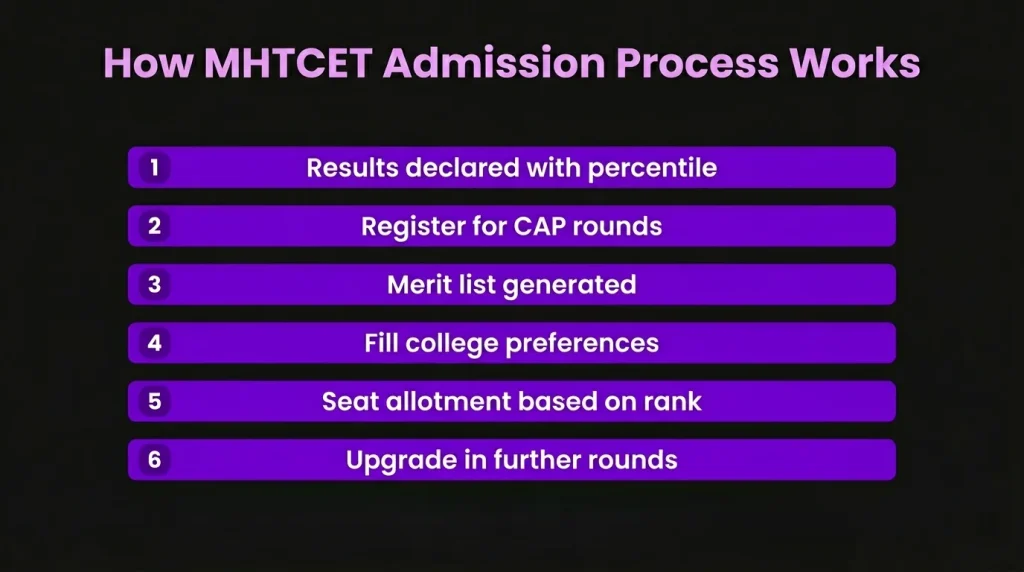
The admission counselling process works as follows:
- MHTCET results are declared with percentile scores on official scorecards.
- Candidates register for CAP (Centralized Admission Process) rounds on the DTE Maharashtra portal.
- A merit list is generated based on percentile, with tie-breaking rules applied (typically higher Mathematics score, then higher Physics score, then age).
- Candidates fill preference lists for colleges and branches during each CAP round.
- Seat allocation matrix assigns seats based on merit rank, category, and preferences.
- Multiple CAP rounds occur to fill remaining seats, with cutoffs dropping each round.
Strategic insight: Many students with 90–95 percentile secure better seats in Round 2 or 3 than in Round 1, because higher-percentile candidates upgrade or leave, releasing previously locked seats. Do not freeze your options after Round 1.
The rank prediction algorithm used internally by DTE Maharashtra also factors in domicile (Maharashtra vs. outside Maharashtra) and category certificates. Candidates should ensure documents are ready before CAP registration opens.
For those also appearing in other state-level tests, the KCET marks vs rank framework provides a useful KCET comparison framework showing how different states structure their admission pipelines, reinforcing why knowing your specific exam’s methodology matters.
Conclusion
- MHTCET marks vs percentile is not a straight-line conversion. Normalization across sessions shapes the final percentile significantly.
- The 90 percentile threshold is the practical minimum for government engineering college admission in competitive branches.
- Scoring 120 targets 90–95 percentile; scoring 150+ targets 98.5–99.1 percentile based on 2025 trends.
- Practice with full-pattern mock tests calibrates expectations and reduces post-result surprises. Phodu Club’s MHTCET test series replicates the exact exam pattern so students know where they actually stand before results day.
Frequently Asked Questions
1) What is the MHTCET percentile of 150 marks in 2026?
A score of 150 out of 200 typically places candidates in the 98.5–99.1 percentile range, depending on session difficulty and total candidates who appeared. This percentile is competitive for Tier-1 government engineering colleges in most branches except top CS programs.
2) If I score 120 in MHTCET, what will my percentile be?
A score of 120 generally translates to approximately 90–95 percentile. This qualifies candidates for several government colleges in less-competitive branches and strong autonomous private colleges. Final percentile depends on the normalization applied across exam sessions.
3) Why does MHTCET use percentile instead of raw marks for admissions?
MHTCET is conducted in multiple sessions with varying difficulty. Percentile-based ranking ensures that a candidate in a tougher session is not disadvantaged versus one in an easier session. It creates a fair, normalized comparison across all appearing candidates.
4) What percentile is required for CS engineering at VJTI Mumbai?
VJTI Mumbai’s Computer Science branch has historically required 99+ percentile for the general category in CAP rounds. This is among the most competitive cutoffs in Maharashtra government engineering colleges and requires both a high raw score and favorable session normalization.
5) Does MHTCET have negative marking that affects the marks-percentile relationship?
No, MHTCET 2026 does not have negative marking. Each correct answer awards 2 marks, and unattempted or wrong answers carry zero marks. This means raw scores tend to be higher overall, which can compress percentile differences in the upper range.
6) Can I predict my MHTCET college eligibility before results are declared?
Yes. Phodu Club’s MHTCET rank predictor lets students input their mock test or expected scores to estimate percentile and college eligibility. Practicing with full-pattern mock tests that mirror actual exam difficulty gives the most accurate pre-result projection.