Getting into a top engineering or pharmacy college in Maharashtra can feel like a race where every mark counts. Each year, thousands of students appear for the MHT CET, hoping to secure a seat in their dream college. But what often decides who gets in and who doesn’t is not just the score it’s the cutoff. The MHT CET cutoff acts as the deciding line between aspiration and admission. It shows the minimum rank or score required for entry into specific colleges and courses. Understanding these cutoffs helps students plan better, set achievable goals, and make smart choices during counselling. This article breaks down everything about MHT CET 2026 cutoffs from expected ranks and past trends to how to check official data and use it strategically. Whether you’re a student, parent, or mentor, this guide will help you approach admissions with clarity and confidence.
Overview of MHT CET
| Section | Details |
| Full Name of Exam | Maharashtra Health and Technical Common Entrance Test (MHT CET). |
| Purpose | The MHT CET is a state-level entrance test that allows students to gain admission into undergraduate courses in Maharashtra. It covers engineering, pharmacy, and agriculture programs. |
| Conducting Authority | The State Common Entrance Test Cell, Maharashtra (commonly called the CET Cell) organises the exam. This authority manages every stage of the process from releasing notifications and collecting applications to conducting the test, declaring results, and handling counselling. |
| Exam Mode | The test is conducted in Computer-Based Test (CBT) mode. Students sit at assigned computer centres, read the questions on screen, and select answers digitally. The system includes simple tools to mark, review, and change responses before submitting the final paper. |
| Streams and Eligibility | Students from both Science (PCM) and Biology (PCB) backgrounds can appear for the exam. The choice of group depends on the course they wish to pursue: engineering aspirants usually choose the PCM group, while those interested in pharmacy or agriculture may choose PCB. |
| Courses Covered | 1. B.E. / B.Tech (Engineering)2. B.Pharm / Pharm.D (Pharmacy)3. Agriculture and Allied Courses (such as B.Sc. in Agriculture, Horticulture, Forestry, etc.) |
| Exam Groups | The MHT CET 2026 is divided into two papers based on the stream:• PCM Group – Physics, Chemistry, Mathematics• PCB Group – Physics, Chemistry, Biology |
| Question Pattern | Each group has its own paper structure. The PCM paper is tougher in Mathematics and includes more numerical questions, while the PCB paper gives equal focus to all three subjects. The questions test understanding, application, and accuracy rather than memorisation. |
| Syllabus Basis | The syllabus follows the Class 11 and Class 12 subjects of the Maharashtra State Board of Secondary and Higher Secondary Education. About 20% of questions are based on the Class 11 syllabus, and 80% are from Class 12. |
| Scoring System | For the PCM group, Mathematics carries 2 marks per question, and Physics and Chemistry carry 1 mark each. For PCB, all subjects carry 1 mark per question. There is no negative marking, so wrong answers do not reduce the score. |
| Key Point for Students | MHT CET 2026 serves as the main gateway to top engineering, pharmacy, and agriculture colleges in Maharashtra. Since it is conducted annually, candidates should prepare according to the latest syllabus and exam pattern released by the CET Cell. |
Understanding MHT CET Cutoff
The MHT CET cutoff is the minimum rank or score required for admission to a specific course in a particular college.
Types of Cutoffs
- Opening Rank – The rank of the first student who got admission in that branch/college.
- Closing Rank – The rank of the last student who got admission.
- Round-wise Cutoffs – Each round of counselling (CAP Round 1, 2, and 3) has its own opening and closing ranks.
Cutoffs vary across rounds because seats get filled and some students withdraw or upgrade.
Factors Influencing MHT CET Cutoffs
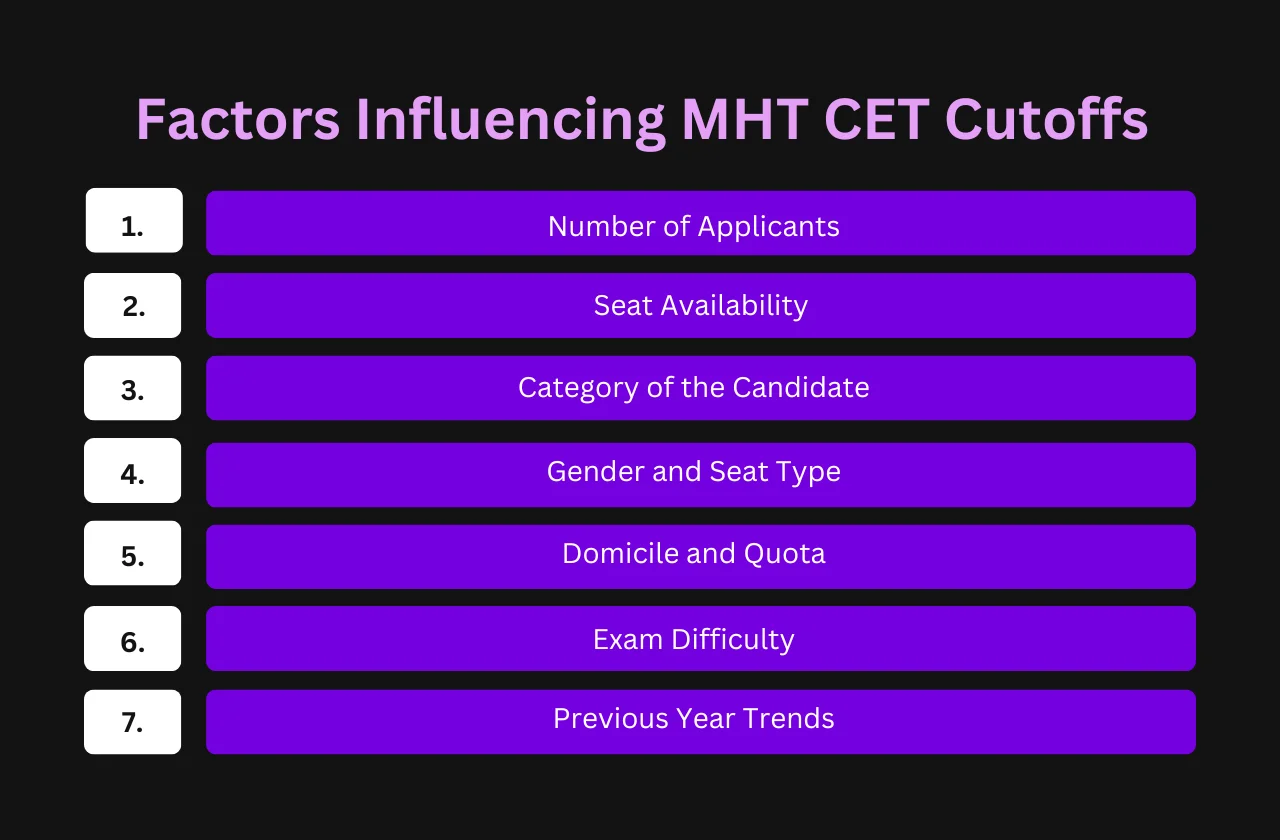
The MHT CET cutoff for each college and course depends on several factors that change every year. Knowing these factors helps students understand why cutoffs rise or fall and what to expect for 2026. Let’s look at the key elements that play a role.
1) Number of Applicants
When more students appear for the exam, competition increases. This pushes the cutoff higher because there are more candidates competing for the same number of seats. If fewer students take the test or apply for a particular branch, cutoffs may drop slightly. For example, Computer Science and IT branches usually attract the highest number of applicants, which is why their cutoffs are much higher than other branches.
2) Seat Availability
Each college has a fixed number of seats for every branch. Colleges with limited seats fill up faster, which leads to higher cutoffs. On the other hand, colleges or branches with more seats tend to have lower closing ranks. For instance, a reputed college with 60 CSE seats will see a tighter cutoff compared to a newer college with 180 seats for the same branch.
3) Category of the Candidate
Cutoffs change based on the category you apply under. Apart from General, OBC, SC, ST, and EWS, there are also SEBC, VJ, NT and other sub-categories. There are separate lists for General and Ladies as well. Reserved categories usually have relaxed cutoffs as per policy, but top colleges still see tight competition because the seats in each category are limited.
4) Gender and Seat Type
In some institutes, seats are divided by gender. For example, women-only colleges like Cummins College, Pune, have separate merit lists. Also, seats may be classified as “Home University” or “Other Than Home University,” which can affect cutoffs for students from different regions within Maharashtra.
5) Domicile and Quota
Maharashtra domicile students have a Home State quota, while candidates from other states apply under the All India quota. Home State quotas usually have more seats and slightly lower cutoffs compared to All India seats, which are highly competitive.
6) Exam Difficulty
When the MHT CET paper is tough, students usually score less. This leads to lower cutoffs, which means a lower score is needed for admission, not a lower rank. If the paper is easy, scores rise across the board and colleges ask for higher scores.
7) Previous Year Trends
Cutoffs follow certain patterns over time. By studying the last three to four years, aspirants can estimate what to expect. These trends reflect changes in exam difficulty, popularity of branches, and performance of students each year.
MHT CET Colleges Cutoff
| College | MHT CET CSE Cut off for General Category (Round 1) | MHT CET CSE Cut off for OBC Category (Round 1) |
| Walchand College of Engineering, Sangli | 1766 | 1929 |
| COEP Technological University | 243 | 535 |
| Dr. D.Y. Patil College of Engineering, Akurdi | 7698 | 8254 |
| PICT, Pune | 791 | 1097 |
| Vishwakarma Institute of Technology (VIT) | 6191 | 7149 |
| SPIT, Mumbai | 504 | 1644 |
| Pimpri Chinchwada College of Engineering (PCCOE) | 5310 | 5559 |
| Thadomal Shahani Engineering College (TSEC), Mumbai | 3583 | — |
| DJSCE, Mumbai | 1584 | — |
| YCC, Nagpur | 69517 | 91208 |
| SGGS, Nanded | 12480 | 14372 |
| Vivekanad Education Society’s Institute of Technology | 5602 | — |
| Bansilal Ramnath Agarwal Charitable Trust Vishwakarma Institute of Technology, Pune | 3505 | 4187 |
| XIT, Mumbai | 16882 | — |
| Shri Vile Parle Kelvani Mandal’s Dwarkadas J. Sanghvi College of Engineering | 1584 | — |
| Agnel’s Charirie’s FR.C. Rodrigue’s Institute of Technology | 11267 | — |
| Pune Vidyarthi Giha’s College of Engineering and Technology, Pune | 46003 | 56539 |
| K.J. Somaiya Institute of Engineering and Information Technology, Sion Mumbai | 48471 | 51126 |
| Vidyalankar Institute of Technology , Wadala, Mumbai | 8692 | 10438 |
MHT CET CSE Round 2 Cutoff 2025
| Institute | MHT CET CSE Cut off for General Category (Round 2) | MHT CET CSE Cut off for OBC Category (Round 2) |
| Government College of Engineering, Amravati | 9629 | 9801 |
| Government College of Engineering, Yavatmal | 51154 | 54719 |
| Shri Sant Gajanan Maharaj College of Engineering, Shegaon | 22085 | 24026 |
| Prof. Ram Meghe Institute of Technology & Research, Amravati | 30214 | 31926 |
| Prof. Ram Meghe Institute of Technology & Research, Amravati (IoT) | 56614 | 52476 |
| P. R. Pote Patil College of Engineering & Management, Amravati | 46975 | 50040 |
Official MHT CET CSE Round 3 Cutoff 2025
| Institute | MHT CET CSE Cut off for General Category (Round 3) | MHT CET CSE Cut off for OBC Category (Round 3) |
| Government College of Engineering, Amravati | 10017 | 11290 |
| Government College of Engineering, Yavatmal | 47359 | 55537 |
| Prof. Ram Meghe Institute of Technology & Research, Amravati | 30546 | 48005 |
| Prof. Ram Meghe Institute of Technology & Research, Amravati (IoT) | 46274 | – |
| Sipna College of Engineering & Technology, Amravati | 40401 | 77291 |
| Shri Shivaji Education Society’s COET, Akola | 78388 | 86210 |
| JSPM’s Babasaheb Naik COE, Pusad | 85654 | 123117 |
| Anuradha College of Engineering & Technology | 92931 | 187852 |
| Shri Hanuman Vyayam Prasarak Mandal’s COET, Amravati | 58997 | 69663 |
MHT CET Colleges Cutoff 2024
To estimate 2026 cutoffs, it’s helpful to look at 2024 data. The table below summarizes closing ranks for major colleges and branches.
| College Name | BTech course name | MHT CET closing rank |
| MKSSS’s Cummins College of Engineering for Women, Pune | BTech Computer Engineering | 2391 |
| BTech Information Technology | 3103 | |
| BTech Electronics and Telecommunication Engineering | 3338 | |
| COEP Technological University, Pune | BTech Robotics and Artificial Intelligence | 645 |
| BTech Electrical Engineering | 1183 | |
| BTech Electronics and Telecommunication Engineering | 799 | |
| BTech Instrumentation and Control Engineering | 1552 | |
| BTech Mechanical Engineering | 2100 | |
| BTech Manufacturing Science and Engineering | 2727 | |
| BTech Metallurgy and Materials Technology | 3727 | |
| Institute of Chemical Technology, Mumbai (ICT Mumbai) | BE Chemical Engineering | 1110 |
| BTech Dyestuff Technology | 5898 | |
| BTech Pharmaceuticals Chemistry and Technology | 3272 | |
| BTech Fibres and Textiles Processing Technology | 6180 | |
| BTech Polymer Engineering and Technology | 2862 | |
| MIT Academy of Engineering, Pune | BE Civil Engineering | 32467 |
| B.Tech Computer Engineering | 9120 | |
| BTech Information Technology | 10056 | |
| BTech Electronics and Telecommunication Engineering | 11584 | |
| BTech Mechanical Engineering | 24766 | |
| BTech Artificial Intelligence and Machine Learning | 9504 | |
| BTech Data Science | 10464 | |
| BTech Software Engineering | 10340 | |
| JSPMs Bhivarabai Sawant Institute of Technology and Research, Pune | BTech Computer Engineering | 18382 |
| BTech Information Technology | 22814 | |
| BTech Electrical Engineering | 39659 | |
| BTech Electronics and Telecommunications Engineering | 23877 | |
| BTech Mechanical Engineering | 46596 | |
| Vishwakarma Institute of Technology, Pune | BTech Civil Engineering | 13706 |
| BTech Computer Engineering | 2807 | |
| BTech Information Technology | 3350 | |
| BTech Electronics and Telecommunication Engineering | 5777 | |
| BTech Instrumentation and Control Engineering | 12971 | |
| BTech Mechanical Engineering | 11147 | |
| BTech Computer Science and Engineering Artificial Intelligence and Machine Learning | 3659 | |
| BTech Computer Science and Engineering Data Science | 4724 | |
| BTech Computer Science and Engineering Artificial Intelligence | 3680 | |
| BTech Computer Science and Engineering Internet of Things and Cyber Security Including Block Chain Technology | 4797 | |
| BTech Computer Engineering Software Engineering | 4540 | |
| BTech Artificial Intelligence and Data Science | 4813 | |
| GH Raisoni College of Engineering, Nagpur | BE Civil Engineering | 43690 |
| BE Computer Science and Engineering | 12848 | |
| BE Information Technology | 19330 | |
| BTech Internet of Things | 21996 | |
| BE Electronics and Telecommunication Engineering | 23554 | |
| BE Electronics Engineering | 26561 | |
| BTech Computer Science and Engineering Artificial Intelligence | 12239 | |
| BE Data Science | 20180 | |
| Dr DY Patil Institute of Technology, Pune | BE Civil Engineering | 34149 |
| BE Computer Science Engineering | 6733 | |
| BE Electrical Engineering | 11449 | |
| BE Electronics and Telecommunication Engineering | 11276 | |
| BE Instrumentation Engineering | 26721 | |
| BE Mechanical Engineering | 18170 | |
| BE Automation and Robotics | 13779 | |
| BE Data Science with Artificial Intelligence | 7172 | |
| Sardar Patel Institute of Technology, Mumbai (SPIT Mumbai) | BTech Computer Science and Engineering | 633 |
| BE Computer Engineering | 933 | |
| BE Electronics and Telecommunication Engineering | 1572 | |
| Yeshwantrao Chavan College of Engineering, Nagpur | BE Civil Engineering | 38706 |
| BE Computer Science and Engineering | 9999 | |
| BE Information Technology | 16097 | |
| BE Computer Technology | 13365 | |
| BE Electrical Engineering | 28201 | |
| BE Electronics and Telecommunication Engineering | 17252 | |
| BE Electronics Engineering | 21336 | |
| BTech VLSI Design and Technology | 22146 | |
| BE Mechanical Engineering | 29583 | |
| BE Artificial Intelligence and Machine Learning | 11344 | |
| BE Data Science with Artificial Intelligence | 16565 |
This shows how competitive admissions are, especially in Pune and Mumbai colleges.
MHT CET 2026 Expected Cutoff
Cutoffs have become more competitive each year, mainly for Computer Science and IT. However, shifts depend on the exam’s difficulty and the number of applicants.
- When papers are tough, ranks relax slightly.
- When more students score high marks, cutoffs rise.
Expected Cutoffs by Stream
| Stream | Top Colleges Expected Cutoff (General Category) |
|---|---|
| Computer Science / IT | 200 – 2500 |
| Electronics & Telecommunication | 2000 – 6000 |
| Mechanical | 4000 – 12000 |
| Civil | 8000 – 20000 |
| B.Pharm | 6000 – 25000 |
Expected Cutoffs by College Tier
- Tier 1: COEP and VJTI. Their CSE cutoffs usually stay under 500.
- Tier 1.5: SPIT and PICT. Strong colleges with CSE cutoffs that sit roughly in the 500–1500 window.
- ICT Mumbai: Doesn’t offer CSE. It’s focused on chemical and related fields, so it can’t be placed in the same CSE tier list.
- Tier 2: Walchand and VIT. Their CSE cutoffs often fall between 1500 and 7000.
- Tier 3: Regional colleges. CSE cutoffs here usually go past 10000.
These are approximate ranges and should be used as reference, not as final data.
How to Use Cutoff Information Effectively
Cutoff data is more than just numbers it’s a practical guide for making wise admission decisions. Understanding how to read and use this information helps you plan your counselling strategy, choose the right colleges, and avoid common mistakes that many students make during the MHT CET admission process. Here’s how to use cutoff data smartly.
During Counseling: Start by preparing a realistic preference list. Include three categories of colleges:
- Aspirational – Top colleges with higher cutoffs that you might reach if you perform exceptionally well.
- Target – Colleges where your expected rank or marks fit within last year’s closing ranks.
- Safe – Colleges where your score is comfortably above the previous year’s cutoff, ensuring a confirmed seat.
This approach ensures that you have options at every stage of the counselling process. Always compare your rank or percentile with the previous year’s cutoff data before finalizing your choices. The State CET Cell publishes round-wise lists, so check how much the cutoffs changed across CAP Round 1, 2, and 3. Do not rely on a single round. Seats may open up in later rounds due to withdrawals, which can improve your chances of getting a better branch or college.
Seat Allotment Strategy: Once the seat allotment results are announced, you’ll have to decide between freeze, float, or slide options:
- Freeze the seat if you are happy with the allotted branch and college. This confirms your admission and ends your participation in further rounds.
- Float if you want to accept the seat but remain eligible for a better college in later rounds.
- Slide if you prefer a different branch within the same college, provided seats open up.
Understand the upgradation rules clearly before locking your choice. Students often lose better opportunities because they do not use these options wisely. Review each round’s result carefully and keep an eye on vacant seat lists, as some colleges release additional seats toward the end.
Backup Plans
Even with careful planning, you might not get your top-choice college. Be prepared with backup options. You can apply to private colleges that offer state-level management quota seats, though fees are usually higher. If eligible, explore the All India Quota, where some Maharashtra colleges reserve seats for students from other states. Also, if you’ve taken JEE Main, your score can open doors to universities outside Maharashtra or in private institutes that accept JEE scores.
Using cutoff data thoughtfully gives you control during counselling. It ensures every choice you make is informed, realistic, and based on actual admission trends rather than guesswork.
Conclusion
Understanding the MHT CET cutoff is essential for making informed college choices. It helps students know where they stand and which institutes match their scores. The 2026 admission process will follow similar patterns as past years, but ranks may shift slightly based on paper difficulty and applicant performance. Students should track round-wise and category-wise data from official sources to make the best decisions during counselling. Use previous trends as a guide, but keep flexibility in your preference list. Always have a mix of dream, target, and safe options to secure a good seat. Avoid relying on assumptions or unofficial predictions. Instead, use verified information released by the State CET Cell. With proper planning and a smart approach to cutoffs, students can increase their chances of getting admission into a top Maharashtra college in 2026.
FAQs
1) What is the difference between opening and closing rank?
The opening rank is the rank of the first student who gets admission to a specific course in a college. The closing rank is the rank of the last student admitted in that round. Together, they show the range of students who secured seats in that branch.
2) Can cutoffs change in special rounds?
Yes. In government colleges, ACAP rounds run on merit, so cutoffs can shift a bit. In private colleges like PICT and SPIT, ACAP is followed by ILS rounds. ILS involves higher fees for popular branches and is partly merit-based, similar to a management quota. Because of this, cutoffs in these rounds can vary.
3) Do reserved category students have relaxed cutoffs?
Yes. Students belonging to SC, ST, OBC, and EWS categories have separate cutoffs. These are generally lower than the General category due to reservation policies set by the government.
4) Will the 2026 cutoff be higher or lower than 2025?
That depends on factors like exam difficulty, the number of applicants, and overall performance. If the 2026 paper is tougher, the cutoff may drop. If many students score higher marks, it may rise.
5) How does domicile affect the cutoff?
Maharashtra students get access to the Home State quota, which usually has more seats and slightly lower cutoffs than the All India quota. They also get one more route for admission because they can use both their MHT-CET score and their JEE score. Non-domicile students compete only through the All India quota, which is tougher.
6) Do management or NRI quotas have cutoffs?
No. Management and NRI quotas don’t follow the centralized cutoff system. The respective colleges based on eligibility, merit, and seat availability handle admissions under these quotas directly.