MET Exam 2026: Eligibility, Key Details & Complete Preparation Guide
If you're planning to study engineering or pharmacy at one of India's top private universities, the MET exam is the gateway you need to crack. Conducted by Manipal Academy of Higher Education (MAHE), it opens doors to B.Tech , B.Pharm, BBA, and dozens of other programmes across MAHE's prestigious campuses. This guide covers everything, eligibility criteria, age limits, registration steps, difficulty level, and how to prepare smartly, so you can walk in on exam day with full confidence.
TL;DR
- The MET exam is a university-level entrance exam conducted by MAHE for admission into UG and PG programmes.
- You need at least 50% aggregate in Physics, Mathematics, and one optional subject from Class 12.
- For 2026, MET is held in two phases, April 13–14 and May 23–24, and you can attempt both.
- To qualify for counselling, you must score a minimum 50 percentile on the MET entrance test.
What Is the MET Exam?
The Manipal Entrance Test (MET) 2026 is one of India's most popular private university entrance exams, conducted by Manipal Academy of Higher Education (MAHE). It offers admissions to various undergraduate and postgraduate courses in engineering, pharmacy, management, health sciences, and more.
The Manipal Entrance Test, earlier known as MU OET, is an online computer-based exam held annually across India. The MET 2026 exam is conducted once every year in around 25 states of India and in Dubai. That's a massive reach, you're not limited to a single city for your slot.
Here's a quick snapshot of the exam's key highlights:
| Parameter | Details |
| Conducting Body | Manipal Academy of Higher Education (MAHE) |
| Exam Mode | Online (Computer-Based Test) |
| Duration | 2 hours |
| Total Questions | 60 ( B.Tech ) |
| Total Marks | 240 ( B.Tech ) |
| Medium | English only |
| Phases (2026) | Phase 1: Apr 13–14 / Phase 2: May 23–24 |
Your best score across both phases will be considered for admission, which means attempting both phases is a smart move, you get a safety net at no extra cost to your preparation momentum. However, final admission is also subject to performance in the group discussion and personal interview rounds. Cracking the MET exam is your ticket to that stage, so treat it as the critical first filter it truly is.
MET Exam Eligibility Requirements: The Full Breakdown
Before you register, confirm you meet every eligibility condition. Educational qualification, age limit, and nationality are all MET 2026 eligibility criteria. If applicants fail to demonstrate eligibility during admission, their candidature will be cancelled. Don't let a paperwork oversight undo months of hard work.
Academic Qualification
Candidates must complete 10+2 or equivalent from a recognised board with Physics, Mathematics, and English as compulsory subjects, along with one optional subject such as Chemistry, Biology, Biotechnology, or a related technical-vocational course. A minimum aggregate of 50% marks applies in Physics, Mathematics, and the optional subject for general category students.
Recognised Boards
MAHE considers the following qualifications for admission to undergraduate courses: Class 12 from recognised Central (CBSE/ISC) or State Boards, GCE 'A' Levels, and International Baccalaureate (IB).
Nationality
Indian Nationals, Foreign Nationals, Non-Resident Indians (NRI), NRI-Sponsored, Overseas Citizens of India (OCI), and Persons of Indian Origin (PIO) are all eligible. MAHE allocates 15% of seats under the Foreign/NRI category.
Reserved Categories
For reserved category candidates, the minimum marks requirement is relaxed as per government norms. Since MET is a private engineering entrance examination, there is no domicile criterion for admissions. This means students from any state across India can apply freely.
Who Can Take the MET Exam? Age & Prerequisites
Age Limit
To appear in this exam, MAHE prescribes no lower or upper age limit. However, you must have completed 17 years of age by December 31, 2025 for the 2026 admissions cycle. There is no upper age cap, a significant relief compared to government entrance exams like those administered by the National Testing Agency for NEET.
No Attempt Limit
Unlike competitive government examinations where attempt limits, age limit relaxation for reserved categories (OBC non-creamy layer, SC/ST reservation), and annual attempt quotas dominate the eligibility conversation, MAHE's MET exam imposes none of these restrictions. You can appear as many times as phases are offered each year.
Subject Prerequisites at a Glance
| Prerequisite | Requirement |
| Compulsory Subjects | Physics, Mathematics, English |
| Optional Subject | Chemistry / Biology / Biotechnology / Technical-Vocational |
| Minimum Aggregate | 50% in Physics + Mathematics + Optional Subject |
| Age | Minimum 17 years by Dec 31, 2025 |
| Board | CBSE / ISC / State Board / IB / GCE A-Level |
| Nationality | Indian / NRI / OCI / PIO / Foreign National |
Candidates with GATE scores are also eligible and may be exempted from MET in some cases, relevant for those applying to postgraduate engineering programmes at MAHE.
MET Exam Registration Process: Step by Step
Timely registration on the official website of Manipal Academy of Higher Education is one of the first steps to appear for MET 2026.
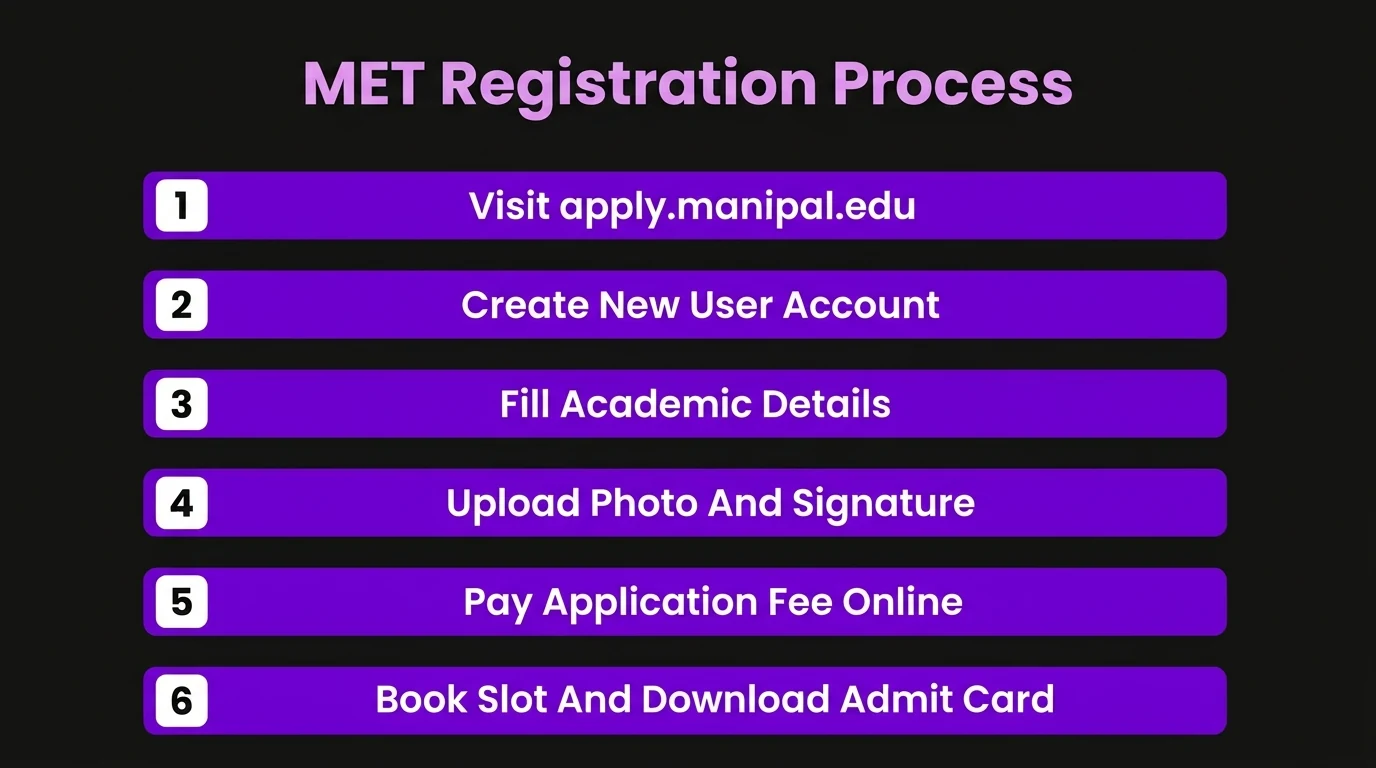
No offline applications are accepted, so the entire process happens digitally.
Visit the portal: Go to apply.manipal.edu and click "New User Registration" to create your account.
Fill the application form: Enter personal details, academic records, course preference, and communication information accurately.
Upload documents: You'll need a scanned passport-size photograph (10 KB to 100 KB, JPG/JPEG, 35mm × 45mm), scanned signature (20 KB to 100 KB, JPG/JPEG), Class 10 marksheet for identity proof, and Class 12 marksheet or equivalent academic records.
Pay the registration fee: Candidates from the general category pay an exam fee of INR 2,000; NRI/OCI/PIO candidates pay INR 2,500. Payment is via credit/debit card or net banking.
Book your slot: Registered applicants must book their slots within the period provided to obtain the admit card.
Download your admit card: A hard copy of the e-Hall ticket along with a valid photo ID (Passport, Driving Licence, Voter ID, Aadhaar, PAN, or School ID) must be presented during registration at the test centre on the day of the test.
Phase deadlines matter: Phase 1 registration closed on March 15, 2026. Phase 2 registration was open until April 26, 2026. Always bookmark the official MAHE website well in advance of each cycle.
After the exam, the final MET rank is prepared based on 50% weightage to the MET score and 50% weightage to aggregate marks in Physics, Mathematics, Chemistry/Optional subject, and English from Class XII. Your board marks genuinely count, don't neglect them.
Is the MET Exam Hard? Difficulty Level Explained
This is the question every student asks, and the honest answer is: it's manageable with the right preparation. Overall, MET is more difficult than 12th standard board exams. However, most students find it easier than JEE Mains. So if you're preparing for JEE Mains, you'll be able to attempt the MET, since the exam syllabus is similar.
Based on the 2026 exam analysis:
- MET 2026 April 14 Shift 1 paper analysis showed overall moderate difficulty. Mathematics had lengthy questions, while Physics was moderate.
- The Mathematics section carried around 25 questions, with Calculus being the most significant topic (5–6 questions on differentiation, integration, and differential equations), and Algebra and Matrices contributing 3–4 questions.
- Physics was moderate with most questions being NCERT-based. Chemistry was the easiest section for most test-takers.
Section-wise question distribution for B.Tech :
| Section | No. of Questions | Marks |
| Mathematics | 20 | 80 |
| Physics | 15 | 60 |
| Chemistry | 15 | 60 |
| English | 10 | 40 |
| Total | 60 | 240 |
Each correct response earns 4 marks. For incorrect MCQs, 1 mark is deducted. Numerical Answer Type (NAT) questions carry no negative marking.
MET Exam Passing Score Requirements
There is no absolute "pass mark" for the MET exam, but there are two key score thresholds you need to know.
Counselling Eligibility Threshold
To undergo MET 2026 counselling, candidates must score a minimum 50 percentile on the MET 2026 entrance test. Scoring below this means you won't progress to the seat-allotment stage regardless of your Class 12 marks.
Safe Score for Good Campuses
A score of 200+ out of 240 can be considered a safe score in MET 2026, resulting in high chances for admission to the desired course and campus. A score of 160+ is generally considered good for B.Tech admissions at less competitive branches or campuses.
Counselling Process
Qualifying candidates participate in the counselling process for seat allotment. You log in with your application number and OTBS password, provide required details, and submit your choice of colleges in order of preference. Seat allotment is done based on your rank, preference, category, and seat availability. MAHE is expected to conduct MET 2026 counselling in 5 rounds to fill all available seats. Candidates can participate in multiple rounds if they don't get their preferred choice initially.
How to Prepare for the MET Exam: A Winning Strategy
Preparation for the MET exam doesn't require reinventing the wheel, it requires consistency and the right resources. Here's what works:
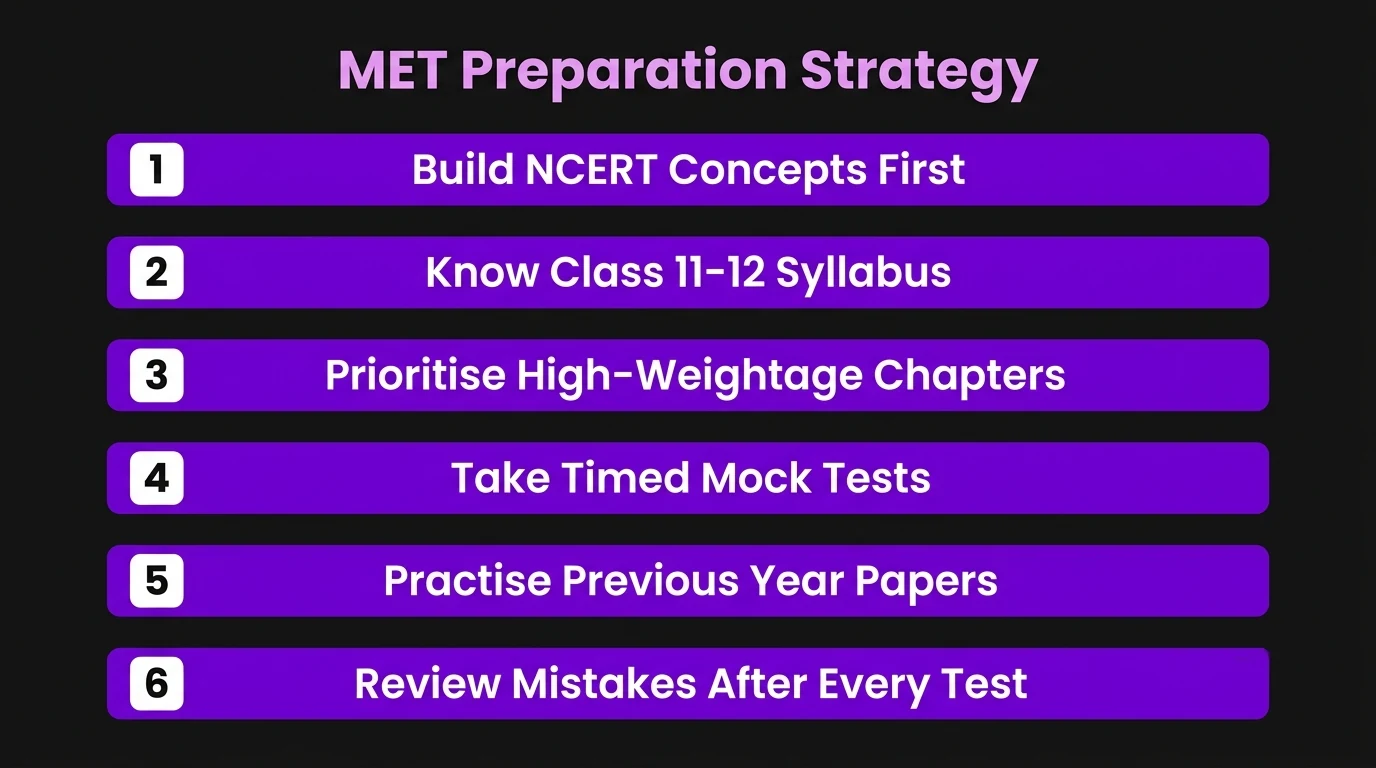
Build your foundation first
Study NCERT books to build clear and strong basic concepts in all subjects. Since the MET syllabus is similar to the 12th standard qualifying exam, NCERT books will help you study and revise important topics and chapters. Don't skip them in favour of advanced material before your base is solid.
Know the syllabus structure
The MET syllabus covers subjects from the Class 11 and 12 curriculum, including Physics, Chemistry, Mathematics/Biology, and English. Build a chapter-wise study plan, prioritising high-weightage topics like Calculus, Electromagnetism, and Organic Chemistry reactions.
Mock tests are non-negotiable
Take mock tests regularly to improve speed, accuracy, and time management skills. Candidates can take the mock test to understand the pattern of the computer-based test and familiarise themselves with the interface. The mock test is for practice purposes only. At Phodu Club, our MET mock test series mirrors the exact exam pattern, same question types, same time pressure, same interface feel, so you're never surprised on exam day.
Practise previous year papers
Practice previous year papers to know question types and improve confidence gradually. Papers reveal which chapters recur annually and how questions are framed, both are things no textbook tells you directly.
Targeted subject tips:
- Physics: Focus on core concepts like mechanics, electromagnetism, optics, and modern physics.
- Chemistry: Master organic mechanisms and reactions for the MET syllabus.
- Mathematics: Prioritise Calculus, Vectors, and Algebra, these three domains alone account for the majority of the section's marks.
- English: Focus on reading comprehension and grammar basics; it's the section where careful students pick up easy marks.
If you're also preparing for BITSAT , the overlapping Physics and Mathematics syllabus means your MET preparation compounds your BITSAT readiness simultaneously, two birds, one disciplined study plan.
Conclusion
Here's what every MET exam aspirant needs to remember:
- Eligibility is clear-cut: 50% aggregate in Physics, Mathematics, and one optional subject from a recognised board, no domicile or attempt-limit barriers.
- Age is flexible: Only a 17-year minimum applies; no upper age cap or age limit relaxation complexity.
- The exam is manageable: Moderate difficulty, NCERT-aligned syllabus, and two phase attempts give you real opportunities to perform well.
- Score goals matter: Aim for 200+ out of 240 for top-campus admissions and clear the 50-percentile counselling threshold as your floor target.
- Mock tests win: Consistent timed practice under exam conditions is the single highest-ROI activity in your preparation.
Start early, stay consistent, and let every mock test sharpen your instincts for the real thing.
Frequently Asked Questions
Q1: What is the MET exam full form?
MET stands for Manipal Entrance Test. Manipal Academy of Higher Education (MAHE) conducts it for admission to undergraduate and postgraduate programmes across its campuses in India and Dubai.
Q2: Is there any age limit for the MET exam in 2026?
MAHE has not set any minimum and maximum age criteria for the MET exam, except that candidates must have completed 17 years of age by December 31, 2025. There is no upper age cap.
Q3: Can NRI and foreign students apply for the MET exam?
Yes. Foreign nationals, PIO Card Holders, OCI candidates, NRI, and NRI Sponsored candidates can apply for MET under the Foreign/NRI category. A separate 15% seat quota is reserved for this group.
Q4: What is the application fee for MET 2026?
General category candidates pay INR 2,000, while NRI/OCI/PIO candidates pay INR 2,500. Payment is completed online during the registration process via card or net banking.
Q5: How many times can I attempt the MET exam in 2026?
MET 2026 is held in two phases, April 13–14 and May 23–24. You can attempt both, and your best score will be considered for admission. There is no restriction on attempting multiple phases.
Q6: What score is considered safe in the MET exam?
A score of 200+ out of 240 can be considered a safe score in MET 2026, resulting in high chances for admission to the desired course and campus. The minimum to qualify for counselling is the 50th percentile.
Want to crack your exam with mentors who did?
Get test series, crash courses and free mentorship from students at IITs, NITs and BITS.