MET Exam Pattern: Full Syllabus & Pattern

Preparing for MET is not just about knowing the syllabus. Many students spend months studying concepts but miss one important step: understanding the exam pattern. The number of questions, marking system, subject weightage, and time limit all play a major role in deciding your final score. Once you know how the paper is designed, your preparation becomes more focused and your chances of avoiding last-minute mistakes improve. In this guide, we break down the complete MET exam pattern and syllabus to help you prepare smarter.
Quick Answer/TL;DR
- Mode: Computer Based Test (CBT)
- Total Questions: 60 (45 MCQs and 15 Numerical Answer Types)
- Total Marks: 240
- Duration: 120 minutes
- Sections: Mathematics, Physics, Chemistry, English
- Marking: +4 for correct, -1 for incorrect MCQs. No negative marking for NATs.
What is the MET Exam?
The Manipal Entrance Test is a highly competitive engineering entrance examination. The Manipal Academy of Higher Education (MAHE) conducts it. While the university offers various undergraduate programs, the majority of students we work with take this test to secure a seat in their flagship B.Tech programs.
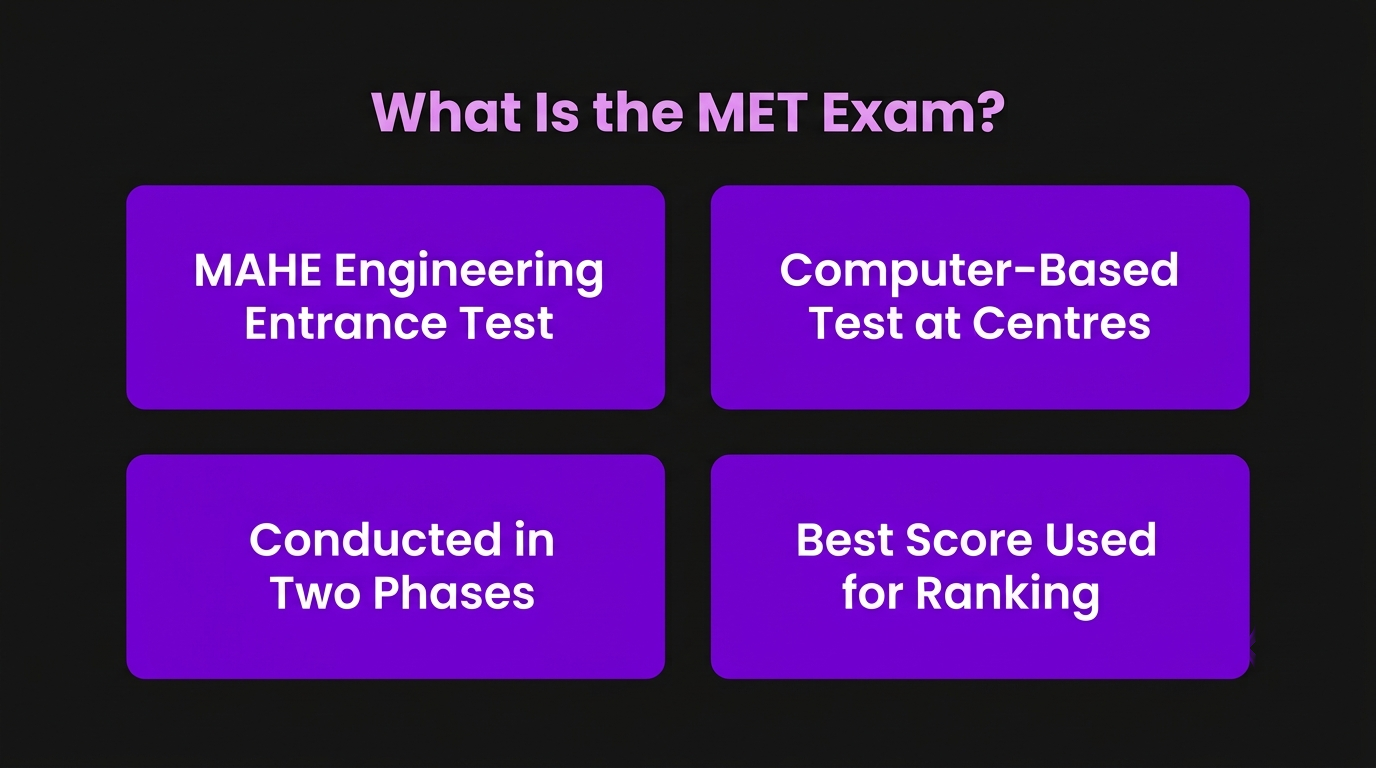
The test is conducted entirely online as a Computer Based Test at designated centers across the country. Over the past few years, the university has standardized the frequency of the test. Based on the 2026 structure, the test is held in two distinct phases. Candidates have the option to appear for both phases if they wish to improve their scores.
One of the biggest advantages of this two-phase system is that the university considers the best of the two scores for the final ranking. This removes a lot of pressure. If you have a bad day during phase one, you have a solid backup opportunity in phase two. To understand the timeline better, you can track the upcoming MET Exam Dates on our platform.
At Phodu Club, we always advise our students to treat phase one as their primary target. This leaves phase two as a true safety net rather than a desperate final attempt. Understanding the core MET Entrance Exam structure is the first step toward building this targeted preparation strategy.
Overview of the met exam pattern for 2027
To score well, you need to know exactly how the paper is structured. We always tell our students that treating every exam like JEE Main is a massive mistake. The time limits, the question distributions, and the marking rules are entirely different here.
Below is the detailed breakdown. Please note that this structure is identical to the official 2026 pattern. MAHE has announced no official changes for 2027, so this remains the most accurate baseline for your preparation.
| Particulars | Details |
| Exam Mode | Computer Based Test (Online) |
| Medium of Language | English |
| Test Duration | Two hours |
| Questions Type | Multiple Choice Questions (MCQs) & Numerical Answer Type (NAT) |
| Sections | |
| MET total Marks | 240 Marks |
| Total Questions | 60 Questions |
| Marking Scheme | For MCQs & NAT, for every correct answer, four marks will be awarded |
| Negative Marking | For MCQs every wrong answer, one mark will be deducted, and no negative marking for NAT. |
When you look at this table, the first thing that should catch your attention is the time limit. You have 120 minutes to solve 60 questions. This gives you exactly two minutes per question on average. This is significantly different from exams that demand extreme speed.
However, do not let that relax you. The questions require solid conceptual clarity. If you are struggling to build a strategy around this timing, we highly recommend checking out our MET Online Coaching where we focus specifically on time allocation strategies.
Section-wise Question Distribution Broken Down
Knowing the overall numbers is not enough. You need to know how those 60 questions are divided across subjects. This dictates how much time you should spend revising each subject.
At Phodu Club, we have noticed that many students ignore the English section completely. This is a critical error. The English section provides fast, easy marks that can significantly boost your overall rank.
Here is the exact distribution of questions and marks across all four sections.
| Section | MCQs | NAT | Total Questions | Total Marks |
| Mathematics | 15 | 5 | 20 | 80 |
| Physics | 10 | 5 | 15 | 60 |
| Chemistry | 10 | 5 | 15 | 60 |
| English | 10 | 0 | 10 | 40 |
| Total | 45 | 15 | 60 | 240 |
You will notice two different question types in the table above. Multiple Choice Questions are standard. You get four options and choose the correct one.
Numerical Answer Type questions are different. For NAT questions, there are no options provided on the screen. Candidates must calculate the answer and type the exact numerical value using a virtual keyboard. This requires high accuracy because you cannot rely on eliminating options.
Practicing these specific question types is crucial. This is exactly why we created Phodu Club's Ultimate MET Test Series . It provides 5 full-length mock tests designed strictly as per the latest MET syllabus and pattern. Because we offer unlimited attempts on all tests, you can practice these tricky NAT questions over and over until you perfect your accuracy.
Understanding the marking scheme in the met exam pattern
Understanding the marking scheme is a critical part of the met exam pattern. How you get rewarded and penalized dictates how you should guess, skip, and attempt questions.
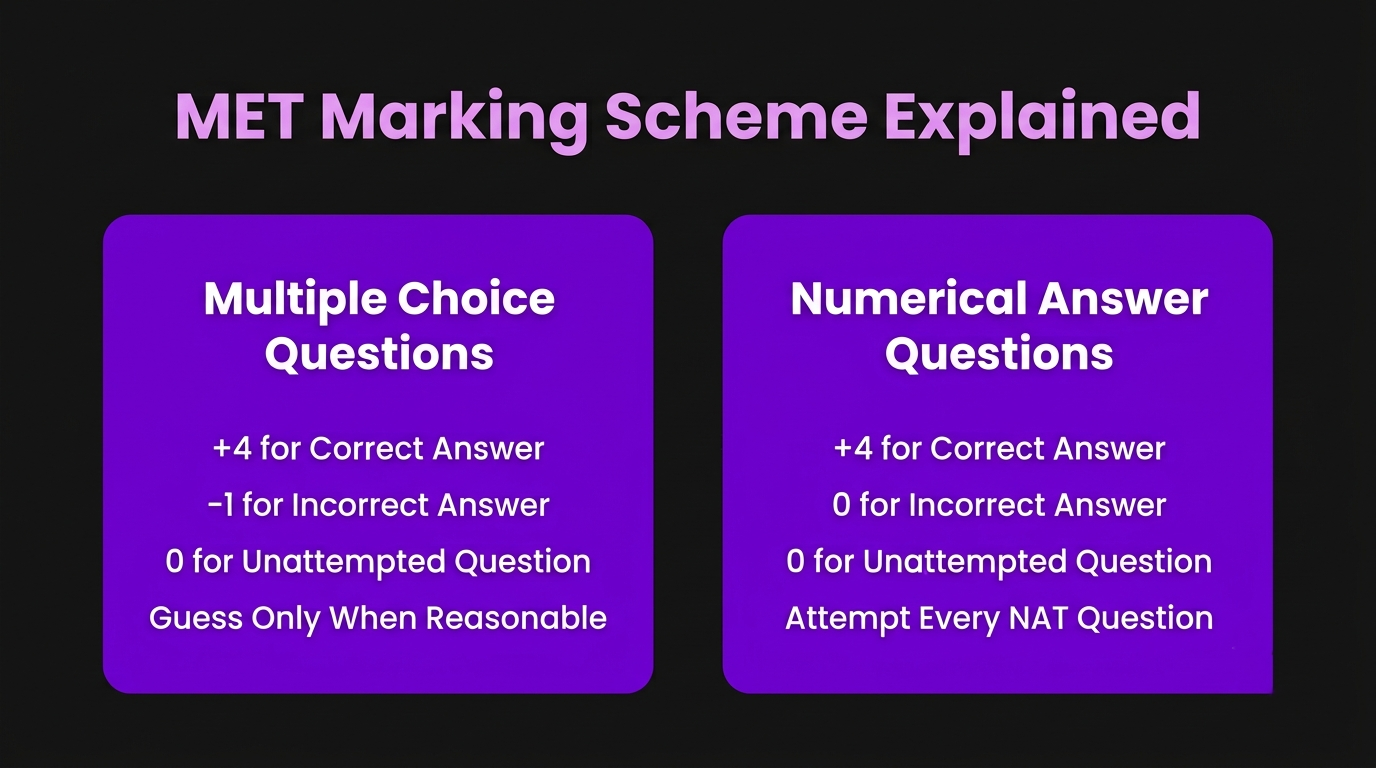
Here is the official marking breakdown based on recent university guidelines.
For Multiple Choice Questions (MCQs):
- You are awarded +4 marks for every correct answer.
- You receive a penalty of -1 mark for every incorrect answer.
- You get 0 marks for questions left unattempted.
For Numerical Answer Type (NAT) Questions:
- You are awarded +4 marks for every correct answer.
- You get 0 marks for an incorrect answer. There is absolutely no negative marking here.
- You get 0 marks for unattempted questions.
This marking scheme presents a massive strategic advantage. Because NAT questions carry no negative penalty, you must attempt every single one of them. Even if you have to take an educated guess, you lose nothing if you are wrong. Leaving a NAT question blank is one of the worst mistakes we see aspirants make.
Another critical rule to remember is the section navigation protocol. According to the recent testing interface updates, once a section is submitted, it cannot be reopened. You cannot jump freely between Math and Physics whenever you want. You must finish your review of a section before you move on. To get comfortable with this restricted navigation, you need a highly accurate testing environment. We strongly advise students to enroll in our Ultimate MET Test Series early in their prep, as every mock comes with detailed solutions and post-test analysis to help you figure out exactly which section is disrupting your pacing.
Full MET Syllabus 2027 (Detailed Breakdown)
To master the met exam pattern, you must align your preparation strictly with the official syllabus. The syllabus provided by the Manipal Academy of Higher Education is heavily based on the Class 11 and 12 CBSE/NCERT curriculum.
At Phodu Club, we do not just give our students a list of chapters. We help them understand what areas hold the most weight. Below is the complete expected syllabus for 2027, sourced from the official MAHE B.Tech 2026 syllabus PDF, along with our strategic insights.
MET Mathematics Syllabus
Mathematics holds the highest weightage with 20 questions totaling 80 marks. It can make or break your final rank.
| Unit | Topics Covered |
| Sets, Relations and Functions | • Sets and their representation• Union, intersection and complement of sets and their algebraic properties• Power set• Relations and types of relations• Equivalence relations• Functions• One-one, into and onto functions• Composition of functions |
| Complex Numbers and Quadratic Equations | • Complex numbers as ordered pairs of real numbers• Representation of complex numbers in the form a + ib• Representation on plane and Argand diagram• Algebra of complex numbers• Modulus and argument (amplitude) of complex numbers• Quadratic equations in real and complex number systems• Solutions of quadratic equations• Relation between roots and coefficients• Nature of roots• Formation of quadratic equations with given roots |
| Matrices and Determinants | • Matrices and algebra of matrices• Types of matrices• Determinants of order two and three• Evaluation of determinants• Area of triangles using determinants• Adjoint and inverse of square matrices• Test of consistency• Solution of simultaneous linear equations in two or three variables using matrices |
| Permutations and Combinations | • Fundamental principle of counting• Permutations and combinations• Meaning and applications of P(n,r) and C(n,r)• Simple applications |
| Binomial Theorem and Applications | • Binomial theorem for positive integral index• General term• Middle term• Simple applications |
| Sequence and Series | • Arithmetic Progressions (AP)• Geometric Progressions (GP)• Insertion of arithmetic and geometric means between two given numbers• Relation between A.M and G.M |
| Limit, Continuity and Differentiability | • Real-valued functions• Algebra of functions• Polynomial, rational, trigonometric, logarithmic and exponential functions• Inverse functions• Graphs of simple functions• Limits, continuity and differentiability• Differentiation of sum, difference, product and quotient of functions• Differentiation of trigonometric, inverse trigonometric, logarithmic, exponential, composite and implicit functions• Second-order derivatives• Applications of derivatives: - Rate of change of quantities - Increasing and decreasing functions - Maxima and minima of functions of one variable |
| Integral Calculus | • Integral as an anti-derivative• Fundamental integrals involving algebraic, trigonometric, exponential and logarithmic functions• Integration by substitution• Integration by parts• Integration by partial fractions• Integration using trigonometric identities• Fundamental theorem of calculus• Properties of definite integrals• Evaluation of definite integrals• Area under curves and regions bounded by simple curves |
| Differential Equations | • Ordinary differential equations• Order and degree of differential equations• Solution by separation of variables• Solution of homogeneous differential equations• Linear differential equation of type:dy/dx + p(x)y = q(x) |
| Coordinate Geometry | • Cartesian system of rectangular coordinates• Distance formula• Section formula• Locus and its equation• Slope of a line• Parallel and perpendicular lines• Intercepts of a line on coordinate axes |
| Three-Dimensional Geometry | • Coordinates of a point in space• Distance between two points• Section formula• Direction ratios and direction cosines• Angle between intersecting lines• Equation of a line• Skew lines• Shortest distance between skew lines and its equation |
| Vector Algebra | • Vectors and scalars• Addition of vectors• Components of vectors in two and three dimensions• Scalar product• Vector product |
| Statistics and Probability | Statistics:• Measures of dispersion• Mean, median and mode of grouped and ungrouped data• Standard deviation• Variance• Mean deviation |
| Trigonometry | • Trigonometrical identities• Trigonometrical functions• Inverse trigonometrical functions• Properties of inverse trigonometric functions |
Math requires immense practice. If you are struggling to cover this vast list, our MET Crash Course focuses strictly on the highest-yield topics to maximize your score in a short time.
MET Physics Syllabus
Physics requires a balance of theoretical understanding and numerical application. There are 15 questions worth 60 marks here.
| Unit | Topics Covered |
| Units and Measurements | • Units of measurements• System of units• SI units• Fundamental and derived units• Least count• Significant figures• Errors in measurements• Dimensions of physical quantities• Dimensional analysis and applications |
| Kinematics | • Frame of reference• Motion in a straight line• Speed and velocity• Uniform and non-uniform motion• Average speed and instantaneous velocity• Uniformly accelerated motion• Velocity-time and position-time graphs• Equations of uniformly accelerated motion• Relative velocity• Motion in a plane• Projectile motion• Uniform circular motion |
| Laws of Motion | • Force and inertia• Newton’s laws of motion• Momentum• Impulse• Conservation of linear momentum and applications• Equilibrium of concurrent forces• Static and kinetic friction• Laws of friction• Rolling friction• Dynamics of uniform circular motion• Centripetal force and applications: - Vehicle on level circular road - Vehicle on banked road |
| Work, Energy and Power | • Work done by constant and variable forces• Kinetic and potential energy• Work-energy theorem• Power• Potential energy of spring• Conservation of mechanical energy• Conservative and non-conservative forces• Motion in a vertical circle• Elastic and inelastic collisions in one and two dimensions |
| Rotational Motion | • Centre of mass of two-particle system• Centre of mass of rigid body• Basic concepts of rotational motion• Moment of force• Torque• Angular momentum• Conservation of angular momentum and applications• Moment of inertia• Radius of gyration• Moment of inertia of simple geometrical objects• Parallel and perpendicular axis theorems• Equilibrium of rigid bodies• Rigid body rotation• Equations of rotational motion• Comparison between linear and rotational motion |
| Gravitation | • Universal law of gravitation• Acceleration due to gravity• Variation of gravity with altitude and depth• Kepler’s laws of planetary motion• Gravitational potential energy• Gravitational potential• Escape velocity• Motion of satellite• Orbital velocity• Time period and energy of satellite |
| Properties of Solids and Liquids | • Elastic behaviour• Stress-strain relationship• Hooke’s law• Young’s modulus• Bulk modulus• Modulus of rigidity• Pressure due to fluid column• Pascal’s law and applications• Effect of gravity on fluid pressure• Viscosity• Stoke’s law• Terminal velocity• Streamline and turbulent flow• Critical velocity• Bernoulli’s principle and applications• Surface energy and surface tension• Angle of contact• Excess pressure across curved surfaces• Drops, bubbles and capillary rise• Heat and temperature• Thermal expansion• Specific heat capacity• Calorimetry• Change of state• Latent heat• Heat transfer: conduction, convection and radiation |
| Thermodynamics | • Thermal equilibrium and temperature concept• Zeroth law of thermodynamics• Heat, work and internal energy• First law of thermodynamics• Isothermal and adiabatic processes• Second law of thermodynamics• Reversible and irreversible processes |
| Kinetic Theory of Gases | • Equation of state of perfect gas• Work done during compression of gas• Assumptions of kinetic theory• Concept of pressure• Kinetic interpretation of temperature• RMS speed of gas molecules• Degrees of freedom• Law of equipartition of energy• Specific heat capacities of gases• Mean free path• Avogadro’s number |
| Oscillations and Waves | • Oscillatory and periodic motion• Time period and frequency• Displacement function• Periodic functions• Simple harmonic motion (SHM)• Equation of SHM• Phase• Oscillation of spring• Restoring force and force constant• Energy in SHM• Simple pendulum and time period derivation• Wave motion• Longitudinal and transverse waves• Speed of travelling waves• Progressive wave equation• Principle of superposition• Reflection of waves• Standing waves in strings and organ pipes• Fundamental mode and harmonics• Beats |
| Electrostatics | • Electric charges and conservation of charge• Coulomb’s law• Forces between charges• Superposition principle• Continuous charge distribution• Electric field and field lines• Electric dipole• Electric field due to dipole• Torque on dipole in uniform field• Electric flux• Gauss’s law and applications• Electric potential• Potential difference• Equipotential surfaces• Electrical potential energy• Conductors and insulators• Dielectrics and polarization• Capacitors and capacitance• Combination of capacitors• Parallel plate capacitor• Energy stored in capacitor |
| Current Electricity | • Electric current• Drift velocity and mobility• Ohm’s law• Resistance• I-V characteristics• Ohmic and non-ohmic conductors• Electrical energy and power• Resistivity and conductivity• Series and parallel combination of resistors• Temperature dependence of resistance• Internal resistance of cells• EMF and potential difference• Combination of cells• Kirchhoff’s laws• Wheatstone bridge• Metre bridge |
| Magnetic Effects of Current and Magnetism | • Biot-Savart law• Magnetic field due to current carrying loop• Ampere’s law and applications• Force on moving charge in magnetic and electric fields• Force on current carrying conductor• Force between parallel currents• Definition of ampere• Torque on current loop• Moving coil galvanometer• Sensitivity and conversion into ammeter and voltmeter• Magnetic dipole moment• Bar magnet as equivalent solenoid• Magnetic field lines• Magnetic field due to dipole• Torque on magnetic dipole• Para, dia and ferromagnetic substances• Effect of temperature on magnetic properties |
| Electromagnetic Induction and Alternating Currents | • Faraday’s law• Induced EMF and current• Lenz’s law• Eddy currents• Self and mutual inductance• Alternating current• Peak and RMS values• Reactance and impedance• LCR series circuit• Resonance• Power in AC circuits• Wattless current• AC generator• Transformer |
| Electromagnetic Waves | • Displacement current• Electromagnetic waves and characteristics• Transverse nature of electromagnetic waves• Electromagnetic spectrum: - Radio waves - Microwaves - Infrared - Visible light - Ultraviolet - X-rays - Gamma rays• Applications of electromagnetic waves |
| Optics | Ray Optics:• Reflection of light• Spherical mirrors• Mirror formula• Refraction of light• Refraction at spherical surfaces• Thin lens formula• Lens maker formula• Total internal reflection and applications• Magnification• Power of lens• Combination of lenses• Prism• Microscope and telescope |
| Dual Nature of Matter and Radiation | • Dual nature of radiation• Photoelectric effect• Hertz and Lenard observations• Einstein’s photoelectric equation• Particle nature of light• Matter waves• de Broglie relation |
| Atoms and Nuclei | • Alpha particle scattering experiment• Rutherford model of atom• Bohr model• Energy levels• Hydrogen spectrum• Composition and size of nucleus• Atomic masses• Mass-energy relation• Mass defect• Binding energy per nucleon• Nuclear fission and fusion |
| Electronic Devices | • Semiconductors• Semiconductor diode• Forward and reverse bias characteristics• Diode as rectifier• LED characteristics• Photodiode• Solar cell• Zener diode• Zener diode as voltage regulator• Logic gates: - OR - AND - NOT - NAND - NOR |
| Experimental Skills | • Vernier callipers measurement• Screw gauge measurement• Simple pendulum experiment• Energy dissipation graph• Metre scale and principle of moments• Young’s modulus experiment• Surface tension by capillary rise• Viscosity using terminal velocity• Speed of sound using resonance tube• Specific heat capacity by mixtures method• Resistivity using metre bridge• Resistance using Ohm’s law• Galvanometer resistance and figure of merit• Focal length measurement of mirrors and lens• Prism deviation experiment• Refractive index using travelling microscope• p-n junction diode characteristics• Zener diode characteristics• Identification of diode, LED, resistor and capacitor |
To truly understand how deep you need to go into these topics, you must review the official MET Exam Syllabus document on our blog.
MET Chemistry Syllabus
Chemistry is generally the most scoring section if you have studied NCERT thoroughly. It is divided into three parts for a total of 15 questions.
| Unit | Topics Covered |
| Some Basic Concepts in Chemistry | • Matter and its nature• Dalton’s atomic theory• Concept of atom, molecule, element and compound• Laws of chemical combination• Atomic and molecular masses• Mole concept and molar mass• Percentage composition• Empirical and molecular formulae• Chemical equations and stoichiometry |
| Atomic Structure | • Nature of electromagnetic radiation• Photoelectric effect• Hydrogen atom spectrum• Bohr model of hydrogen atom• Postulates of Bohr model• Energy of electron and radii of different orbits• Limitations of Bohr model• Dual nature of matter• de Broglie relationship• Heisenberg uncertainty principle• Elementary ideas of quantum mechanics• Quantum mechanical model of atom• Atomic orbitals as one-electron wave functions• Variation of Ψ and Ψ² with r for 1s and 2s orbitals• Quantum numbers: - Principal quantum number - Angular momentum quantum number - Magnetic quantum number• Shapes of s, p and d orbitals• Electron spin and spin quantum number• Rules for filling electrons: - Aufbau principle - Pauli exclusion principle - Hund’s rule• Electronic configuration of elements• Stability of half-filled and completely filled orbitals |
| Chemical Bonding and Molecular Structure | • Kossel-Lewis approach to chemical bond formation• Ionic and covalent bonds |
| Chemical Thermodynamics | • System and surroundings• Extensive and intensive properties• State functions• Entropy• Types of processes• First law of thermodynamics• Work, heat, internal energy and enthalpy• Heat capacity and molar heat capacity• Hess’s law• Enthalpy of: - Bond dissociation - Combustion - Formation - Atomization - Sublimation - Phase transition - Hydration - Ionization - Solution• Second law of thermodynamics• Spontaneity of processes• ΔS of universe• ΔG as criteria for spontaneity• Standard Gibbs energy change (ΔG°)• Relationship between ΔG° and equilibrium constant |
| Solutions | • Concentration terms: - Molality - Molarity - Mole fraction - Percentage by volume and mass• Vapour pressure of solutions• Raoult’s law• Ideal and non-ideal solutions• Vapour pressure-composition curves• Colligative properties: - Relative lowering of vapour pressure - Depression in freezing point - Elevation in boiling point - Osmotic pressure• Determination of molecular mass using colligative properties• Abnormal molar mass• Van’t Hoff factor and significance |
| Equilibrium | • Dynamic equilibrium concept• Physical equilibria: - Solid-liquid - Liquid-gas - Gas-gas - Solid-gas• Henry’s law• Characteristics of physical equilibrium• Chemical equilibrium• Law of chemical equilibrium• Equilibrium constants Kp and Kc• Significance of ΔG and ΔG° in equilibrium• Factors affecting equilibrium: - Concentration - Pressure - Temperature - Catalyst• Le Chatelier’s principle |
| Redox Reactions and Electrochemistry | • Electronic concepts of oxidation and reduction• Redox reactions• Oxidation number• Rules for assigning oxidation numbers• Balancing redox reactions• Electrolytic and metallic conduction• Conductance in electrolytic solutions• Molar conductivity• Variation with concentration• Kohlrausch’s law and applications• Electrochemical cells: - Electrolytic cells - Galvanic cells• Types of electrodes• Electrode potential• Standard electrode potential• Half-cell and cell reactions• EMF of galvanic cell• Nernst equation and applications• Relationship between cell potential and Gibbs energy• Dry cell• Lead accumulator• Fuel cells |
| Chemical Kinetics | • Rate of chemical reaction• Factors affecting reaction rate: - Concentration - Temperature - Pressure - Catalyst• Elementary and complex reactions• Order and molecularity• Rate law• Rate constant and units• Zero and first-order reactions• Differential and integral forms• Half-life calculations• Effect of temperature on reaction rate• Arrhenius theory• Activation energy• Collision theory of bimolecular gaseous reactions |
| Classification of Elements and Periodicity in Properties | • Modern periodic law• Present form of periodic table• s, p, d and f block elements• Periodic trends: - Atomic radius - Ionic radius - Ionization enthalpy - Electron gain enthalpy - Valency - Oxidation states - Chemical reactivity |
| p-Block Elements | • General introduction of Groups 13 to 18 elements• Electronic configuration• Trends in physical and chemical properties• Variation across periods and groups• Unique behaviour of first element of each group |
| d- and f-Block Elements | Transition Elements:• General introduction• Electronic configuration• Occurrence and characteristics• Physical properties• Ionization enthalpy• Oxidation states• Atomic radii• Colour• Catalytic behaviour• Magnetic properties• Complex formation• Interstitial compounds• Alloy formation• Preparation, properties and uses of K₂Cr₂O₇ and KMnO₄ |
| Coordination Compounds | • Introduction to coordination compounds• Werner’s theory• Ligands• Coordination number• Denticity• Chelation• IUPAC nomenclature of mononuclear complexes• Isomerism• Bonding: - Valence bond theory - Crystal field theory basics• Colour and magnetic properties• Importance in: - Qualitative analysis - Metal extraction - Biological systems |
| Purification and Characterisation of Organic Compounds | • Purification methods: - Crystallization - Sublimation - Distillation - Differential extraction - Chromatography• Qualitative analysis of nitrogen, sulphur, phosphorus and halogens• Quantitative analysis basics• Estimation of carbon, hydrogen, nitrogen, halogens, sulphur and phosphorus• Empirical and molecular formula calculations |
| Some Basic Principles of Organic Chemistry | • Tetravalency of carbon• Shapes of simple molecules• Hybridization• Classification of organic compounds• Functional groups• Homologous series• Structural and stereoisomerism• Trivial and IUPAC nomenclature• Homolytic and heterolytic bond fission• Free radicals• Carbocations and carbanions• Stability of intermediates• Electrophiles and nucleophiles• Electronic effects: - Inductive effect - Electromeric effect - Resonance - Hyperconjugation• Organic reactions: - Substitution - Addition - Elimination - Rearrangement |
| Hydrocarbons | • Classification and nomenclature• Isomerism• Preparation methods• Properties and reactions |
| Organic Compounds Containing Halogens | • Preparation methods• Properties and reactions• Nature of C-X bond• Substitution reaction mechanisms• Uses and environmental effects of: - Chloroform - Iodoform - Freons - DDT |
| Organic Compounds Containing Oxygen | • General preparation methods• Properties and reactions• Uses of oxygen-containing organic compounds |
| Organic Compounds Containing Nitrogen | • Preparation methods• Properties and reactions• Uses |
| Biomolecules | • Introduction and importance of biomolecules |
| Principles Related to Practical Chemistry | • Detection of extra elements in organic compounds: - Nitrogen - Sulphur - Halogens• Detection of functional groups: - Alcoholic and phenolic hydroxyl - Aldehyde and ketone carbonyl - Carboxyl group - Amino group• Preparation of inorganic compounds: - Mohr’s salt - Potash alum• Preparation of organic compounds: - Acetanilide - p-Nitroacetanilide - Aniline yellow - Iodoform• Titrimetric exercises: - Acid-base titration - Oxalic acid vs KMnO₄ - Mohr’s salt vs KMnO₄• Qualitative salt analysis:Cations: Pb²⁺, Cu²⁺, Al³⁺, Fe³⁺, Zn²⁺, Ni²⁺, Ca²⁺, Ba²⁺, Mg²⁺, NH₄⁺Anions: CO₃²⁻, S²⁻, SO₄²⁻, NO₃⁻, NO₂⁻, Cl⁻, Br⁻, I⁻• Experimental principles: 1. Enthalpy of solution of CuSO₄ 2. Enthalpy of neutralization of strong acid and base 3. Preparation of lyophilic and lyophobic sols 4. Kinetic study of iodide ions with hydrogen peroxide |
Organic chemistry relies on understanding reaction mechanisms. Name reactions from NCERT and their specific reagents must be on your fingertips. Many students ask us Is MET Exam is Tough compared to others. Our answer is always that if your Chemistry basics are strong, the paper becomes significantly easier.
A Quick Note on Effectively Revising PCM
We know that trying to revise the entirety of Physics, Chemistry, and Mathematics in the final few weeks is incredibly overwhelming. That is why our Ultimate MET Test Series goes beyond just providing mocks. When you enroll, you also get access to our Ultimate Revision Notes—which are handwritten, highly aesthetic short notes created by actual exam toppers specifically covering all PCM chapters. They are the perfect tool to compress your revision time right before taking a mock.
MET English Syllabus
The English section contains 10 MCQs worth 40 marks. Our mentors at Phodu Club consider this the ultimate rank booster.
| Unit | Topics Covered |
| Grammar and Language Use | • Grammatical accuracy and sentence construction skills |
| Vocabulary | • Understanding contextual use of vocabulary• Synonyms and antonyms• Idiomatic usage• One-word substitutions• Commonly confused pairs of words• Collocations• Phrasal verbs• Idioms |
| Punctuation and Usage | • Proper use of punctuation marks• Commas• Semicolons• Colons• Dashes• Capitalisation• Identification of incorrect usage• Sentence improvement• Redundancy in sentences• Ambiguity in sentences• Avoidance of run-on sentences• Avoidance of sentence fragments |
| Reading Comprehension | • Understanding and interpreting different types of texts• Short comprehension passages based on: - Narrative topics - Descriptive topics - Expository topics - Argumentative topics |
Do not ignore this section. Spend 15 minutes a week brushing up on basic grammar rules. This small effort can push your rank up by hundreds of places. You can use our MET College Predictor to see how a slight jump in marks changes your college prospects.
Conclusion
To summarize the core metrics, you will face 60 questions in 120 minutes for a total of 240 marks. You must navigate a mix of 45 MCQs with negative marking and 15 NAT questions with no negative penalty across Math, Physics, Chemistry, and English. The syllabus remains heavily anchored to the NCERT Class 11 and 12 curriculum. While 2027 details are fully expected to follow this 2026 structure, we always advise students to verify final details on the official MAHE website once the new brochure drops.
We have worked with enough students to know this: effort alone doesn't fix your score. The right strategy does. Knowing the rules of the game is the only way to win it. That is exactly what we focus on at Phodu Club. If you are struggling to improve your scores or need a structured test-taking strategy, our Ultimate MET Test Series is designed for you. With 5 full-length mocks, detailed analysis, and topper-crafted PCM revision notes, we provide everything you need to reach your target campus.
Frequently Asked Questions (FAQ)
1) What is the met exam pattern for 2027?
The 2027 structure is expected to remain a 120-minute Computer Based Test comprising 60 questions. It is divided into Mathematics (20 questions), Physics (15 questions), Chemistry (15 questions), and English (10 questions). The paper totals 240 marks.
2) How does the met exam pattern handle negative marking?
There is a specific rule for negative marking. For Multiple Choice Questions (MCQs), you lose 1 mark for every incorrect answer. However, for Numerical Answer Type (NAT) questions, there is zero negative marking.
3) How many questions are there in MET? \
There are exactly 60 questions in the paper. This includes 45 Multiple Choice Questions and 15 Numerical Answer Type questions divided across four subjects.
4) What is the difference between MCQ and NAT in MET?
MCQs provide four options, and you must select the correct one. NAT questions do not provide options. You must solve the problem and type the exact numerical answer into a virtual box on the screen.
5) Is the MET syllabus the same as JEE Main?
The syllabus is highly similar as both are based on the CBSE/NCERT Class 11 and 12 curriculum. However, the Manipal test includes a specific section for English which is not present in JEE Main. The depth of the questions is also generally less intense than JEE.
6) How many phases are there in MET 2027?
Based on recent trends from 2026, the university conducts the examination in two distinct phases, usually spaced a few weeks apart.
7) Can I appear in both phases of MET?
Yes, candidates are allowed and encouraged to appear in both phases if they wish to improve their score. The university will consider the highest of your two scores for the final rank list.
8) What are the total marks in the MET exam?
The examination is conducted for a maximum of 240 marks. Every correct answer, regardless of whether it is an MCQ or a NAT question, awards you 4 marks.
9) Is the English section compulsory in MET?
Yes, the English section is mandatory for all B.Tech aspirants. It contains 10 Multiple Choice Questions and accounts for 40 total marks in your final score.
10) Where can I check the official met exam pattern for the upcoming cycle?
You should always verify the latest structural rules, syllabus updates, and marking schemes on the official Manipal Academy of Higher Education (MAHE) admissions website once they release the 2027 informational brochure.
Want to crack your exam with mentors who did?
Get test series, crash courses and free mentorship from students at IITs, NITs and BITS.