Every student preparing for IIM Indore’s IPMAT eventually searches for some version of the same question: is IPMAT tough? And every answer they find is either dishonestly reassuring (“It’s just Class 10 maths, anyone can crack it!”) or uselessly vague (“It depends on your preparation”). Neither of these answers helps a student make a real decision about whether to attempt the exam, how seriously to take preparation, or what a realistic outcome looks like. The honest answer to whether IPMAT is tough requires 3 things: actual difficulty level data from the exam’s question papers, a realistic success rate drawn from applicant and seat numbers, and an honest analysis of what separates students who clear it from those who do not. This guide provides all 3. If you are considering the IPMAT, or are already in preparation and trying to calibrate your effort level, this is the analysis that will give you an accurate picture of what you are actually working towards.
What Does “Tough” Mean in the Context of IPMAT?
Before analysing whether IPMAT is tough, it helps to define what “tough” actually means for an entrance exam. There are 3 distinct dimensions where difficulty can exist.
Dimension 1: Content difficulty. Are the topics tested at an advanced level that requires deep specialised knowledge?
Dimension 2: Competition difficulty. How many students are competing for how many seats?
Dimension 3: Execution difficulty. Even if individual questions are solvable, does the exam’s time pressure, marking scheme, and multi-section structure make performing consistently on exam day genuinely hard?
Most students who ask whether IPMAT is tough are thinking primarily about Dimension 1. The honest answer to that specific question is: the content is not advanced. The topics tested in IPMAT are drawn from Class 9, 10, and 11 Mathematics and standard English language skills. There is no Calculus. There is no advanced trigonometry. There is no Data Interpretation.
But the more complete answer is that IPMAT is genuinely difficult on Dimensions 2 and 3, which is where most students who prepare without understanding the exam’s structure fail.
IPMAT Difficulty Level: What the Exam Actually Tests
QA Difficulty: Not Advanced, But Fast and Applied
The Quantitative Ability section of IPMAT tests arithmetic, algebra, number theory, geometry, and modern mathematics at Class 9 to 11 level. A student who has studied Class 10 NCERT Mathematics and Class 11 NCERT Mathematics has covered the content. That much is true.
What is not true is that familiarity with the content is the same as exam-readiness.
IPMAT QA questions are applied word problems, not textbook exercises. A percentage question does not ask “what is 15% of 240?” It presents a business scenario with multiple price changes, asks for an effective profit margin, and requires identifying the correct relationship before any calculation begins. An algebra question does not ask “solve x squared minus 5x plus 6 = 0.” It presents 2 conditions on a progression, asks for the sum of the first 10 terms, and requires 2 steps of algebraic reasoning before the summation formula even comes into play.
Beyond the framing, the time pressure is real. 40 questions in 40 minutes is 60 seconds per question on average. For medium-difficulty problems requiring 2 to 3 steps, 60 seconds demands both conceptual fluency and computational speed that untimed textbook practice does not build.
Honest assessment of QA difficulty: The content level is Class 9 to 11. The application and speed requirements are significantly harder than school exams. A student who has studied the topics but never practiced solving problems under strict time pressure will find IPMAT QA genuinely tough.
VA Difficulty: Not Obscure, But Genuinely Developmental
The Verbal Ability section tests Reading Comprehension, vocabulary, grammar, para jumbles, and critical reasoning. None of these topics require specialised knowledge. No student needs to study economics or history to answer IPMAT VA questions.
What students do need is developed language skill, and this is where the difficulty genuinely lies. RC inference questions require the ability to track an argument across 500 words, identify implications that are not explicitly stated, and distinguish between what the passage says and what it implies. This skill develops through months of active reading practice. It does not develop through reading the passage 3 times or through completing grammar exercises.
Vocabulary questions in IPMAT test words at the level of quality editorial writing. Words like “ostensible,” “cogent,” “loquacious,” “ephemeral,” and “circumspect” appear regularly. These are not impossible words. But a student who has not actively built vocabulary through a daily practice system will guess on 40 to 50% of vocabulary questions, incurring negative marking losses that compound across the paper.
Honest assessment of VA difficulty: The content level is accessible, but the skills are developmental. Students who have not built active reading habits, vocabulary depth, and grammar instinct over several months will find VA genuinely difficult, regardless of content knowledge.
IPMAT Success Rate: The Numbers Behind the Competition
This is where the honest analysis of whether IPMAT is tough becomes most important. Because the competition difficulty is real, significant, and frequently underestimated.
Registered candidates in 2025: Over 40,000
Seats in IIM Indore’s IPM programme: Approximately 150 (General + reserved categories combined)
Selection rate from registered pool: Under 0.4%
To put this in perspective: IPMAT selects fewer than 4 students out of every 1,000 who register. In terms of competition intensity, this places IPMAT among the most selective undergraduate entrance examinations in India.
For comparison:
- IIT JEE Advanced qualifies approximately 2.5% of Advanced-registered candidates
- NEET-UG’s top medical colleges admit less than 1% of applicants
- IPMAT selects under 0.4% of registered candidates
By this metric alone, IPMAT is unambiguously tough. Not because the problems are unsolvable, but because the competition is extraordinarily dense.
According to IIM Indore’s official IPM programme information, the programme has grown in popularity every year since its 2011 launch, with applicant numbers rising consistently as awareness of the IPM route has expanded. The trend means the selection rate may continue to tighten in future cycles.
Who Actually Clears IPMAT: The Honest Profile
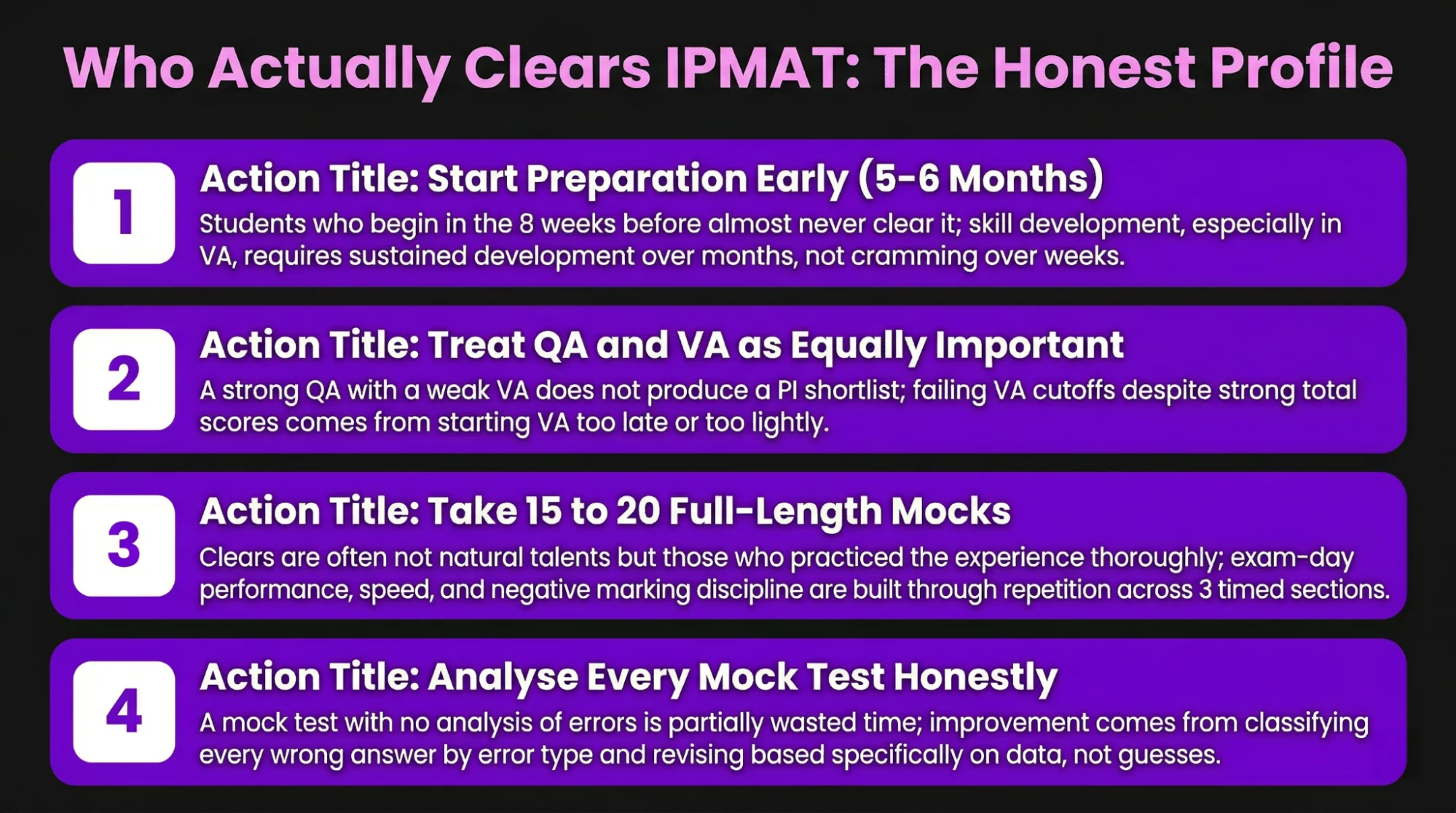
The question “is IPMAT tough?” becomes more answerable when it is rephrased as: “who clears IPMAT, and what did they do differently from those who did not?”
Looking at students who earn IIM Indore IPM seats, a consistent profile emerges. They are not uniformly from elite schools or high-income families. They are not uniformly from the Science stream. They do not all have 95%+ boards scores. What they do consistently share is this:
- They started at least 5 to 6 months before the exam. Students who begin preparation in the 8 weeks before IPMAT almost never clear it. The skills IPMAT tests, especially in VA, require sustained development over months, not cramming over weeks.
- They treated both QA and VA as equally important from Day 1. The sectional cutoff structure means a strong QA performance with a weak VA score does not produce a PI shortlist. Students who cracked the exam understood this structurally. Students who failed to clear VA cutoffs despite strong total scores consistently report having started VA preparation too late or too lightly.
- They took 15 to 20 full-length timed mock tests before the exam. The students who clear IPMAT are not necessarily the most naturally talented. They are often the students who have practiced the exam experience most thoroughly. Exam-day performance at competitive speed, with negative marking discipline, across 3 independently timed sections is a skill built through repetition.
- They analysed every mock test with genuine honesty. A mock test that produces a score but no analysis of errors is preparation time partially wasted. The students who improve across a mock test series are the ones who classify every wrong answer by error type and revise specifically based on what the data shows, not what they guess.
The Specific Things That Make IPMAT Tough in Practice
Beyond difficulty level and competition, here are the specific exam features that make IPMAT tough in execution for students who have not specifically prepared for them.
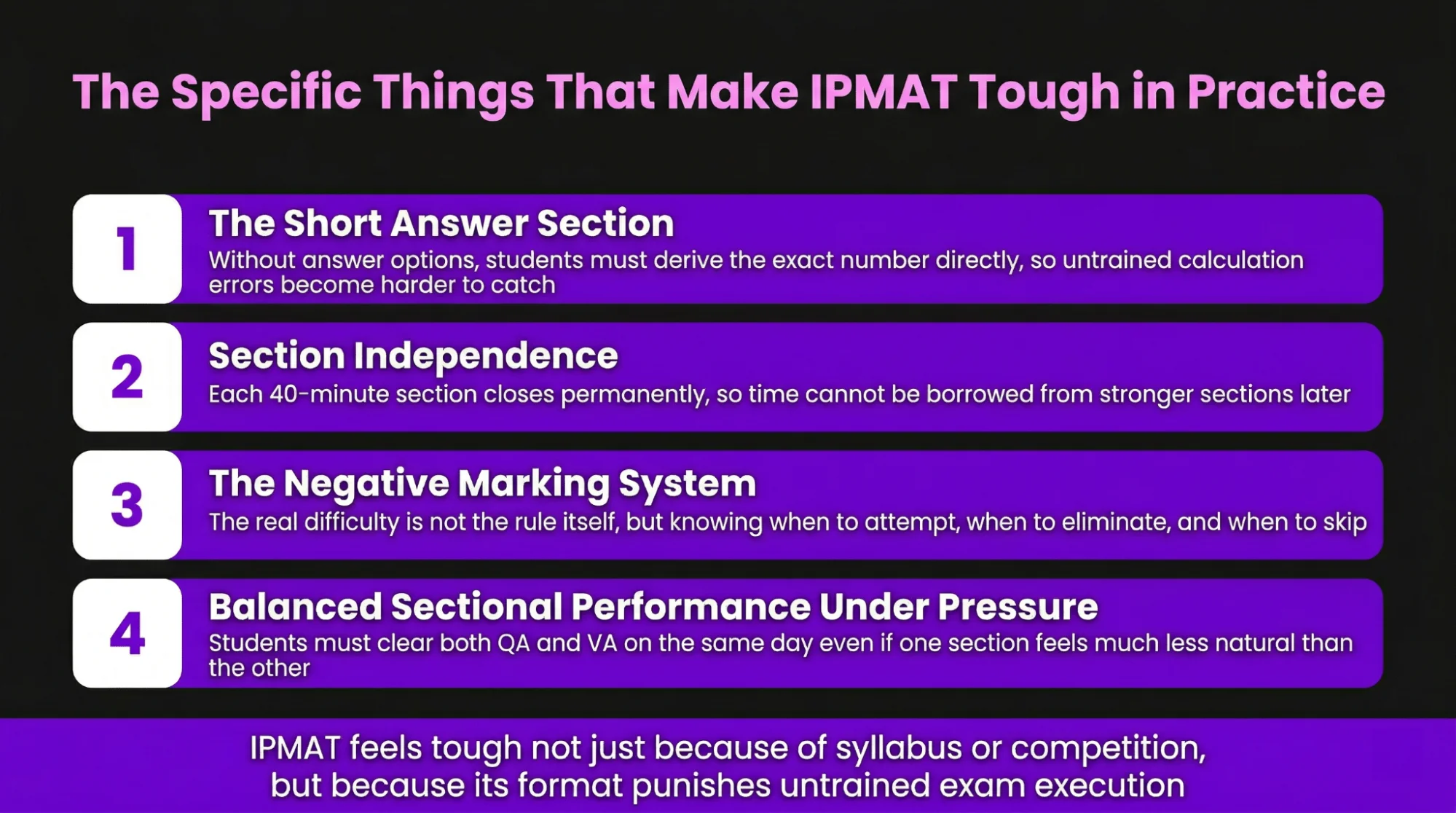
The Short Answer Section
The QA Short Answer section has no options. Students must derive and enter a numerical answer. For students who have only practiced MCQ-format QA questions, this section is disorienting on exam day. Without options to validate against, calculation errors go undetected. Without options to eliminate from, questions that would yield to process-of-elimination cannot be approached that way.
The Short Answer section’s no-negative-marking structure is an opportunity, not a source of difficulty. But capturing that opportunity requires practicing option-free numerical derivation specifically, not just MCQ practice.
Section Independence
Each of the 3 sections has its own 40-minute timer that closes permanently. A student who is slow in QA MCQ cannot use time from the VA section to compensate. This structural feature means the exam is actually 3 separate 40-minute tests, not one 120-minute test.
Students who practice with a single 120-minute timer systematically develop false confidence. On exam day, the section timer closes before they expect it to, and questions they planned to return to are locked away permanently. This is one of the most commonly cited sources of difficulty among students who underperform relative to their mock test scores.
The Negative Marking System
The +4/-1 marking scheme sounds simple. In practice, it creates a decision discipline that most students have never developed before IPMAT. The question of when to attempt, when to eliminate and attempt, and when to skip requires a calibrated, practised judgment. Students who apply a blanket “always attempt” or “never guess” policy both leave marks on the table.
The students who lose the most to negative marking are consistently those who over-attempt uncertain questions in the final 10 minutes of a section, when time pressure increases the rate of unvalidated guesses.
Balanced Sectional Performance Under Pressure
Clearing both QA and VA sectional cutoffs simultaneously, while managing negative marking and section timers, on a single exam day is genuinely difficult. Students who are very strong in QA and weak in VA face the specific challenge of performing adequately in a section where their skills are less developed, while sitting next to the section where they feel confident. The mental discipline required to give VA the same focused attention as QA on exam day, after months of QA-weighted preparation, is real.
Is IPMAT Tough Compared to JEE?
This is the most common comparison students make, particularly those from the Science stream who are deciding whether to target IPMAT, JEE, or both.
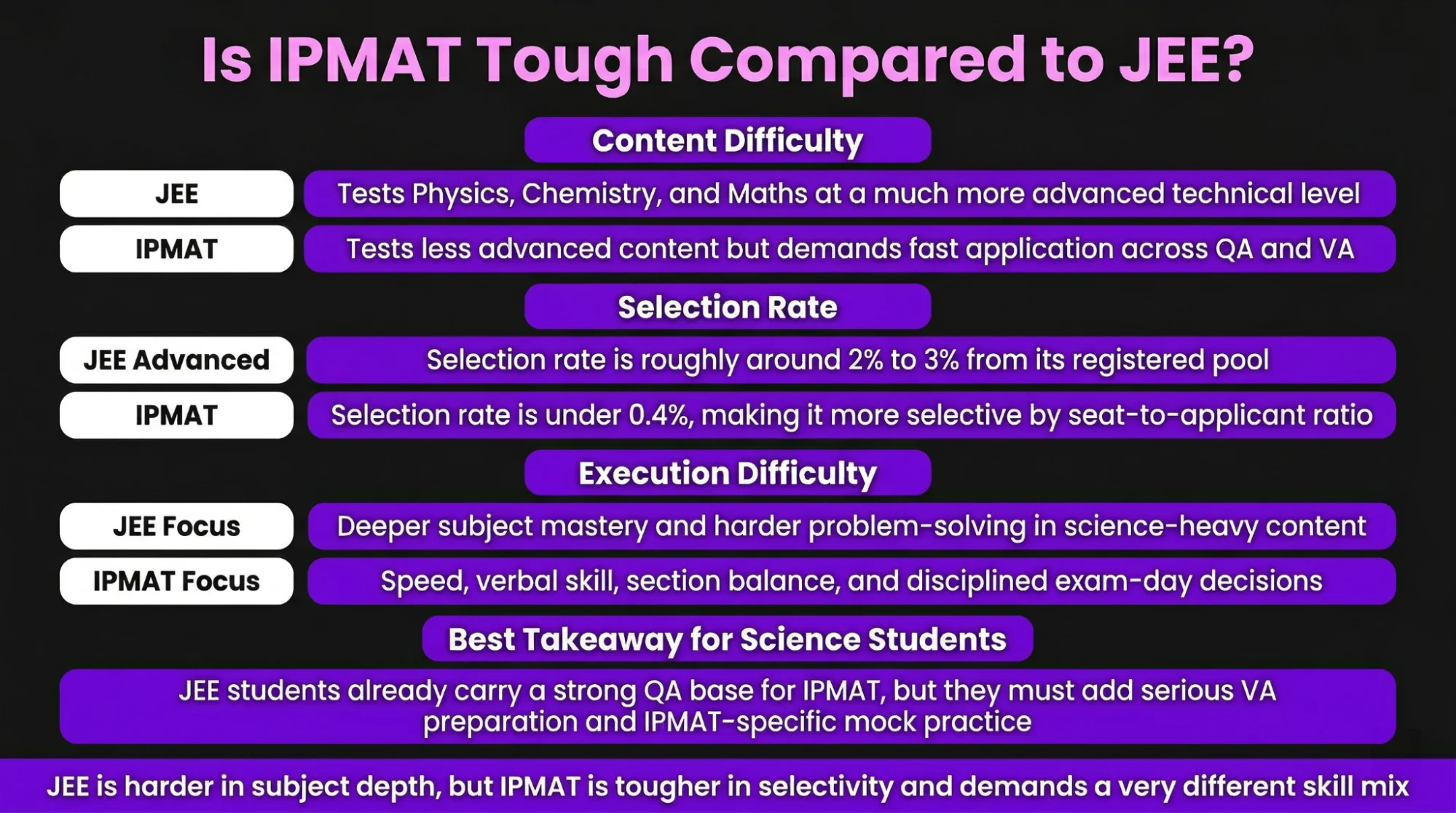
- Content difficulty comparison: JEE tests Physics, Chemistry, and Mathematics at Class 11 and 12 level, including topics like Calculus, advanced Mechanics, organic reaction mechanisms, and Electrochemistry. JEE content is substantially more advanced than IPMAT content. In terms of what you need to know to be able to solve individual questions, JEE questions are harder than IPMAT questions.
- Competition and selection rate comparison: JEE Advanced’s selection rate from the Advanced-registered pool is approximately 2 to 3%. IPMAT’s selection rate from the registered pool is under 0.4%. By this metric, IPMAT is more selective.
- Execution difficulty comparison: JEE tests content depth and problem-solving creativity. IPMAT tests content application speed, language skills, and exam-condition discipline across 2 very different subjects simultaneously. These are different types of difficulty that do not map cleanly onto each other.
- The honest summary: IPMAT questions are less technically advanced than JEE questions. But IPMAT is more selective by seat-to-applicant ratio, tests a completely different type of skill in VA, and requires a specific exam-condition discipline that JEE preparation does not develop.
A Science stream student who has prepared for JEE has strong QA foundations in the topics that overlap with IPMAT. They need to add VA preparation and IPMAT-specific mock test practice. The overlap makes dual preparation feasible for motivated students.
Is IPMAT Tough for Commerce or Arts Students?
One of the most persistent myths around IPMAT difficulty is that it is easier for Science students and harder for Commerce or Arts students. This myth deserves a direct response.
- For Commerce students: Arithmetic intuition from Class 11 to 12 Accountancy and Business Studies is a genuine QA advantage. Percentages, profit-loss, and compound interest feel familiar. The disadvantage is that Commerce students who did not take Mathematics in Class 11 to 12 need to build algebra and number theory from a lower base. This is achievable with 5 to 6 months of structured practice. The advantage in VA is real for Commerce students who regularly read business publications.
- For Arts students: Strong reading habits and analytical writing practice from subjects like History, Political Science, or English Literature translate into a genuine VA advantage. RC inference and tone questions feel more natural to students who have analysed texts in their curriculum. The disadvantage is QA, where arithmetic and algebra must often be rebuilt from Class 9 to 10 foundations. This is achievable but requires starting earlier, at least 7 to 8 months before the exam, to allow adequate time for QA foundation building.
The honest summary: IPMAT is not selectively tough for any stream. It rewards the specific preparation you build, regardless of your academic background. Stream only determines your starting point, not your ceiling.
According to the Journal of Educational Psychology, students who approach skill development with a growth mindset, treating their current deficits as preparation targets rather than fixed limitations, consistently outperform students who treat stream background as a predictor of exam outcome. The IPMAT preparation data is consistent with this research: Arts and Commerce students regularly earn IIM Indore IPM seats.
The Gap Between “IPMAT Is Doable” and “I Am Ready for IPMAT”
The most important nuance in the IPMAT difficulty discussion is the gap between these two statements: “IPMAT is doable for a well-prepared student” (true) and “I am ready for IPMAT because the content seems familiar” (frequently false).
Students fall into the second trap most often in 2 ways.
- Trap 1: Familiarity with topics mistaken for preparation. A student who has studied arithmetic in school and can solve basic percentage problems correctly feels prepared for IPMAT QA arithmetic. But IPMAT arithmetic requires solving multi-step percentage word problems in under 60 seconds, under negative marking pressure, in the middle of a 40-question section where every wrong answer costs a mark. Familiarity with the topic is not the same as being able to execute on it under those conditions.
- Trap 2: Mock test scores on easy material mistaken for exam readiness. Students who practice on mock tests that are calibrated below IPMAT difficulty consistently score higher in practice than they do on the actual exam. The gap between practice score and actual score is one of the most demoralising experiences IPMAT aspirants report, and it is entirely avoidable by practicing on correctly calibrated material.
The standard that defines readiness for IPMAT: consistently scoring above the estimated General category overall threshold (approximately 220 to 250) on full-length, correctly calibrated mock tests with strict section-independent timing, while keeping negative marking losses below 10 to 12 marks per MCQ section.
A student who reaches this standard in mock tests is genuinely ready for the exam. A student who has covered the syllabus but has not built this mock test performance standard has preparation work remaining, regardless of how familiar the content feels.
IPMAT Difficulty: What It Means for Preparation Effort
The honest analysis of IPMAT difficulty has direct preparation implications.
- Implication 1: 6 months of consistent daily preparation is the standard, not a luxury. Students who crack IPMAT with 2 to 3 months of preparation exist, but they are the exception, not the pattern. The typical successful IPMAT aspirant has 5 to 6 months of structured daily preparation behind them. For VA specifically, which develops over time rather than through cramming, shorter timelines consistently produce weaker section scores.
- Implication 2: Mock tests are not a final-stage activity. Given the execution difficulty of IPMAT, full-length mock tests must begin in Month 2 to 3 of preparation, not Month 5. Early mock tests serve as diagnostics. Mid-preparation mocks serve as progress benchmarks. Final-phase mocks serve as simulation. Compressing all mock test practice into the final 4 to 6 weeks produces students who are well-prepared on content but underprepared on exam execution.
- Implication 3: VA must receive equal daily attention from Day 1. Given that VA skills develop over months and cannot be crammed, treating VA as a secondary concern in the first 3 months of preparation guarantees a structural gap at the VA sectional cutoff. Daily active reading, a vocabulary journal, and timed VA practice from the first week of preparation is not optional. It is the preparation pattern that consistently separates students who clear the VA cutoff from those who do not.
- Implication 4: Negative marking discipline must be trained explicitly. The +4/-1 marking scheme is not self-correcting. Students who do not explicitly train their attempt decisions, through mock tests where they track negative marking losses separately and adjust strategy accordingly, arrive at exam day without the discipline that the marking scheme demands.
Team Phodu Club consistently observes that students who approach IPMAT with accurate difficulty calibration, neither underestimating its competition intensity nor being paralysed by it, prepare most effectively. The Phodu Club IPMAT Test Series provides full-length mock tests calibrated to actual IPMAT exam difficulty, giving students the most accurate available benchmark of their genuine readiness level, not an inflated score from easier practice material.
Conclusion: Is IPMAT Tough? The Honest Answer
Is IPMAT tough? Yes, in the ways that matter. The content is not advanced by the standards of competitive examinations like JEE or NEET, but the competition is fierce (under 0.4% selection rate), the execution is demanding (3 independent sections, negative marking, 60 seconds per question), and the VA skills required are genuinely developmental (they build over months, not weeks).
The students who find IPMAT tough in a demoralising way are the ones who underestimated the competition, started too late, skipped VA preparation in the early months, or practiced on material easier than the actual exam. These are all avoidable mistakes.
The students who find IPMAT hard in an honest, achievable way are the ones who started 5 to 6 months out, gave both QA and VA equal daily attention, took 15 to 20 full-length mock tests on correctly calibrated material, and systematically eliminated their preparation gaps through honest error analysis. These students find IPMAT tough in the same way a well-trained athlete finds their competition tough: it is a genuine challenge, they have prepared for it specifically, and they have a realistic chance of performing at the level required.
IPMAT is not easy. It is not impossible. It is a 6-month preparation challenge that rewards those who approach it with the right structure, the right timeline, and the honest self-assessment to know when preparation is genuinely competition-ready and when it is not.
Frequently Asked Questions (FAQ)
1) Is IPMAT tough to crack?
IPMAT is genuinely competitive, with a selection rate under 0.4% of registered candidates for approximately 150 seats at IIM Indore. The content (Class 9 to 11 Mathematics and standard English skills) is not advanced, but the competition intensity, time pressure, and VA developmental requirements make it a genuinely difficult exam that rewards serious, structured 5 to 6 month preparation.
2) Is IPMAT tougher than JEE?
JEE content is more advanced (Calculus, advanced Physics and Chemistry) than IPMAT content. But IPMAT is more selective by seat-to-applicant ratio (under 0.4% vs. JEE Advanced’s approximately 2 to 3%). IPMAT tests VA skills that JEE does not, and requires different exam-condition disciplines. The two exams test different skills and are difficult in different ways.
3) Is IPMAT tough for Commerce students?
No more than for other streams. Commerce students have a genuine QA advantage in arithmetic topics. Their main gap is typically in algebra and number theory, which are buildable with structured 5 to 6 month preparation. VA preparation is equally required regardless of stream.
4) Is IPMAT tough for Arts students?
Arts students often have a genuine VA advantage from their reading and analytical writing experience. The QA gap requires more foundational work and benefits from starting 7 to 8 months before the exam. Many Arts students have earned IIM Indore IPM seats through structured preparation.
5) How many students clear the IPMAT every year?
Approximately 150 students earn final IIM Indore IPM seats each year from 40,000+ registered candidates. A further 400 to 600 are shortlisted for the PI. The selection rate from registered candidates is under 0.4%.
6) What is the difficulty level of IPMAT questions?
QA questions are at Class 9 to 11 Mathematics difficulty in content but require application and speed that goes beyond school exam performance. VA questions test RC inference, editorial-level vocabulary, and grammar at a level above casual language use. Approximately 25 to 30% of questions are easy, 45 to 50% are medium, and 20 to 25% are hard.
7) Can an average student crack the IPMAT?
The framing of “average student” is less useful than asking: is a student willing to invest 5 to 6 months of consistent daily preparation, practice on correctly calibrated mock tests, and build both QA and VA to a competitive standard simultaneously? Students who meet this description from any academic background have a realistic chance of clearing IPMAT.
8) Is IPMAT tough because of time pressure?
Time pressure is one of the most challenging aspects of IPMAT execution. 60 seconds per question on average in QA, with negative marking and section-independent timers, requires practised speed that untimed preparation does not build. Training under real exam-condition timing from Month 3 onwards is essential for managing this difficulty.
9) What makes IPMAT hard for most students who fail to clear it?
The most common reasons are: starting too late (under 3 months before the exam), treating VA as secondary to QA until too late, practicing on mock tests that are easier than the actual exam, and not developing negative marking discipline through structured analysis of mock test attempt patterns.
10) How do I prepare effectively given IPMAT’s difficulty?
Start 5 to 6 months before the exam. Give QA and VA equal daily attention from Day 1. Begin full-length mock tests in Month 2 to 3. Analyse every mock test for error patterns, not just scores. Practice on correctly calibrated material that accurately reflects real IPMAT difficulty. The Phodu Club IPMAT Test Series provides full-length mock tests matched to actual IPMAT exam difficulty, giving you the most accurate available benchmark of genuine readiness throughout your preparation.