Most students preparing for the IPMAT syllabus 2026 make the same mistake: they treat every topic as equally important and try to cover everything at once. Six months later, they have touched every chapter but mastered none of them. The result is a mock test score that never moves. The reality is that the IPMAT exam — whether for IIM Indore or IIM Rohtak — rewards depth over breadth. Knowing which topics carry more weight, how they are tested, and how the syllabus differs between the two exams is not optional preparation. It is the foundation everything else is built on. This guide breaks down the complete IPMAT syllabus 2026, section by section, for both IIM Indore and IIM Rohtak — so you can build a preparation plan that is precise, not scattered.
Why Understanding the Syllabus Deeply Matters for IPMAT
Here is a situation many students experience. They spend 3 weeks on coordinate geometry because it feels important. They solve 100 problems. Then on exam day, 2 coordinate geometry questions appear — while 9 questions on percentages, ratio, and time-speed-distance go badly because those topics never got the same attention.
This is what happens when students prepare without a clear understanding of topic weightage.
The IPMAT syllabus 2026 is not prescribed in a rigid document the way a CBSE board exam syllabus is. IIM Indore and IIM Rohtak do not publish a detailed topic list officially. But analysis of previous years’ question papers — from 2019 through 2025 — reveals extremely consistent patterns in which topics are tested, how frequently, and at what difficulty level.
According to exam analysis data compiled from previous IPMAT papers, the Quantitative Ability section draws approximately 60–65% of its questions from arithmetic and algebra alone. Students who master these 2 areas first are in a structurally stronger position than students who spread preparation time evenly across all topics.
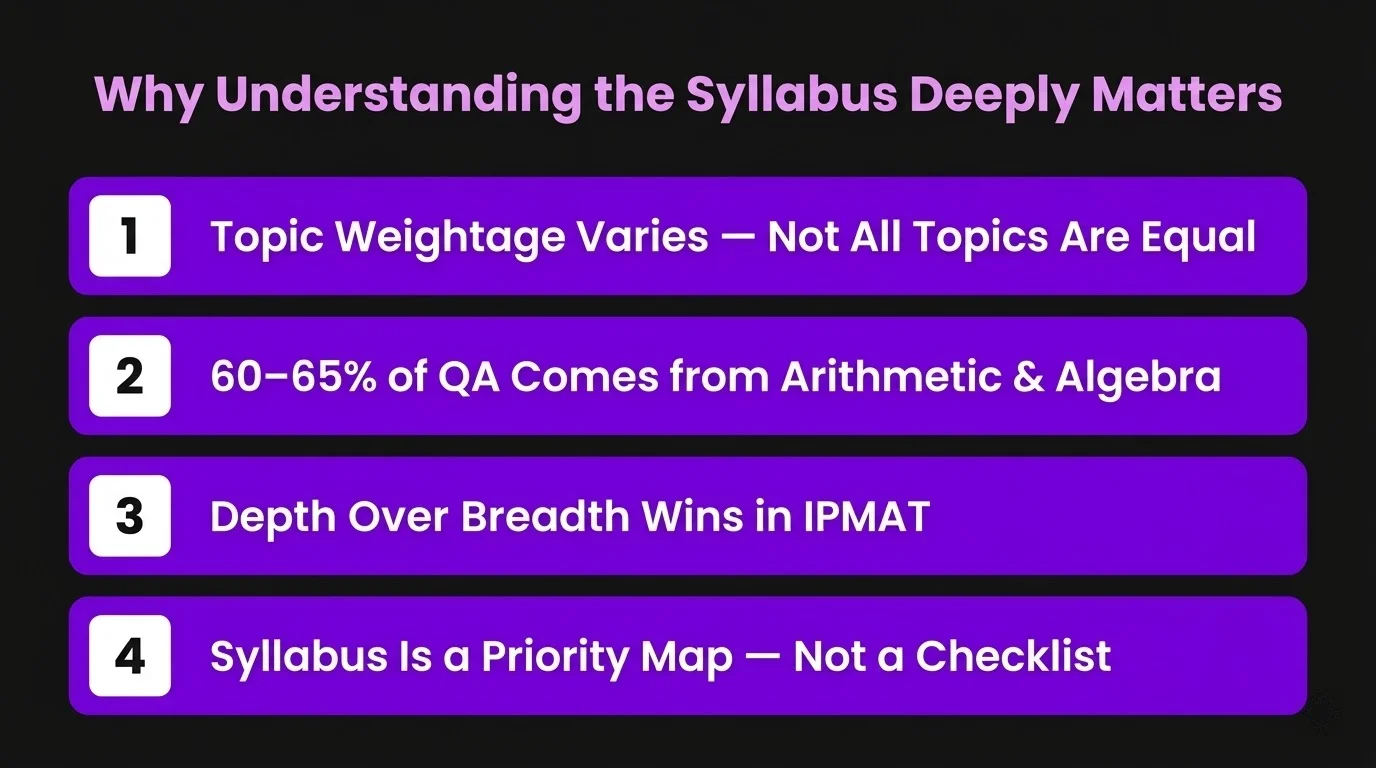
Understanding the IPMAT syllabus 2026 this way — not as a checklist to tick, but as a priority map to follow — is what Team Phodu Club consistently finds separates students who improve steadily from those who plateau.
IPMAT Syllabus 2026: IIM Indore vs IIM Rohtak — Key Differences
Before diving into topic-level detail, it is important to understand how the two exams differ in structure, because the syllabus emphasis shifts meaningfully between them.
IIM Indore IPMAT
| Section | Format | Questions | Time |
| Quantitative Ability (MCQ) | Multiple Choice | 30 | 40 minutes |
| Quantitative Ability (Short Answer) | Non-MCQ | 15 | 40 minutes |
| Verbal Ability (MCQ) | Multiple Choice | 45 | 40 minutes |
- Total: 100 questions | 400 marks | 120 minutes
- Negative marking: −1 for wrong answers in MCQ sections; no negative marking in Short Answer
- Sections covered: Quantitative Ability and Verbal Ability only
IIM Rohtak IPM-AT
| Section | Format | Questions | Time |
| Quantitative Ability | Multiple Choice | 40 | 40 minutes |
| Logical Reasoning | Multiple Choice | 40 | 40 minutes |
| Verbal Ability | Multiple Choice | 40 | 40 minutes |
- Total: 120 questions | 480 marks | 120 minutes
- Negative marking: −1 for wrong answers across all sections
- Key difference: IIM Rohtak includes a dedicated Logical Reasoning section that IIM Indore does not
This structural difference is significant. A student preparing only for IIM Indore’s IPMAT does not need to dedicate preparation time to Logical Reasoning. A student targeting IIM Rohtak’s IPM-AT — or planning to appear for both — must account for LR as a full, separately scored section.
Always verify the latest pattern from the official IIM Indore website and IIM Rohtak’s official IPM page before the exam, as patterns may be revised for 2026.
IPMAT Syllabus 2026: Quantitative Ability (IIM Indore & Rohtak)
The QA section is the most heavily weighted component of the IPMAT syllabus 2026. For IIM Indore, it accounts for 60 out of 100 questions — 60% of the entire paper. For IIM Rohtak, it accounts for one-third of the total questions.
Here is the complete topic breakdown, organised by priority level based on previous years’ question frequency.
Arithmetic — Highest Priority
Arithmetic questions appear in both the MCQ and Short Answer sections in IIM Indore’s IPMAT. They consistently form the largest single cluster of questions in the QA section.
Topics to master:
- Percentages — calculation, percentage change, application in profit/loss
- Profit, Loss, and Discount — cost price, selling price, marked price, successive discounts
- Ratio and Proportion — direct and inverse proportion, partnership problems
- Time, Speed, and Distance — relative speed, trains, boats and streams
- Time and Work — work efficiency, pipes and cisterns, combined work problems
- Simple and Compound Interest — annual, half-yearly, quarterly compounding
- Averages — weighted averages, combined averages
- Mixtures and Alligation — combining mixtures, replacement problems
Preparation advice: Every arithmetic topic has a core formula and a set of question types that repeat across years. Build a formula reference sheet for arithmetic first. Then solve 50+ problems per topic before moving on. Speed in arithmetic is non-negotiable — most of your QA MCQ time will be spent here.
Algebra — High Priority
Algebra questions test both conceptual understanding and the ability to work with abstract relationships. They appear with high frequency in the IPMAT syllabus 2026 QA section.
Topics to master:
- Linear equations — single and simultaneous equations
- Quadratic equations — factorisation, discriminant, nature of roots
- Inequalities — linear and quadratic inequalities, modulus
- Progressions — Arithmetic Progression (AP), Geometric Progression (GP), Harmonic Progression (HP)
- Functions — domain, range, types of functions
- Logarithms — properties of logarithms, solving log equations
- Polynomials — remainder theorem, factor theorem
Preparation advice: Algebra questions in IPMAT frequently combine 2 or more sub-topics. A question on progressions may involve simultaneous equations to find the first term and common difference. Practice multi-step algebra problems regularly rather than only isolated single-concept questions.
Number Theory — Medium-High Priority
Number theory questions appear less frequently than arithmetic and algebra but can be difficult to solve under time pressure without solid preparation.
Topics to master:
- Divisibility rules — 2 through 12
- HCF and LCM — for integers and fractions
- Remainders — Euler’s theorem applications, cyclicity of remainders
- Prime numbers — identifying primes, prime factorisation
- Factors — number of factors, sum of factors, product of factors
- Units digit and last 2 digits problems
- Number of zeros in factorials and products
Geometry and Mensuration — Medium Priority
Geometry is tested in both IIM Indore and IIM Rohtak papers. The difficulty level varies — some years have straightforward formula-application questions, while others test more complex reasoning.
Topics to master:
- Lines and Angles — parallel lines, transversals, angle relationships
- Triangles — congruence, similarity, Pythagoras theorem, area formulas, special triangles
- Quadrilaterals — properties of parallelograms, rectangles, squares, trapezoids
- Circles — chords, tangents, arcs, sector area, inscribed and circumscribed figures
- Coordinate Geometry — distance formula, section formula, slope, equation of a line
- Mensuration — 2D (area of triangles, circles, polygons) and 3D (cube, cylinder, sphere, cone)
Modern Mathematics — Medium Priority
Modern maths questions test logical thinking and combinatorial reasoning. These topics appear with moderate frequency in the IPMAT syllabus 2026.
Topics to master:
- Permutations and Combinations — arrangements, selections, circular permutations
- Probability — basic probability, conditional probability, independent events
- Sets and Venn Diagrams — union, intersection, complement, word problems
- Mathematical Reasoning — basic logic statements
IPMAT Syllabus 2026: Verbal Ability (IIM Indore & Rohtak)
The Verbal Ability section is where many IPMAT aspirants — particularly those from the Science stream — lose marks they should not lose. It accounts for 40 out of 100 questions in IIM Indore’s IPMAT. A weak VA performance can drag your total below the sectional cutoff even if your QA performance is strong.
Here is the complete topic breakdown for VA in the IPMAT syllabus 2026.
Reading Comprehension — Highest Priority
Reading Comprehension (RC) consistently carries the most weight in the VA section. IIM Indore typically includes 2–3 passages per paper, with 4–6 questions per passage.
What is tested:
- Main idea and central argument of the passage
- Inference-based questions — what can be concluded from the passage
- Vocabulary in context — meaning of specific words or phrases as used in the passage
- Author’s tone and attitude
- Specific detail retrieval — finding directly stated information
How RC passages are structured: Passages in IPMAT are typically analytical or argumentative — drawn from topics like economics, social science, philosophy, science and technology, or environmental issues. Literary or narrative passages are less common.
Preparation advice: Read 1 quality editorial or opinion article daily from The Hindu, Indian Express, or a reputed international source. After reading, summarise the main argument in 2 sentences without looking back at the text. This practice builds both comprehension speed and retention — exactly what RC questions in the IPMAT exam demand.
Vocabulary — High Priority
Vocabulary questions appear across multiple question types in the IPMAT syllabus 2026.
Topics to master:
- Synonyms and antonyms — direct vocabulary testing
- Analogies — word relationships (e.g., Doctor : Hospital :: Teacher : ?)
- Word-in-context — choosing the correct meaning of a word as used in a specific sentence
- Fill in the blanks — selecting the appropriate word for a given sentence context
- Idioms and phrases — meaning and usage
Preparation advice: Build a vocabulary journal. Write 8–10 new words every day with their meaning, an example sentence, and any common synonyms or antonyms. Review the previous week’s words every Sunday. Consistent vocabulary building over 4–5 months will compound meaningfully. Passive reading of word lists — without writing or using the words — produces very little retention.
Grammar — Medium-High Priority
Grammar questions in the IPMAT exam test practical language usage, not theoretical rules.
Topics to master:
- Error spotting — identifying grammatical errors in a given sentence
- Sentence correction — rewriting or choosing the corrected version of a sentence
- Fill in the blanks — articles, prepositions, conjunctions, modals
- Active and passive voice transformation
- Direct and indirect speech
- Subject-verb agreement
- Tense usage
Preparation advice: Work through a standard grammar reference such as Wren & Martin. Focus specifically on error spotting and sentence correction exercises — these formats appear most frequently in the IPMAT exam. Understanding why a sentence is wrong is more useful than memorising rules in isolation.
Para Jumbles and Para Completion — Medium Priority
These question types test your ability to understand logical flow and coherence in written text.
Topics to master:
- Para Jumbles — rearranging 5–6 sentences into a coherent paragraph
- Odd Sentence Out — identifying the sentence that does not belong in a given set
- Para Completion — choosing the most appropriate sentence to begin or end a paragraph
Preparation advice: When solving para jumbles, look for 3 structural clues: pronouns that reference nouns introduced earlier, transitional words (however, therefore, moreover), and the logical progression of an argument from claim to evidence to conclusion. Practicing 3–5 para jumbles daily builds the pattern recognition needed to solve these quickly under time pressure.
Critical Reasoning — Medium Priority
Critical reasoning questions test argument analysis skills and appear in some years more prominently than others.
Topics to master:
- Identifying the conclusion of an argument
- Strengthening and weakening arguments
- Drawing valid inferences from a set of statements
- Identifying assumptions in an argument
IPMAT Syllabus 2026: Logical Reasoning (IIM Rohtak Only)
Students targeting IIM Rohtak’s IPM-AT need to prepare a full additional section. The Logical Reasoning section has 40 questions and is just as heavily weighted as QA and VA in the IPM-AT exam.
Topics to master:
Verbal Reasoning
- Syllogisms — drawing valid conclusions from given statements
- Blood relations — family tree-based questions
- Direction and distance problems
- Coding and decoding
- Analogies and series completion
Analytical Reasoning
- Seating arrangements — linear and circular
- Puzzles — scheduling, assignment, and sequencing problems
- Input-output problems
- Data sufficiency
Preparation advice for LR: LR is the most time-sensitive section in the IPM-AT. Arrangement and puzzle questions can consume 6–8 minutes each if you are not fast. Practice solving seating arrangement problems within 4 minutes. Build a consistent framework for each question type so you are not figuring out the approach under exam pressure — you are executing a known method.
Students who plan to attempt both IIM Indore IPMAT and IIM Rohtak IPM-AT should begin LR preparation no later than Month 3 of their 6-month study plan, alongside QA and VA.
Topic Priority Summary: Where to Focus First
Based on question frequency analysis across IPMAT papers from 2019–2025, here is a clear priority ranking for your IPMAT syllabus 2026 preparation:
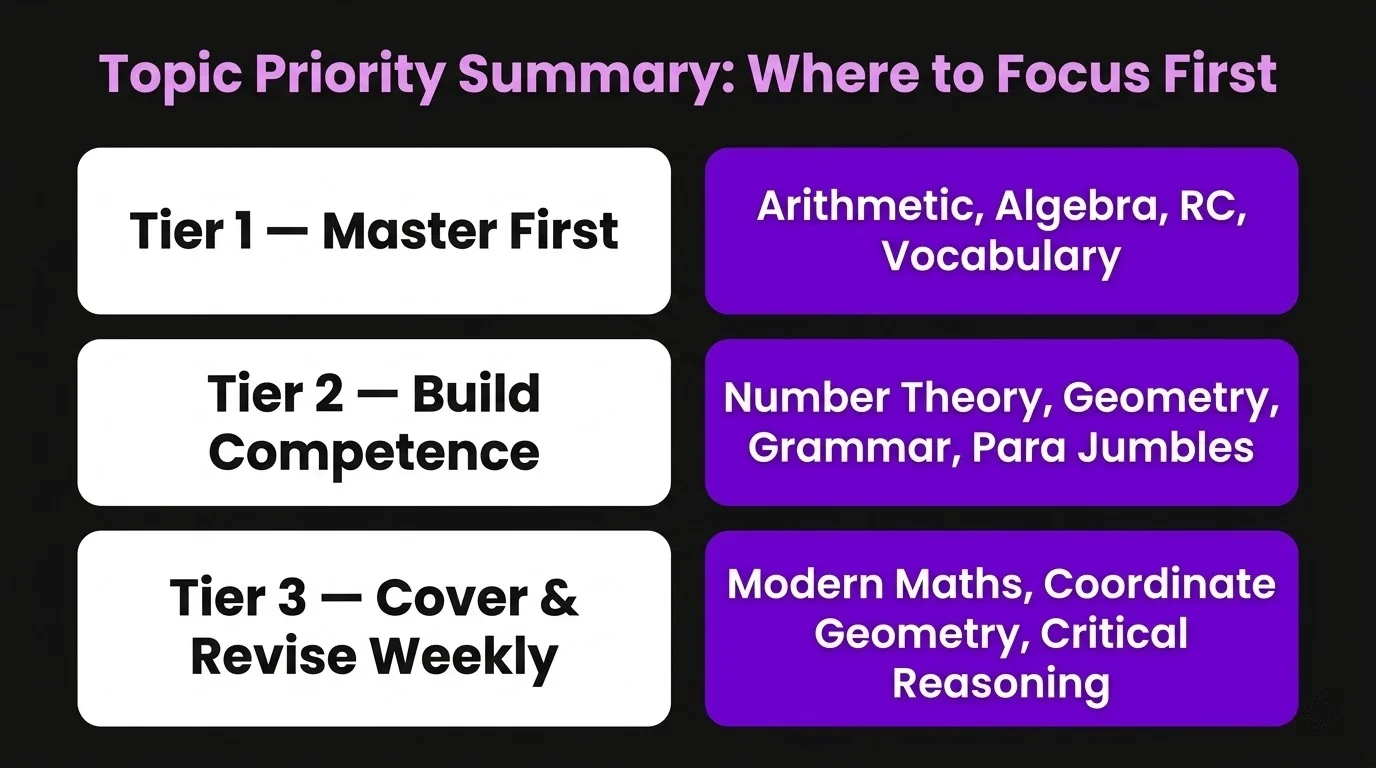
Tier 1 — Master these first (Highest impact on score)
- Arithmetic (all subtopics)
- Algebra (equations, progressions, inequalities)
- Reading Comprehension
- Vocabulary (synonyms, antonyms, word-in-context)
Tier 2 — Build strong competence (Medium-high impact)
- Number Theory
- Geometry and Mensuration
- Grammar (error spotting, sentence correction)
- Para Jumbles and Para Completion
Tier 3 — Cover thoroughly but allocate less revision time
- Modern Mathematics (P&C, Probability, Sets)
- Coordinate Geometry
- Critical Reasoning
- Logical Reasoning (required only for IIM Rohtak IPM-AT)
This priority framework is not about ignoring Tier 3 topics — it is about knowing where to invest the most time, especially in the final 6–8 weeks of preparation when revision decisions must be deliberate.
Many students at Phodu Club begin improving their mock test scores as soon as they rebuild their preparation around this priority structure — focusing their daily practice time on Tier 1 topics while maintaining Tier 2 and 3 topics through weekly revision rather than daily deep-dives.
Common Syllabus-Related Mistakes to Avoid
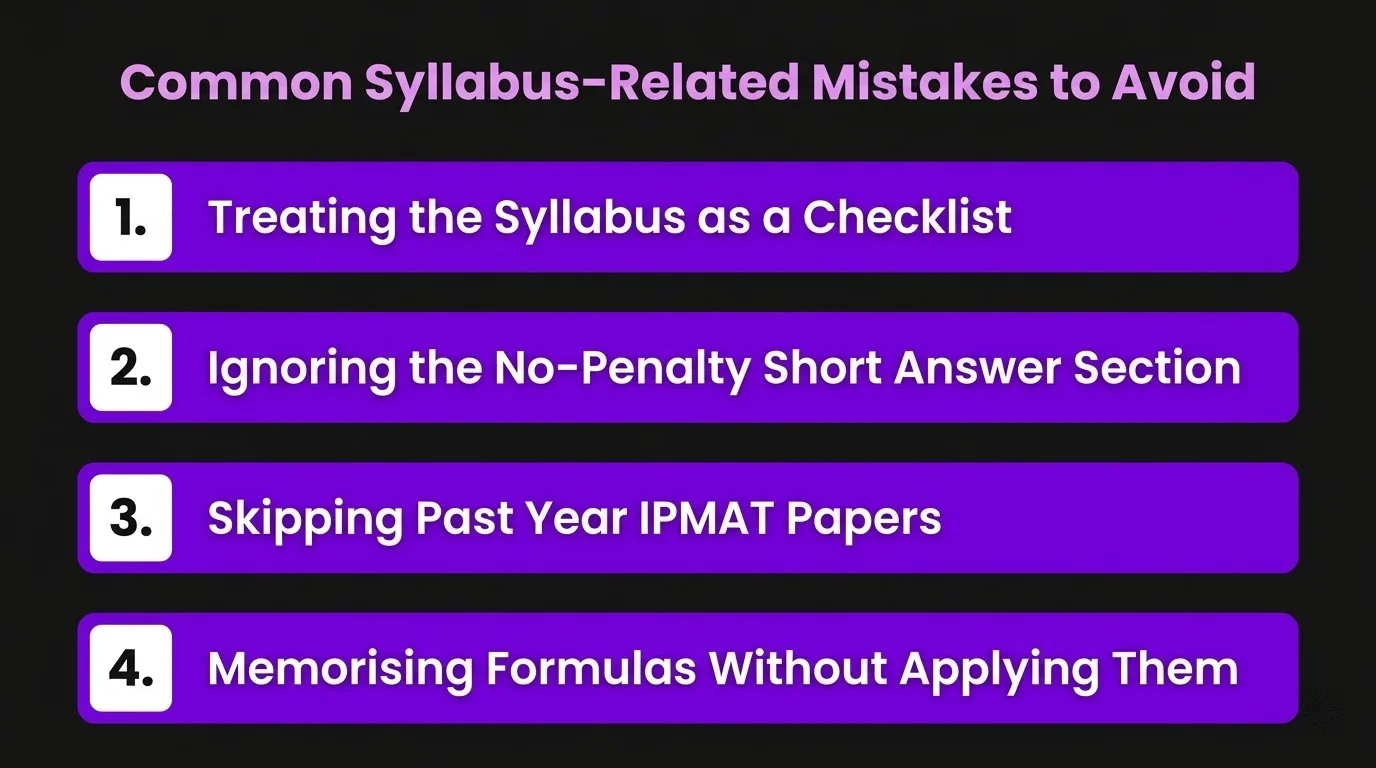
Mistake 1: Treating the syllabus as a checklist Touching every topic once and moving on creates an illusion of preparation. The IPMAT exam does not reward breadth — it rewards the ability to solve unfamiliar problems quickly. That comes from depth, not coverage.
Mistake 2: Neglecting the Short Answer section Many students prepare the Short Answer section of IIM Indore’s IPMAT the same way they prepare the MCQ section. This is a strategic error. Because there is no negative marking, your approach should be different — attempt every question, including those where you are only partially confident.
Mistake 3: Skipping past year papers Past year IPMAT papers are the single most reliable guide to what will actually appear in the exam. Solving the last 5–7 years of papers under timed conditions is non-negotiable. The patterns are consistent enough that regular past paper practice directly improves performance on the actual IPMAT exam.
Mistake 4: Memorising formulas without understanding applications Knowing the formula for compound interest is not preparation. Being able to solve a compound interest problem framed as a word problem — in under 90 seconds — is preparation. Every formula in the IPMAT syllabus 2026 should be practiced in applied problem-solving contexts, not just memorised in isolation.
According to research published by the National Council of Educational Research and Training (NCERT), students who engage in applied problem-solving alongside conceptual learning consistently outperform students who rely on formula memorisation alone in competitive examination environments.
How to Use the Syllabus to Build Your Study Plan
Now that you have a clear picture of the IPMAT syllabus 2026, here is how to convert it into a practical preparation structure:
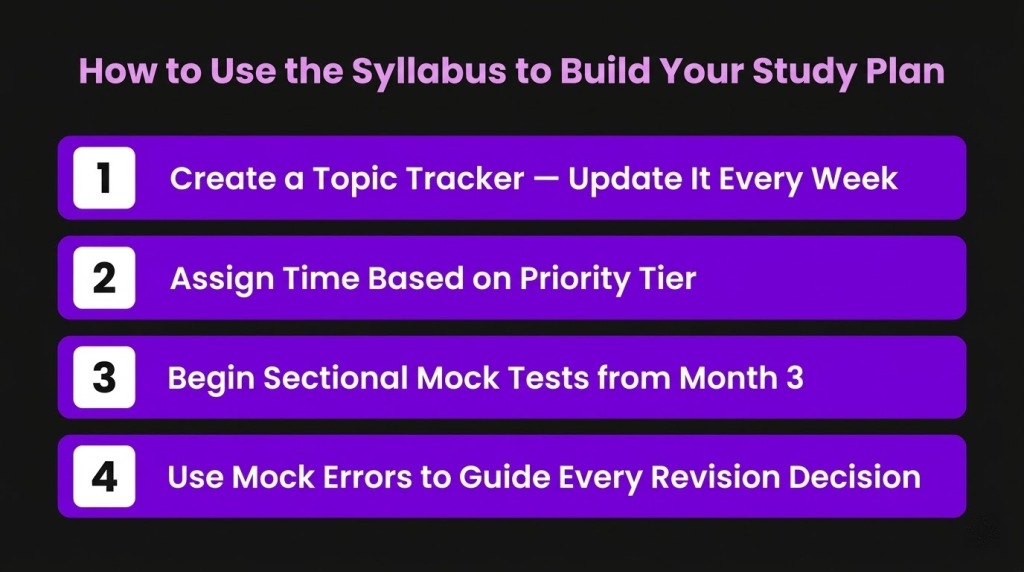
Step 1: Create a topic tracker List every topic from both QA and VA sections. Mark each as: Not Started / In Progress / Practiced / Revised. Update it weekly. This gives you a live view of where you stand relative to the full syllabus.
Step 2: Assign time to each topic based on priority Tier 1 topics and get daily practice time. Tier 2 topics get 3–4 sessions per week. Tier 3 topics get 1–2 sessions per week plus regular inclusion in mixed practice.
Step 3: Begin mock testing from Month 3 Do not wait until you have covered the full syllabus before attempting mock tests. Begin sectional mocks from Month 3. Early mock tests reveal which topics are weakest under time pressure — information that is worth more than another theory revision week.
Step 4: Use mock test errors to prioritise revision Every wrong answer in a mock test is a data point. Track errors by topic over 5–6 mocks. The topics that produce the most errors are the ones that need additional practice — regardless of how confident you feel about them during solo study.
The Phodu Club IPMAT Test Series includes full-length tests built to match the actual difficulty level of the IPMAT exam. Using a test series that reflects real exam difficulty ensures your practice benchmarks are accurate — so you are not surprised on exam day by the actual standard of questions.
Conclusion
The IPMAT syllabus 2026 is learnable, manageable, and far less intimidating once it is broken down into clear priorities. The students who crack IIM Indore or IIM Rohtak’s IPM programme are not students who covered every topic equally. They are students who mastered the highest-priority topics first, practiced under real time pressure consistently, and used their mock test errors to guide every revision decision.
Start with Tier 1. Build speed in arithmetic and algebra. Read every day for VA. Track your syllabus progress every week. Take mock tests from Month 3. Analyse every result honestly. And stay consistent across the full preparation window — because the IPMAT exam rewards students who compound improvement over months, not those who sprint for the last 4 weeks.
One topic mastered today. One mock test was reviewed honestly this week. One weak area was corrected this month. That is how the IPMAT syllabus 2026 gets conquered.
Frequently Asked Questions (FAQ)
1) Is there an official IPMAT syllabus 2026 document?
IIM Indore and IIM Rohtak do not publish a detailed official syllabus document for the IPMAT exam. The IPMAT syllabus 2026 is derived from analysis of previous years’ question papers and official programme information. Past papers from 2019–2025 are the most reliable reference for understanding what topics are tested.
2) What is the difference between the IIM Indore and IIM Rohtak IPMAT syllabus?
IIM Indore’s IPMAT covers Quantitative Ability (MCQ + Short Answer) and Verbal Ability. IIM Rohtak’s IPM-AT covers Quantitative Ability, Logical Reasoning, and Verbal Ability. The key difference is the addition of a full Logical Reasoning section in IIM Rohtak’s exam.
3) Which topics are most important in the IPMAT syllabus 2026 QA section?
Arithmetic and Algebra are the highest-priority topics in the QA section, collectively accounting for the majority of questions in both IIM Indore and IIM Rohtak exams. Number Theory and Geometry are medium-high priority topics.
4) Does the IPMAT syllabus 2026 include Logical Reasoning for IIM Indore?
No. Logical Reasoning is not part of IIM Indore’s IPMAT exam. It is a dedicated section only in IIM Rohtak’s IPM-AT. Students targeting only IIM Indore do not need to prepare LR.
5) How should I prepare Reading Comprehension for the IPMAT syllabus 2026?
Read 1 quality editorial daily from The Hindu or Indian Express. Practice RC passages under timed conditions — aim to complete a 600-word passage with 4–5 questions in under 8 minutes. Build vocabulary simultaneously to handle word-in-context questions.
6) Is Class 11 and 12 Maths sufficient for the IPMAT QA section?
Class 10 and 11 Mathematics covers most of the IPMAT syllabus 2026 QA section. Class 12 Calculus and higher-level topics are generally not tested. The focus is on speed and problem-solving ability within the topics listed above.
7) How many topics are in the IPMAT syllabus 2026 Verbal Ability section?
The VA section broadly covers Reading Comprehension, Vocabulary, Grammar, Para Jumbles, Para Completion, and Critical Reasoning. RC and Vocabulary carry the highest question frequency and should be prioritised from Day 1.
8) Should I use the same study material for IIM Indore and IIM Rohtak preparation?
QA and VA preparation is common to both. If you are targeting IIM Rohtak’s IPM-AT in addition to IIM Indore’s IPMAT, add a dedicated Logical Reasoning preparation track starting from Month 3 of your study plan.
9) How do I track my IPMAT syllabus 2026 progress?
Create a topic-level tracker listing every QA and VA topic. Update it weekly with your status: Not Started, In Progress, Practiced, or Revised. Combine this with mock test error tracking to ensure your revision time is spent on actual weak areas.
10) Where can I practice questions covering the full IPMAT syllabus 2026?
The Phodu Club IPMAT Test Series covers the complete IPMAT syllabus 2026 with full-length mock tests matched to actual exam difficulty. Practicing on well-calibrated tests ensures your preparation benchmarks are accurate before the real exam.