The IPMAT results day is a moment most students imagine throughout their preparation — the culmination of 5 or 6 months of arithmetic problems, editorial reading, vocabulary journals, and timed mock tests. But imagining the moment and being prepared for it are different things. The students who extract the most value from their IPMAT results are the ones who know exactly what to do the instant the scorecard is available: where to find it, how to interpret every number on it, how to assess their position relative to the cutoff, and what immediate decisions the score requires. The students who are least prepared for the results day are the ones who have spent 6 months preparing for the exam and 0 hours preparing for the result — who discover at 10 PM on results night that their scorecard portal keeps timing out, that they do not know which of their 3 section scores to benchmark against which cutoff, and that they have no idea whether a total score of 238 puts them safely in the PI shortlist zone or dangerously close to the margin. This guide covers the complete IPMAT results picture for 2026: when results are declared, how the scorecard download works, how to read every number on the scorecard, and how to use previous year cutoff data to analyse exactly where the 2026 result leaves you.
IPMAT Results 2026: Expected Date and Declaration Timeline
IIM Indore has officially confirmed that IPMAT 2026 will be held on Monday, May 4, 2026 (afternoon shift), and the admit card was released on April 21, 2026. As of now, IIM Indore has not announced an official result date, answer key date, PI shortlist date, or final merit list date on its admissions page. So your earlier timeline should be updated like this:
| Stage | Updated Timeline (Official & Expected) |
| IPMAT 2026 Exam | May 4, 2026 (Confirmed) |
| Provisional Answer Key | May 9 – May 12, 2026 |
| Answer Key Challenge Window | 2–3 days after provisional key |
| Final Answer Key | Mid-May 2026 |
| IPMAT 2026 Results Declaration | Last week of May / First week of June 2026 |
| PI Shortlist Announcement | 1–2 weeks after results (Mid-June) |
| Personal Interview (PI) Dates | late June – early July 2026 |
| Final Merit List | Late July – early August 2026 |
IPMAT results 2026 will be published on the official IIM Indore portal. Third-party websites frequently publish “IPMAT results declared” articles before actual declaration — sometimes with fabricated or outdated data. The only authoritative source is IIM Indore’s own portal. Bookmark it. Do not rely on result aggregator sites.
IPMAT Results 2026: The Scorecard Download — Complete Process
When IPMAT results are declared, your scorecard is available for download from the IIM Indore portal. Here is the complete download process.
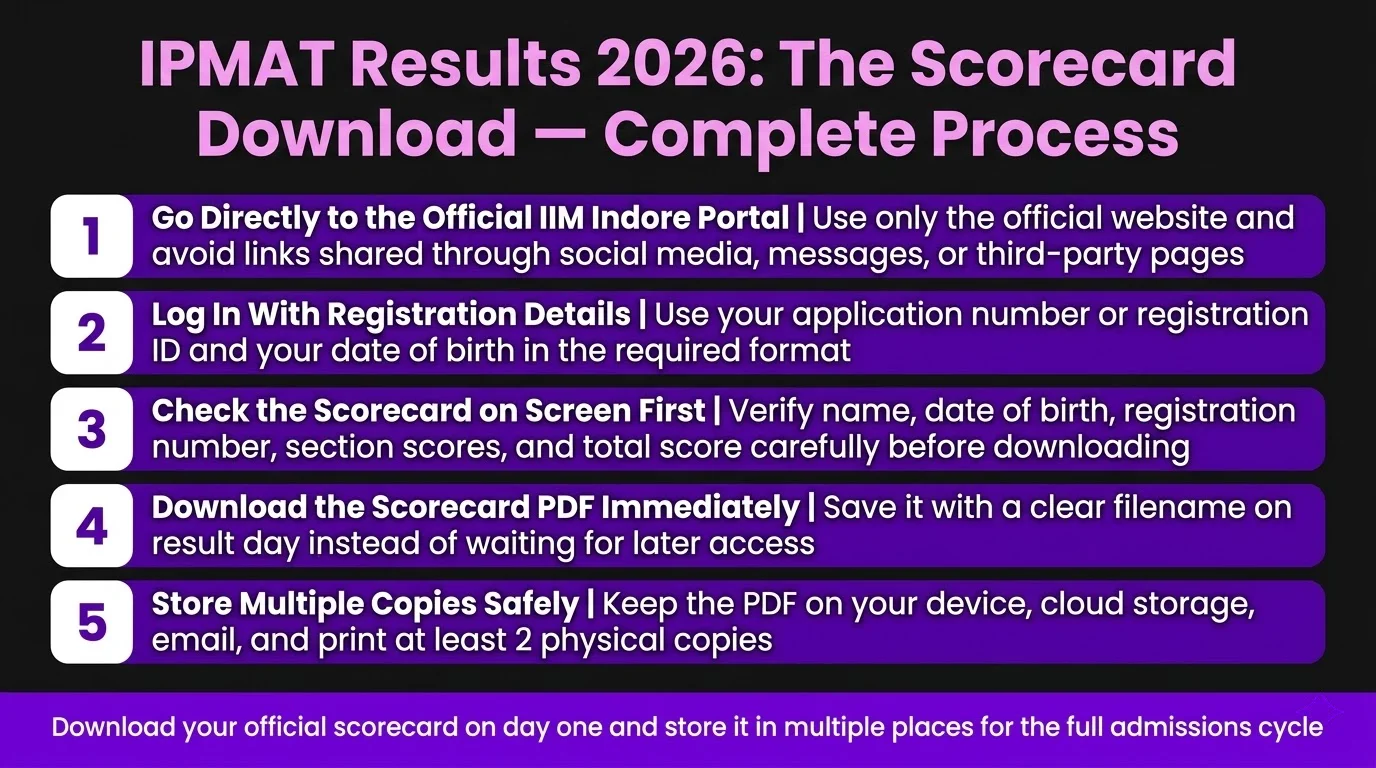
Step 1: Navigate directly to the official portal
Open www.iimidr.ac.in directly. On results day, the homepage or the Admissions section will carry a specific link for the IPMAT 2026 results. Do not use links shared on WhatsApp, social media, or forwarded emails — they may point to third-party sites or phishing pages designed to capture login credentials.
Step 2: Log in with registration credentials
The results portal requires authentication. You will need:
- Your application number or registration ID (issued at the time of registration)
- Your date of birth in the format specified on the portal
If you have misplaced your application number, check: the confirmation email from IIM Indore sent at registration, the registration confirmation PDF you downloaded, and the SMS (if sent to your registered mobile number). If none of these are recoverable, contact IIM Indore admissions with your full name, registered email, and date of birth to retrieve your application details before results day.
Step 3: Access and review the scorecard on screen
After logging in, your scorecard will display on screen. Before downloading, review every field:
- Full name: Must match your Class 10 and 12 certificates exactly
- Date of birth: Must match board documents
- Registration number: Record this for all future correspondence
- Section scores: QA MCQ, QA Short Answer, VA MCQ — individually
- Total score: Sum of the 3 section scores
- Percentile or rank: Some scorecard formats include a merit rank or percentile indicator
If any personal detail — name, date of birth — is incorrect on the scorecard, contact IIM Indore’s admissions office immediately. Do not wait until the PI stage.
Step 4: Download the scorecard as a PDF
Most portals provide a “Download Scorecard” or “Print” button that generates a PDF. Click this and save the PDF with a clear filename — for example, “IPMAT_2026_Scorecard_[Your Name].pdf.”
Why to download immediately: IIM Indore’s portal remains active through the admissions cycle but may be archived after a period. Students who do not download their scorecard on results day occasionally find the portal inaccessible months later when they need the document for a counselling process or college application. Download on day one.
Step 5: Save multiple copies
Save the scorecard PDF in at least 3 locations:
- On your primary device
- On a cloud storage service (Google Drive, Dropbox, iCloud)
- As an email attachment to yourself (so it is permanently accessible from your inbox)
Print 2 physical copies. The original scorecard is required at document verification, PI, and in some cases at final admission. Physical copies are backup for situations where digital access fails.
Reading Your IPMAT Results Scorecard: What Every Number Means
The IPMAT results scorecard contains 4 numbers that matter — not just one. Here is how to read each of them.
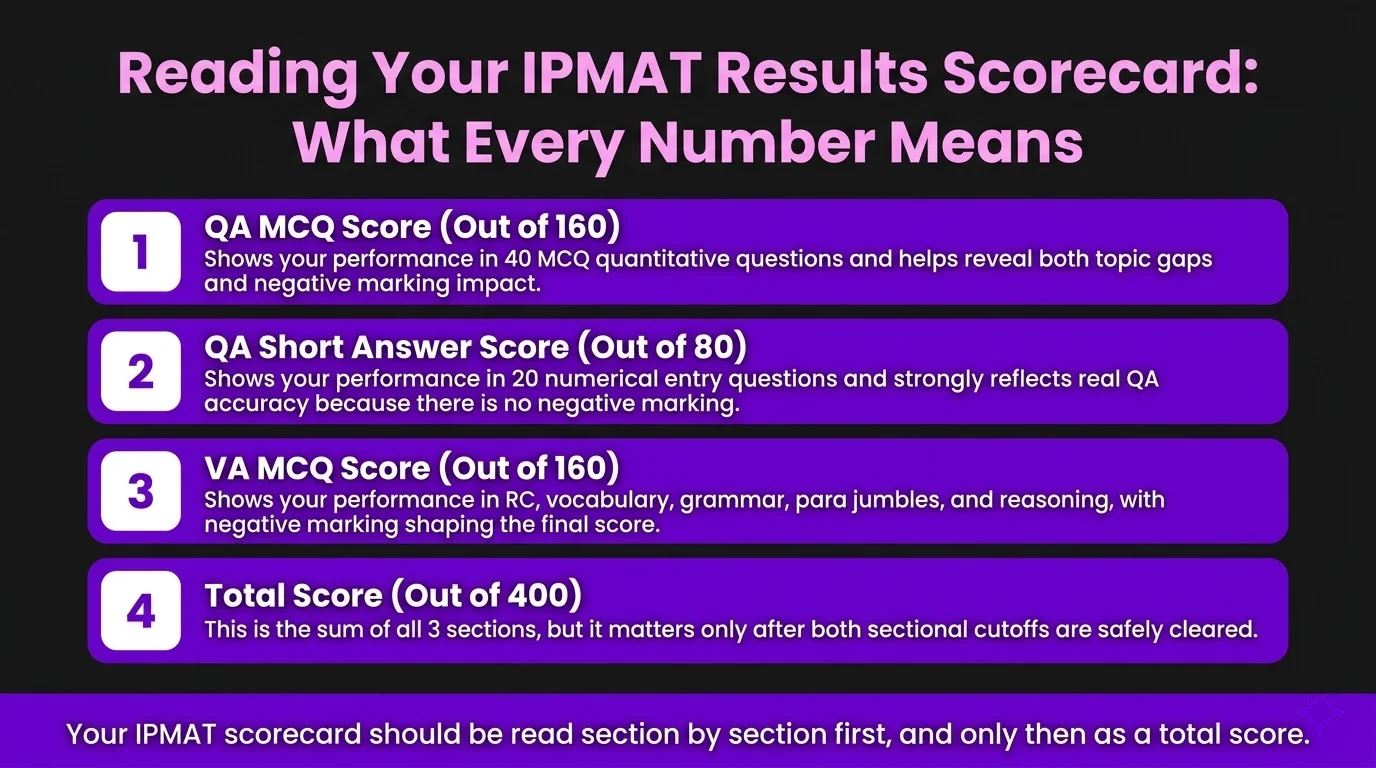
Number 1: QA MCQ Score (out of 160)
This reflects your performance in the first section — 40 multiple-choice quantitative questions with +4/−1 marking. The raw score is: (correct answers × 4) − (wrong answers × 1). Unattempted questions contribute 0.
How to analyse your QA MCQ score:
- A score above 80 (50% of maximum) typically indicates solid QA preparation
- A score between 60–80 suggests adequate preparation with room for improvement in specific topics
- A score below 60 indicates either conceptual gaps in major topics (arithmetic, algebra) or excessive negative marking from over-attempting uncertain questions
Self-reconstruction after results: If you kept notes on your exam-day experience, reconstruct the approximate number of questions you attempted and the proportion you were confident about. This reconstruction gives you a rough accuracy estimate — which tells you whether a low QA MCQ score reflects wrong approaches (content gap) or correct approaches with errors (speed/carefulness gap).
Number 2: QA Short Answer Score (out of 80)
This reflects your performance in the second section — 20 numerical entry questions with +4/0 marking. Every attempted question either earns +4 or 0; nothing is deducted.
How to analyse your QA Short Answer score: The Short Answer score is a near-pure indicator of QA preparation quality — unblemished by negative marking risk. A student who scored 48/80 attempted 12 questions correctly and either got 8 wrong or left 8 unattempted.
The critical diagnostic question: Did you attempt all 20 questions? If not — if you left Short Answer questions blank — your score understates your actual QA ability. Even partially-reasoned attempts in a no-negative-marking section have positive expected value. Unattempted Short Answer questions are marks left on the table, not questions wisely avoided.
Number 3: VA MCQ Score (out of 160)
This reflects your performance in the third section — 40 multiple-choice verbal questions with +4/−1 marking. RC, vocabulary, grammar, para jumbles, and critical reasoning all feed into this single score.
How to analyse your VA score: The VA score is the most diagnostic of preparation balance. A very high QA combined score with a low VA score is not just a sectional weakness — it is a PI shortlist disqualifier if VA falls below the sectional cutoff. Conversely, a high VA score with moderate QA usually indicates a student from an Arts or Commerce background who built strong VA habits but needs more QA practice.
Negative marking in VA: Unlike QA Short Answer, all VA errors carry the −1 penalty. A VA score of 64 could reflect: 20 correct (80) −16 wrong (−16) = 64. Or 18 correct (72) −8 wrong (−8) = 64. The same score reached through different attempt profiles requires different remediation in a future preparation cycle.
Number 4: Total Score (out of 400)
The sum of all 3 section scores. This is the number that gets benchmarked against the overall score threshold for PI shortlisting — but only after both sectional cutoffs are independently cleared.
The key relationship between total score and cutoff: A high total score with a sectional failure is worth less for shortlisting than a moderate total score with both sectional cutoffs cleared. The IPMAT results ranking is not a simple aggregate — the cutoff structure makes it a constrained optimisation. Your total score matters for shortlisting only within the universe of students who cleared both sectional cutoffs.
IPMAT Results 2026: Cutoff Analysis — Where Does Your Score Stand?
The most important analytical task after downloading your IPMAT results scorecard is assessing where your score sits relative to the cutoff — section by section and in total.
Step 1: Check QA Sectional Cutoff Clearance
Add your QA MCQ score and QA Short Answer score. Based on historical patterns for the General category, the QA sectional cutoff has ranged between approximately 52–78 out of 240.
| Your QA Combined Score | Likely Position |
| Above 90 | Comfortably cleared — strong QA performance |
| 70–90 | Cleared with margin — solid QA standing |
| 52–70 | Within historical cutoff range — borderline, depends on 2026 paper difficulty |
| Below 52 | At risk of missing QA cutoff — outcome depends on actual 2026 threshold |
Step 2: Check VA Sectional Cutoff Clearance
Based on historical patterns for the General category, the VA sectional cutoff has ranged between approximately 48–70 out of 160.
| Your VA Score | Likely Position |
| Above 80 | Comfortably cleared — strong VA performance |
| 60–80 | Cleared with margin — good VA standing |
| 48–60 | Within historical cutoff range — borderline |
| Below 48 | At risk of missing VA cutoff |
Step 3: Check Total Score Against Overall Threshold
If both sectional benchmarks appear cleared, assess your total against the historical overall shortlist threshold. Based on 2023, 2024, and 2025 patterns, General category PI shortlists have formed at approximately 190–235 total.
| Your Total Score | Estimated PI Shortlist Probability (General Category) |
| 260 and above | High — comfortably above historical threshold range |
| 230–260 | Good — within strong shortlist zone |
| 200–230 | Moderate — in the competitive borderline zone |
| 175–200 | Lower — depends heavily on 2026 paper difficulty and pool performance |
| Below 175 | Unlikely for General category — but verify after actual 2026 cutoffs are announced |
The critical caveat on all benchmarks: These ranges are based on 2023–2025 patterns. The actual 2026 IPMAT results cutoff depends on the 2026 paper’s difficulty and the applicant pool’s score distribution — variables that are unknowable before the results are declared. A score that looks borderline against historical benchmarks may be comfortably above the 2026 actual cutoff if the paper was harder than usual. A score that looks strong may be closer to the margin if the paper was unusually accessible.
Wait for the actual PI shortlist announcement before drawing definitive conclusions from your total score.
IPMAT Results 2026: Category-Wise Cutoff Analysis
For students in reserved categories, the cutoff analysis follows the same structure with different thresholds. Here is the category-wise framework.
OBC-NCL Category
Based on historical patterns, OBC-NCL cutoffs have been approximately 80–90% of General category thresholds.
| Measure | Estimated OBC-NCL Range |
| QA sectional cutoff | 42–64 out of 240 |
| VA sectional cutoff | 38–58 out of 160 |
| Overall shortlist threshold | 160–200 out of 400 |
EWS Category
EWS cutoffs have historically been broadly comparable to OBC-NCL cutoffs.
| Measure | Estimated EWS Range |
| QA sectional cutoff | 42–64 out of 240 |
| VA sectional cutoff | 38–58 out of 160 |
| Overall shortlist threshold | 160–200 out of 400 |
SC Category
SC cutoffs reflect the academic eligibility relaxation and age limit relaxation applicable to this category.
| Measure | Estimated SC Range |
| QA sectional cutoff | 28–50 out of 240 |
| VA sectional cutoff | 24–44 out of 160 |
| Overall shortlist threshold | 105–150 out of 400 |
ST Category
ST cutoffs are typically the most relaxed among all reserved categories.
| Measure | Estimated ST Range |
| QA sectional cutoff | 22–40 out of 240 |
| VA sectional cutoff | 20–36 out of 160 |
| Overall shortlist threshold | 88–125 out of 400 |
PwD Category
PwD cutoffs have historically aligned closely with ST category cutoffs.
| Measure | Estimated PwD Range |
| QA sectional cutoff | 22–40 out of 240 |
| VA sectional cutoff | 20–36 out of 160 |
| Overall shortlist threshold | 88–125 out of 400 |
Important note on category-wise cutoffs: These figures are compiled from student-reported data and post-result analysis — IIM Indore does not officially publish cutoff figures after each cycle. Treat them as directional estimates, not authoritative thresholds. The actual 2026 cutoffs will only be known after IIM Indore announces them in the context of the PI shortlist.
IPMAT Results and Score Percentile: Understanding Your Relative Position
Beyond the absolute cutoff, understanding where your score sits in the overall distribution of the applicant pool gives a more complete picture of your position.
With over 40,000 registered candidates and a paper that distributes scores across a range, the percentile equivalent of various scores provides useful context.
Approximate score-to-percentile mapping (General category, based on historical patterns):
| Score Range | Estimated Percentile | Context |
| 300+ | 99th percentile and above | Top 400 students in the pool |
| 260–300 | 97th–99th percentile | Strong shortlist territory |
| 230–260 | 94th–97th percentile | Competitive shortlist zone |
| 200–230 | 88th–94th percentile | Borderline shortlist zone |
| 175–200 | 80th–88th percentile | Below typical shortlist threshold |
| Below 175 | Below 80th percentile | Below shortlist range for General category |
Why percentile matters more than absolute score for year-to-year comparison: A score of 240 in 2024 and a score of 240 in 2026 may represent different relative performances — if the 2026 paper was harder and 240 represents the 96th percentile rather than the 93rd. The percentile captures your performance relative to the pool, which is ultimately what determines shortlisting.
Since IIM Indore selects approximately 400–600 students for PI from 40,000+ candidates, the shortlist captures roughly the top 1–1.5% of the scored pool — corresponding to approximately the 98.5th–99th percentile range and above.
Using Your IPMAT Results for Multi-Exam Strategy
Students who appeared for multiple IPM entrance exams receive IPMAT results, IPM-AT results, and JIPMAT results on independent timelines. Here is how to use each result strategically.
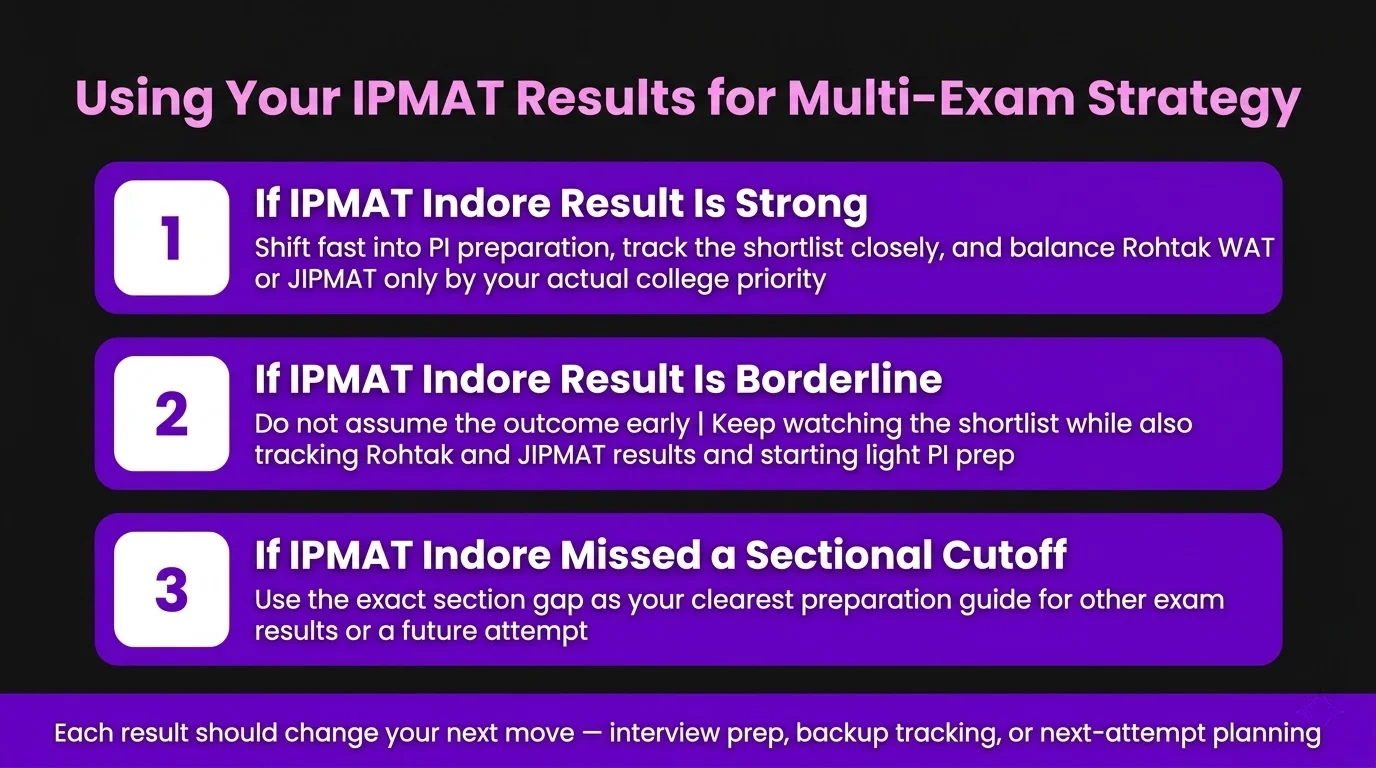
If IPMAT Indore Result Is Strong (Likely Shortlisted)
Prioritise PI preparation for IIM Indore immediately. Monitor the shortlist announcement daily. Begin WAT preparation if you received an IPM-AT shortlist call from IIM Rohtak simultaneously — WAT is a unique post-exam stage that IIM Indore’s process does not include.
If JIPMAT results are still pending and your IPMAT Indore position is strong, JIPMAT preparation remains relevant — but its priority relative to PI preparation depends on your institution preference. Most students who receive a strong IIM Indore IPMAT result and a JIPMAT result prioritise the IIM Indore PI.
If IPMAT Indore Result Is Borderline (Uncertain Shortlist)
Do not assume a verdict before the PI shortlist is announced. Historical cutoff ranges are estimates — the actual 2026 threshold may be lower if the paper was harder. Continue monitoring the IIM Indore portal for the shortlist announcement. Simultaneously, track IIM Rohtak and JIPMAT results — a stronger performance in one of the other exams may produce a shortlist call even if IIM Indore does not.
Begin light PI preparation during this uncertainty window. If a shortlist call arrives, having 2–3 weeks of preliminary PI preparation in place is significantly better than starting from zero.
If IPMAT Indore Result Missed a Sectional Cutoff
This is the most clearly defined outcome — and the one that produces the most precise preparation direction for a future attempt.
The missed sectional score tells you exactly where the next preparation cycle must focus. A VA score of 40 when the estimated VA cutoff is 52 for General category is a gap of 12 marks — approximately 3 additional correct VA answers. This is specific, actionable, and achievable with the right preparation focus.
Check the JIPMAT result separately — its cutoffs are independent and a missed IPMAT Indore VA cutoff does not determine JIPMAT outcome.
If age eligibility permits a second attempt, the IPMAT results from this year are the most valuable possible preparation data for 2027. No mock test, no practice paper, and no coaching material gives a more accurate picture of preparation gaps than an actual IPMAT result from the real exam.
IPMAT Results 2026: What to Do in the First 24 Hours
The 24 hours following IPMAT results declaration are the most time-compressed action window in the entire admissions cycle. Here is the exact sequence.
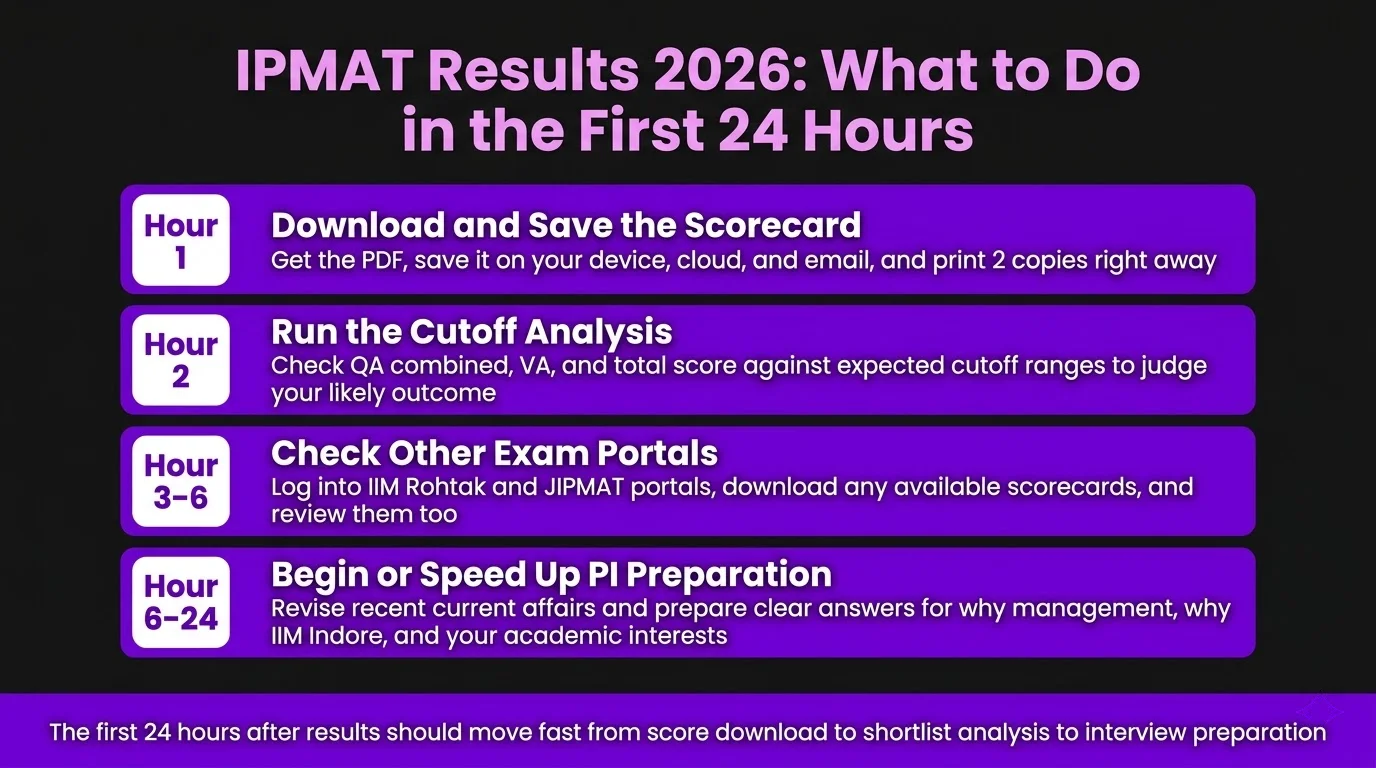
Hour 1: Download and save the scorecard Access the portal. Download the PDF. Save to device, cloud, and email. Print 2 copies. This takes 10 minutes. Do it before anything else.
Hour 2: Run the cutoff analysis Apply the framework from this article — QA combined vs. QA estimated cutoff, VA vs. VA estimated cutoff, total vs. overall estimated threshold. Identify your most likely outcome: strong shortlist, borderline, or missed sectional cutoff.
Hour 3–6: Check other exam portals Log into IIM Rohtak’s portal and NTA’s JIPMAT portal. Check whether results for those exams have also been declared. If yes, download and analyse those scorecards using the same framework. If no, set calendar reminders to check daily.
Hour 6–24: Begin or accelerate PI preparation If your cutoff analysis suggests strong or borderline shortlist probability, begin PI preparation immediately. Review current affairs from the past 3 months. Write down your answers to the core PI questions — why management, why IIM Indore, what career do you want, what was your most intellectually challenging subject in school. These are not trick questions — but students who answer them unprepared give noticeably weaker PI responses than students who have thought carefully about the answers in advance.
According to IIM Indore’s official programme documentation, the PI stage contributes meaningfully to the final merit list — making post-result PI preparation not optional but essential for any student in or near the shortlist zone.
IPMAT Results for JIPMAT and IIM Rohtak: Independent Analysis
JIPMAT Results 2026
JIPMAT results are published on NTA’s official website, typically in July 2026 — 3–5 weeks after the JIPMAT exam date. The JIPMAT result scorecard shows QA, DILR, and VA section scores separately. The JIPMAT selection process uses a centralised counselling model — qualifying the written exam places you in a merit ranking used for seat allocation across IIM Jammu and IIM Bodhgaya through counselling rounds.
The JIPMAT cutoff functions differently from IIM Indore’s — rather than a fixed PI shortlist threshold, it is the minimum score required to participate in counselling. Most students who appear for JIPMAT and obtain a reasonable score qualify for counselling — the competitive differentiation happens within counselling through merit ranking and seat availability.
IIM Rohtak IPM-AT Results 2026
IPM-AT results are published on IIM Rohtak’s official portal. The scorecard shows QA, LR, and VA scores separately plus a total out of 480. IIM Rohtak applies independent sectional cutoffs for all 3 sections — LR cutoff clearance is an additional requirement compared to IIM Indore’s 2-section cutoff structure. Students who clear all 3 sectional cutoffs and the overall threshold are shortlisted for WAT and PI.
Making Sense of IPMAT Results: The Bigger Picture
The IPMAT results — whatever they show — are a single data point in a longer trajectory. Here is the perspective that helps students use results constructively rather than reacting to them impulsively.
A strong result does not guarantee a seat. The PI remains and it is consequential — approximately 400–600 students are shortlisted for PI and only ~150 earn final admission. A student with a 270 total who enters the PI underprepared can be displaced by a student with a 235 total who walks in with genuine self-awareness, current affairs knowledge, and clear articulation of their goals.
A missed sectional cutoff does not permanently close the IIM IPM path. Students who are still within age eligibility have a precisely calibrated preparation target for the next cycle. The section that missed the cutoff — and the specific margin of that miss — is the most accurate preparation diagnosis available.
A borderline total score does not determine the outcome. The PI shortlist announcement — not the self-analysis performed immediately after results — is the authoritative statement on shortlist status. Students who conclude they did not make the shortlist based on their own cutoff calculation before the shortlist is published sometimes discover they were wrong.
The preparation that earned the result — or that will earn the next result — begins with structured mock test practice that accurately simulates the real exam. The Phodu Club IPMAT Test Series provides full-length mock tests calibrated to actual IPMAT difficulty, with the section-wise performance analytics that track preparation progress and predict result performance accurately before exam day. Students who enter results day having practiced on correctly calibrated full-length tests rarely find their actual result surprising — because their preparation built an accurate forecast of where they would stand.
Conclusion
The IPMAT results 2026 will be declared 3–5 weeks after the exam — in June–July 2026. The scorecard, available for download from the official IIM Indore portal, shows 4 numbers that matter: QA MCQ score, QA Short Answer score, VA MCQ score, and total score. Each number must be read against its own benchmark — the QA and VA sectional cutoffs that both must be cleared independently, and the overall threshold that must be reached simultaneously.
A score of 250 with 170 in QA and 80 in VA is a different result from a score of 250 with 145 in QA and 105 in VA — because the sectional cutoff structure gives different shortlist probabilities to the same total depending on how the marks are distributed.
Read every number. Run the cutoff analysis section by section. Download the scorecard immediately. Check all 3 exam portals within the first 24 hours. And begin PI preparation the same day — because the gap between results day and PI shortlist announcement is 1–2 weeks, and the gap between shortlist and PI is 2–3 more. The students who use every day of that window are the ones who convert their written exam performance into a final merit list placement.
Frequently Asked Questions (FAQ)
1) When will IPMAT results 2026 be declared?
IPMAT results 2026 are expected 3–5 weeks after the exam date — placing the result declaration in June–July 2026 based on historical patterns. The provisional answer key is released within 5–7 days of the exam; the final result follows approximately 2–3 weeks later. Monitor the official IIM Indore website for the confirmed result date.
2) How do I download the IPMAT 2026 scorecard?
Log into the official IIM Indore portal using your application number and date of birth. Navigate to the IPMAT 2026 results section, review your scorecard on screen, and download the PDF. Save copies to your device, cloud storage, and email. Print 2 physical copies for document verification.
3) What does the IPMAT results scorecard show?
The IPMAT results scorecard shows your QA MCQ score (out of 160), QA Short Answer score (out of 80), VA MCQ score (out of 160), and total score (out of 400). It also shows your personal details as registered — verify these match your board documents exactly.
4) What is a good IPMAT results score for PI shortlisting in 2026?
Based on 2023–2025 patterns, General category students with total scores of 230+ who have cleared both sectional cutoffs (QA approximately 52–78, VA approximately 48–70) are in the competitive shortlist zone. Scores above 260 represent strong shortlist probability. Actual 2026 cutoffs will only be known after IIM Indore announces them with the PI shortlist.
5) What if my IPMAT results show I missed the VA sectional cutoff?
A missed VA sectional cutoff means no PI shortlist for IPMAT Indore 2026 regardless of total score. Check JIPMAT and IIM Rohtak results separately — they have independent cutoffs. For a future IPMAT attempt, the VA miss is a precise preparation target — the specific marks gap identifies the daily reading, vocabulary, and RC practice required in the next preparation cycle.
6) How long after IPMAT results is the PI shortlist announced?
The PI shortlist is typically announced 1–2 weeks after IPMAT results declaration. Monitor the IIM Indore portal daily from results day onwards. Begin PI preparation immediately after results — do not wait for the shortlist to start.
7) Are IPMAT results the same as the PI shortlist?
No. IPMAT results show your exam scores. The PI shortlist — announced 1–2 weeks later — is the list of students who cleared both sectional cutoffs and the overall threshold, qualifying them for the Personal Interview. Results and shortlist are two separate announcements.
8) Where are the JIPMAT results 2026 published?
JIPMAT results are published on NTA’s official website, typically in July 2026 — approximately 3–5 weeks after the JIPMAT exam. The JIPMAT result uses a centralised counselling model rather than a PI process.
9) Can I challenge my IPMAT results score?
The IPMAT results score itself cannot be formally challenged after declaration — the challenge window applies to the provisional answer key, which is released before the results. If you believe your score is incorrect, contact IIM Indore’s admissions office with your specific concern and transaction reference.
10) How do I prepare for the PI after seeing my IPMAT results?
Begin immediately — do not wait for the shortlist. Review current affairs from the past 3–4 months, write and practise answers to core PI questions (why management, why IIM Indore, career goals), and arrange mock interviews with teachers, mentors, or peers. The Phodu Club IPMAT Test Series builds the written exam performance that earns the result worth celebrating — and the result worth taking into a PI shortlist with confidence.