There is no single preparation resource more honest about what the IPMAT exam actually tests than its own previous year papers. Every IPMAT PYQ — from 2019 through 2025 — is a direct window into IIM Indore’s question style, topic weightage, difficulty calibration, and the specific type of reasoning the exam rewards. Yet most students treat previous year papers as something to attempt in the final 2 weeks, after the syllabus is “done.” This is backwards. IPMAT PYQs should be the starting point of preparation — used to understand what you are preparing for — and the ending point, used to test whether you are actually ready. This guide covers how to find, use, and extract maximum value from IPMAT PYQs from 2019 to 2025, what patterns the papers reveal, how to approach QA and VA questions strategically, and how to use PYQ analysis to guide every revision decision.
Why IPMAT PYQs Are the Most Valuable Preparation Resource Available
Most students preparing for the IPMAT exam spend months working through textbooks, topic-wise exercise sets, and coaching material — without ever sitting down with an actual past paper until the exam is 3 weeks away. This sequence is a mistake, and understanding why reveals the correct way to use IPMAT PYQs.
Here is the problem. Coaching material and topic-wise practice are designed to build skills in isolation. A chapter on percentages has 50 percentage problems. A chapter on reading comprehension has 10 passages. All the problems in each chapter are the same type, drawn from the same topic, with no time pressure and no switching between subjects.
The IPMAT exam is nothing like this. It gives you 40 QA MCQ questions in 40 minutes — questions that span arithmetic, algebra, number theory, geometry, and modern mathematics, in unpredictable order, at varying difficulty levels, with a negative marking system that punishes guessing. A student who has only practiced in topic-isolated, untimed conditions has never actually experienced the cognitive demand of the real exam.
IPMAT PYQs fix this. They show you the actual question style — how arithmetic problems are framed as word problems, how algebra combines 2 sub-topics in a single question, how RC passages are structured differently from school comprehension exercises. They calibrate your understanding of what “difficulty” means in the IPMAT context. And they reveal — often uncomfortably — the gap between what you know in theory and what you can execute under pressure.
According to research published by the American Psychological Association, retrieval practice — the act of testing yourself on material under conditions that resemble the actual assessment — produces significantly stronger learning outcomes than re-reading or topic-wise revision alone. IPMAT PYQs are the most authentic retrieval practice tool available for this exam.
What 7 Years of IPMAT PYQs Reveal: Pattern Analysis (2019–2025)
Solving every available IPMAT PYQ from 2019 through 2025 produces a remarkably consistent picture of what the exam tests, how it is structured, and which topics carry the most weight year after year.
| IPMAT PYQs | Link |
| IPMAT PYQ 2025 | Coming Soon |
| IPMAT PYQ 2024 | Coming Soon |
| IPMAT PYQ 2023 | Coming Soon |
| IPMAT PYQ 2022 | Coming Soon |
| IPMAT PYQ 2021 | Coming Soon |
| IPMAT PYQ 2020 | Coming Soon |
| IPMAT PYQ 2019 | Coming Soon |
How to Use IPMAT PYQs Strategically: A Phased Approach
IPMAT PYQs are most valuable when they are used systematically — not all at once, not at random, and not as a panic measure in the final 2 weeks. Here is the phased approach that produces the best results.
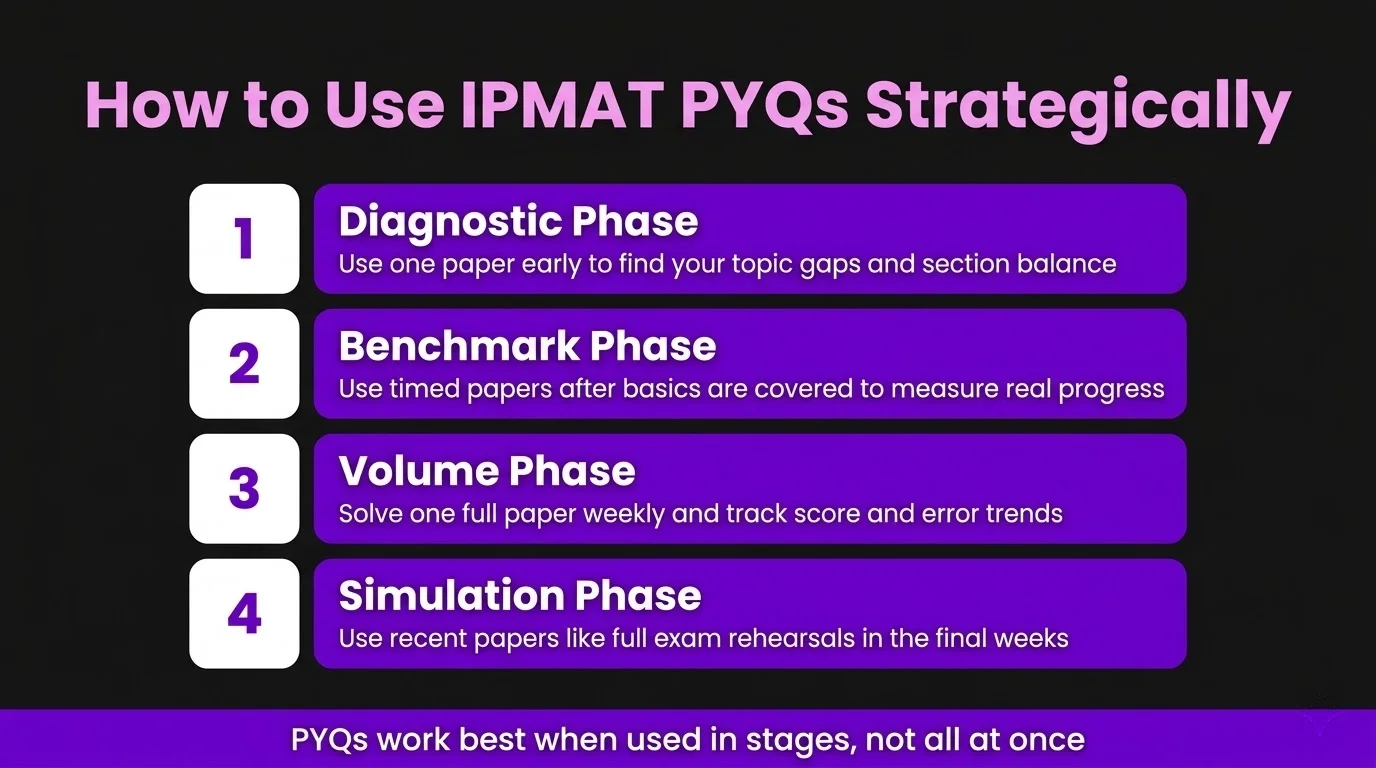
Phase 1: Diagnostic Use (Month 1 of Preparation)
Before building your preparation plan, use 1–2 IPMAT PYQs as a diagnostic tool.
How to do this: Take a full-length IPMAT PYQ from 2022 or 2023 untimed. Do not worry about speed. Work through every question honestly — attempt what you can, note what you cannot attempt, and flag questions that feel familiar but that you cannot solve completely.
What to look for: After completing the diagnostic PYQ, you should be able to answer:
- Which QA topics produced the most wrong or unattempted answers?
- How did your VA performance compare across RC, vocabulary, and grammar?
- What was the ratio of “I knew how to approach this” to “I had no idea where to start”?
This diagnostic information — not intuition, but data from actual IPMAT PYQ exposure — becomes the foundation of your topic priority map. Students who begin preparation without this diagnostic step often prioritise the wrong topics because they overestimate competence in familiar areas and underestimate gaps in unfamiliar ones.
Phase 2: Benchmark Use (Months 2–3 of Preparation)
After completing your foundational topic coverage in arithmetic, algebra, and VA basics, use an IPMAT PYQ under timed conditions for the first time.
How to do this: Attempt a full-length IPMAT PYQ from a different year than your diagnostic — strictly timed, 40 minutes per section, no extensions.
What to look for: Your score matters less than what drives it. After the timed attempt:
- Count questions where your approach was correct but calculation was wrong
- Count questions where you knew the topic but misread the question
- Count questions where you had no approach at all
- Note which sections you ran out of time on
These 3 error categories — wrong execution, misreading, no approach — require completely different remediation. Categorising your errors from IPMAT PYQs at this stage directs your Month 3–4 preparation with surgical precision.
Phase 3: Volume Use (Months 4–5 of Preparation)
By Month 4, your preparation has covered the full IPMAT exam syllabus across both QA and VA. Now use IPMAT PYQs as timed volume practice — not just for analysis, but to build the exam-taking stamina and speed that only comes from repetition under real conditions.
How to do this: Attempt 1 full IPMAT PYQ per week at this stage, strictly timed. After each attempt, spend 90 minutes in structured analysis — wrong answers categorised and connected to specific revision actions.
What to look for: Score trends across 4–5 timed IPMAT PYQ attempts. If your score is improving, continue current preparation. If it has plateaued across 3 consecutive papers, the issue is not effort — it is the analysis. Return to your error log and check whether you are actually revising the topics your errors are pointing to, or whether you are continuing to practice the topics you are already strong in.
Phase 4: Simulation Use (Month 6 — Final Preparation)
In the final 4–6 weeks before the exam, use the most recent available IPMAT PYQs — 2024, 2025 — as close-to-exam simulations.
How to do this: Attempt these papers at the exact time of day as the actual IPMAT exam. Same start time, same desk, same environment. No phone. No interruptions. Strictly 120 minutes. This is not just practice — it is neurological calibration. Training your cognitive performance to peak at the exam’s scheduled time is a real and measurable benefit.
What to look for: At this stage, the goal is not diagnosis — it is confirmation. You want to confirm that your speed per section is within target, your accuracy is above your personal benchmark, and your exam-time decision-making (when to attempt, when to skip, when to eliminate and guess) is functioning as trained.
Topic-Wise Analysis of IPMAT PYQs: What Each Year’s Paper Emphasised
Here is a year-by-year summary of notable patterns in IPMAT PYQs, which helps students understand how the exam has evolved and what consistency exists across papers.
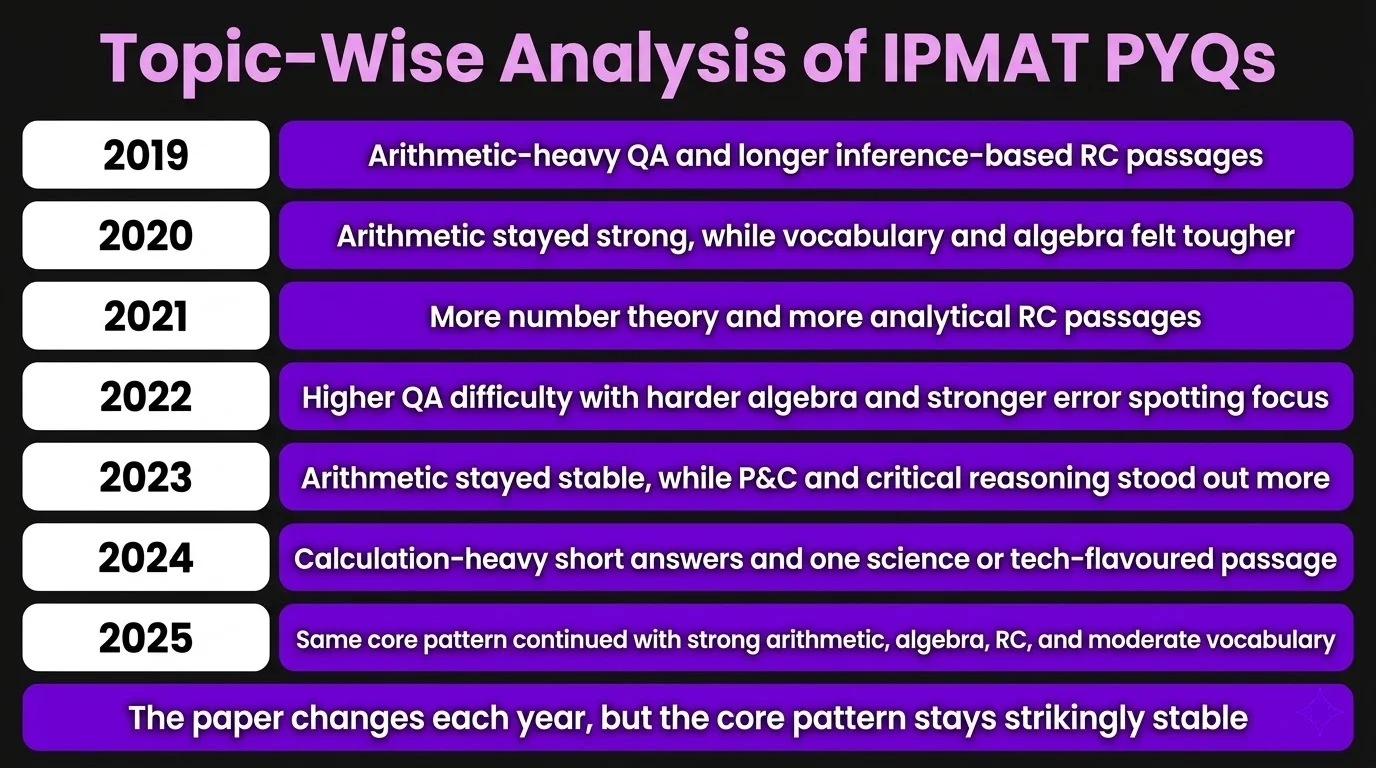
IPMAT 2019: The first widely analysed paper in the modern IPMAT format. QA was heavily arithmetic-weighted. VA introduced longer RC passages with more inference-heavy questions than many students expected. Para jumbles appeared with 5-sentence structures. Overall difficulty: moderate.
IPMAT 2020: Conducted in an unusual format due to the pandemic disruption. Some question types shifted in presentation. Arithmetic remained dominant in QA. Vocabulary questions were notably more challenging than 2019. Algebra combined sub-topics more aggressively than the previous year.
IPMAT 2021: The exam returned to a more standard format. QA saw a higher proportion of number theory questions than previous years — remainders and cyclicity questions appeared with increased frequency. RC passages in VA were longer and more analytical. Para completion questions appeared for the first time with notable frequency.
IPMAT 2022: QA difficulty increased overall. Algebra and inequalities questions were more complex, with several requiring 3-step reasoning. VA difficulty in RC remained high, with vocabulary-in-context questions requiring precise meaning discrimination. Grammar questions focused heavily on error spotting.
IPMAT 2023: Arithmetic difficulty moderated relative to 2022. P&C questions were notably tricky — involving circular arrangements with multiple restrictions. VA continued with 2–3 RC passages. A higher proportion of critical reasoning questions appeared compared to previous IPMAT PYQs.
IPMAT 2024: Based on student-reported feedback, QA maintained the arithmetic-algebra dominance pattern from previous years. Short Answer section questions were calculation-heavy. VA introduced one passage on a scientific or technology-related topic — a slight shift from the predominantly social science passages of earlier years.
IPMAT 2025: The most recent IPMAT paper. Continued the established pattern with strong arithmetic-algebra weightage. The VA section maintained RC as the dominant component. Vocabulary question difficulty was moderate. Students who had worked through previous IPMAT PYQs reported high pattern familiarity with question structure and approach requirements.
The consistent conclusion across all IPMAT PYQs from 2019–2025: Arithmetic and algebra together constitute the majority of QA marks in every paper. RC and vocabulary constitute the majority of VA marks in every paper. Every other topic is important but secondary to these 4 pillars. Any student whose preparation is not anchored in these 4 areas is structurally underprepared regardless of how many IPMAT PYQs they attempt.
Solving IPMAT PYQs: Common Student Mistakes and How to Avoid Them
Most students who attempt IPMAT PYQs make the same set of mistakes — mistakes that limit the value they extract from one of the most useful preparation resources available.
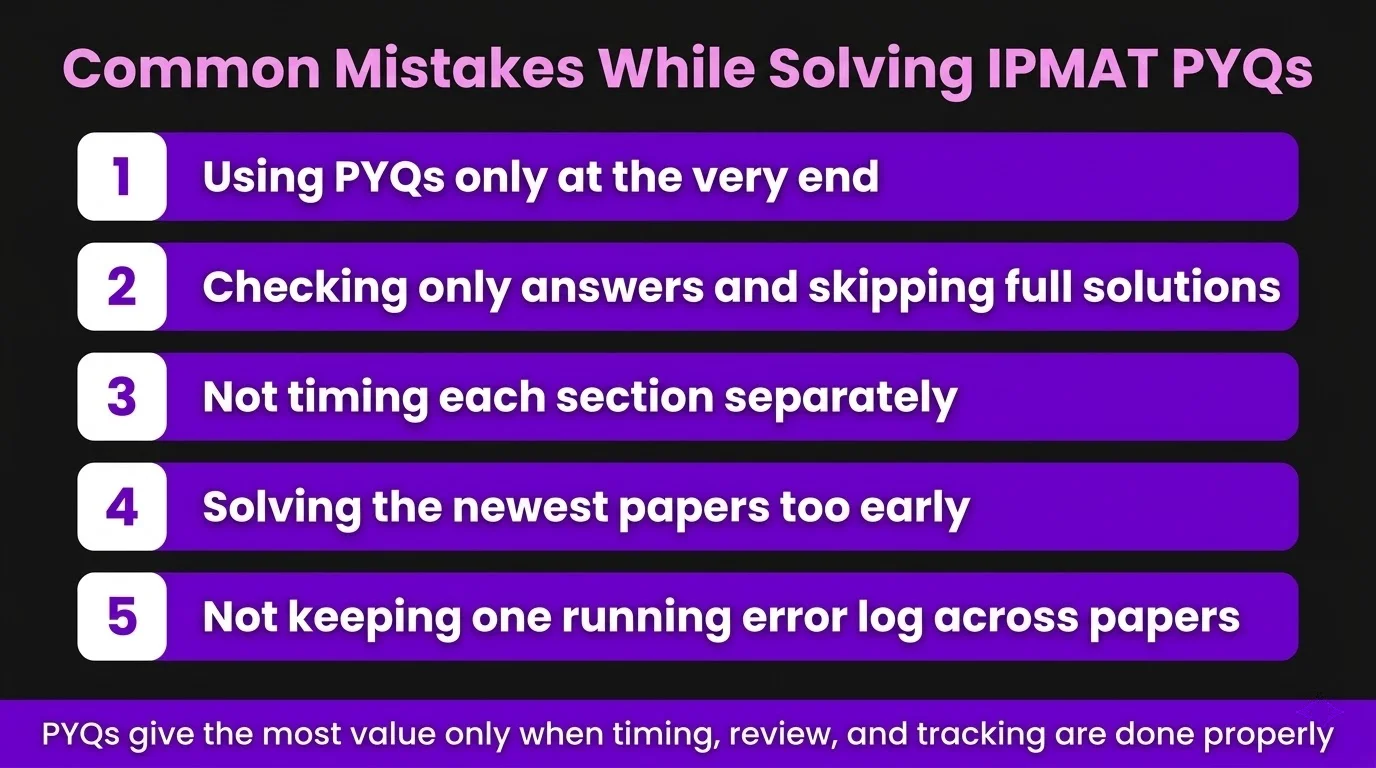
Mistake 1: Attempting PYQs without completing foundational preparation A student who attempts an IPMAT PYQ in Month 1 without any preparation, gets a low score, feels discouraged, and concludes that the exam is beyond their level. This conclusion is wrong — it reflects the starting position, not the ceiling. IPMAT PYQs used as diagnostic tools in Month 1 are valuable. IPMAT PYQs used as performance benchmarks before foundational preparation is complete are demoralising and misleading.
Use the first IPMAT PYQ as a diagnostic — to understand the exam, not to judge your readiness.
Mistake 2: Checking only the answer, not the solution method The answer key tells you whether you were right or wrong. The solution tells you whether your approach was right or wrong. These are different. A student who gets the correct answer through an inefficient method — spending 4 minutes on a problem that an optimal approach solves in 90 seconds — has identified an efficiency gap that the answer key alone does not reveal.
After every IPMAT PYQ, review the solution method for every question — not just the ones you got wrong.
Mistake 3: Not timing sections independently Students who attempt IPMAT PYQs with a single 120-minute timer — rather than independent 40-minute timers for each section — get an inflated sense of their performance. In the actual exam, each section closes independently. A student who is slow in QA MCQ cannot compensate by being fast in VA. The section-independent timer must be practised in every IPMAT PYQ attempt, without exception.
Mistake 4: Attempting the most recent PYQ first The most recent IPMAT PYQ should be saved for the final simulation phase of preparation — not attempted early when it has maximum diagnostic value that has not yet been built into preparation. Use papers from 2019–2022 for early practice and save 2024–2025 for final simulation.
Mistake 5: Not maintaining an error log across multiple PYQ attempts Students who attempt IPMAT PYQs without recording their errors across papers lose the cumulative diagnostic value that makes PYQs powerful. A student who makes the same percentage error in 3 consecutive IPMAT PYQs but does not record and track this across papers may not notice the persistent pattern until the actual exam.
Maintain a single running error log across all IPMAT PYQ attempts. Update it after every paper. This log — over 10–15 papers — becomes the most accurate picture of your persistent gaps and is worth more than any single paper’s score.
How to Build a QA Solution Approach from IPMAT PYQs
One of the most practical outputs of working through IPMAT PYQs is developing a reliable, consistent approach to common question types. Here is how to build that approach across the most frequently appearing QA topics.
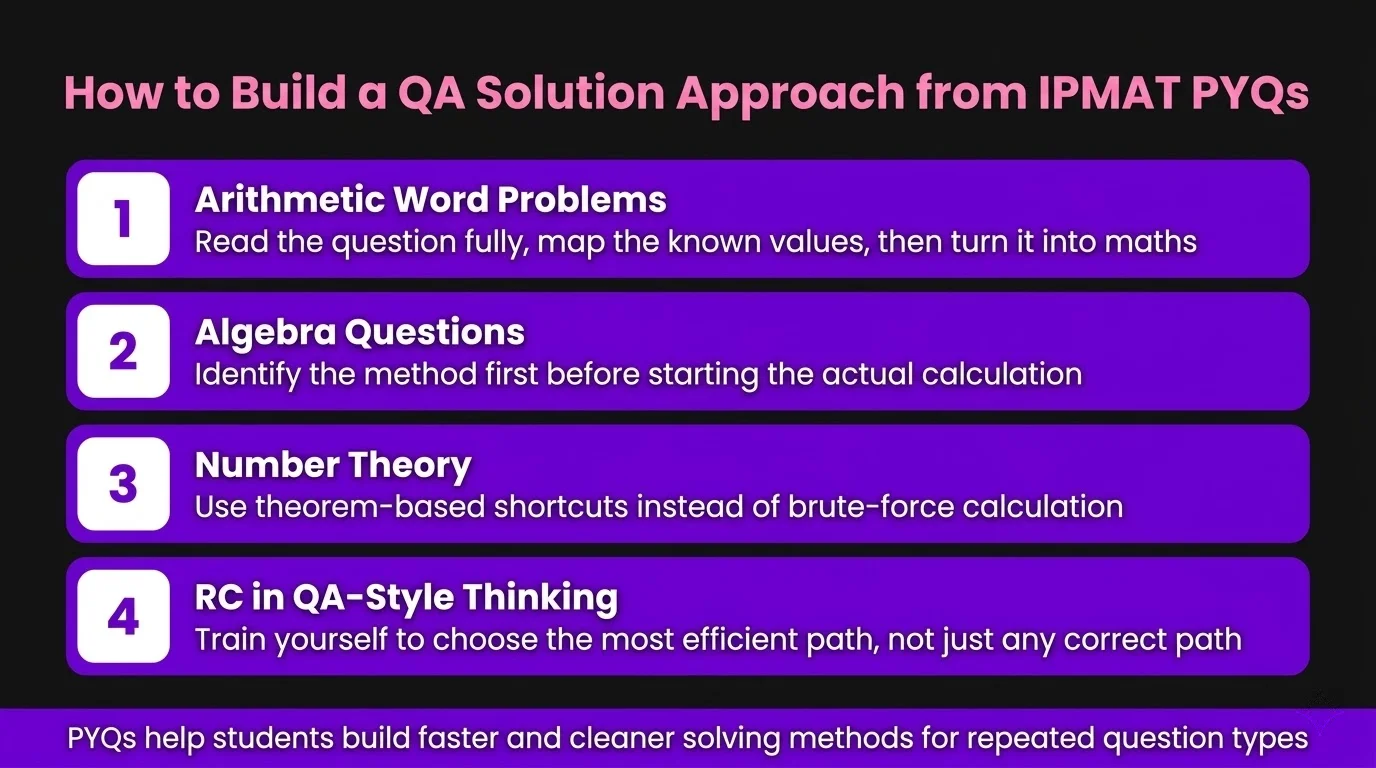
Arithmetic word problems — the 3-step read: Every arithmetic word problem in IPMAT PYQs rewards the same 3-step approach: (1) Identify what is known and what is unknown before writing anything. (2) Convert the word problem into a mathematical expression using the correct relationship (ratio, percentage, time-rate). (3) Solve and verify the answer makes intuitive sense in the context of the problem.
Students who start writing equations before fully reading the problem make consistent errors in IPMAT PYQs — particularly in TSD and ratio problems where the setup determines the entire solution path.
Algebra combination questions — identify the technique first: When facing an algebra question in IPMAT PYQs, spend 15–20 seconds identifying the technique before solving. Is it substitution? Factorisation? Discriminant analysis? Graphical reasoning? Students who start calculating before identifying the technique waste time and frequently switch methods midway — a significant speed cost.
Number theory — apply known theorems, do not calculate brute force: The largest time-wasters in number theory IPMAT PYQs are students who attempt to calculate remainders by testing values rather than applying Euler’s theorem or cyclicity rules. Build a theorem sheet for number theory. Apply the correct theorem first — then verify with 1 test case if time permits.
RC — argument tracking, not detail hunting: The most common error in RC sections of IPMAT PYQs is reading the passage while looking for specific details rather than tracking the overall argument. IPMAT RC questions lean heavily towards inference and main idea — which require understanding the argument structure, not memorising specific facts. Read the passage once for argument structure, then answer questions — looking up specific details only when needed for detail-retrieval questions.
IPMAT PYQs and Mock Tests: How to Use Both Together
IPMAT PYQs and full-length mock tests are complementary, not interchangeable. Understanding the difference between them allows students to use each for maximum value.
IPMAT PYQs provide:
- Authentic exam question style and framing
- Real difficulty calibration based on actual IIM Indore papers
- Year-by-year pattern comparison that reveals topic consistency
- The exact types of questions that have appeared — and that are likely to appear again
Full-length mock tests provide:
- Higher volume of practice (PYQs are limited to 7 years of papers)
- New question variations that prevent over-familiarity with specific PYQ questions
- Performance tracking across a larger sample of attempts
- Adaptive difficulty in some test series that challenges students beyond their comfort zone
The optimal strategy: use IPMAT PYQs for pattern understanding, diagnostic analysis, and final simulation. Use full-length mock tests for volume practice, error tracking across many attempts, and sustained exam-condition performance building.
Students who combine structured IPMAT PYQ analysis with regular full-length mock practice build both authentic familiarity with the exam and the broad practice volume needed to internalise question-solving approaches across all topic types.
Team Phodu Club consistently finds that students who use IPMAT PYQs for pattern understanding and then practice extensively on full-length mock tests — rather than relying on PYQs alone for all practice volume — improve faster and more consistently than students who use either resource in isolation. The Phodu Club IPMAT Test Series provides full-length mock tests calibrated to actual IPMAT exam difficulty, designed to complement IPMAT PYQ practice with the volume and question variety that PYQs alone cannot provide.
Where to Access IPMAT PYQs
Students preparing for the IPMAT exam should be aware of the legitimate channels for accessing previous year question papers, and the limitations of each.
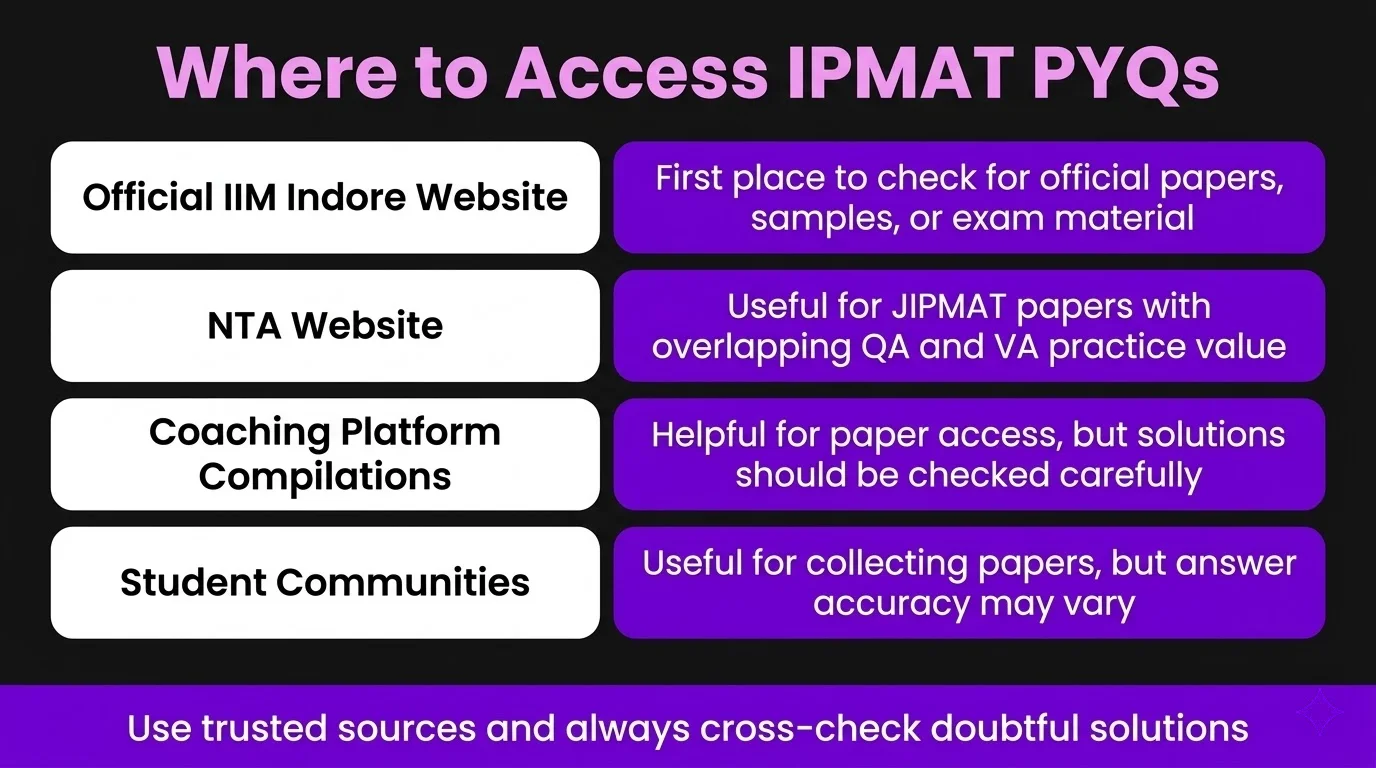
IIM Indore official website: IIM Indore’s official portal is the first and most authoritative source to check. In some years, official or sample question sets are made available — though full previous year papers with official answer keys are not always publicly accessible from the official site.
NTA official website (for JIPMAT PYQs): The NTA website publishes previous year JIPMAT question papers and official answer keys. Since JIPMAT shares significant topic overlap with IPMAT Indore in QA and VA, JIPMAT PYQs also serve as useful practice material for IPMAT preparation.
Coaching platform compilations: Several established coaching platforms compile and publish IPMAT PYQs with solutions — both in PDF format and as interactive question banks. When using these resources, verify the accuracy of solutions independently for questions where the platform’s explanation and your reasoning diverge. Errors in compiled solutions exist in third-party resources.
Student communities and forums: Year-specific IPMAT PYQs are often shared by previous-year aspirants in student communities. These are useful for paper coverage but should not be treated as authoritative for solution methodology — crowdsourced solutions vary significantly in quality and accuracy.
Important caution: Regardless of source, always verify answer keys for QA questions where the numerical answer can be independently calculated. VA answer keys — particularly for inference and tone questions — sometimes involve subjective judgement calls where reasonable students disagree with the official answer. If you disagree with an official answer on a VA question, note it in your error log but do not let it undermine your confidence in your own reasoning without examining the question and options carefully.
IPMAT PYQs and the Personal Interview: The Connection Students Miss
A dimension of IPMAT PYQs that most students overlook entirely: previous year papers are also useful for understanding the academic foundation that IIM Indore’s PI faculty is likely to probe.
Students shortlisted for the IIM Indore PI after the written IPMAT exam often face questions about their analytical thinking — the same quantitative and verbal reasoning as the IPMAT tests. A faculty member who asks you to reason through a word problem verbally, or asks you to explain the argument in a passage you have read, is testing the same skills that IPMAT PYQs develop in written form.
Students who have worked through 7 years of IPMAT PYQs with genuine understanding — not just correct answers, but clear reasoning about why an answer is correct — are in a structurably stronger position for the PI than students who have only practised for the written paper.
According to IIM Indore’s admissions documentation, the PI process evaluates analytical thinking alongside communication skills — and the analytical capability tested in the written IPMAT exam is the same capability assessed in the PI. Treating IPMAT PYQ preparation as PI preparation for its analytical reasoning component is not a stretch — it is an accurate characterisation of what both stages test.
Conclusion
IPMAT PYQs from 2019 to 2025 are not just practice material. They are the most honest available statements of what IIM Indore’s IPMAT exam demands, what it rewards, and what it consistently tests year after year. Seven years of papers tell a clear story: arithmetic and algebra dominate QA; RC and vocabulary dominate VA; the difficulty distribution is consistent; the question style is stable.
Students who begin preparation by understanding this story — who use IPMAT PYQs diagnostically first, then as benchmarks, then as volume practice, and finally as exam simulations — build preparation that is aligned with the actual exam from Day 1.
Students who treat IPMAT PYQs as a last-minute supplement discover 2 weeks before the exam that the question style is different from their coaching material, that the difficulty calibration is different from their practice sets, and that their time per question is significantly over target.
One IPMAT PYQ attempted honestly today with full section-independent timing. One error log entry written with the specific error type and the revision action it requires. One pattern identified that changes how you prepare for the next 2 weeks. That is what effective IPMAT PYQ practice looks like — and it is how the students who crack IIM Indore’s IPM programme build their preparation from the ground up.
Frequently Asked Questions (FAQ)
Q1. What are IPMAT PYQs?
IPMAT PYQs are the previous year question papers from IIM Indore’s Integrated Programme in Management Aptitude Test. They include the actual questions, answer keys, and in many cases detailed solutions from every IPMAT exam conducted since 2019. They are the most authentic preparation resource available for IPMAT aspirants.
Q2. Where can I find IPMAT PYQs?
IPMAT PYQs can be accessed from the official IIM Indore website, NTA’s website for JIPMAT PYQs, established coaching platform compilations, and student communities. Always verify solution accuracy independently, especially for QA questions where the numerical answer can be calculated directly.
Q3. How many years of IPMAT PYQs should I solve?
Solve all available IPMAT PYQs from 2019 to 2025 — at minimum 5–6 complete papers. Earlier papers establish the baseline pattern. More recent papers from 2023–2025 reflect the current difficulty calibration most accurately. Save the most recent 1–2 papers for final simulation in the last 4–6 weeks of preparation.
Q4. When should I start solving IPMAT PYQs in my preparation?
Use 1 IPMAT PYQ diagnostically in Month 1 — untimed, to understand the exam format and identify baseline gaps. Begin timed PYQ practice from Month 3, after completing foundational topic coverage. Increase to 1 full PYQ per week in Month 4–5. Use the most recent papers as exam simulations in Month 6.
Q5. How do I analyse IPMAT PYQs effectively after attempting them?
For every wrong answer: identify the error type — conceptual gap, wrong approach, calculation error, misread question, or time pressure. For every correct answer that took more than 2 minutes: identify the efficiency gap and note the faster approach. Maintain a cumulative error log across all IPMAT PYQ attempts and use it to guide weekly revision decisions.
Q6. Do IPMAT PYQs repeat questions?
Exact questions do not repeat. But question patterns, topic combinations, and difficulty structures repeat consistently across IPMAT PYQs. A student who has solved all available IPMAT PYQs will recognise the type of reasoning required for most questions in a new paper — even if the specific numbers and framing are different.
Q7. Are IPMAT PYQs sufficient for complete exam preparation?
No. IPMAT PYQs provide pattern understanding and authentic question exposure — but there are only 7 years of papers (2019–2025), which limits practice volume. Full-length mock tests from a quality test series supplement IPMAT PYQ practice with higher volume and new question variety. Use both together for complete preparation.
Q8. How are IPMAT PYQs different from JIPMAT PYQs?
IPMAT PYQs are from IIM Indore’s exam — covering QA (MCQ + Short Answer) and VA. JIPMAT PYQs are from NTA’s exam for IIM Jammu and IIM Bodhgaya — covering QA, Data Interpretation + Logical Reasoning, and VA. QA and VA questions from JIPMAT PYQs serve as useful supplementary practice for IPMAT Indore preparation, despite the structural difference.
Q9. Should I time myself when solving IPMAT PYQs?
Yes — from Month 3 onwards, every IPMAT PYQ must be attempted under strict section-independent timing: 40 minutes per section, with no time transfer between sections. Using a single 120-minute timer instead of independent section timers is a common mistake that produces an unrealistically favourable performance picture.
Q10. How do I supplement IPMAT PYQ practice with additional mock tests?
The Phodu Club IPMAT Test Series provides full-length mock tests calibrated to actual IPMAT exam difficulty — designed to complement IPMAT PYQ practice with the question volume and variety that 7 years of past papers alone cannot provide. Using both together gives you authentic pattern knowledge from PYQs and broad practice volume from mock tests.