More than 40,000 students registered for the IPMAT exam and related IPM entrance tests in 2025 — all competing for a few hundred seats at some of India’s most respected management institutions. Yet most of these students begin preparing without a clear understanding of what the exam actually tests, how it is structured, or what a realistic preparation plan looks like. If you are a Class 11 or Class 12 student considering this path to an IIM, starting with the right information is half the battle. This guide covers everything — exam dates, pattern, syllabus, and a practical strategy — so you can walk into the IPMAT exam 2026 prepared, not guessing.
What Is the IPMAT Exam?
The IPMAT exam is the entrance test for IIM Indore’s 5-year Integrated Programme in Management (IPM). It is one of the most prestigious undergraduate-level management entrance exams in India, giving Class 12 students a direct route into an IIM — without waiting for a bachelor’s degree or sitting for CAT.
The 5-year IPM programme integrates 3 years of undergraduate study with 2 years of MBA-level coursework. Graduates receive a qualification equivalent to an MBA from IIM Indore — one of Asia’s top business schools. According to IIM Indore’s official IPM page, the programme has produced graduates consistently placed at leading companies across industries.
It is important to note that the IPMAT exam conducted by IIM Indore is separate from two other IPM entrance tests:
- JIPMAT, conducted by the National Testing Agency (NTA) for IIM Jammu and IIM Bodhgaya
- IPM-AT, conducted independently by IIM Rohtak for its own IPM programme
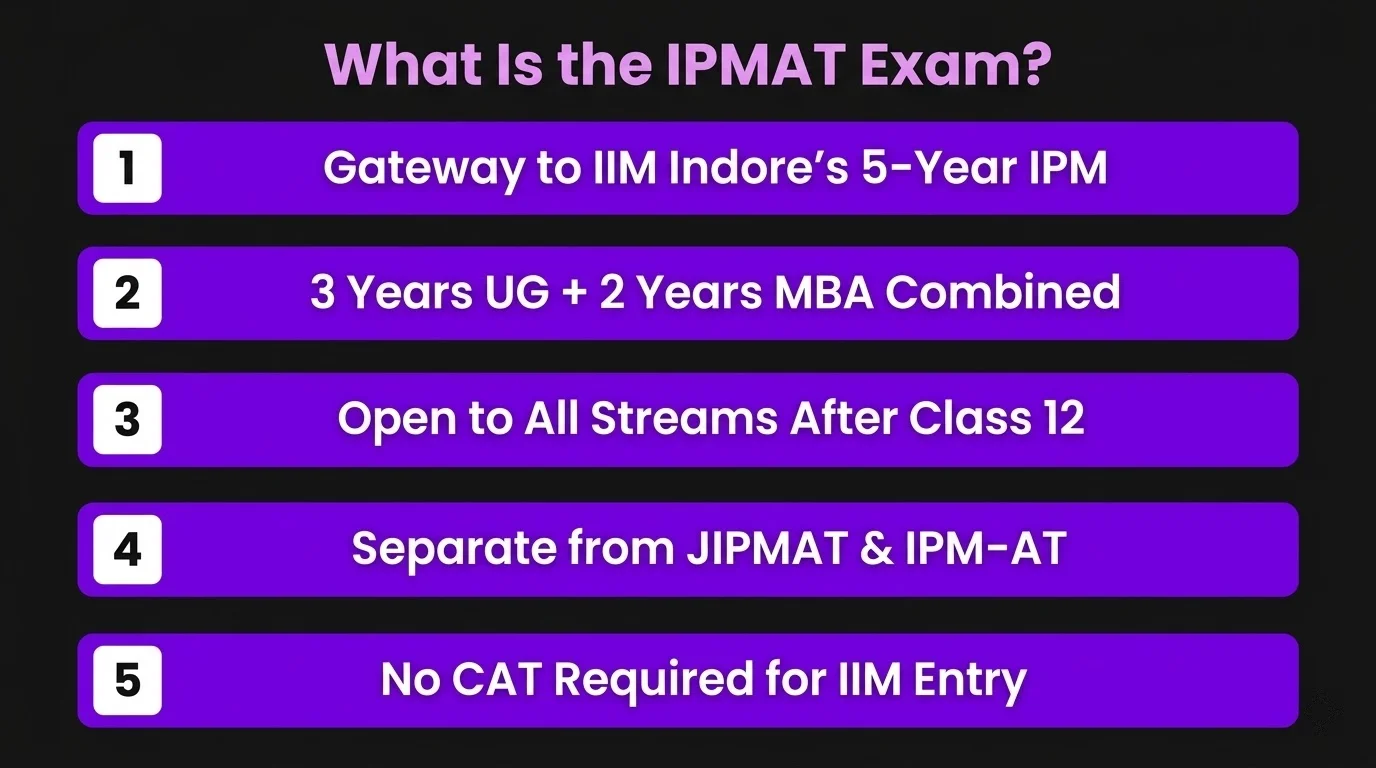
All three exams serve the same purpose — identifying high-potential students for integrated management programmes — but have different patterns, syllabi, and cutoffs. This article focuses primarily on the IIM Indore IPMAT exam, with relevant references to JIPMAT and IPM-AT where applicable.
IPMAT Exam 2026: Expected Dates and Schedule
IIM Indore has officially released the schedule and important dates of IPMAT 2026 exam. Registration has already closed and the exact trial date has been confirmed.
Here is the updated timeline:
| Event | Official 2026 Timeline |
| Application window opens | February 2, 2026 |
| Last date to apply | March 17, 2026 (Extended from March 14) |
| Application form edit window | March 23 – March 24, 2026 |
| Admit card release | Last week of April – First week of May 2026 (Expected) |
| IPMAT exam date | May 4, 2026 (2:00 PM to 4:00 PM) |
| Result declaration | Late May – Early June 2026 (Expected) |
| Personal Interview (PI) round | June – July 2026 (Expected) |
| Final admissions | July – August 2026 (Expected) |
Always monitor the official IIM Indore website directly for date announcements. Do not rely on third-party sources for registration deadlines. Missing the application window means waiting an entire year.
For JIPMAT 2026, the NTA typically releases the notification between March and April. Check NTA’s official website for updates.
IPMAT Exam Eligibility: Who Can Apply?
Before investing months of preparation, confirm you meet the eligibility requirements.
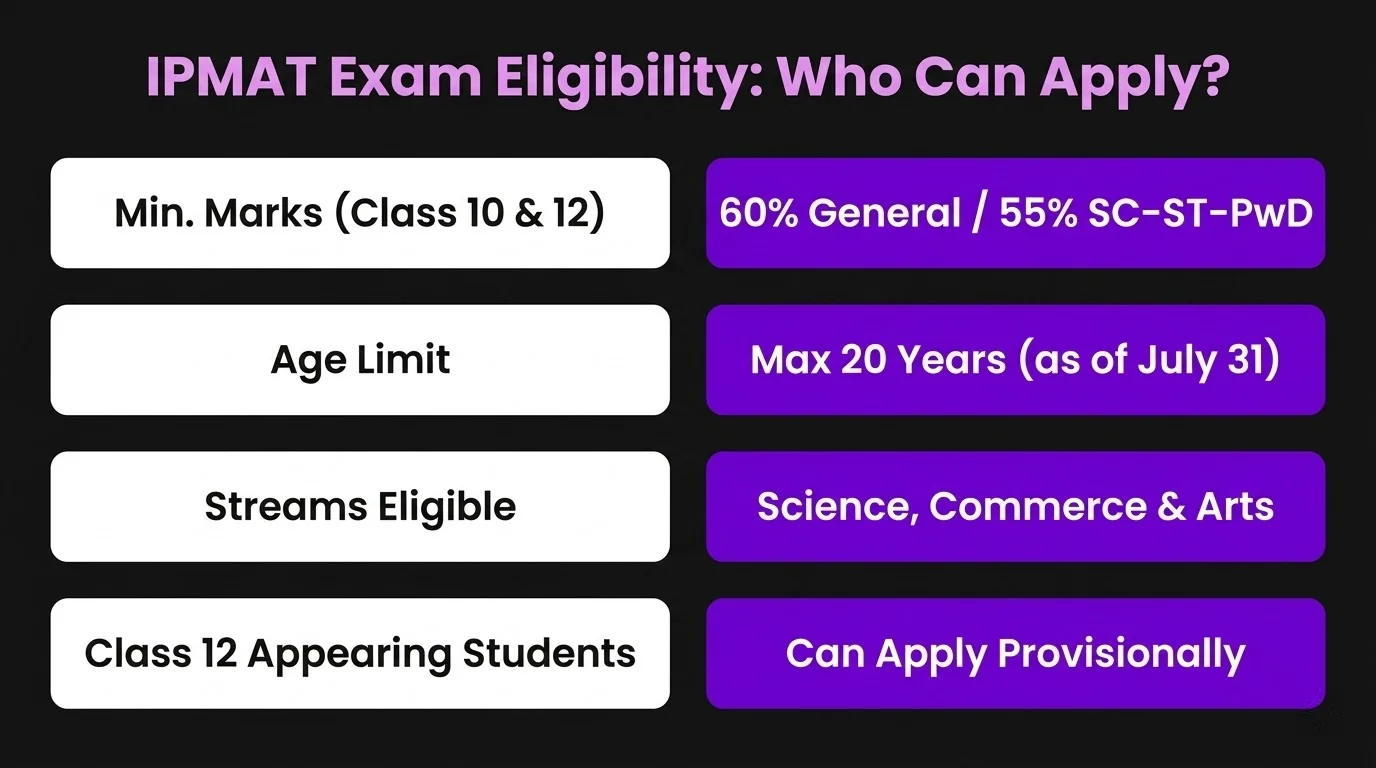
For IIM Indore IPMAT exam:
- Minimum 60% aggregate marks in both Class 10 and Class 12 (55% for SC/ST/PwD candidates)
- Age limit: Maximum 20 years as of July 31, 2026
- Students from all streams — Science, Commerce, Arts — are eligible
- Class 12 students appearing in board exams in 2026 may apply provisionally
For JIPMAT (IIM Jammu and IIM Bodhgaya):
- Minimum 60% in Class 12 (55% for SC/ST/PwD candidates)
- Age limit: 20 years as of July 31 of the exam year
- All streams eligible
For IIM Rohtak IPM-AT:
- Minimum 60% in Class 12 (55% for SC/ST/PwD candidates)
- Age limit: 20 years
- All streams eligible
One critical reminder: your Class 10 percentage matters for IIM Indore’s IPMAT specifically. Students who meet the Class 12 cutoff but fall short on Class 10 marks have been made ineligible in previous years. Check both requirements carefully.
IPMAT Exam Pattern 2026
Understanding the structure of the IPMAT exam is the first step in building a focused preparation strategy. The IIM Indore IPMAT exam is divided into 3 sections, each timed independently.
IIM Indore IPMAT Exam Pattern
| Section | Format | Number of Questions | Time Allotted |
| Quantitative Ability (MCQ) | Multiple Choice | 40 | 40 minutes |
| Quantitative Ability (Short Answer) | Non-MCQ | 20 | 40 minutes |
| Verbal Ability (MCQ) | Multiple Choice | 40 | 40 minutes |
Total: 100 questions | 120 minutes | 400 marks
Marking scheme:
- QA MCQ and VA MCQ: +4 for correct, −1 for incorrect
- QA Short Answer: +4 for correct, no negative marking
Key observations about the exam pattern:
The Short Answer section is the only section without negative marking. This means you should attempt every single question in this section, even if you are uncertain. Leaving questions blank in the Short Answer section is a mistake no well-prepared student should make.
Sectional time limits mean you cannot borrow time from one section to compensate in another. If you are struggling in QA MCQ, you cannot continue working on it once the 40-minute window ends. This makes time management a skill to train separately, not assume you will figure it out on exam day.
The Personal Interview (PI) round follows the written test for shortlisted students. Both the written test score and the PI performance factor into the final selection.
Always verify the exact pattern from the official IIM Indore website before the exam, as the institute may make adjustments for IPMAT 2026.
IPMAT Exam Syllabus 2026
The IPMAT exam does not have a rigid prescribed syllabus document in the way a school board exam does. However, analysis of previous years’ papers reveals clear and consistent topic patterns.
Quantitative Ability Syllabus
Arithmetic (High Priority)
- Percentages, profit and loss, discount
- Ratio and proportion, partnerships
- Time, speed, and distance
- Time and work, pipes and cisterns
- Simple and compound interest
- Averages and mixtures
Algebra (High Priority)
- Linear and quadratic equations
- Inequalities
- Sequences and series — AP, GP, HP
- Functions and graphs
- Logarithms
Geometry and Mensuration (Medium Priority)
- Lines, triangles, quadrilaterals, circles
- Coordinate geometry
- Area, surface area, and volume calculations
Number Theory (Medium Priority)
- Divisibility rules, HCF, LCM
- Remainders and modular arithmetic
- Prime numbers, factor theory
Modern Mathematics (Medium Priority)
- Permutations and combinations
- Probability
- Sets and Venn diagrams
Verbal Ability Syllabus
Reading Comprehension (High Priority)
- 2–3 passages per exam with 4–6 questions each
- Passages are typically analytical or opinion-based
Vocabulary (High Priority)
- Synonyms and antonyms
- Analogies
- Word-in-context questions
Grammar (Medium Priority)
- Error identification and sentence correction
- Fill in the blanks with appropriate words
- Active and passive voice, reported speech
Para Jumbles and Para Completion (Medium Priority)
- Rearranging sentences into a coherent paragraph
- Identifying the odd sentence out
Critical Reasoning (Medium-High Priority)
- Inference and conclusion questions
- Strengthen and weaken the argument questions
The Verbal Ability section in IIM Indore’s IPMAT exam is significantly more demanding than what most Science stream students are used to from school exams. Underestimating it is one of the most common and costly mistakes aspirants make.
The Real Problem Many IPMAT Aspirants Face
Here is a situation many students recognise. You have been studying for months. QA topics feel covered. You start a mock test and 25 minutes into the VA section, you realise your reading speed is far below what the exam demands. A 600-word passage sits before you. You have 7 minutes left for 4 questions. You panic.
This is not an unusual scenario. It is the direct result of treating the IPMAT exam as primarily a mathematics test. According to education research published by the American Psychological Association, students who study in siloed sessions — focusing on one subject in isolation without integration — perform significantly worse under timed, multi-domain exam conditions than students who practice integrated testing regularly.
Three other common problems aspirants face:
Problem 1: Solving questions without checking time per question In the IPMAT exam, you have approximately 1 minute per question in each MCQ section. Most students have never timed this granularity during practice.
Problem 2: Knowing formulas but not when to use them A student might know the compound interest formula perfectly but freeze when a question frames the same concept in an unfamiliar word problem structure. This is a concept application gap — not a knowledge gap.
Problem 3: Inconsistent preparation over a long period Students study intensely for 3 weeks, slow down for 10 days due to school exams, then struggle to rebuild momentum. This cycle repeats and leads to underprepared students sitting for a highly competitive exam.
Recognising these 3 patterns early — and designing a preparation plan that addresses them — is more valuable than any single study tip.
Subject-Wise Preparation Strategy for the IPMAT Exam
Quantitative Ability
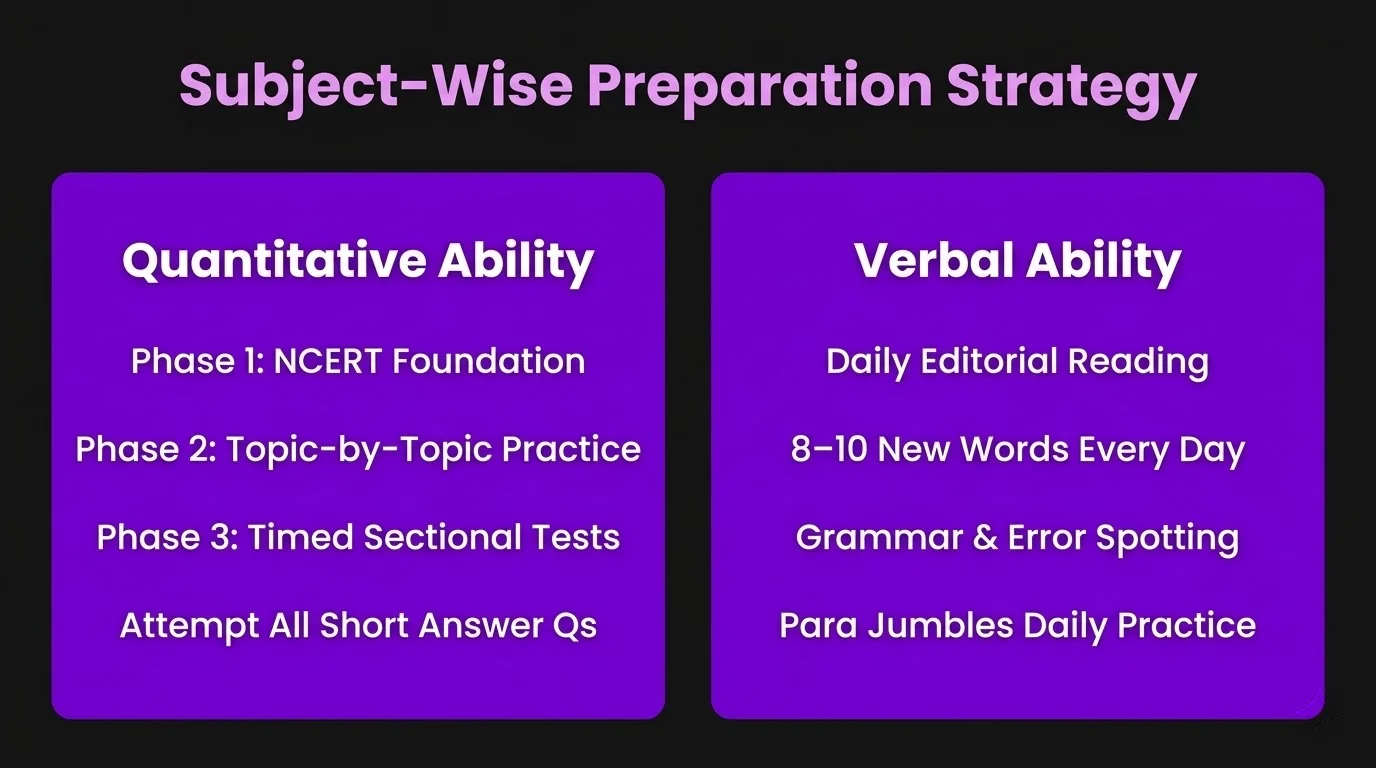
Phase 1 — Build the foundation (Months 1–2) Start with Class 10 NCERT Mathematics and move through Class 11 topics. Do not skip this phase, even if you are confident in maths. The IPMAT exam tests speed and precision, not just knowledge.
Phase 2 — Topic-by-topic practice (Months 2–4) Take one topic at a time. Solve a minimum of 40–50 problems per topic before moving forward. For each topic:
- Understand the core concept and formula
- Solve easy problems first to build confidence
- Progress to medium and hard problems
- Solve mixed problems combining 2 or more concepts
Phase 3 — Timed sectional practice (Months 4–6) Practice QA sections under real time pressure. Target completing 40 MCQ problems in 35 minutes to build a 5-minute buffer. Use the Short Answer section to maximise marks — attempt every question since there is no penalty.
Verbal Ability
The biggest mistake students make with VA in the IPMAT exam is starting preparation too late. Start Day 1 of your preparation cycle.
Daily reading practice Read 1 editorial or opinion article from The Hindu, Indian Express, or a quality business publication every day. Focus on understanding the argument structure: what is the author claiming, what evidence are they using, and what conclusion do they reach?
Vocabulary building Learn 8–10 new words daily. Use them in sentences immediately. Review the previous week’s words every Sunday. After 3 months, this alone will meaningfully improve your performance on vocabulary-based questions.
Grammar foundation Work through a standard grammar reference systematically. Focus on error spotting and sentence correction — these are the most frequently tested grammar formats in the IPMAT exam.
Para jumble practice: Practice rearranging 5–6 sentence paragraphs daily. Look for transitional logic, pronouns that reference earlier sentences, and idea flow. These patterns are learnable with consistent practice.
Team Phodu Club regularly finds that students who dedicate equal daily time to VA and QA consistently outperform those who treat VA as a secondary subject in the IPMAT exam preparation cycle.
How to Build a 6-Month IPMAT Exam Preparation Plan
A structured plan matters more than the number of hours studied. Here is a month-by-month framework:
Month 1: Foundation
- Revise Class 10 mathematics completely
- Begin Class 11 algebra and arithmetic
- Start daily reading for VA
- Learn 8–10 vocabulary words daily
Month 2: Concept Building
- Complete all arithmetic topics with 40+ problems each
- Begin geometry and number theory
- Practice grammar exercises daily
- Solve 2–3 RC passages per week under timed conditions
Month 3: Topic Mastery
- Complete geometry, coordinate geometry, and number theory
- Begin permutations, combinations, and probability
- Start para jumble and critical reasoning practice
- Increase RC passage practice to 4–5 per week
Month 4: Integration
- Solve mixed-topic QA problems daily
- Take 1 full-length sectional mock test per week (QA and VA separately)
- Analyse every mock in detail — time spent, accuracy, error types
- Identify your 3 weakest QA and VA topics and revise them
Month 5: Mock Test Cycle
- Take 1 full-length IPMAT exam mock test every week
- Apply a structured review process after every mock (covered in the next section)
- Reduce time per QA question in practice to 50 seconds per MCQ question
- Continue daily vocabulary and reading practice
Month 6: Final Revision
- Take 2 full-length mock tests per week
- Revise all formula sheets and concept notes
- Focus entirely on weak areas identified through mock test analysis
- Simulate exam-day conditions: same start time, same environment, zero distractions
Students who use the Phodu Club IPMAT Test Series during Months 5 and 6 benefit from full-length mocks built to match the actual IPMAT exam difficulty. Practicing on the right difficulty level ensures your speed and accuracy benchmarks are calibrated correctly before the real exam.
How to Analyse a Mock Test Properly
Taking mock tests is table stakes for IPMAT exam preparation. What separates high scorers from average scorers is what happens after the mock test.
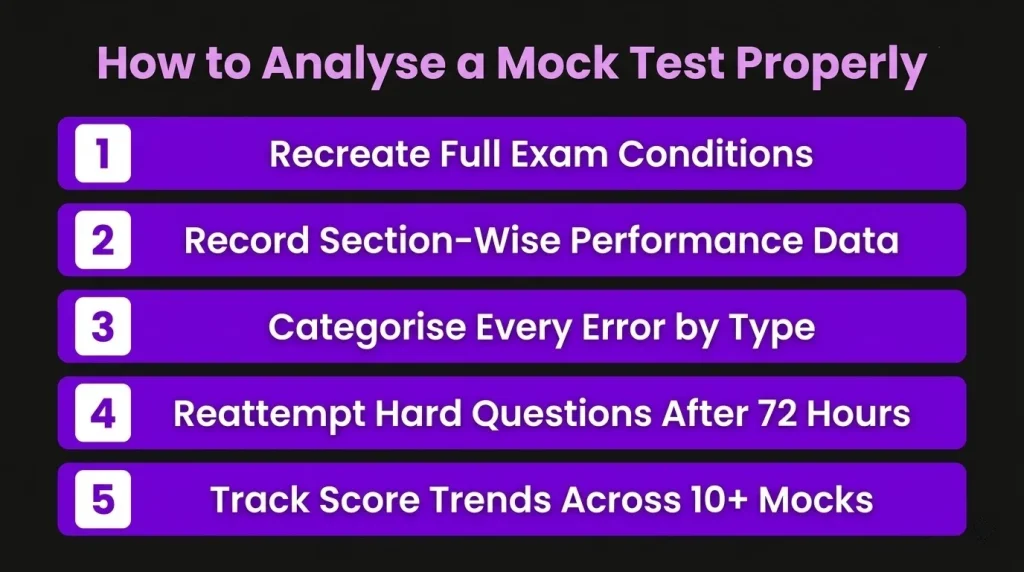
Step 1: Recreate full exam conditions No phone, no breaks, no background noise. 120 minutes, 3 sections, independent timers for each. The purpose is to train your brain to perform under real conditions, not comfortable ones.
Step 2: Record your performance data After each mock, note down:
- Total score and section-wise scores
- Number of questions attempted vs. correct vs. wrong
- Average time per question in each section
- Questions left unattempted and why
Step 3: Categorise every error Go through every wrong answer and classify the mistake:
- Conceptual gap → Revise the topic
- Formula forgotten → Add to your revision sheet
- Calculation error → Practice arithmetic drills
- Misread question → Practice reading questions more carefully
- Time pressure → Work on speed in that question type
Step 4: Reattempt difficult questions without solutions 72 hours after the mock test, come back to the questions you could not solve — without looking at the solutions. This retrieval practice strengthens long-term memory significantly. Research from the Journal of Educational Psychology confirms that retrieval-based practice produces measurably stronger retention than passive re-reading.
Step 5: Track your score trend over 10+ mocks Improvement in the IPMAT exam comes from tracking trends, not individual data points. After 10 mocks, patterns become visible: maybe your QA accuracy is strong but your VA speed is consistently low. These patterns guide your revision priorities far more reliably than instinct.
IPMAT Exam Cutoffs and What You Need to Score
IIM Indore does not publish a fixed cutoff for the IPMAT exam. The cutoff varies each year based on exam difficulty and the number of students appearing. Based on previous years’ data and analysis:
- Overall score benchmark: 190–220+ out of 400 is generally competitive for shortlisting
- Sectional cutoffs exist: You must clear minimum scores in both QA and VA sections separately — a very high QA score cannot compensate for a failing VA score
- Final selection: Shortlisted students appear for a Personal Interview (PI). Both the IPMAT exam score and PI performance contribute to the final merit list
The IIM Indore IPM programme offers approximately 150 seats per year, making the effective acceptance rate from the pool of applicants extremely competitive. According to IIM Indore’s programme documentation, the selection process places significant weight on the PI component in addition to the written test.
This means strong preparation cannot stop at the mock test stage. Students who are shortlisted for PI need to simultaneously work on communication skills, general awareness, and the ability to articulate their reasoning clearly under pressure.
Conclusion
The IPMAT exam is one of the most rewarding entrance tests a Class 12 student in India can attempt. It opens a direct path to an IIM — a path most students believe is years away. But the exam is genuinely competitive, and treating it casually is the single biggest mistake aspirants make.
Students who crack the IPMAT exam are not always the most mathematically gifted. They are the ones who respected both sections equally, built their speed through consistent timed practice, analysed every mock test seriously, and stayed disciplined through a 6-month preparation window.
One clear concept understood today. One mock test was reviewed honestly this weekend. One vocabulary word used in a sentence tonight. Improvement in the IPMAT exam does not arrive in dramatic leaps — it builds through small, consistent actions done every single day.
Frequently Asked Questions (FAQ)
1) What is the IPMAT exam?
The IPMAT exam (Integrated Programme in Management Aptitude Test) is the entrance test for IIM Indore’s 5-year IPM programme. It tests students on Quantitative Ability and Verbal Ability and is open to Class 12 students from all streams.
2) When will the 2026 IPMAT exam be?
Based on previous years, the IPMAT 2026 exam is scheduled to be held in late May or early June 2026. The official notification is expected in January–February 2026. Check IIM Indore official website for confirmed dates.
3) What is the IPMAT exam syllabus?
The IPMAT exam covers Quantitative Ability (arithmetic, algebra, geometry, number theory, modern mathematics) and Verbal Ability (reading comprehension, vocabulary, grammar, para jumbles, and critical reasoning). There is no rigid prescribed syllabus — previous year papers are the most reliable guide.
4) Is there negative marking in the IPMAT exam?
Yes, in the MCQ sections: −1 for every wrong answer. The Quantitative Ability Short Answer section has no negative marking. Managing negative marking strategically is a critical part of IPMAT exam preparation.
5) What is the IPMAT exam pattern in terms of sections and marks?
The IPMAT exam has 3 sections: QA MCQ (40 questions, 40 minutes), QA Short Answer (20 questions, 40 minutes), and VA MCQ (40 questions, 40 minutes). Total: 100 questions, 400 marks, 120 minutes.
6) How many months of preparation are enough for the IPMAT exam?
6 months of consistent, structured preparation is sufficient for most students. Students who start 10–12 months early have the advantage of deeper concept building and more mock test cycles.
7) What is the difference between IPMAT, JIPMAT, and IPM-AT?
IIM Indore conducts IPMAT for its own programme. NTA conducts JIPMAT for IIM Jammu and IIM Bodhgaya. IIM Rohtak conducts IPM-AT for its own IPM programme. All 3 are separate exams with different patterns and separate registrations.
8) Is Maths background compulsory for the IPMAT exam?
No. Students from Science, Commerce, and Arts streams can appear. However, the QA section is substantial — students without a strong Class 10 maths foundation will need to invest more time in QA preparation.
9) What is a good score in the IPMAT exam?
A score of 190–220+ out of 400 is generally competitive for shortlisting at IIM Indore. Clearing sectional cutoffs in both QA and VA is mandatory — a strong overall score with a weak VA section will not cause a shortlist.
10) Where can I practice full-length IPMAT exam mock tests?
The Phodu Club IPMAT Test Series offers full-length mock tests designed to match the actual IPMAT exam pattern and difficulty. Practicing on tests calibrated to the right difficulty level is essential for building real exam readiness.