At Phodu Club, we see students panic about eligibility before opening a book. You might be scoring well in practice tests, but a lingering doubt about the IPMAT age limit stops you from giving your 100%. We have worked with droppers who assumed they were too old, only to find out they were perfectly eligible. If you are targeting IIM Indore or Rohtak for 2026, you need absolute clarity on the date of birth cutoffs. Let us look at the exact rules so you can stop worrying and start studying.
IPMAT Age Limit: TL;DR
For the 2026 exam, the general IPMAT age limit requires candidates to be born on or after August 1, 2006. Candidates from SC, ST, and PwD categories get a five-year relaxation, meaning they must be born on or after August 1, 2001.
Why the IPMAT age limit for IIM Indore Matters First
We get this question all the time from students who are taking a drop year: “Am I too old to apply?” It is a highly valid fear. Aspirants waste hours scrolling through internet discussion boards looking for answers, which ruins their study momentum. At Phodu Club, our students learn early on that stressing over administrative details takes away precious energy from solving actual Quantitative Aptitude problems.
When you know the eligibility rules inside out, you remove a major psychological hurdle. You stop thinking about “what ifs” and start focusing on your accuracy. According to the official IIM Indore admission criteria portal [1], they strictly enforce their date of birth requirements. If you do not meet them, your application will be rejected regardless of your score. That is why we tell our students to check the dates, verify their documents, and then completely shut off that part of their brain to focus purely on clearing the cutoffs.
Official IPMAT age limit 2026: Exact Date of Birth Cutoffs
To make things incredibly simple, we have compiled the exact dates you need to check. The official admission document for 2026 will confirm these, but based on strict historical patterns from IIM Indore and the Ministry of Social Justice guidelines [2][3], the cutoff date remains consistent year after year.
For General, NC-OBC, and EWS Categories:
You must be born on or after August 1, 2006. If your birthday is July 31, 2006, you are not eligible. There are no exceptions to this strict rule.
For SC, ST, and PwD Categories:
You get five-year relaxation. This means you must be born on or after August 1, 2001.
Here is a quick reference table we share with our students:
| Category | Date of Birth Requirement | Approximate Maximum Age |
| General | On or after August 1, 2006 | 20 Years |
| NC-OBC | On or after August 1, 2006 | 20 Years |
| EWS | On or after August 1, 2006 | 20 Years |
| SC | On or after August 1, 2001 | 25 Years |
| ST | On or after August 1, 2001 | 25 Years |
| PwD | On or after August 1, 2001 | 25 Years |
Many students misunderstand the criteria and think it is purely about the number of years you have been alive. It is strictly about the cutoff date. We had a student last year who missed the cutoff by two days and spent months studying before realizing the error. Always check your official 10th standard mark sheet. The date of birth printed there is the only one the authorities accept during document verification.
Does the IPMAT age limit affect Double Droppers?
One of the most common mistakes we see is students checking their date of birth but ignoring the year of passing class 12. The age restriction is only half the battle.
To be eligible for the 2026 exam, you must have passed your 12th standard (or equivalent) in 2024, 2025, or be appearing in 2026. If you passed class 12 in 2023, you are not eligible for the 2026 exam, even if your date of birth is valid.
Real Student Scenario:
We worked with a student named Rahul. He passed his 12th standard in 2024 and took a double drop to prepare for 2026. His birthdate was October 2006. While he perfectly satisfied the general rules, he was worried about his academic gap. We told him the rules are strictly administrative. Since he passed in 2024, he was fully eligible to write the exam in 2026. Once we cleared that doubt, his practice scores shot up because he finally focused on his weak areas. We frequently tell our students to read about deciding if taking a drop is worth the effort to build the right mindset for a gap year.
If you are considering a partial drop for your entrance prep, you must be extremely strict with your schedule. Managing a college degree while preparing for IIM Indore requires intense discipline.
Based on IIM Rohtak’s official admission notifications [4], there are sometimes slight variations in the required academic percentages. Typically, general category students need 60% aggregate in standard 10 and 12, while SC, ST, and PwD students need 55%. Always wait for the official brochure, but aiming high in your board exams is always a safe strategy.
Clearing the IIM Indore Cutoff: Why Raw Effort Fails and Strategy Wins
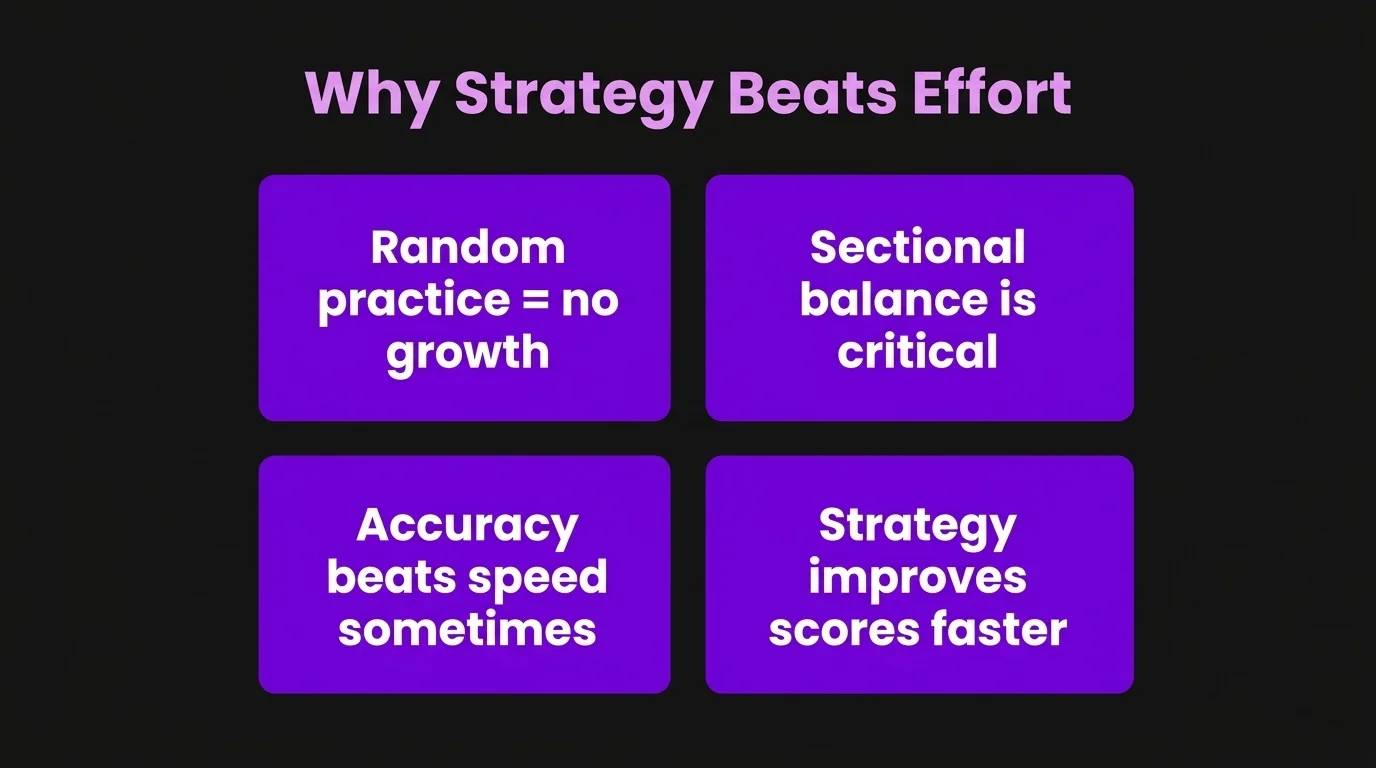
Once you verify that you fall within the IPMAT age limit, the real work begins. We have seen this pattern again and again—students get excited about being eligible, buy a bunch of books, study randomly for three months, and then hit a massive score plateau.
Effort alone does not fix your score. At Phodu Club, we focus on strategy. You need a structured approach to beat the competition. Let’s see what actually moves the needle in your preparation.
- Stop Solving Questions Blindly: Students think doing 500 questions a day is the path to success. It is not. If you are doing 500 questions using the wrong method, you are just reinforcing bad habits. You must focus on the approach. Are you using options to eliminate answers? Are you choosing the right questions to skip?
- Sectional Balance is Mandatory: IIM Indore has strict sectional cutoffs. You can score perfectly in Quantitative Aptitude (MCQ), but if you bomb the Verbal Ability section, you will not get an interview call. We see aspirants who are strong in math completely ignore English until the last month. That is a guaranteed way to fail. You must allocate time based on your weak areas, not your comfort zones.
- Speed vs Accuracy: In the Short Answer (SA) section of Quantitative Aptitude, there are no options to guide you. Accuracy is everything here. However, in the Verbal Ability section, you have to read fast and make quick decisions. Approaching every section with the same speed strategy will ruin your attempt. We teach our students to slow down on SA and speed up on Verbal.
IPMAT Quantitative Aptitude Strategy: Scoring High Without Being a Math Expert
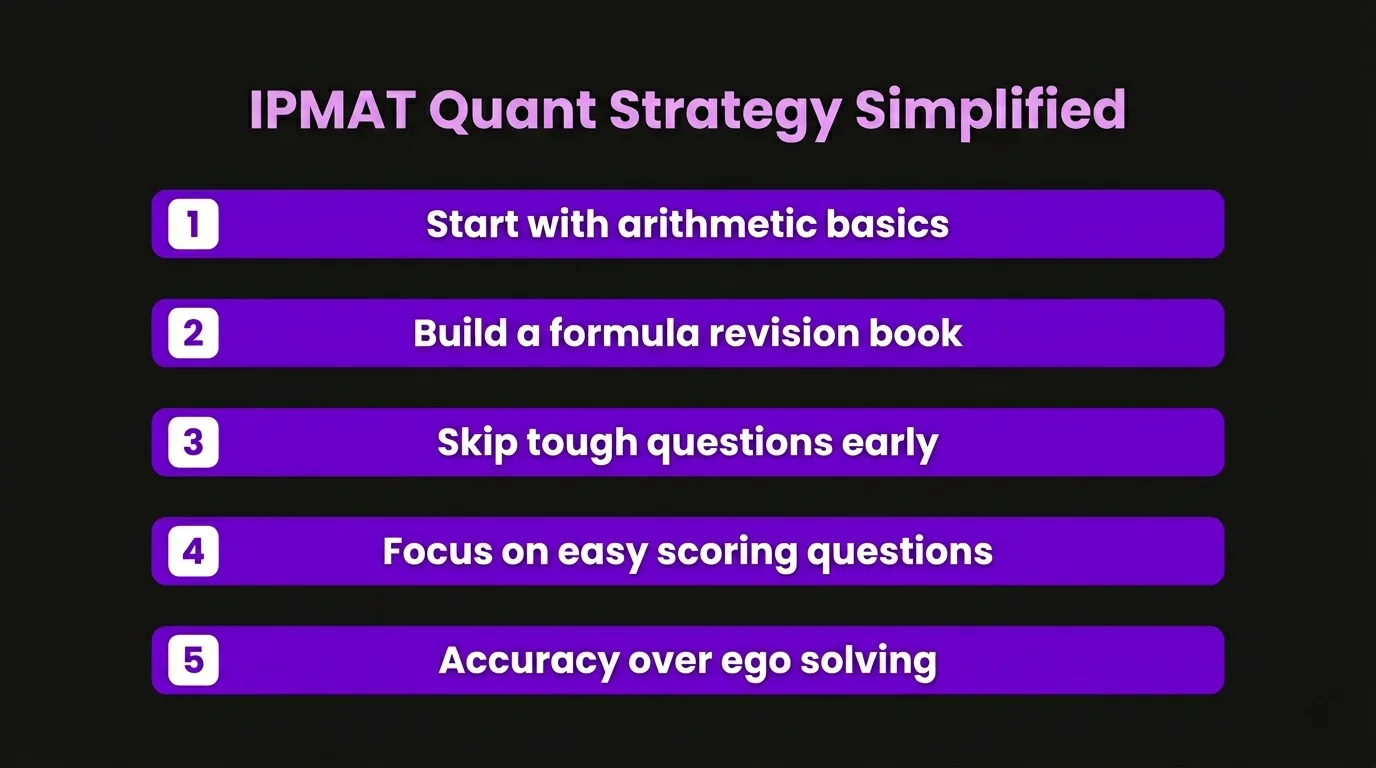
The math section scares a lot of non-math students. But here is the truth we tell our students: you do not need to be a math genius to clear the cutoffs. You just need to be smart about which questions you attempt. Data from recent 2025 exam trends shows a sharp increase in competition, which is why a solid math strategy is non-negotiable. Often, students ask how to start preparation early from class 11, and the answer is always building the foundation first.
Step 1: Master Arithmetic First
Do not start with complex Higher Math like Probability or Vectors. Start with Percentages, Profit and Loss, Ratio and Proportion, and Time, Speed, and Distance. These topics create the foundation of the exam. If your arithmetic is weak, your entire math score will suffer.
Step 2: Build a Formula Book
Write down every formula you encounter. Revise this book every Sunday. When you are sitting in the exam hall, you should not be wasting time trying to recall the formula for the volume of a frustum. It should be automatic. We teach our students the exact method of making short revision sheets so formulas become second nature.
Step 3: The Skill of Skipping
We tell aspirants we have helped: your ego is your biggest enemy. If a question takes more than two minutes, leave it. The exam does not reward you for solving the hardest question. Every correct answer gives you the same marks. Find the easy ones first.
Real Student Scenario:
We had a student stuck at 20 marks in the QA section. She was stubbornly trying to solve every algebra question in order. We made her skip questions and read the entire paper in the first 10 minutes. By simply picking the easy arithmetic questions first, her score jumped to 45 in two weeks. Strategy always beats raw effort.
Step 4: Handling the Short Answer Section
IIM Indore has a unique Short Answer section where you type the answer in a box. There are no options for reverse engineering. We tell our students that this section tests your absolute conceptual clarity. You can not plug in options (a), (b), (c), or (d) to see what fits. You must know the steps. Start practicing without looking at options. Cover the choices in your practice books with a piece of paper. This forces your brain to figure out the exact value.
IPMAT Verbal Ability Preparation: Fixing Reading Speed and Logic for IIM Indore
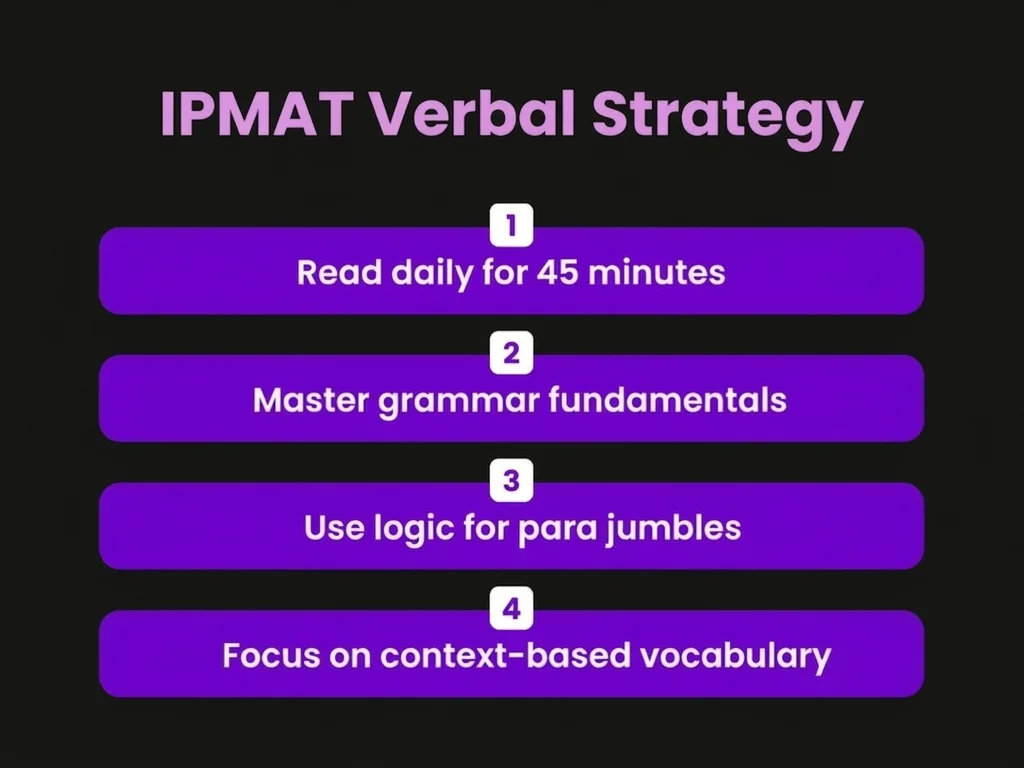
Many students think Verbal Ability is just about knowing difficult vocabulary words. It is actually about reading comprehension and logic. If you just confirmed your eligibility and are starting your English prep, do not memorize the dictionary.
Step 1: Read Every Single Day
We force our students to read editorials, opinion pieces, and non-fiction books. The exam passages are dense. If you are not used to reading long, boring texts, you will lose focus during the test. Read for 45 minutes daily.
Step 2: Sentence Structure Fundamentals
You need to know the rules of verbs, nouns, modifiers, and tenses. Many questions ask you to spot the error in a sentence. You can not rely on “what sounds right.” You must know the exact language structures that are being broken.
Step 3: Para Jumbles Need Logic, Not English
Para jumbles are like a puzzle. Look for transition words, pronouns, and opening statements. We teach our students to pair sentences together first before trying to sequence the entire paragraph.
Step 4: Vocabulary in Context
According to historical exam analysis sources, direct synonym-antonym questions are disappearing. Now, the exam tests vocabulary in context. You will see a sentence with a blank, and you have to pick the right word. Knowing the dictionary definition is not enough; you must know how the word is used in daily language.
IPMAT Mock Test Analysis: The Exact Steps We Use to Fix Stagnant Scores
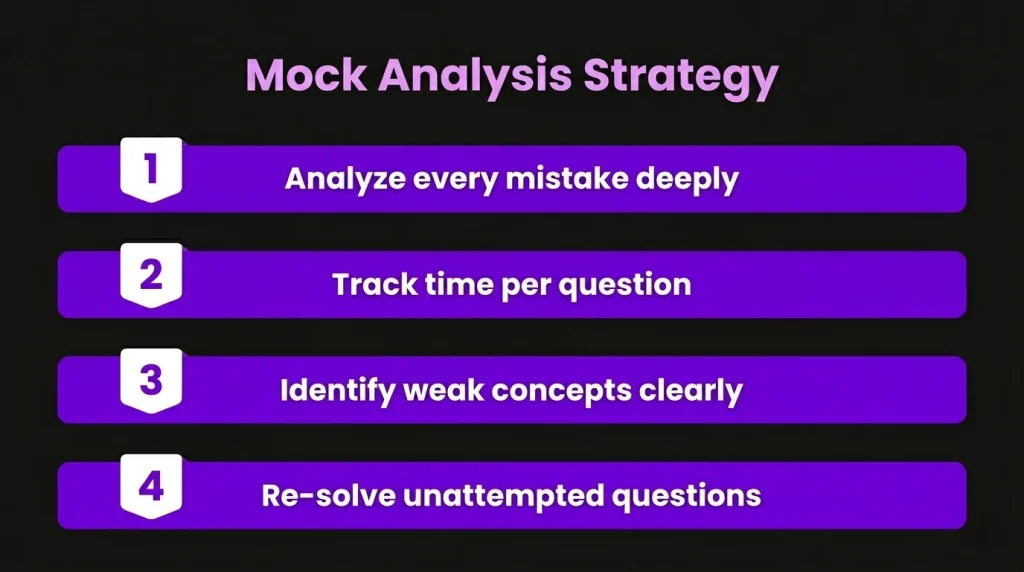
Mocks are where the real improvement happens. But most students take a computer-based mock, look at their low score, feel sad, and then close the laptop. That is a massive waste of time.
You must analyze your mocks. At Phodu Club, we focus heavily on the mock analysis phase. Taking a mock requires two hours. Analyzing it deeply requires another three hours.
- Categorize Your Mistakes: When you get a question wrong, figure out why. Was it a silly mistake? Did you not know the concept? Did you run out of time? Create a spreadsheet and track these errors.
- Track Your Time Per Question: If you spent five minutes on a single reading comprehension question, you have effectively failed that section, even if you got the answer right. You must learn to guess or skip and move on.
- Re-solve the Unattempted Questions: After the mock ends, try solving the questions you left blank without any time pressure. If you can solve them easily, it means your problem is exam anxiety and time pressure, not a lack of knowledge.
Building a Daily IPMAT Routine That Actually Sticks
Consistency is where most aspirants fail. They study ten hours one day and then do zero hours for the next three days. That method guarantees burnout.
We strongly advise a structured daily routine.
- Morning: Two hours of Quantitative Aptitude. This is when your brain is freshest. Focus on solving hard problems.
- Afternoon: One hour of Verbal Ability. Read articles, practice sentence correction, and do two reading comprehension passages.
- Evening: One hour of revision. Go through the mistakes you made earlier in the week.
By sticking to this four-hour schedule daily, you will accumulate massive knowledge over a few months. Do not wait for motivation. Discipline is what gets you into IIM Indore. You have already checked the dates; you know you are eligible. Now you just have to put in the structured work.
The Reality of IIM Indore Cutoffs vs Target Scores
Clearing the cutoff is not enough. Many students aim just for the minimum marks required to get an interview call. This is a very dangerous strategy. IIM Indore gives 65% importance to your aptitude test score and 35% to your personal interview score for the final merit list.
If you just barely clear the written test cutoffs, you will have to score almost perfectly in your interview to get a seat. That is extremely difficult. We teach our students to aim for at least 30 to 40 marks above the expected cutoff. This creates a massive safety net. When you walk into the interview room knowing you already have a high written score, your confidence changes completely.
IIM Indore Interview Prep: What to Do After Clearing the Written Test
Clearing the written test is only the first phase. IIMs place huge importance on the personal interview. Many students ignore interview prep until the results are out. You only get about 10 to 15 days between the result and the interview date. That is not enough time to build communication skills.
Start practicing early. Read the newspaper daily to stay updated on current affairs. Practice answering basic questions in front of a mirror: “Why do you want to join this program?” “Why not engineering or traditional commerce?”
Your interviewers are looking for clarity of thought. They do not expect you to know the answer to every technical question. If you do not know something, confidently say, “I am not aware of this, but I am willing to read about it.” Confidence and honesty score much higher than bluffing.
Final Document Checklist Before the 2026 Exam Year Starts
Before you completely dive into your books, make sure your paperwork is sorted.
- Check your 10th mark sheet to confirm your date of birth perfectly matches the eligibility rules.
- If you are claiming a category reservation, ensure your caste or disability certificate is up to date and in the exact layout required by the IIMs.
- Make sure your 12th standard passing certificate is valid and your percentage meets the minimum criteria.
Getting rejected at the interview stage because your documents were incorrect is the worst possible outcome. Sort this out now so you can give 100% of your attention to your preparation.
Taking Control of Your IIM Preparation Journey
We have worked with enough students to know this — effort alone does not fix your score. The right strategy does. Knowing the IPMAT age limit is just step one. Now that you are sure you can write the exam, it is time to build a solid, structured plan. Stop solving random questions and start focusing on your weak areas, analyzing your mocks, and balancing your sections. That is exactly what we focus on at Phodu Club. We give you the clear direction you need to stop guessing and start scoring.
Frequently Asked Questions (FAQ)
1) What is the general IPMAT age limit for the 2026 exam?
For General, NC-OBC, and EWS candidates, the maximum age is approximately 20 years as of the exam year. You must be born on or after August 1, 2006.
2) How does the IPMAT age limit work for SC and ST students?
Candidates from SC, ST, and PwD categories receive a five-year relaxation. They must be born on or after August 1, 2001.
3) Can I apply if I took a drop year after my 12th standard?
Yes, droppers are perfectly eligible as long as they passed their 12th standard in 2024, 2025, or are appearing for it in 2026, and they meet the date of birth criteria.
4) Does IIM Rohtak have the same date of birth rules as IIM Indore?
Historically, both institutions maintain very similar date of birth criteria, but IIM Rohtak releases its own separate notification. Always check the official brochure for slight changes in academic percentage requirements.
5) What happens if the date of birth on my Aadhaar card is different from my 10th mark sheet?
Authorities strictly consider the birth date printed on your standard 10 (SSC) certificate. You should get your other IDs updated to match your 10th mark sheet to avoid issues during document verification.
6) How long does it take to prepare for this exam from scratch?
Most students need about 4 to 6 months of dedicated preparation. It highly depends on your starting point in math and reading speed. Focusing strictly on weak areas speeds up the process.
7) How do I improve my mock scores if they are stuck at average marks?
Stop taking daily mocks and start analyzing them. Spend two hours reviewing a mock to find out exactly why you lost marks. Fix those specific concepts before taking the next test.
8) How can Phodu Club help me clear the exam?
At Phodu Club, we provide a mentorship-driven approach to fix stagnant scores. Instead of just giving you endless videos, we help you build an attempt strategy, identify your exact weak areas, and give you practical steps to improve your accuracy and speed.