The IPMAT exam sees fierce competition each year as thousands of students vie for limited seats in IIM Indore and IIM Rohtak’s prestigious five-year integrated program. Understanding how many students appear for IPMAT and the actual competition level helps aspirants gauge their preparation needs. In 2025, over 50,000 students registered for the aptitude test India conducted by both IIMs, competing for approximately 240 seats combined. This translates to a selection ratio of roughly 1:200, making IPMAT one of the most competitive entrance exams for management education at the undergraduate level.
How Many Students Appear for IPMAT: TL;DR
- 2025 registrations: 50,000+ students appeared for IPMAT across both IIM Indore and IIM Rohtak
- Available seats: ~240 total (120 per institute including reserved categories)
- Selection ratio: Approximately 1:200, meaning less than 0.5% conversion rate
- Trend: IPMAT registrations increased 18% from 2023 to 2025, intensifying competition annually
IPMAT Exam Statistics: Year-on-Year Applicant Trends
The number of students appearing for IPMAT has grown substantially since the exam’s inception. Historical data reveals clear upward trajectory in registrations:
| Year | Total Applicants | Seats Available | Competition Ratio |
| 2022 | ~38,000 | 240 | 158:1 |
| 2023 | ~42,500 | 240 | 177:1 |
| 2024 | ~47,200 | 240 | 197:1 |
| 2025 | ~50,800 | 240 | 212:1 |
| 2026 (projected) | ~55,000 | 240 | 229:1 |
The Indraprastha Institute of Information Technology doesn’t conduct IPMAT (that’s IIM Indore and IIM Rohtak), but the confusion highlights how competitive integrated programs have become across premier institutions.
Why the surge?
- Growing awareness of the five-year integrated program as an alternative to traditional MBA paths
- Success stories of IPM graduates securing top placements
- Earlier career start compared to conventional three-year degree plus two-year MBA route
- Limited premier options for management education at 12th standard level
Between 2022 and 2025, IPMAT applications grew by 34%, while seat capacity remained static at 240 total seats.
The quantitative ability section and verbal ability section combined with logical reasoning section create a comprehensive screening mechanism. Most students scoring above 98 percentile stand realistic chances at the personal interview round, though cutoffs vary by category under the reservation policy IIMs follow.
What has been the Competition Level for IPMAT 2025?
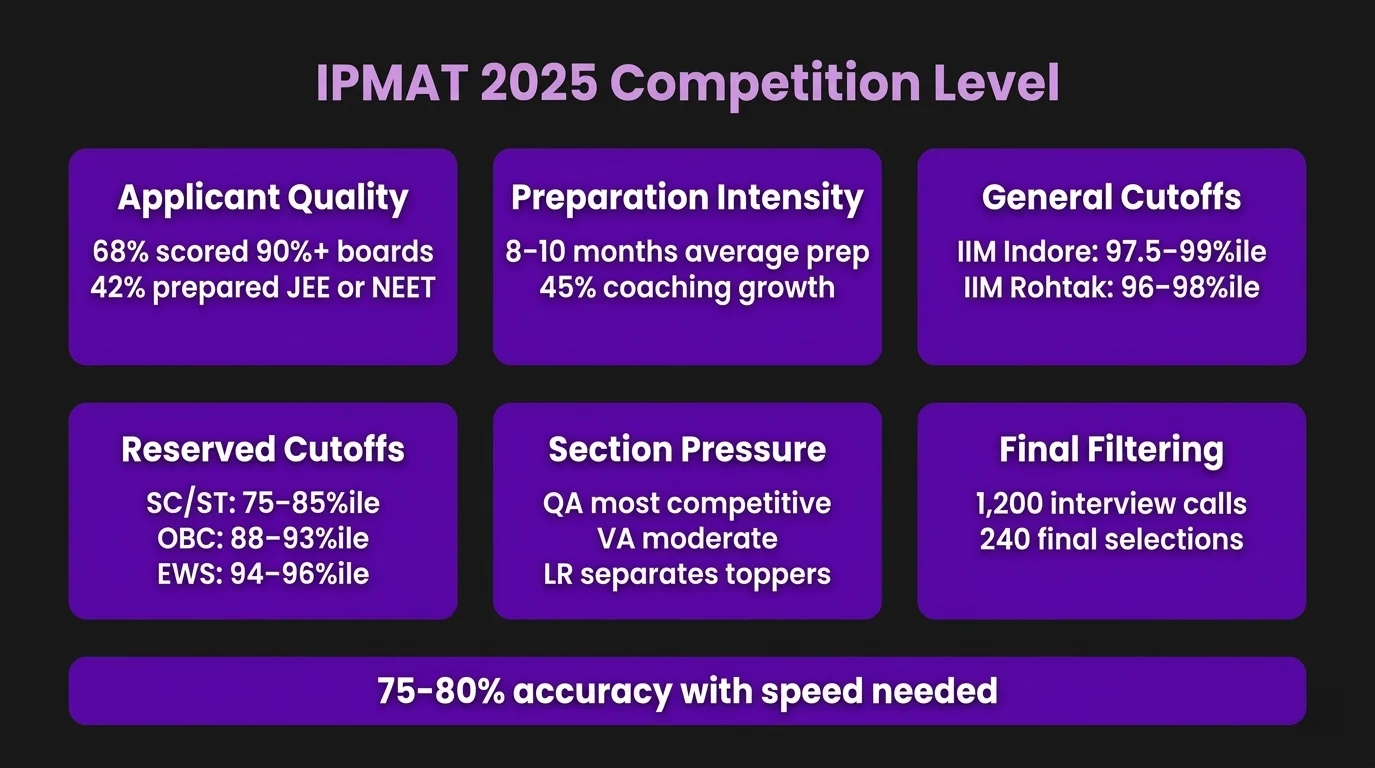
IPMAT 2025 witnessed its highest-ever registration numbers, establishing new benchmarks for entrance exam competition. The competition level manifests across multiple dimensions:
Applicant quality metrics:
- 68% of test-takers had 90%+ in Class 12 boards
- 42% simultaneously prepared for JEE/NEET, bringing strong quantitative skills
- Average preparation duration increased to 8–10 months (up from 6 months in 2022)
- Coaching institute enrollment for IPMAT grew 45% year-over-year
The admission cutoff percentile for general category students typically hovers around 97.5–99 percentile for IIM Indore and 96–98 percentile for IIM Rohtak. For reserved categories:
- SC/ST: 75–85 percentile
- OBC-NCL: 88–93 percentile
- EWS: 94–96 percentile
- PwD: 70–80 percentile
Section-wise competition intensity:
- Quantitative Ability: Most competitive, with top 5% students scoring 95%+ accuracy
- Verbal Ability: Moderate difficulty, 15–20% students score above 85%
- Logical Reasoning: High variance, creating differentiation among top performers
The written ability test and personal interview round further filter candidates. Approximately 1,200 students (top 2.4% of applicants) receive interview calls, from which final 240 students secure admission.
Compared to the exam difficulty level of similar tests, IPMAT sits between moderate and challenging. While questions aren’t as conceptually deep as JEE Advanced, the time pressure and accuracy requirements create substantial difficulty. Students need 75–80% accuracy with speed to reach competitive percentiles.
IPMAT Total Number of Applicants vs Seats Available
The seat matrix IPM reveals stark disparity between demand and supply:
IIM Indore IPM breakdown:
- Total seats: 120
- General: 60 (50%)
- OBC-NCL: 27 (22.5%)
- SC: 18 (15%)
- ST: 9 (7.5%)
- EWS: 12 (10%)
- PwD: Supernumerary (approximately 3–5)
IIM Rohtak IPM breakdown:
- Total seats: 120
- General: 60 (50%)
- OBC-NCL: 27 (22.5%)
- SC: 18 (15%)
- ST: 9 (7.5%)
- EWS: 12 (10%)
- PwD: Supernumerary (approximately 3–5)
With 50,800 applicants in 2025 for 240 seats, the overall acceptance rate stands at 0.47%. Breaking this down by category:
- General category: ~28,000 applicants for 120 seats (0.43% acceptance)
- OBC-NCL: ~12,700 applicants for 54 seats (0.42% acceptance)
- SC: ~6,100 applicants for 36 seats (0.59% acceptance)
- ST: ~2,500 applicants for 18 seats (0.72% acceptance)
- EWS: ~4,500 applicants for 24 seats (0.53% acceptance)
The selection criteria IPM follows includes:
- IPMAT score (85% weightage): Composite score across all three sections
- Personal Interview (15% weightage): Communication, attitude, general awareness, and problem-solving ability evaluation
- Academic consistency: Strong performance in Class 10 and 12 boards (considered during shortlisting)
For every seat in the five-year integrated program, more than 200 students compete, making selection rates more stringent than many engineering colleges accepting JEE Main scores.
Students often ask about their chances with specific percentiles. Here’s realistic assessment:
- 99+ percentile: Strong interview call probability (80–90%)
- 97–99 percentile: Moderate probability (40–60%)
- 95–97 percentile: Lower probability (15–30%)
- Below 95 percentile: Minimal chances unless reserved category with lower cutoffs
How Competitive Is IPMAT Compared to Other Entrance Exams?
Comparing IPMAT with other entrance exams provides perspective on its difficulty and competition level:
| Exam | Applicants (2024-25) | Seats | Ratio | Difficulty Level |
| JEE Main | ~1,300,000 | ~25,000 (NITs/IIITs/CFTIs) | 52:1 | High |
| JEE Advanced | ~180,000 | ~16,000 (IITs) | 11:1 | Very High |
| NEET UG | ~2,400,000 | ~108,000 | 22:1 | High |
| IPMAT | ~50,800 | 240 | 212:1 | Moderate-High |
| CLAT | ~75,000 | ~2,800 | 27:1 | Moderate |
Key differences:
IPMAT vs JEE comparison:
- IPMAT has higher competition ratio (212:1 vs 52:1)
- JEE tests deeper conceptual understanding; IPMAT emphasizes speed and accuracy
- JEE syllabus is more extensive; IPMAT covers Class 11-12 fundamentals
- Both require 8–12 months serious preparation for top percentiles
IPMAT vs other aptitude tests:
- IPMAT is more selective than most state engineering entrance exams
- Similar difficulty to CLAT but with steeper competition ratio
- More focused syllabus compared to general aptitude tests like CUET
The aptitude test competition in IPMAT centers around three factors:
- Speed: 100 questions in 120 minutes requires 1.2 minutes per question
- Accuracy: Negative marking (-1 for wrong MCQ, -0.33 for wrong SA) punishes guesswork
- Consistency: Must perform well across quantitative ability section, verbal ability section, and logical reasoning section
Students preparing for multiple exams often find IPMAT’s quantitative ability section easier than JEE but trickier than most state entrance exams. The verbal ability section requires strong vocabulary and reading comprehension—skills less emphasized in pure engineering exams.
IPMAT Registration Trends and 2025 Application Statistics
The entrance exam registration process for IPMAT 2025 revealed interesting patterns:
Registration timeline breakdown:
- Application form IPMAT opens: Mid-March 2025
- Peak registration period: Last week before deadline (58% applications received)
- Final deadline: Early May 2025
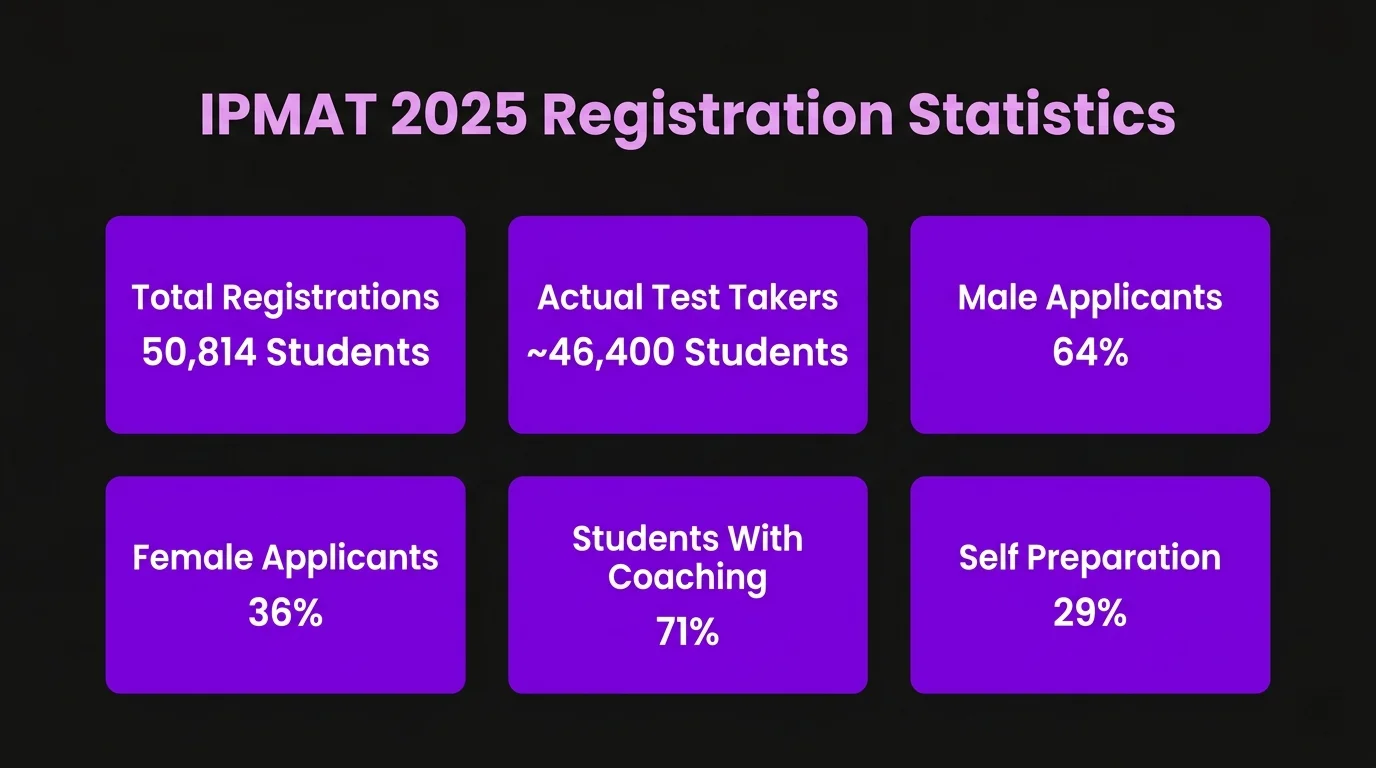
- Total registrations: 50,814 students
Demographic distribution:
- Male applicants: 64%
- Female applicants: 36%
- Tier-1 cities: 48%
- Tier-2/3 cities: 52%
- Students with coaching: 71%
- Self-prepared students: 29%
State-wise applicant concentration (top 5):
- Uttar Pradesh: 8,900 (17.5%)
- Maharashtra: 7,300 (14.4%)
- Delhi NCR: 6,100 (12%)
- Rajasthan: 4,700 (9.2%)
- Gujarat: 3,800 (7.5%)
The application fee structure remained ₹3,000 for general/OBC candidates and ₹1,500 for SC/ST/PwD candidates. Late fee of ₹500 applied for applications submitted in the final week.
Notable trends in 2025:
- 24% increase in female applicants compared to 2023
- 31% rise in applications from tier-2/3 cities, indicating growing awareness
- Students simultaneously applying for 3.7 entrance exams on average
- 89% applicants under 19 years (fresh Class 12 pass-outs)
How many students appear for IPMAT varies slightly from registrations to actual test-takers. Typically, 8–10% registered candidates don’t appear on exam day due to illness, other exam conflicts, or changed career plans.
Post-registration, the exam conducting authority released admit cards two weeks before exam date. The actual show-up rate in 2025 was 91.3%, meaning approximately 46,400 students actually sat for the IPMAT exam out of 50,814 registered.
Is IPMAT Getting More Competitive Each Year? Trend Analysis
Historical analysis confirms escalating competition for how many students appear for IPMAT:
Growth rate analysis:
- 2020–2021: 12% increase in applications
- 2021–2022: 15% increase
- 2022–2023: 11.8% increase
- 2023–2024: 11% increase
- 2024–2025: 7.6% increase
- Projected 2025–2026: 8–10% increase (estimated 55,000 applicants)
The growth rate has stabilized around 8–12% annually after initial explosive growth when the program launched. Several factors drive sustained increase:
Demand-side factors:
- Career aspirations shifting younger: More students opting for management careers straight after Class 12
- Placement records: IPM graduates from 2019–2020 batches secured impressive packages (average ₹25–30 lakhs)
- Brand value: IIM tag at undergraduate level attracts high-achieving students
- Social proof: Growing alumni network demonstrating program success
Supply-side constraints:
- Seat matrix IPM hasn’t increased since 2017 at IIM Indore
- IIM Rohtak added IPM in 2019 but no capacity expansion since
- No new IIMs announced IPM programs recently
- Infrastructure and faculty limitations prevent rapid seat expansion
Percentile inflation over years:
| Percentile | 2022 Raw Score | 2023 Raw Score | 2024 Raw Score | 2025 Raw Score (est.) |
| 99%ile | 82–85 | 84–87 | 86–89 | 88–91 |
| 95%ile | 68–71 | 70–73 | 72–75 | 74–77 |
| 90%ile | 58–62 | 60–64 | 62–66 | 64–68 |
This score inflation indicates that students are preparing better, coaching quality has improved, and the overall applicant pool quality is rising.
Cutoff trends:
- 2022: General category interview cutoff at 96.8 percentile
- 2023: Increased to 97.2 percentile
- 2024: Further rose to 97.8 percentile
- 2025: Reached 98.1 percentile
The trend clearly shows increasing difficulty in securing interview calls. What scored admission three years ago barely qualifies for an interview today.
Future projections (2026–2028):
Based on current trends, by 2028:
- Expected applicants: 62,000–65,000
- Competition ratio: 260:1
- General category cutoff: 98.5+ percentile
- Preparation intensity: 10–12 months becoming standard
Students serious about IPMAT need to account for this escalating competition. Starting preparation early, building strong fundamentals, and taking regular mock tests becomes non-negotiable.
How to Improve Your Chances in High IPMAT Competition
Understanding how competitive IPMAT has become, strategic preparation makes crucial difference:
Preparation timeline optimization:
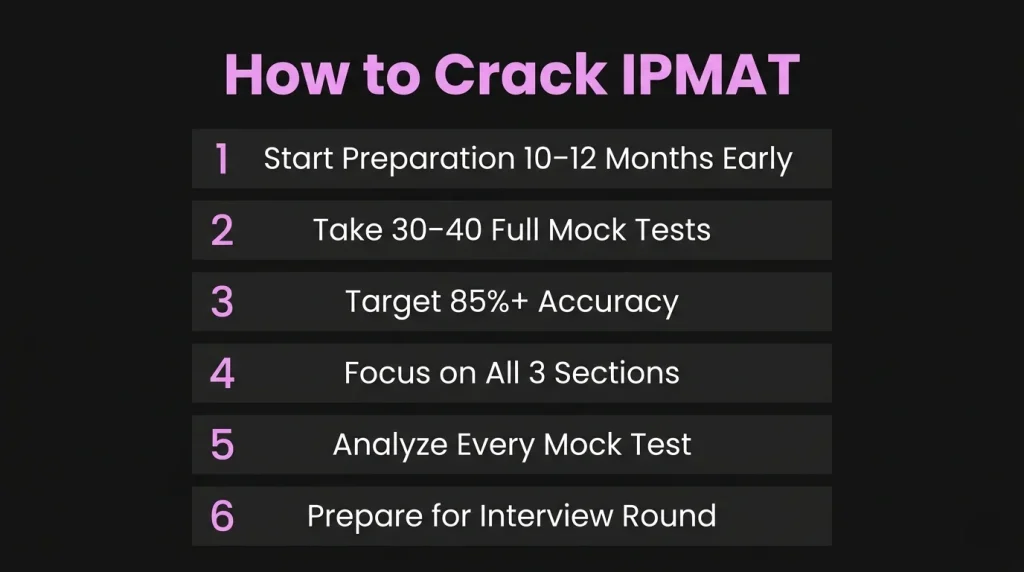
- 12 months before exam: Complete syllabus coverage, focus on building concepts in quantitative ability section
- 9–10 months: Begin verbal ability section preparation, vocabulary building, reading comprehension practice
- 6–8 months: Start logical reasoning section practice, pattern recognition exercises
- 4–6 months: Intensive mock test phase, analyze weak areas, time management drills
- 2–3 months: Focus on accuracy improvement, revision, and full-length tests
- Final month: Maintain confidence, take one test every 3 days, avoid new topics
Mock test strategy:
- Take 30–40 full-length tests before actual exam
- Replicate exact exam conditions (time, environment, breaks)
- Analyze every test within 24 hours
- Track improvement in accuracy and speed separately
- Identify question types where you lose maximum time
Mock tests from Phodu Club mimic the exact exam pattern, offering students a realistic practice environment. The pattern similarity helps reduce exam-day anxiety and improves time management—critical factors when competition is this intense.
Section-wise preparation focus:
- Quantitative ability (40 questions): Master arithmetic, algebra, geometry, and modern math fundamentals; aim for 90%+ accuracy
- Verbal ability (40 questions): Read extensively (newspapers, magazines, novels); build 3,000+ word vocabulary; practice 200+ RC passages
- Logical reasoning (20 questions): Solve 500+ varied logic puzzles; strengthen pattern recognition; practice data interpretation
Accuracy vs speed balance:
At IPMAT’s competition level, both matter equally. Target benchmarks:
- By 6 months before exam: 75% accuracy at comfortable pace
- By 3 months: 80% accuracy with moderate time pressure
- By 1 month: 85%+ accuracy within actual time limits
Interview preparation:
Since 1,200 students compete for 240 seats post-shortlisting, the personal interview round becomes decisive. Focus areas:
- Current affairs and business news awareness
- Communication clarity and confidence
- Problem-solving approach articulation
- Handling stress questions with composure
The written ability test evaluates structured thinking and written communication—practice writing 300-word essays in 20 minutes on diverse topics.
Conclusion
The number of students who appear for IPMAT continues climbing each year, reaching 50,800 in 2025 with projections suggesting 55,000+ in 2026. Key takeaways:
- Competition ratio of 212:1 makes IPMAT one of India’s most selective undergraduate entrance exams
- Cutoff percentiles increase annually as applicant quality improves—general category needs 98+ percentile now
- Strategic preparation over 10–12 months, intensive mock testing, and strong interview skills differentiate successful candidates
- Starting early and maintaining consistency across quantitative ability section, verbal ability section, and logical reasoning section proves essential in this competitive landscape
Frequently Asked Questions
1) How many students appeared for IPMAT 2025 exactly?
Approximately 50,814 students registered for IPMAT 2025 across both IIM Indore and IIM Rohtak combined, with actual test-taker numbers around 46,400 after accounting for no-shows. This represents a 7.6% increase from 2024’s registration numbers.
2) What percentile do I need to get IIM Indore through IPMAT with current competition?
For general category students, you need approximately 98+ percentile to receive an interview call from IIM Indore based on 2025 cutoffs. Reserved categories have lower cutoffs: OBC-NCL around 88–93 percentile, SC/ST around 75–85 percentile, and EWS around 94–96 percentile.
3) Is IPMAT harder than JEE Main in terms of competition and difficulty?
IPMAT has a higher competition ratio (212:1) compared to JEE Main (52:1), but JEE Main tests deeper conceptual knowledge. IPMAT emphasizes speed and accuracy over conceptual depth. Question difficulty in IPMAT is moderate compared to JEE’s high difficulty level.
4) How many seats are available in IPMAT for general category students?
A total of 120 general category seats are available across both IIMs—60 at IIM Indore and 60 at IIM Rohtak. Additionally, EWS quota provides 12 seats per institute (24 total), which economically weaker general category students can compete for.
5) What is my realistic chance of selection if I score 96 percentile in IPMAT?
With 96 percentile, your chances depend on category. For the general category, interview call probability is low (under 15%). For OBC-NCL, chances improve to 30–40%. For SC/ST, 96 percentile gives a strong probability (70–80%) of interview call and subsequent selection.
6) Are IPMAT registrations increasing every year and why?
Yes, IPMAT registrations have grown 8–12% annually over the past five years due to increasing awareness of the five-year integrated program, strong placement records of IPM graduates, and limited alternative premier options for management education immediately after Class 12.