BITSAT (Birla Institute of Technology and Science Admission Test) is the entrance exam for admission into BITS Pilani and its campuses in Goa, Hyderabad, and Dubai. Every year, thousands of students appear for this exam to secure a seat in top engineering and science courses.
BITSAT is known for its speed-based testing. It checks students on their understanding, accuracy, and time management. The exam is online and includes Physics, Chemistry, Mathematics (or Biology), English, and Logical Reasoning.
This article will help students understand all the key points of BITSAT 2026. It includes exam dates, eligibility, syllabus, pattern, and preparation tips. Students will also find a step-by-step strategy, book recommendations, mock test suggestions, and last-minute revision plans. All the information is presented in simple language to help students focus better and prepare confidently.
BITSAT 2026 Exam Overview
BITSAT (Birla Institute of Technology and Science Admission Test) is the entrance exam for admission to BITS Pilani and its campuses in Goa, Hyderabad, and Dubai. BITSAT 2026 will be held in two sessions. Candidates can choose to appear in either Session 1, Session 2, or both sessions. If a student appears in both sessions, the best score among the two will be considered for admission.
The exam is conducted online and is based on the NCERT syllabus for Classes 11 and 12. It tests students in Physics, Chemistry, Mathematics/Biology, English Proficiency, and Logical Reasoning. The exam is speed-based and includes 130 questions in total.
To help students plan well, here is the tentative schedule for BITSAT 2026:
Important Dates and Deadlines for BITSAT 2026
| Events | Date |
| BITSAT 2026 Application form | 15th December 2025 |
| Last Date to apply online for Session I or both sessions | To Be Announced |
| Correction in the application form | To Be Announced |
| Test centre allotment | To Be Announced |
| Candidates to reserve test date and slot | To Be Announced |
| Admit card | To Be Announced |
| BITSAT 2026 Online Test Session- I | 15th to 17th April 2026 |
| Application window to apply for Session II | To Be Announced |
| Editing in the application form | To Be Announced |
| Test center allotment | To Be Announced |
| Candidates to reserve test date and slot | To Be Announced |
| Admit card (Session II) | To Be Announced |
| BITSAT 2026 Online Test session II | 24th to 26th May 2026 |
| Apply for admission | To Be Announced |
| Editing of preference application form | To Be Announced |
| Admit list and Waitlist announcement after Iteration I | To Be Announced |
Students must regularly check the official BITS admission website for any updates or changes. Keep a copy of all submitted forms, hall tickets, and payment receipts for future reference. Following this schedule carefully will help you stay ahead in your BITSAT 2026 journey.
BITSAT Exam Pattern & Marking Scheme
BITSAT 2026 will be an online computer-based test. It is designed to check the student’s knowledge in Physics, Chemistry, Mathematics or Biology, English Proficiency, and Logical Reasoning. The total duration of the exam is 3 hours (180 minutes) without any break.
The BITSAT-2026 exam is divided into four parts:
| Part | Subject | Number of Questions |
| Part I | Physics | 30 |
| Part II | Chemistry | 30 |
| Part III (a) | English Proficiency | 10 |
| Part III (b) | Logical Reasoning | 20 |
| Part IV | Mathematics (or Biology)* | 40 |
| Total | — | 130 |
- Candidates applying for B.Pharm or B.E. Environmental and Sustainability Engineering can choose Biology instead of Mathematics in Part IV.
- All questions are multiple choice with four options. Only one option is correct.
- Each correct answer gets +3 marks.
- Each wrong answer results in -1 mark.
- Unattempted questions get 0 marks.
Navigation and Flexibility
- Candidates can move freely between questions.
- There is no time limit for any individual section.
- You can skip questions and return to them later.
- However, you cannot select more than one option per question.
Extra Questions Option: BITSAT has a special feature for top-performing students. If a student answers all the 130 questions and still has time left, the system unlocks 12 extra questions. These questions are:
- 3 from Physics
- 3 from Chemistry
- 3 from Mathematics or Biology
- 3 from Logical Reasoning
That means you can answer up to 142 questions if you attempt all 130 questions first. But keep in mind:
- Once you choose to attempt these 12 extra questions, you cannot go back to change any of your previous answers from the 130 questions.
- These extra questions are optional. Attempt them only if you are confident.
Level of Difficulty: The paper is designed in such a way that a well-prepared student can attempt all 130 questions in 3 hours. However, not all students may be able to do so, especially due to the pressure of speed and accuracy.
The questions are selected randomly from a large question bank. Each student gets a unique set of questions. All sets are made equal in terms of difficulty, question types, and content.
Language and Tools Allowed
- The test will be in English only.
- No calculators or logarithmic tables are allowed.
- Scratch pads will be provided for rough work.
- You must carry a pen for signing and rough work.
- Mobile phones, smartwatches, and personal belongings are strictly prohibited.
BITSAT Syllabus Breakdown
The BITSAT 2026 syllabus is based on the NCERT curriculum of Class 11 and Class 12. Students preparing for BITSAT should follow the NCERT textbooks for Physics, Chemistry, Mathematics (or Biology), English, and Logical Reasoning.
Physics includes important topics like:
- Mechanics
- Heat and Thermodynamics
- Current Electricity
- Electromagnetism
- Waves and Optics
- Modern Physics
Chemistry covers:
- Physical Chemistry: States of Matter, Thermodynamics, Electrochemistry
- Organic Chemistry: Hydrocarbons, Alcohols, Reactions of Organic Compounds
- Inorganic Chemistry: Periodic Table, Chemical Bonding, Coordination Compounds
Mathematics includes:
- Algebra, Trigonometry, and Calculus
- Coordinate Geometry
- Probability and Statistics
Biology (for B.Pharm aspirants) includes:
- Cell Structure
- Genetics
- Human Physiology
- Ecology and Environment
English Proficiency and Logical Reasoning includes:
- Grammar, Vocabulary, Synonyms
- Reading Comprehension
- Logical sequences, Coding-Decoding, Pattern Identification
Students must stick to the NCERT syllabus and practice thoroughly. All questions in BITSAT will be framed from these topics. No questions will be asked outside this syllabus.
Step-by-Step BITSAT Preparation Strategy
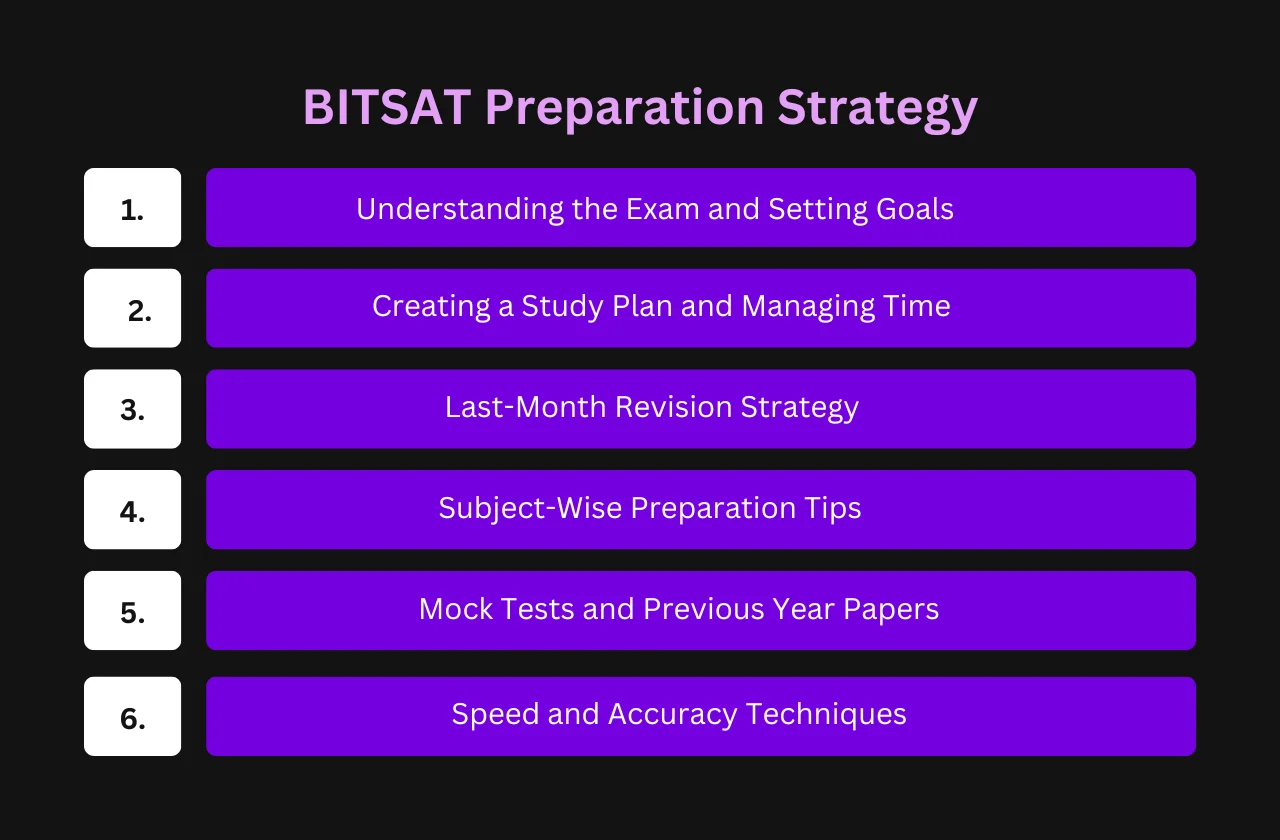
Preparing for BITSAT 2026 needs a clear plan, strong basics, and good time management. This section will guide you through a full strategy, including how to start, how to plan your months, what to focus on for each subject, and how to revise.
1) Understanding the Exam and Setting Goals
Before starting preparation, understand the exam pattern, marking scheme, and topics covered. BITSAT is not only about knowing concepts. It is also about speed, accuracy, and time control.
- BITSAT has 130 questions to be solved in 180 minutes.
- That gives you less than 1.4 minutes per question.
- You also get a chance to solve 12 extra questions if you complete all 130 questions.
Why is Goal-Setting Important?
- It keeps you motivated and focused.
- It helps you break your preparation into small parts.
- You can track your daily and weekly progress.
2) Creating a Study Plan and Managing Time
There is no perfect plan. You need a plan that suits your daily routine and learning speed. Below are two types of plans:
3-Month Intensive Plan (For Late Starters)
Preparing within a limited timeframe requires disciplined scheduling, focused study blocks, and consistent revision. The following plan reduces time allocated to English and Logical Reasoning while strengthening core subjects and retention efficiency.
Daily Study Structure (6–8 Effective Hours)
- Morning Session — 2.5 Hours
- Primary Subject Focus (Physics / Chemistry / Mathematics)
Use peak mental energy for concept-heavy learning.
- Study new topics
- Work through solved examples
- Practice foundational problems
Midday Revision — 45 Minutes
Same-Day Reinforcement
- Review formulas and key concepts
- Revisit difficult questions
- Solve 10–15 mixed practice problems
Evening Session — 2.5 Hours
Second Core Subject + Intensive Practice
- Problem-solving sessions
- Previous years’ questions
- Timed practice sets
- Application-focused learning
Night Session — 45 Minutes
- English or Logical Reasoning (Alternate Days)
- Keep this session light and skill-focused.
English Days
- Reading comprehension practice
- Vocabulary building
- Short grammar drills
Logical Reasoning Days
- Puzzles and arrangements
- Analytical reasoning sets
- Pattern recognition exercises
Sunday — Performance Analysis and Weak Area Improvement
- Detailed mock test review
- Error classification and correction
- Reattempt incorrect questions
- Focused revision of weak topics
- Light reinforcement practice
6-Month Balanced Plan (For Early Starters)
This plan is designed around learning phases, workload balance, and feedback cycles. The emphasis is on concept clarity first, then exam-level application, followed by testing and precision revision.
Phase 1 — Foundation Building (Weeks 1–8)
Goal: Strong conceptual base using NCERT and core references.
Focus Areas:
- Physics: Theory clarity + basic numericals
- Chemistry: NCERT mastery (Physical, Organic mechanisms, Inorganic facts)
- Mathematics: Concept depth + standard problem types
- English & Logical Reasoning: Light, consistent practice (2–3 sessions/week)
Study Approach
- Learn concepts in short focused blocks
- Solve fundamental problems immediately after theory
- Maintain a formula and error notebook
- Weekly mini-tests for retention checks
Outcome
- Complete conceptual coverage
- Comfort with standard question patterns
- Reduced dependence on memorization
Phase 2 — Application & Exam-Level Practice (Weeks 9–16)
Goal: Transition from learning to solving.
Focus Areas:
- Mixed subject problem sets
- BITSAT-type speed questions
- Timed sectional practice
- Increasing question volume
Study Approach
- Topic-wise advanced problems
- Previous years’ questions
- Timed practice to build speed
- Identify weak chapters early
English & Logical Reasoning
- 2 short sessions per week
- Focus on accuracy and speed, not theory depth
Outcome
- Faster problem-solving
- Familiarity with exam difficulty
- Clear subject-wise strengths and gaps
Phase 3 — Testing & Performance Optimization (Weeks 17–20)
Goal: Convert preparation into exam performance.
Focus Areas
- Regular mock tests
- Time management
- Accuracy under pressure
Study Approach
- 2–3 full-length mocks per week
- Simulate real exam conditions
- Deep performance analysis after each test
- Redo incorrect and skipped questions
Outcome
- Improved speed and stamina
- Refined exam strategy
- Reduction in repeated mistakes
Phase 4 — Final Revision & Precision Practice (Weeks 21–24)
Goal: Consolidation and recall strength.
Focus Areas:
- Formula revision
- Important reactions and concepts
- High-yield chapters
- Error notebook mastery
Study Approach
- Alternate-day full mock tests
- Rapid revision cycles
- Light practice between tests
- Avoid new heavy topics
Outcome
- Strong recall
- Stable mock scores
- Exam readiness
3) Last-Month Revision Strategy
The final month is about converting preparation into reliable exam performance. At this stage, improvement comes from precision, recall speed, and test temperament rather than new learning.
| Time Block | Duration | Focus Area | Purpose | Key Activities |
| Rapid Recall | 45–60 min | Formulas & Core Concepts | Memory activation | Physics & Math formulas, Chemistry reactions, key concepts, error notebook review |
| Test Practice | 2–3 hrs | Mock / Sectional Tests | Exam stamina & timing control | Full mock every 2–3 days; sectional timed tests on other days; real exam simulation |
| Performance Analysis | 1–1.5 hrs | Test Review | Score improvement | Classify mistakes (concept, calculation, misread, time pressure), re-solve errors, log weak areas |
| Targeted Practice | 1.5–2 hrs | Weak Chapters | Corrective improvement | Chapter-wise problem sets, exam-pattern questions, timed drills for speed |
| Light Skills Practice | 30–45 min | English & Logical Reasoning | Accuracy maintenance | Reading comprehension, vocabulary drills, logical puzzles, pattern practice |
What to Avoid in the Final Month
| Avoid | Reason |
| Starting new heavy topics | Low retention and high stress |
| Using multiple new books | Fragmented preparation and confusion |
| Random problem solving | No measurable improvement |
| Excessive comparison with others | Reduces focus and confidence |
| Irregular sleep schedule | Direct impact on performance and recall |
4) Subject-Wise Preparation Tips
Let’s now break down the best way to prepare each subject.
Physics Preparation Tips: Physics can be tough if you don’t focus on concepts.
Books to Use:
- NCERT Class 11 & 12
- HC Verma (Concepts of Physics)
- Arihant BITSAT Physics Guide
How to Study:
- Start with NCERT theory for basic understanding.
- Move to HC Verma for solving problems.
- Make a formula sheet and revise it every 2 days.
- Solve at least 50 questions per chapter before moving ahead.
Chemistry Preparation Tips: Chemistry is scoring if you focus on the right material.
Books to Use
- NCERT Class 11 & 12
- OP Tandon (Physical + Inorganic)
- MS Chouhan (Organic)
How to Study
- Start with NCERT Inorganic Chemistry. Every line is important.
- Learn named reactions and mechanisms for Organic.
- Practice numerical problems
- Make short notes
- Revise Chemistry daily. Memory-based subjects need repetition.
Mathematics Preparation Tips: Maths can fetch high marks if you practice enough.
Books to Use
- NCERT + RD Sharma
- Cengage for Calculus and Algebra
- Arihant BITSAT Maths Guide
How to Study
- Start with NCERT to learn basic theory.
- Solve 20-30 MCQs daily
- Focus on speed and accuracy.
- Memorize standard formulas and identities.
- Practice mental calculation and estimation methods.
English & Logical Reasoning Tips: This section can boost your score if prepared well.
Books to Use
- Word Power Made Easy – Norman Lewis
- Wren and Martin – Grammar
- RS Aggarwal – Logical Reasoning
How to Study
- Learn 10 new words daily from Word Power Made Easy.
- Practice comprehension questions regularly.
- Revise grammar rules like tenses, articles, voice, and speech.
- Solve reasoning puzzles and coding-decoding daily.
- Use online apps for daily practice (like CAT Prep apps).
Biology (For B.Pharm and B.E. Environmental Aspirants): Biology is fact-based and needs regular revision.
Books to Use
- NCERT Biology Class 11 & 12
- Trueman’s Biology (for extra practice)
How to Study
- Read and revise NCERT line by line.
- Focus on diagrams, definitions, and cycles.
- Practice MCQs from each chapter.
- Create flashcards
5) Mock Tests and Previous Year Papers
Mock tests are the most important part of BITSAT preparation.
Why Take Mock Tests?
- Helps you get used to the exam format.
- Builds time management skills.
- Shows your strong and weak areas.
- Prepares you for the real exam pressure.
Best Sources for Mock Tests
- Phodu Club BITSAT Test Series
- Arihant BITSAT Practice Tests
How to Analyze Mock Tests
- Note down your total score.
- Check time taken per section.
- Find where you lost marks (silly mistakes, lack of knowledge, speed).
- Maintain a notebook of mistakes and solutions.
- Reattempt only your incorrect questions the next day.
6) Speed and Accuracy Techniques
To score well in BITSAT, both speed and accuracy are important.
Time Management per Section
| Section | Suggested Time |
| Physics | 35 minutes |
| Chemistry | 35 minutes |
| Math/Biology | 45 minutes |
| English & Reasoning | 25 minutes |
| Extra Questions | If Time Allows |
Tips to Improve Speed
- Use short tricks and formulas.
- Skip lengthy questions and come back later.
- Solve easier questions first in each subject.
Tips to Improve Accuracy
- Read questions carefully before answering.
- Avoid random guesses.
- Double-check units and options.
Elimination Method for MCQs
- Remove clearly wrong options.
- Choose between the last two using logic.
- Use previous knowledge to rule out impossible choices.
Bonus: Do’s and Don’ts During Preparation
Do’s
- Follow a regular schedule.
- Take breaks between study sessions.
- Stay healthy and eat well.
- Sleep for 6–8 hours.
- Track your progress weekly.
Don’ts
- Don’t waste time on social media.
- Don’t leave any subject completely.
- Don’t panic if mock test scores are low.
- Don’t skip revision.
Monthly Strategy
| Month | Focus Area | Goals |
| Month 1 | Basics + NCERT | Complete basic theory of all subjects |
| Month 2 | Practice | Start solving MCQs and questions |
| Month 3 | Advanced Questions | Solve mixed-level questions from BITSAT books |
| Month 4 | Mock Tests | Weekly full-length tests + error tracking |
| Month 5 | Speed Practice | Focus on time-bound questions |
| Month 6 | Revision | Revise notes, solve mocks, and take light tests |
This step-by-step preparation plan will help students stay organized and confident. Whether you have 3 months or 6 months left, follow the plan that matches your schedule. Be consistent, test regularly, and revise often. That is the key to cracking BITSAT 2026 with a high score.
Conclusion
BITSAT 2026 is a competitive exam. But with the right plan and hard work, students can perform well. Start early and follow a smart study strategy. Use NCERT as your base and build on it with extra practice. Take mock tests seriously and revise your mistakes. Choose the right books and use good online resources. Most importantly, stay confident and focused.
With the tips and strategies in this guide, students can prepare effectively and aim for top scores in BITSAT 2026.
Frequently Asked Questions (FAQs)
1) Can I take BITSAT twice in a year?
Yes, you can take BITSAT two times in the same year. BITS will consider the better score for admission.
2) Is NCERT enough for BITSAT?
NCERT is good for Chemistry and basic understanding. But for high scores, practice from extra books like HC Verma, MS Chouhan, and Cengage.
3) How difficult is BITSAT compared to JEE?
BITSAT has simpler questions than JEE Advanced. But BITSAT tests speed and accuracy more. You have less time per question.
4) What is a good BITSAT score for CS in BITS Pilani?
A score above 300 is usually needed for Computer Science in BITS Pilani. Cutoffs may change slightly every year.
5) Can I get admission with 75% in 12th but a high BITSAT score?
Yes. If you have 75% in PCM and 60% in each subject, you can get admission with a high BITSAT score.