BITSAT is an important exam for students who want admission to BITS Pilani, Goa, or Hyderabad. It tests knowledge in Physics, Chemistry, Mathematics/Biology, English, and Logical Reasoning. Many students focus more on the technical subjects and ignore English and Logical Reasoning. However, these sections can boost overall scores if prepared well.
The English section checks grammar, vocabulary, and reading skills. The Logical Reasoning section tests problem-solving abilities through verbal and non-verbal questions. These sections may seem easy, but without proper practice, students can lose marks due to negative marking.
Scoring well in these sections can give an advantage over other candidates. A strong vocabulary, clear understanding of grammar, and logical thinking are essential for success. This guide explains the complete syllabus, key concepts, and preparation tips for English and Logical Reasoning. With the right approach, students can improve accuracy and complete these sections quickly during the exam.
BITSAT 2026 Exam Pattern
BITSAT follows a unique pattern that includes multiple-choice questions across different subjects. The test aims to evaluate a student’s analytical, problem-solving, and comprehension skills. Understanding the pattern is crucial for effective preparation.
Mode of Exam
BITSAT is a computer-based test (CBT), meaning students have to answer all questions on a computer screen. There is no offline or pen-and-paper mode for this exam.
Duration
The total duration of BITSAT is 3 hours (180 minutes). There are no breaks during the exam, so students must manage their time effectively. Since there are 130 questions, students need to answer quickly while maintaining accuracy.
Number of Questions
BITSAT consists of 130 multiple-choice questions (MCQs). Each question has four options, with only one correct answer. The distribution of questions across different subjects is as follows:
| Section | Subject | Number of Questions |
| Part I | Physics | 30 |
| Part II | Chemistry | 30 |
| Part III | (a) English Proficiency | 10 |
| (b) Logical Reasoning | 20 | |
| Part IV | Mathematics/Biology* | 40 |
(*Biology is only for B.Pharm aspirants. All other students must attempt Mathematics.)
Each section carries significant weight in determining the final score. While Physics, Chemistry, and Mathematics/Biology have the highest number of questions, English and Logical Reasoning can boost scores if prepared well.
Marking Scheme
BITSAT follows a positive and negative marking scheme, so students must be cautious while answering questions.
- Correct Answer: +3 marks
Incorrect Answer: -1 mark - Unanswered Question: No marks deducted or awarded
Since incorrect answers lead to negative marking, students should avoid guessing blindly. Instead, they should attempt only those questions where they can eliminate wrong options with some confidence.
Extra Questions (Bonus)
BITSAT has a unique feature of 12 extra questions. If a student answers all 130 questions, they get an option to attempt 12 additional questions. These extra questions come from the same subjects:
| Subject | Number of Extra Questions |
| Physics | 3 questions |
| Chemistry | 3 questions |
| Mathematics/Biology | 3 questions |
| Logical Reasoning | 3 questions |
Once a student chooses to attempt the extra questions, they cannot return to the original 130 questions. This means they must be confident in their previous answers before proceeding to the extra set. These bonus questions help high-scoring students improve their overall performance, but they require a strong command of the syllabus and excellent time management.
BITSAT 2026 Important Dates (Tentative)
BITSAT is conducted in two sessions. Students can appear for Session-1, Session-2, or both. If they take both sessions, the higher score will be considered for admission. The tentative schedule for BITSAT 2026 is:
| Event | Corrected Date / Status |
| Session 1 / Both Sessions Application | Closed (Ended March 19, 2026) |
| Application Edit Window (Session 1) | Closed (Ended March 22, 2026) |
| Test City Allotment Announcement | 28 March 2026 (Saturday) |
| Slot Booking (Session 1) | 29 to 31 March 2026 |
| Hall Ticket Download (Session 1) | 10 April 2026 until exam date |
| BITSAT 2026 Session 1 Exam | 15 to 16 April 2026 |
| Application Window (Session 2 Only) | 20 April to 02 May 2026 |
| Application Edit Window (Session 2) | 04 to 06 May 2026 |
| Test Center Allotment (Session 2) | 12 May 2026 |
| Slot Booking (Session 2) | 13 to 15 May 2026 |
| Hall Ticket Download (Session 2) | 20 May 2026 until exam date |
| BITSAT 2026 Session 2 Exam | 24 to 26 May 2026 |
| Apply with Class 12 Marks & Preferences | 17 April to 01 June 2026 |
| Editing of Marks and Preferences | 03 to 05 June 2026 |
| Admit List & Waitlist (Iteration I) | 15 June 2026 |
| Last Date to Accept Offer & Pay Fees | 22 June 2026 |
Students must keep track of these dates and complete their applications before the deadline. Slot booking for the exam is done on a first-come, first-served basis, so candidates should book their test slots early to get their preferred exam date and time.
Key Points to Remember
- BITSAT is a speed-based test. Since there are 130 questions in 180 minutes, students must answer quickly while avoiding negative marking.
- Time management is crucial. Some questions may be tricky, so students should avoid spending too much time on one question.
- The exam has no sectional time limits. Students can switch between sections as per their preference. However, a balanced approach is recommended.
- Practice is essential. Solving previous years’ papers and mock tests will help in understanding the difficulty level and improving accuracy.
- Bonus questions can be beneficial. If students are confident in their answers, attempting extra questions can improve their scores.
BITSAT English Syllabus: Complete Info (2026)
BITSAT includes an English Proficiency and Logical Reasoning section to test candidates’ language skills and problem-solving abilities. Many students focus mainly on Physics, Chemistry, and Mathematics/Biology but underestimate this part of the exam. However, scoring well in this section can significantly improve overall performance.
| Name of the topic | Subtopics among the topic |
| Composition | Paragraph unity |
| Rearrangement | |
| Linkers or Connectives | |
| Vocabulary | Apology |
| Synonyms, Antonyms, Odd Word, One Word, Jumbled letters, Homophones, Spelling | |
| Contextual meaning | |
Reading comprehension | Vocabulary |
| Content or ideas | |
| Construction | |
| Reference | |
| Reconstruction or wording | |
Grammar | Question tags, Phrasal verbs |
| Voice, Transformation | |
| The agreement, Time and Tense, Parallel construction, Relative pronouns | |
| Determiners, Prepositions, Modals, Adjectives |
Logical Reasoning
Logical reasoning tests a candidate’s ability to analyze and solve problems logically. The section is divided into verbal and non-verbal reasoning.
| Name of the topic or section | Subtopics among the section |
| Non-verbal reasoning | Figure Formation and Analysis |
| Rule detection | |
| Paper cutting | |
| Pattern perception | |
| Figure matrix | |
Verbal reasoning | Logical Deduction – Reading Passage |
| Chart logic | |
| Analogy | |
| Series completion | |
| Classification |
How to Prepare Effectively for BITSAT English & Logical Reasoning
The English Proficiency and Logical Reasoning section in BITSAT is often overlooked by students who focus more on Physics, Chemistry, and Mathematics/Biology. However, this section can be a score booster if prepared properly. It requires a mix of language skills, critical thinking, and pattern recognition. Since BITSAT is a speed-based exam, practicing efficiency and accuracy is crucial.
Here is a detailed guide on study resources, time management strategies, and common mistakes to avoid while preparing for these sections.
Recommended Study Resources
Using the right books and materials can make preparation easier. Below are some recommended resources for English proficiency and logical reasoning.
Grammar Books
A strong foundation in grammar helps in sentence correction, error detection, and comprehension. These books provide clear explanations and practice exercises.
- High School English Grammar and Composition by Wren & Martin – Covers all essential grammar topics with exercises.
- Objective General English by S.P. Bakshi – Useful for multiple-choice grammar-based questions.
- English Grammar in Use by Raymond Murphy – Provides simple explanations with practical examples.
Vocabulary Builders
A rich vocabulary helps in synonyms, antonyms, one-word substitutions, idioms, and phrasal verbs questions. The following books will help in improving word knowledge:
- Word Power Made Easy by Norman Lewis – Best for learning new words with root-based methods.
- 30 Days to a More Powerful Vocabulary by Wilfred Funk & Norman Lewis – Helps in expanding vocabulary quickly.
- Barron’s 1100 Words You Need to Know – Provides frequently used words in exams with example sentences.
Reading Comprehension and Writing Skills
Improving reading skills helps in quickly finding answers in comprehension passages. These resources will help in comprehension and writing-related questions:
- Reading articles from newspapers like The Hindu or The Indian Express – Improves reading speed and comprehension ability.
- Practice from previous years’ BITSAT question papers – Helps in understanding passage patterns.
- Cambridge English Grammar & Writing Guides – Useful for sentence formation and logical writing.
Logical Reasoning Books
Logical reasoning requires pattern recognition, deduction skills, and problem-solving techniques. These books provide a strong foundation:
- A Modern Approach to Verbal & Non-Verbal Reasoning by R.S. Aggarwal: Covers all logical reasoning topics with examples.
- How to Prepare for Logical Reasoning by Arun Sharma: Helps in building analytical thinking.
- Test of Reasoning by Edgar Thorpe: Useful for practicing complex reasoning problems.
- NTSE Preparation Books (Level 1 & 2): Reference books designed for the National Talent Search Examination are also effective for BITSAT preparation.
Time Management Tips
BITSAT has a strict time limit, and candidates must balance speed and accuracy. Many students struggle because they spend too much time on a single question. Here are effective strategies to manage time during preparation and in the actual exam.
During Preparation
Set Daily Goals: Dedicate 30–45 minutes daily for English and Logical Reasoning. Spend 15 minutes on vocabulary, 15 minutes on grammar, and 15 minutes on reading comprehension. For logical reasoning, solve at least 10–15 questions daily.
Use a Timer: Set a timer while solving practice questions to simulate exam conditions. Try to solve English questions in 30–40 seconds and Logical Reasoning in under a minute per question.
Regular Mock Tests: Attempt full-length BITSAT mock tests every week. Analyze which types of questions take more time and work on improving speed. Practicing under timed conditions helps in building exam stamina and enhances accuracy. For the best preparation, Phodu Club BITSAT Test Series is highly recommended. It provides high-quality questions that match the actual exam difficulty.
Improve Weak Areas: If comprehension passages take too long, practice skimming techniques.: If analogy or series questions are difficult, solve more puzzles to improve pattern recognition.
During the Exam
Start with Easy Questions: Attempt vocabulary-based and grammar questions first, as they take less time. Logical reasoning questions like analogy and classification should be done quickly.
Skip Tough Questions: Do not spend more than 60 seconds on a single question. If confused, mark it for review and move forward.
Use the Elimination Method: If unsure about an answer, eliminate incorrect options to improve chances of guessing correctly.
Keep an Eye on the Timer: Reserve at least 5–7 minutes at the end to review marked questions.
Common Mistakes to Avoid in BITSAT English Section
Many students lose marks unnecessarily in the English Proficiency and Logical Reasoning section of BITSAT due to avoidable mistakes. While this section is considered easier than Physics, Chemistry, and Mathematics/Biology, small errors can lower overall scores. By identifying these mistakes and learning how to avoid them, students can improve their accuracy and confidence.
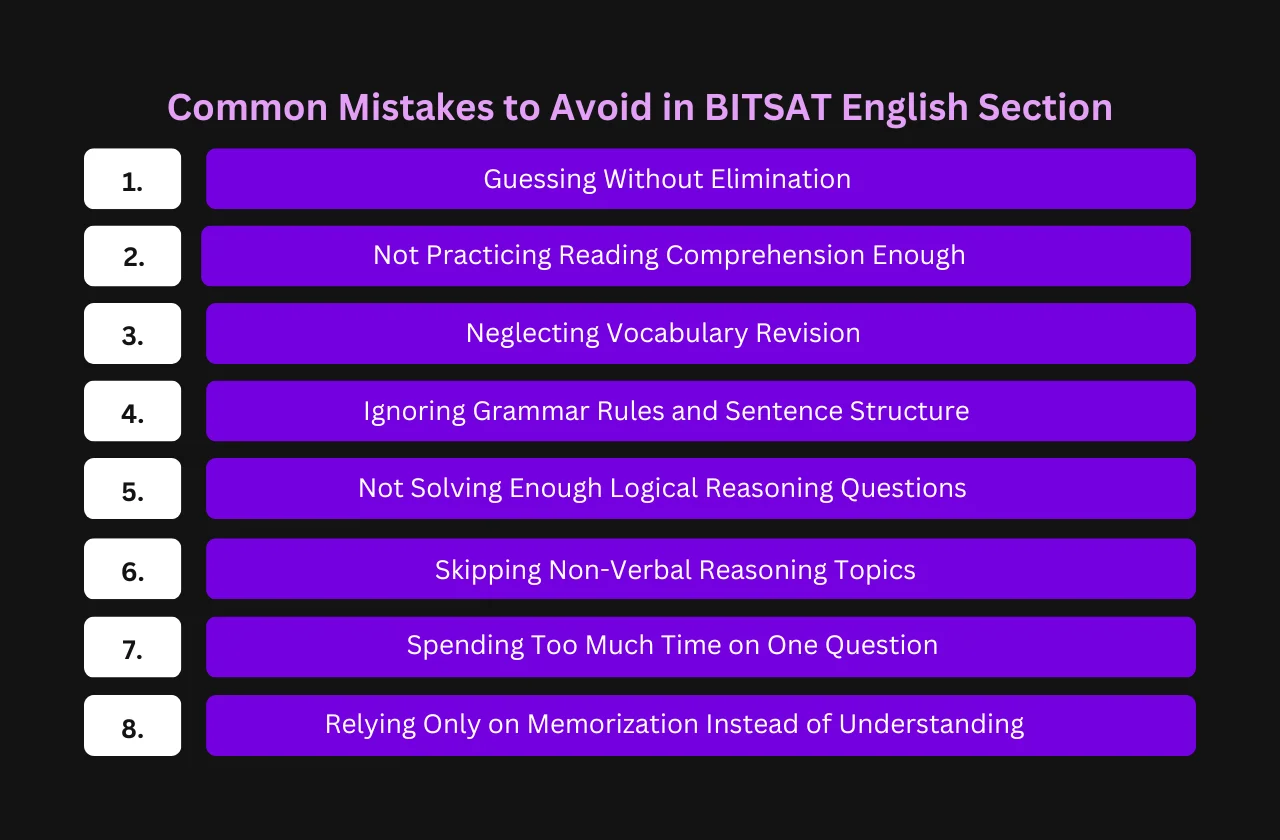
1) Guessing Without Elimination
BITSAT follows negative marking, where one mark is deducted for each incorrect answer. Some students guess blindly when unsure, hoping to get lucky. However, this often results in more negative marks than positive scores.
How to Avoid It
- If completely unsure, skip the question instead of taking a random guess.
- If at least two options can be eliminated, take an educated guess.
- Practicing mock tests regularly helps in identifying patterns and improving accuracy in uncertain questions.
2) Not Practicing Reading Comprehension Enough
Many students believe that reading comprehension is easy and does not require much practice. However, in BITSAT, comprehension passages are lengthy and time-consuming. If students do not practice skimming techniques, they waste too much time on these questions.
How to Avoid It
- Practice at least one passage daily from newspapers, books, or previous BITSAT papers.
- Learn skimming techniques to quickly find main ideas, supporting evidence, and conclusions.
- Underline keywords and transition words while reading to speed up comprehension.
3) Neglecting Vocabulary Revision
Many students focus on learning new words but do not revise them, leading to forgetting important words during the exam. BITSAT often includes synonyms, antonyms, and idioms, making a strong vocabulary essential.
How to Avoid It
- Maintain a vocabulary journal and write down new words along with their meanings.
- Revise words regularly, especially from previous weeks.
- Use flashcards or apps like Anki or Quizlet to test vocabulary knowledge.
- Learn word roots, prefixes, and suffixes to guess meanings of unfamiliar words.
4) Ignoring Grammar Rules and Sentence Structure
BITSAT tests fundamental grammar concepts, including subject-verb agreement, tenses, prepositions, and parallel construction. Some students rely on instinct rather than understanding the actual grammar rules. This leads to confusion in tricky sentence correction questions.
How to Avoid It
- Study grammar from Wren & Martin’s English Grammar or Raymond Murphy’s Grammar in Use.
- Solve error detection exercises daily to strengthen sentence correction skills.
- Read sentences out loud to check for structural errors.
5) Not Solving Enough Logical Reasoning Questions
Many students believe logical reasoning is easy and assume common sense is enough to solve these questions. However, pattern-based and sequence-based questions require practice. Without preparation, students struggle to recognize patterns quickly, which wastes time during the exam.
How to Avoid It
- Solve 10–15 logical reasoning questions daily to improve pattern recognition skills.
- Focus on series, analogies, classification, and chart logic questions.
- Use books like R.S. Aggarwal’s Verbal and Non-Verbal Reasoning for structured practice.
6) Skipping Non-Verbal Reasoning Topics
Many students prepare only verbal reasoning and ignore non-verbal reasoning topics such as figure matrices, paper cutting, and pattern perception. Since these questions appear regularly in BITSAT, ignoring them leads to missed marks.
How to Avoid It
- Practice visual puzzles, figure series, and folding patterns from logical reasoning books.
- Spend at least 15 minutes daily solving non-verbal reasoning questions.
- Use online resources like puzzle-solving apps or YouTube tutorials for better understanding.
7) Spending Too Much Time on One Question
BITSAT is a time-based exam, and wasting time on a single question can lead to missing out on easier questions later. Logical reasoning questions like chart logic and figure matrix can be time-consuming if not approached correctly.
How to Avoid It
- Set a time limit of 40–60 seconds per question during practice.
- If stuck, mark the question for review and move forward.
- During mock tests, identify which types of questions take too much time and work on improving speed.
8) Relying Only on Memorization Instead of Understanding
Some students try to memorize grammar rules and reasoning concepts instead of understanding their applications. This results in confusion in tricky questions.
How to Avoid It
- Instead of memorizing rules, apply them in practice questions to see how they work.
- Focus on why certain grammar rules apply rather than just rote learning them.
- Use real-life examples to understand sentence structures and vocabulary meanings.
Conclusion
The English and Logical Reasoning sections in BITSAT play a crucial role in the final score. Many students overlook these areas, but mastering them can significantly improve overall performance. A strong grasp of grammar, vocabulary, and reading skills is essential for the English section, while logical reasoning skills enhance problem-solving speed and accuracy.
Along with available resources, command over English can be built only through dedicated reading, exploring new words, and practicing comprehension using newspapers, books, and online articles as much as possible. Regular practice with mock tests and previous years’ papers also makes a big difference. Time management is crucial, as students must balance speed with accuracy. Avoiding careless mistakes, understanding negative marking, and focusing on high-scoring topics can help maximize marks.
With the right preparation strategy, students can confidently tackle these sections and increase their chances of securing admission to BITS Pilani, Goa, or Hyderabad. Consistent effort and smart study techniques will ensure success in the exam.