Why IPMAT Rewards Maths Maturity Over Coaching Hours

We see this pattern every year: students solve thousands of basic math problems, clock 10-hour study days, and still freeze during the actual exam. They tell us, "I knew the formula, but I didn't know how to apply it." The truth is, tackling IPMAT Questions requires more than just memorizing shortcuts or logging endless hours at a coaching center. It requires mathematical maturity. At Phodu Club, we’ve learned that the students who clear the cutoffs aren’t always the ones who study the longest; they are the ones who understand the why behind the math.
Quick Answer
- Mathematical maturity beats rote learning: Understanding first principles is more crucial than knowing a hundred shortcuts.
- Coaching hours don't guarantee success: Quality of conceptual practice matters significantly more than the quantity of repetitive drills.
- Adaptability is key: The exam tests your ability to apply basic concepts to twisted, unfamiliar scenarios.
- Error analysis is non-negotiable: Reviewing mistakes with detailed solutions and senior mentorship builds the logical framework needed for exam day.
Understanding the Exam Pattern and Its Focus on IPMAT Questions
When we sit down with aspirants who are just starting their preparation, the first thing we do is break down the reality of the exam pattern. The Integrated Programme in Management Aptitude Test (conducted by IIM Indore and IIM Rohtak) is not your standard 12th-grade board exam. It is designed to filter out students who rely purely on rote memorization.
The IIM Indore pattern, for instance, strictly divides the quantitative section into Multiple Choice (MCQ) and Short Answer (SA). The SA section is where rote learners usually fall apart because there are no options to reverse-engineer or guess from. You either know the logical path to the answer, or you don't.
We worked with a student last year who consistently scored 95% in his high school math exams but struggled to cross the 15-mark threshold in the SA section during his initial mock tests. Why? Because his entire strategy was built on elimination rather than foundational solving.
Actionable Takeaway: Stop looking at the options first. When you practice, hide the multiple-choice options and force your brain to build the logical path from the ground up. This exact methodology is why we designed the 44 Phodu IPMAT problem sets inside Phodu Club's Ultimate IPMAT Pack —to force you to build your logic, not just guess the answer.
If you want a deeper dive into the structure, check out our complete breakdown of the IPMAT Exam Pattern .
What Mathematical Maturity Really Means for Quantitative Aptitude
We hear the term "mathematical maturity" thrown around a lot, but what does it actually mean in the context of your preparation?
At Phodu Club, we define mathematical maturity as the ability to abstract, synthesize, and apply first principles to novel problems. It is the exact opposite of formula-plugging. If someone asks you a time, speed, and distance problem, a rote learner immediately tries to remember the formula for average speed. A mathematically mature student visualizes the scenario, understands the relative motion, and builds the equation naturally.
Rote Learning vs. Mathematical Maturity
| Feature | Rote Learning Approach | Mathematical Maturity Approach |
| Encountering a new problem | "Which formula applies here?" | "What is the core concept being tested?" |
| Handling complex wording | Gets confused and skips the problem. | Breaks the problem down into smaller, logical statements. |
| Learning style | Memorizes 50 different variations of a topic. | Understands 1 core concept and adapts it to 50 variations. |
| Exam pressure reaction | Panics if the exact practiced model doesn't appear. | Stays calm and relies on fundamental logic to build a solution. |
We get this question all the time from our students: "Which trick should I use for this profit and loss problem?" We always reply, "Don't look for the trick. What is the fundamental relationship between cost price and selling price here?"
Actionable Takeaway: For the next week, ban yourself from using formula cheat sheets. If you need a formula, derive it. If you can't derive it, you don't understand the concept well enough yet. Build your basics with resources like the Best Books for IPMAT .
Why IPMAT Questions Reward Conceptual Depth Over Rote Coaching Hours
There is a common misconception that sitting in a coaching center for six hours a day will automatically translate to a high score. We built Phodu Club precisely because we saw students putting in massive amounts of effort into traditional coaching modules and still facing stagnant scores.
When we look closely at how students handle IPMAT Questions, the trap of traditional coaching becomes obvious. Traditional centers often treat aptitude prep like an assembly line. They give you a booklet, teach you three shortcuts, and make you solve 100 identical problems.
The Trap of Over-Reliance on Coaching
Hours spent on repetitive drills give you a false sense of security. You feel productive because your pen is moving and you are ticking boxes, but your brain isn't actually being challenged. When the actual exam presents a twisted application of probability mixed with geometry, the assembly-line training fails.
We recently mentored a student who had attended a premier coaching institute for an entire year. She had solved over 5,000 quantitative problems. Yet, her mock scores were stuck in the 40th percentile. We realized she was operating on autopilot. She was matching problem templates in her head instead of reading the specific constraints of the problem in front of her.
The Real Nature of Quantitative Problems
The reality is that IIMs want thinkers, not calculators. According to historical data and recent exam trends (2025–2026 patterns), the difficulty level of the quantitative section ranges from moderate to difficult, heavily leaning on concept-heavy applications rather than direct formula plugs. Topics like Modern Math, Algebra, and Number System require you to understand the why and how it connects.
Actionable Takeaway: Shift your preparation ratio. Instead of spending 20% of your time learning a concept and 80% solving repetitive drills, spend 50% of your time deeply understanding the theory and 50% solving high-quality, varied problems. We specifically curated 1700+ IPMAT relevant questions in our Ultimate IPMAT Pack with JEE foundation to ensure you are exposed to this exact level of conceptual depth, rather than repetitive busywork. Read more about this approach in our guide on How to Prepare for IPMAT: Coaching or Self-Study .
Key Characteristics of High-Quality IPMAT Questions in Quantitative Ability
If you analyze the anatomy of real IPMAT Questions, you will notice a distinct blend of simplicity in calculation but complexity in comprehension. The examiners deliberately design problems that look intimidating but dissolve quickly if you apply the right conceptual lens.
1) Multi-Concept Integration
High-quality problems rarely test just one topic. You might see a question that requires you to use the properties of prime numbers to solve a combinatorics problem. If your study strategy has been strictly compartmentalized (studying geometry in March and probability in April without mixing them), you will struggle to bridge the gap.
2) Constraint-Based Logic
Many problems introduce subtle constraints. For example, a word problem might subtly state that "x is a positive integer." A rote learner might find a fractional value for 'x' and select the closest option. A mathematically mature student recognizes the constraint and realizes the problem requires a Diophantine equation approach or logical testing.
3) Proof-Oriented Thinking
While you don't have to write out proofs, understanding how proofs work is a massive advantage. Knowing why the sum of an infinite geometric progression converges helps you manipulate unusual series problems that don't fit the standard textbook formula.
We’ve seen aspirants panic during their early mocks when they encounter these multi-layered problems.
Actionable Takeaway: Every time you practice, pick three completely different topics (e.g., Algebra, Time/Work, Number System) and solve five problems from each in a mixed format. When you review, rely on the detailed solutions and analysis provided in your mock test series to see how the multi-concept integration is broken down logically.
How to Practice IPMAT Questions Effectively for Conceptual Mastery
It is entirely possible to build mathematical maturity without burning hours in a crowded coaching classroom. The secret lies in deliberate practice. Deliberate practice means stepping out of your comfort zone and focusing specifically on the areas where you make mistakes.
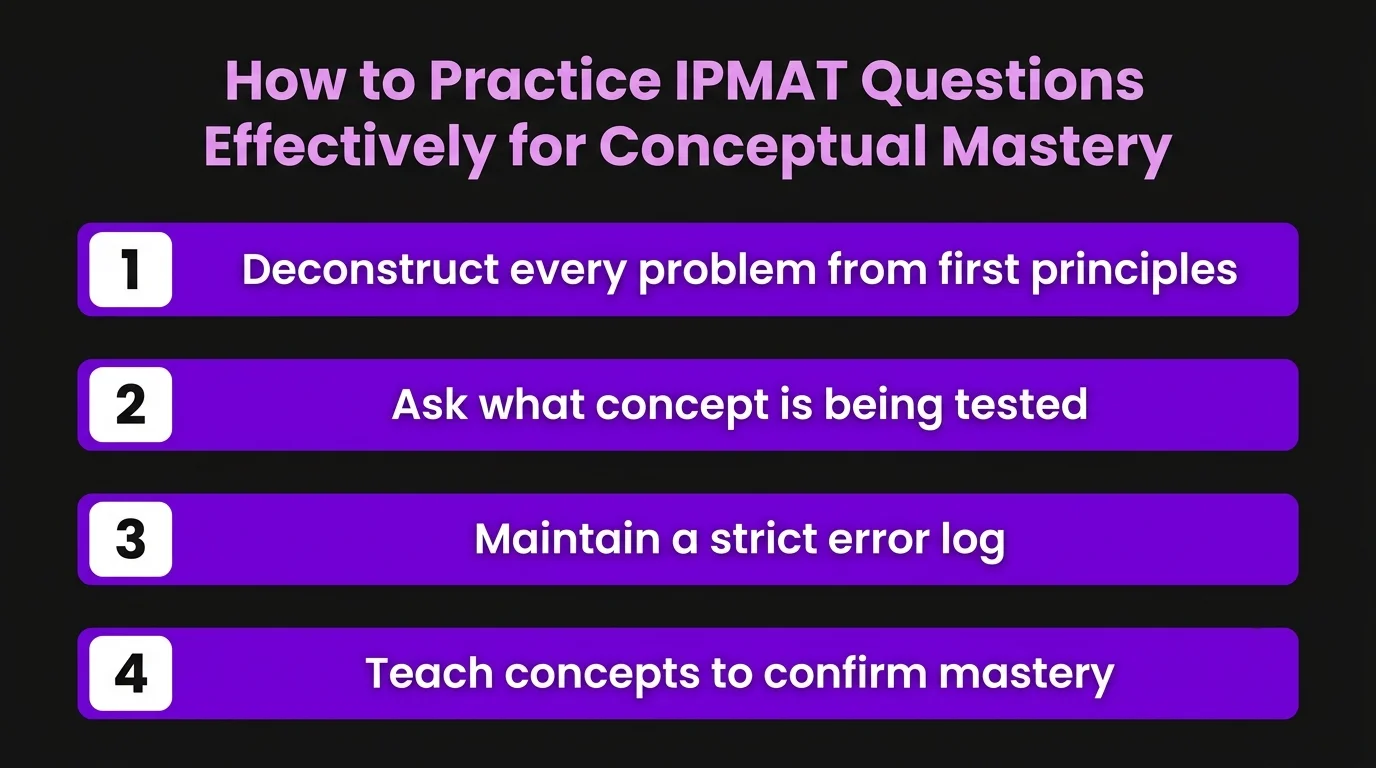
1) The "First Principles" Deconstruction
When you review past papers, don't just solve them. Deconstruct them. Ask yourself:
- What is the underlying principle here?
- How could the examiner change this problem to make it harder?
- Can I solve this without using any standard formulas?
When we teach our students to deconstruct past IPMAT Questions, their perspective shifts completely. They stop fearing unfamiliar problems because they know they can break them down into familiar, fundamental pieces.
Stuck on a deconstruction? This is why we included an exclusive 24/7 community with IIM IPM seniors in our Ultimate Pack. If a problem doesn't make sense, you don't have to wait for your next coaching class—you drop it in the community and get the exact logical breakdown from someone studying at an IIM right now. You can find official resources and past papers in our IPMAT Previous Year Papers section.
2) Implement a Strict Error Log
We cannot stress this enough: if you do not have an error log, you are leaving marks on the table. We worked with a student who was stuck at a stagnant score for three months. We made her stop taking new tests and forced her to create a spreadsheet detailing every single mistake she had made in the past. Within thirty days, her score jumped by 35%.
Your error log should include:
- The exact problem.
- The core concept tested.
- Why you got it wrong (Calculation error? Conceptual gap? Misread the problem?).
- The step-by-step logical solution (extracted directly from the detailed mock solutions).
Bonus: The Ultimate IPMAT Pack allows unlimited attempts for all tests. This means you can take a mock, fill out your error log, study your weak areas, and retake the exact same mock a month later to verify that you’ve actually mastered those concepts.
3) Teach to Learn
One of the best ways we check if our students have truly achieved mathematical maturity is by asking them to teach a concept back to us. If you can explain a complex probability concept to someone who hates math in simple, everyday language, you have mastered it.
Actionable Takeaway: Start an error log today. Dedicate your Sunday mornings purely to reviewing the mistakes you logged from Monday to Saturday. Do not solve anything new until you have mastered your past errors. Participate in our regular strategy and QnA sessions to discuss these errors live.
Actionable 30-Day Plan to Strengthen Your Maths Foundation
We get asked constantly for a structured plan. We often tell our students: "A structured 30 days is better than a chaotic 6 months." If you are feeling lost or stuck in a score plateau, use this 30-day blueprint. This is designed for self-study and requires high discipline.
Phase 1: Core Fundamentals (Days 1–10)
Forget shortcuts. Forget speed. Your only goal in this phase is 100% accuracy and conceptual depth.
- Days 1-3: Number System & Arithmetic. Go back to basic divisibility rules, remainders, percentages, and ratios. Understand the proofs.
- Days 4-6: Algebra. Focus on quadratic equations, inequalities, and logarithms. Visualize graphs. Don't just solve for 'x'; understand what 'x' represents on a coordinate plane.
- Days 7-9: Geometry & Mensuration. Derivations are your best friend here. Know exactly how the volume of a cone is derived from a cylinder.
- Day 10: Revision & Mini-Test. Take an untimed sectional test. Analyze every single gap.
Phase 2: Application & Cross-Linking (Days 11–20)
Now, we start mixing concepts and building adaptability.
- Days 11-13: Modern Math. Permutation, Combination, and Probability. These require pure logic. Map out scenarios visually before writing any numbers.
- Days 14-16: Word Problems & Data Interpretation. Focus on translating heavy English text into simple mathematical equations.
- Days 17-19: PYQ Deconstruction. Download the IPMAT Question Paper PDF . Do not solve them as a test. Take 5 problems a day and spend an hour dissecting them.
- Day 20: Sectional Mock. Take a timed sectional test. Focus on skipping problems that are designed to waste your time.
Phase 3: Exam Strategy & Simulation (Days 21–30)
This is where you build stamina and refine your attempt strategy across different exam formats.
- Days 21-25: Full-Length Mocks. Take one mock every alternate day. This is the exact time to deploy the 9 IPMAT Indore mocks and 7 IPMAT Rohtak mocks available in Phodu Club's Ultimate Pack. If you are keeping backup options open, utilize the included JIPMAT, BMSAT, DBE, UGAT, NPAT, or SET mocks.
- Days 26-28: Intensive Error Analysis. Spend these days only on your error log. Re-solve everything you got wrong in the past 25 days using the detailed analysis provided with your test series.
- Days 29-30: Mindset & Light Revision. No heavy solving. Review your concept notes. Get your sleep schedule aligned with the exam timings.
Actionable Takeaway: Print this 30-day plan out. Pin it to your wall. Treat it as a non-negotiable contract with yourself. If you need structured guidance through this, explore our IPMAT Crash Course .
Common Myths About Preparation That Hold Students Back
At Phodu Club, part of our job is deprogramming the bad advice students receive from well-meaning but misinformed sources. Let’s clear the air on a few things.
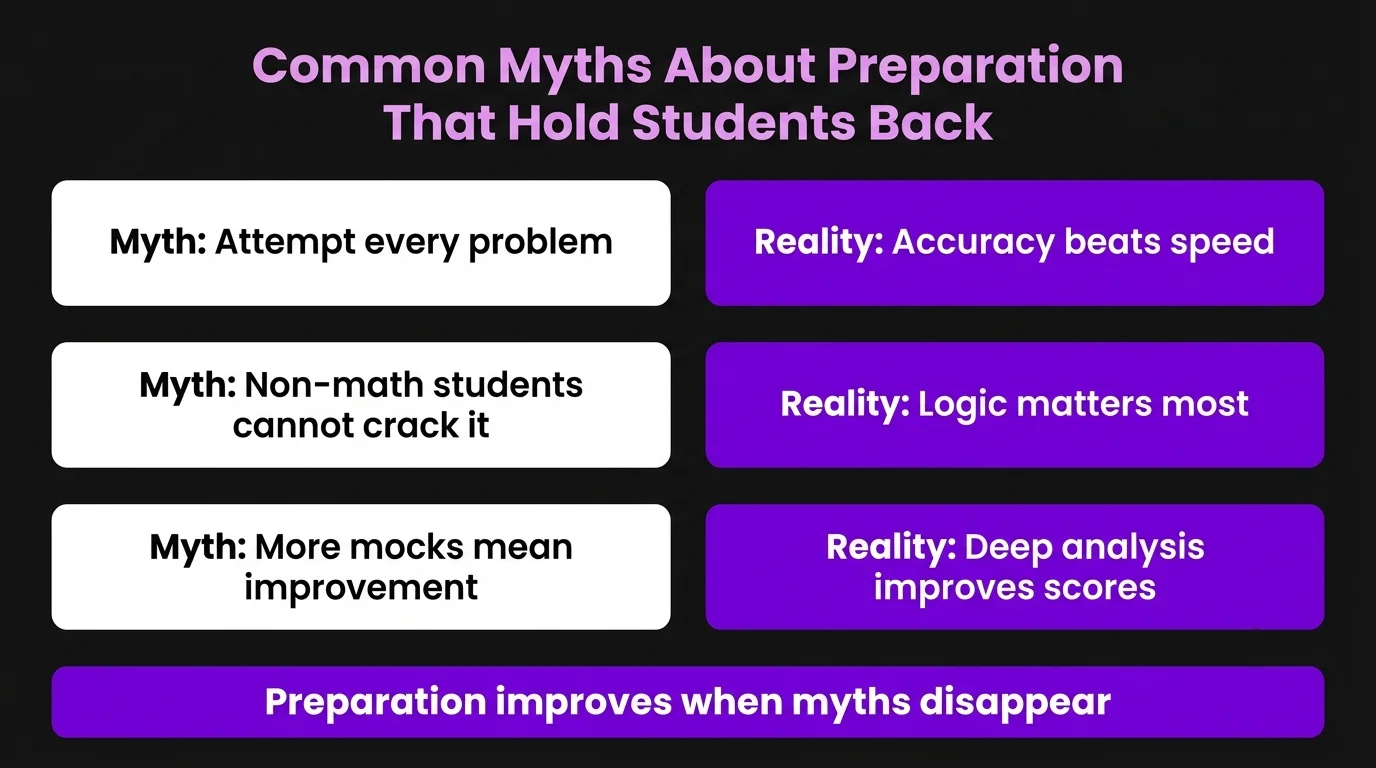
Myth 1: "I need to attempt every problem to clear the cutoff."
Reality: Accuracy trumps speed. The exam has negative marking. We’ve seen aspirants clear the cutoffs by attempting fewer problems with 90% accuracy, while others fail because they attempted everything with 50% accuracy. Understand the art of skipping.
Myth 2: "Non-math students can't crack the quantitative section."
Reality: Mathematical maturity does not require you to have taken advanced calculus in 12th grade. It requires logical reasoning. Some of our most successful students came from Humanities and Commerce backgrounds. They succeeded because they didn't have bad rote-learning habits to unlearn; they built their logic from first principles.
Myth 3: "More mocks equal higher scores."
Reality: Taking a mock test only measures your current ability; it does not improve it. Analysis improves it. Taking 10 mocks and analyzing them deeply is infinitely better than taking 40 mocks and just looking at the final score. Use resources like the IPMAT Rank Predictor to gauge where you stand, but spend your real energy on the breakdown of your performance.
Conclusion
We’ve worked with enough students to know this: effort alone doesn’t fix your score. The right strategy does. Spending endless hours in a coaching center memorizing tricks will only take you so far. When the exam day arrives, and the paper is tougher than expected, rote memory shatters. Logic and maturity endure.
Approaching IPMAT Questions with mathematical maturity changes the game. It transforms you from a stressed student trying to recall a formula into a confident problem-solver who can navigate any twist the examiner throws at you.
That’s exactly what we focus on at Phodu Club. We don't just hand you material and wish you luck; we help you rewire how you think about mathematics and exam strategy. Stop counting the hours you study, and start making the hours count by focusing on deep, conceptual clarity.
Ready to change your approach? Dive into Phodu Club's Ultimate IPMAT 2026 Pack , leverage our 1700+ problem sets, get your doubts cleared by IIM seniors 24/7, and start building real exam maturity today.
Frequently Asked Questions (FAQ)
1) How do I analyze IPMAT Questions effectively?
Effective analysis means looking past the correct option. When reviewing a problem, ask yourself three things: What core concept was tested? Did I take the shortest logical path? What trap did the examiner set that I fell into? Use the detailed solutions provided in your mock tests to document this in an error log and prevent repeating the same mistake.
2) Is self-study enough to crack the exam, or is coaching mandatory?
Self-study is absolutely enough if it is highly structured. Coaching provides a framework, but if you have discipline, a solid 30-day plan, and good resources (like past papers, quality mock series, and access to senior mentorship like we provide in our Ultimate Pack), you can build the necessary mathematical maturity on your own.
3) I am stuck at a plateau in my mock test scores. How do I improve?
Score plateaus usually happen when you keep taking tests without fixing the underlying conceptual gaps. Stop taking full mocks for a week. Do a deep dive into your error log, identify the top three topics you consistently get wrong, and rebuild those concepts from first principles before taking another test.
4) How much time should I allocate to quantitative aptitude daily?
It depends on your current proficiency, but a good baseline is 2 to 3 hours a day. However, the breakdown is crucial: spend 1 hour on concept building and reading, 1 hour on mixed problem solving (using resources like the 1700+ questions in our pack), and 1 hour thoroughly analyzing the mistakes you made during practice.
5) How is Phodu Club different from traditional coaching institutes?
At Phodu Club, we focus on mentorship and strategy, not just endless problem-solving. Traditional coaching gives generic advice; we focus on why your specific score isn't improving. Through resources like our 24/7 IIM senior community and strategy sessions, we help you identify your weak areas, fix your attempt strategy, and build real mathematical maturity rather than relying on shortcuts.
6) Does having a non-math background in 11th and 12th disadvantage me?
Not necessarily. While math students might have a slight initial advantage in calculation speed, the exam tests logical application. Non-math students often do very well because they learn the concepts from scratch logically, rather than relying on half-remembered, rote-learned formulas from high school.
7) How many past year papers should I solve before the actual exam?
You should aim to solve at least the last 5 to 7 years of official past papers. Do not solve them at the beginning of your prep. Save them for when you have covered the syllabus, and treat them as gold-standard metrics to test your conceptual maturity and time management.
8) Should I focus on speed or accuracy during my initial preparation?
Always prioritize accuracy first. Speed is a byproduct of mathematical maturity. If you try to build speed before you understand the core concepts deeply, you will just learn how to make mistakes faster. Achieve 90% accuracy first, and the speed will naturally follow as you become more familiar with the logical patterns.
Want to crack your exam with mentors who did?
Get test series, crash courses and free mentorship from students at IITs, NITs and BITS.