The MHT CET 2026 is right around the corner, and if you’re aiming for a top score, you’ll need more than just hard work—you’ll need a smart strategy. The exam covers key subjects like Physics, Chemistry, and Mathematics (or Biology), and knowing which chapters carry the most weight can make a real difference. It’s not just about studying harder, it’s about studying smarter. By focusing on the right topics, practicing regularly, and managing your time wisely, you can boost your chances of success. This guide will break down everything you need to know about the MHT CET 2026, from the exam pattern to must-know chapters, so you can approach the exam with confidence. Let’s dive in.
MHTCET 2026 Exam Overview
The State Common Entrance Test Cell, Maharashtra will conduct the MHT CET 2026, in a computer-based online format. The exam will test your knowledge in Physics, Chemistry, and Mathematics (PCM) for Engineering students and Biology (PCB) for students pursuing medical or related courses.
Exam Pattern for MHTCET 2026
The MHT CET 2026 will consist of two papers:
- Paper 1 – Mathematics
- Paper 2 – Physics and Chemistry
Here are the key details about the exam:
| Particular | Details |
| Name of Exam | Maharashtra Common Entrance Test (MHT CET) |
| Exam Conducting Authority | State Common Entrance Test Cell, Maharashtra |
| Mode of Exam | Computer-Based Test (Online mode) |
| Number of Papers/Sections | Paper 1 – MathematicsPaper 2 – Physics and Chemistry |
| Duration | 90 minutes for each paper |
| Type of Questions | Multiple Choice Questions (MCQs) |
| Total Marks | 200 |
| Marking Scheme | Mathematics: 2 marks for every correct answerPhysics & Chemistry: 1 mark for every correct answerNo negative marking |
The MHT CET exam follows a multiple-choice question (MCQ) format with no negative marking. The total marks for the exam will be 200, with different marking schemes for Mathematics and Physics/Chemistry papers.
MHTCET 2026 Exam Syllabus
The syllabus for MHT CET 2026 will be based on the topics taught in Class 11 and Class 12 as per the Maharashtra State Board of Secondary and Higher Secondary Education (MSBSHSE). The weightage for Class 11 topics will be around 20%, while the remaining 80% will be based on Class 12 topics.
Relation to Maharashtra State Board Syllabus
MHT CET syllabus closely aligns with the Maharashtra State Board syllabus, so students should focus on understanding the topics covered in both Class 11 and Class 12 to prepare effectively.
MHTCET Important Chapters 2026
Some chapters carry more weight in the MHT CET exam, and students should focus on these topics for better preparation. Below is a list of important topics for Physics, Chemistry, and Mathematics based on previous years’ analysis.
MHT CET Important Topics for Physics 2026
- Electromagnetic Induction
- Magnetic Effects of Current
- Kinetic Theory of Gases and Radiation
- Atoms, Molecules, and Nuclei
- Oscillations
- Rotational Motion
- Electrostatics
- Semiconductors
- Wave Motion
MHT CET Important Topics for Chemistry 2026
- Alcohols, Phenols, and Ethers
- Organic Compounds containing Nitrogen
- Solid State
- Chemical Thermodynamics and Energetics
- Coordination Compounds
- p-Block elements
- d-Block and f-Block elements
- Chemical Kinetics
- Solutions and Colligative Properties
MHT CET Important Topics for Mathematics 2026
- Calculus
- Three-Dimensional Geometry
- Differentiation
- Integration
- Trigonometry
- Functions
- Probability, Limits, Continuity, and Differentiability
- Vectors
MHTCET 2026 Chapter-Wise Weightage
Knowing the chapter-wise weightage for MHT CET 2026 helps in planning your preparation strategy. Here are the weightages for each subject based on previous years:
MHTCET 2026 Mathematics Chapter-Wise Weightage
| Chapter | Weightage of Marks |
| Integration | 9% |
| Trigonometric Functions | 8% |
| Three Dimensional Geometry | 8% |
| Differentiation | 7% |
| Probability Distribution | 8% |
| Matrices | 5% |
| Circles | 6% |
| Conics | 5% |
| Vectors | 7% |
| Continuity | 5% |
| Applications of Derivatives | 5% |
| Differential Equations | 6% |
| Bernoulli Trials and Binomial Distribution | 4% |
| Pair of Straight Lines | 5% |
| Line | 3% |
| Plane | 4% |
| Linear Programming Problems | 2% |
| Applications of Definite Integrals | 4% |
| Statistics | 3% |
| Mathematical Logic | 3% |
MHTCET 2026 Physics Chapter-Wise Weightage
| Chapter | Weightage of Marks |
| Kinetic Theory of Gases and Radiation | 12% |
| Oscillations | 8% |
| Atoms, Molecules, and Nuclei | 8% |
| Rotational Motion | 7% |
| Electrostatics | 7% |
| Magnetic Effects of Electric Current | 6% |
| Electromagnetic Induction | 6% |
| Semiconductors | 6% |
| Wave Motion | 5% |
| Magnetism | 5% |
| Circular Motion | 4% |
| Surface Tension | 4% |
| Interference and Diffraction | 4% |
| Current Electricity | 4% |
| Gravitation | 3% |
| Stationary Waves | 3% |
| Electrons and Photons | 3% |
| Elasticity | 2% |
| Wave Theory of Light | 2% |
| Communication Systems | 1% |
MHTCET 2026 Chemistry Chapter-Wise Weightage
| Chapter | Weightage of Marks |
| Chemical Thermodynamics and Energetics | 15% |
| p-Block Elements – Group 15 to 18 | 9% |
| Coordination Compounds | 9% |
| d and f Block Elements | 8% |
| Alcohols, Phenols, and Ethers | 8% |
| Organic Compounds Containing Nitrogen | 8% |
| Solid State | 6% |
| Solutions and Colligative Properties | 6% |
| Chemical Kinetics | 5% |
| Halogen Derivatives of Alkanes and Arenes | 5% |
| Aldehydes, Ketones and Carboxylic Acids | 5% |
| Biomolecules | 4% |
| Polymers | 4% |
| Chemistry in Everyday Life | 5% |
MHTCET 2026 Preparation Strategy Based on Important Chapters
When preparing for the MHT CET 2026, it’s crucial to work smarter, not harder. Instead of trying to cover every single topic in the syllabus equally, focus more on the chapters that carry higher weight in the exam. By targeting these important chapters, you can ensure that you maximize your score while minimizing wasted effort. A clear strategy based on these chapters can help you stay on track and make the best use of your time. Here’s a comprehensive guide to preparing for MHT CET 2026, focusing on the most important chapters in Physics, Chemistry, and Mathematics.
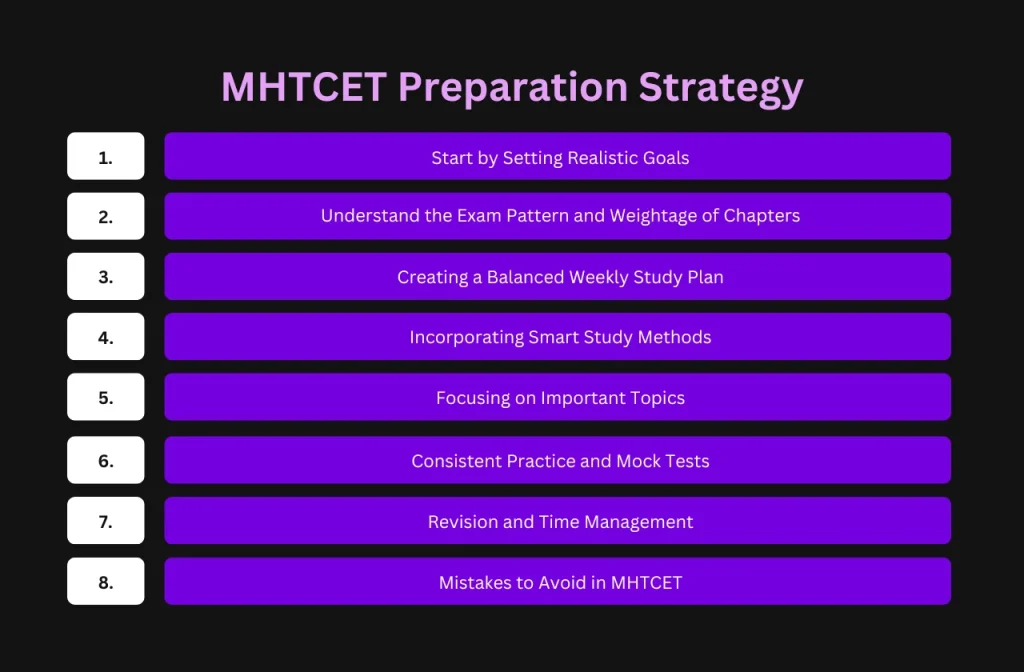
1) Start by Setting Realistic Goals
Before diving into preparation, set a clear and realistic score target. Your target score should align with your college goals. For instance, if you’re aiming for top-tier engineering colleges, you might set a target score of 160+ out of 200. If you’re aiming for a mid-tier college, you might aim for 120–140.
This target will help guide your study plan. It’s important to recognize that a high score can often be achieved by focusing more on high-weight chapters that show up frequently in the exam.
2) Understand the Exam Pattern and Weightage of Chapters
MHT CET 2026 has two main papers:
- Paper 1: Mathematics
- Paper 2: Physics and Chemistry (combined)
Understanding which chapters carry the most weight in each subject allows you to prioritize your preparation effectively. A good strategy is to spend more time on the chapters with the highest weightage, ensuring you cover these in-depth.
By understanding the weightage, you can prioritize the topics that are more likely to appear in the exam. This allows you to study more efficiently and increase your chances of scoring higher.
3) Creating a Balanced Weekly Study Plan
Now that you know the important chapters, it’s time to create a study plan. It’s essential to keep a balance between the subjects and allocate time in a way that covers all topics. Start with a weekly study schedule that includes:
- 3 days for Mathematics: Since Mathematics is the most challenging subject for many, it’s important to allocate time for deep problem-solving.
- 2 days for Physics: Focus on chapters like Kinetic Theory of Gases and Oscillations that carry more weight.
- 2 days for Chemistry: Cover key chapters like Thermodynamics and p-Block Elements.
You can adjust the number of days based on your comfort level with each subject. For example, if you’re more comfortable with Physics, you might reduce the number of days for Physics and increase Chemistry or Mathematics time.
4) Incorporating Smart Study Methods
To make your preparation even more effective, use the following study techniques:
- Active recall: Don’t just passively read through your notes. Actively try to recall the key concepts and formulas without looking at them. This method strengthens your memory.
- Spaced repetition: Revising a topic several times at increasing intervals helps reinforce your understanding.
- Practice problems: In Mathematics, especially, practice is key. Make sure to solve plenty of problems, starting from easy ones and progressing to difficult ones. This builds your confidence and speed.
- Use multiple resources: Don’t rely only on your school books. Use reference books, online tutorials, and videos to gain different perspectives on the same topic.
5) Focusing on Important Topics
Each subject has its own set of important chapters that you should give priority to. Let’s dive deeper into how you can approach each subject’s key chapters.
Mathematics
Mathematics is a subject that requires constant practice. You need to master both the concepts and the problem-solving techniques. Here are the key chapters you should focus on:
- Integration: This topic carries a weight of 9%. Ensure you understand the fundamental integration techniques, as they are essential for both theoretical and numerical problems.
- Trigonometric Functions: With an 8% weight, this topic is crucial. Understand the identities, equations, and properties, as these are frequently tested.
- Three-Dimensional Geometry: Also weighted at 8%, this topic involves vectors and coordinate geometry, which often appear in both theory and application-based questions.
- Differentiation: Differentiation forms the backbone of many problems in Physics and Mathematics, making it crucial for your preparation.
Physics
Physics involves both theory and problem-solving. Focus on topics that have a high weight in the exam and ensure you practice numerical problems related to them.
- Kinetic Theory of Gases and Radiation: This chapter has the highest weightage (12%), so make sure you understand the laws of gases, ideal gas equations, and the concept of radiation.
- Oscillations: This topic has a weightage of 8%. Focus on SHM (Simple Harmonic Motion), damped and forced oscillations, and resonance.
- Atoms, Molecules, and Nuclei: At 8%, this chapter involves understanding the structure of atoms, atomic models, and radioactivity, which are frequently tested.
- Electrostatics: Electrostatics is also an important topic with a 7% weightage. Pay close attention to Coulomb’s Law, electric fields, and potential energy.
Chemistry
Chemistry requires both conceptual clarity and memorization. Focus on the chapters that are heavily weighted.
- Chemical Thermodynamics and Energetics: With a weightage of 15%, this topic is crucial. Understand the laws of thermodynamics, enthalpy, entropy, and Gibbs free energy.
- p-Block Elements: At 9%, p-block elements (groups 15 to 18) are a significant part of your preparation. Focus on the properties, uses, and reactions of these elements.
- Coordination Compounds: Another 9% chapter, coordination compounds deal with the structure, bonding, and properties of complex compounds.
- d-Block and f-Block Elements: These elements also have an 8% weight. Make sure you understand their properties, electronic configurations, and reactivity.
6) Consistent Practice and Mock Tests
The importance of regular practice cannot be overstated. Practice helps you improve both speed and accuracy. Each week, make sure to:
- Solve a mix of problems: Start with easy problems to boost confidence and then move to more complex ones.
- Take chapter-wise tests: After completing a chapter, test yourself on the important topics within that chapter.
- Take full-length mock tests: These tests simulate the real exam experience and help you build stamina. After taking each mock test, review your answers carefully to identify areas of improvement.
Mock tests also help you practice time management, an essential skill for the MHT CET.
7) Revision and Time Management
In the final weeks before the exam, focus on revision. This is when you should revisit all the high-weight chapters, formulas, and important concepts. Don’t try to learn new topics at this stage; instead, solidify
your understanding of the topics you’ve already studied.
During the exam:
- Start with the easy questions: Begin with questions you are confident about, which will give you a mental boost.
- Manage your time well: If a question seems too complex, don’t dwell on it for too long. Move on and come back later.
- Avoid guessing: Since there is no negative marking, it’s tempting to guess answers, but only guess if you have a reasonable chance of getting it right.
8) Mistakes to Avoid in MHTCET 2026
- Ignoring Class 11 Portions: Even though they carry less weight, don’t neglect Class 11 chapters entirely.
- Leaving Entire “Easy” Chapters for Later: Even easy chapters can boost your score when revised.
- Focusing Only on Memorization: Problem-solving is essential, especially in Physics and Mathematics.
- Over-Focusing on One Subject: Balance all subjects and chapters during preparation.
Conclusion
In conclusion, preparing for MHT CET 2026 requires a focused, strategic approach. By prioritizing high-weight chapters, practicing regularly, and managing your time effectively, you can maximize your chances of success. Start by setting a clear target score and build a balanced study plan that covers important topics in Physics, Chemistry, and Mathematics. Use mock tests and problem-solving to build speed and accuracy. During the final weeks, focus on revision rather than learning new topics, and manage your time wisely during the exam. Remember, consistency is key, and by sticking to a well-organized strategy, you can tackle MHT CET 2026 with confidence. Stay calm, stay focused, and trust the process — your efforts will pay off in the end.
FAQs
1) How much time should I spend preparing for MHT CET 2026?
Ideally, you should dedicate around 4-5 hours each day for preparation, with more time closer to the exam date.
2) Are mock tests important for MHT CET preparation?
Yes, mock tests are very important as they help you familiarize yourself with the exam format and improve time management.
3) What should I do if I feel unprepared for certain chapters?
Spend extra time revising those chapters, use alternative resources like videos, and practice problems to strengthen your understanding.