MHT CET Cutoff: Cutoff, Rank & Percentile
We get this question all the time: "I scored 110 in my recent mock tests, will I get into VJTI?" Waiting for the MHTCET cutoff to drop is one of the most stressful parts of this journey. At Phodu Club, we see students obsessing over raw scores without realizing that the Maharashtra CET is fundamentally a percentile game. You might be putting in 10 hours a day, but if you don't understand how your shift's difficulty and the normalisation process affect your final state merit rank, you're flying blind. We built our platform to fix this exact lack of clarity. Let’s break down everything you need to know about scores, ranks, percentiles, and how to actually secure your seat.
Quick Answer/TL;DR
- Percentiles over Marks: MHT CET cutoffs depend on normalized percentiles, not raw scores.
- Shift Difficulty Matters: Harder shifts require lower raw marks to achieve a 99+ percentile due to normalization.
- Top College Targets: For General/Open category students, VJTI CS/Computer Engineering typically closes around 99.90+ percentile, while COEP CS/Computer Engineering generally requires a high 99.8+ to 99.9+ percentile range.
- Actionable Step: Stop guessing blindly. Use mock analysis, accuracy tracking, and percentile-based targets to improve performance and secure a higher state rank.
MHTCET’s Big Misconception: Raw Score vs. Normalisation
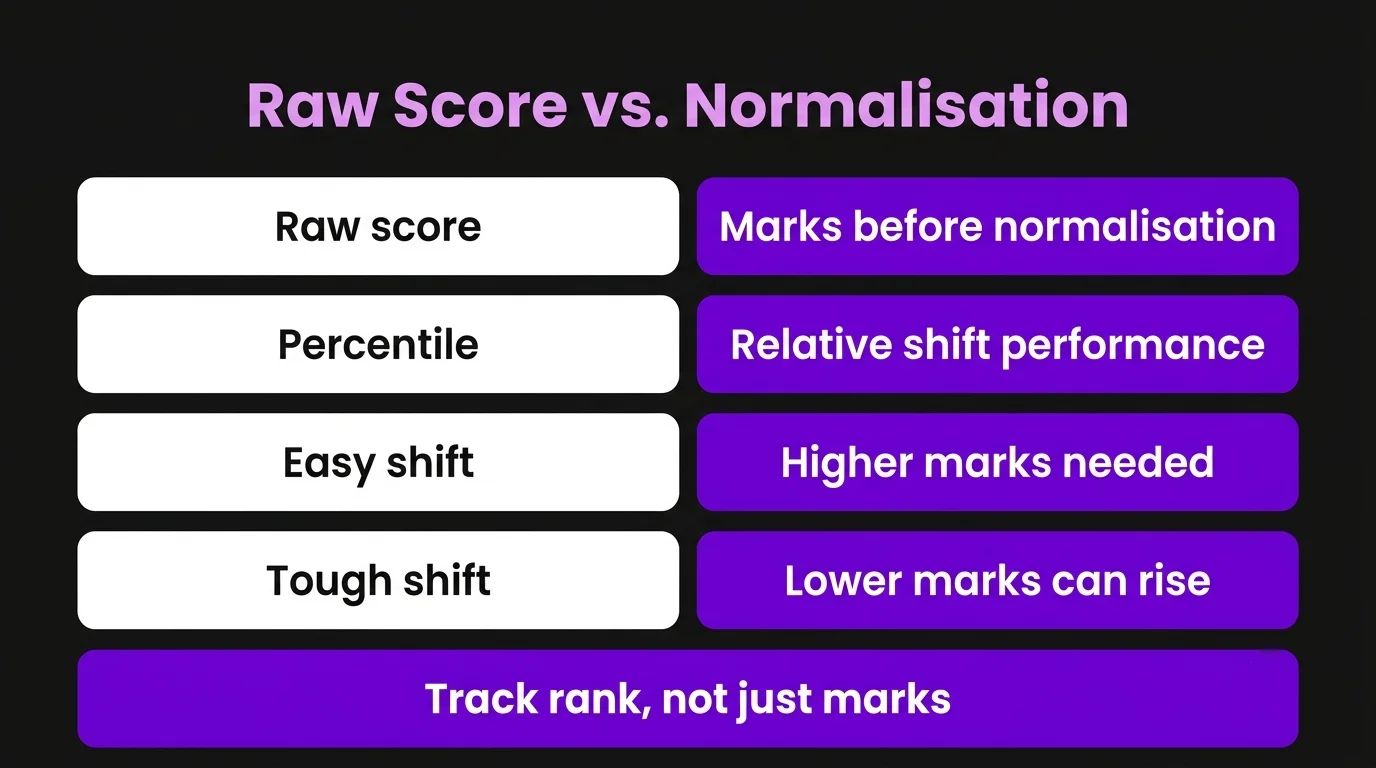
Many students dive headfirst into solving hundreds of MCQs before understanding how the MHTCET cutoff actually works. The Maharashtra CET is conducted across multiple shifts over several days. Because no two question papers are exactly alike in difficulty, the State CET Cell uses a mathematical normalisation process. This means your raw score (say, 120/200) is converted into a percentile relative to the performance of other students in your specific shift.
What Students Get Wrong
One of the most common mistakes we see is students looking at last year's MHTCET cutoff and assuming a specific raw mark will guarantee admission. For instance, a student might think, "I need exactly 145 marks to get a 99 percentile." But if their shift is exceptionally easy, 145 marks might only yield a 97 percentile. Conversely, in a brutally difficult physics and math shift, 120 marks could push them to the 99th percentile.
A Real Student Example from Phodu Club
We worked with a student named Rohan last year. He was consistently scoring around 115 in his MHTCET Test Series , leaving him incredibly demotivated because he thought he needed 150+ for a good college. When the actual exam happened, his shift was known to be one of the toughest in the 2025 cycle. He scored 118, but because of normalisation, his percentile jumped to 98.4, landing him a solid seat in a top Pune college. He almost gave up because he didn't understand the system.
Key Insight
Do not fixate on an arbitrary raw score. Instead, focus on maximizing your accuracy and relative performance. Track your rank in competitive, state-level mocks rather than just counting your marks.
Decoding the Cutoffs: MHT CET Percentile vs. State Merit Rank (SMR)
The Logic Behind the Numbers
The first thing you need to decide about the MHTCET cutoff is how your percentile translates into a State Merit Rank (SMR). The CET Cell releases merit lists based on percentiles. Your rank is what actually determines your place in the Centralised Admission Process (CAP) rounds.
When you see a cutoff for a college, it is usually represented as a State Merit Number (e.g., Rank 450) and a corresponding percentile (e.g., 99.85). Since nearly 3 to 4 lakh students appear for the PCM group, even a 0.01 difference in percentile can shift your rank by hundreds of spots.
Expected Percentile to Rank Mapping (Based on 2025-2026 Trends)
To give you a clear preparation direction, here is how percentiles generally map to state ranks. (Note: This fluctuates slightly each year depending on total registrations, but it serves as an excellent benchmark).
| MHT CET Percentile | Expected State Merit Rank (SMR) | Category of Colleges |
| 99.90 - 100 | 1 - 250 | Tier 1 (VJTI, COEP) - Core Tech Branches |
| 99.50 - 99.89 | 251 - 1,500 | Tier 1 (CS/IT/ExTC) & Tier 2 Top Branches |
| 99.00 - 99.49 | 1,501 - 3,500 | Tier 2 (SPIT, PICT, Walchand) |
| 98.00 - 98.99 | 3,501 - 8,000 | Tier 2 (Core Branches) / Tier 3 (CS/IT) |
| 95.00 - 97.99 | 8,001 - 18,000 | Good Regional Colleges (Tech Branches) |
| 90.00 - 94.99 | 18,001 - 35,000 | Average Private Colleges |
| 80.00 - 89.99 | 35,001 - 65,000 | Lower Tier Private Colleges |
Strategic Advice
Use tools like our MHT CET Rank Predictor to continuously gauge where you stand after every major mock test. If your target college requires a rank of 2000, you immediately know you need to push past the 99.3 percentile mark. For a deeper dive into this metric, check out our guide on Percentile Not Marks: How MHT CET Normalisation Decides Rank .
Target Scores for Top Maharashtra Engineering Colleges
Setting Realistic Goals
You cannot hit a target you haven't clearly defined. When students join Phodu Club, we force them to write down their top three college and branch combinations. From there, we reverse-engineer the required percentile.
Let’s look at the expected MHTCET cutoff for top institutions based on recent CAP round data for the Open/General category (GOPENH/GOPENO).
1) VJTI, Mumbai (Veeramata Jijabai Technological Institute)
VJTI remains the crown jewel of Maharashtra state engineering colleges.
- Computer Engineering: 99.92+ Percentile (Rank < 150)
- Information Technology: 99.85+ Percentile (Rank < 350)
- Electronics & Telecom (EXTC): 99.60+ Percentile (Rank < 1000)
- Further Reading: MHT CET Cutoff for VJTI
2) COEP Technological University, Pune
COEP is fiercely competitive, especially for students in the Pune region.
- Computer Engineering: 99.88+ Percentile
- Mechanical Engineering: 98.50+ Percentile
- Civil Engineering: 97.00+ Percentile
3) SPIT, Mumbai (Sardar Patel Institute of Technology)
Known for phenomenal placements, SPIT has consolidated its branches into core tech.
- Computer Engineering: 99.75+ Percentile
- Computer Science and Engineering (Data Science): 99.50+ Percentile
4) PICT, Pune (Pune Institute of Computer Technology)
If you want coding culture, PICT is the place.
- Computer Engineering: 99.65+ Percentile
- Information Technology: 99.45+ Percentile
A Real Student Example from Phodu Club
We had a student, Neha, whose sole focus was PICT Computer Engineering. She was scoring in the 95th percentile range two months before the exam. Instead of panicking, we looked at the data. She needed to jump to the 99.6+ range. We analyzed her mocks and found she was losing heavy marks in integration and 3D geometry. By fixing just those two weak areas rather than restudying the whole syllabus, her score jumped by 15 marks, securing her a 99.7 percentile and a seat at PICT.
Pro Tip
Stop studying blindly. Check the specific MHT CET Colleges Cutoff for your target, identify the percentile gap, and find the high-weightage chapters that will bridge that exact gap.
The Step-by-Step MHTCET Strategy to Clear Your Target
You have the data. Now, how do you actually clear the MHTCET cutoff for CS in a top-tier college? Effort alone doesn't fix a stagnant score; a surgical strategy does.
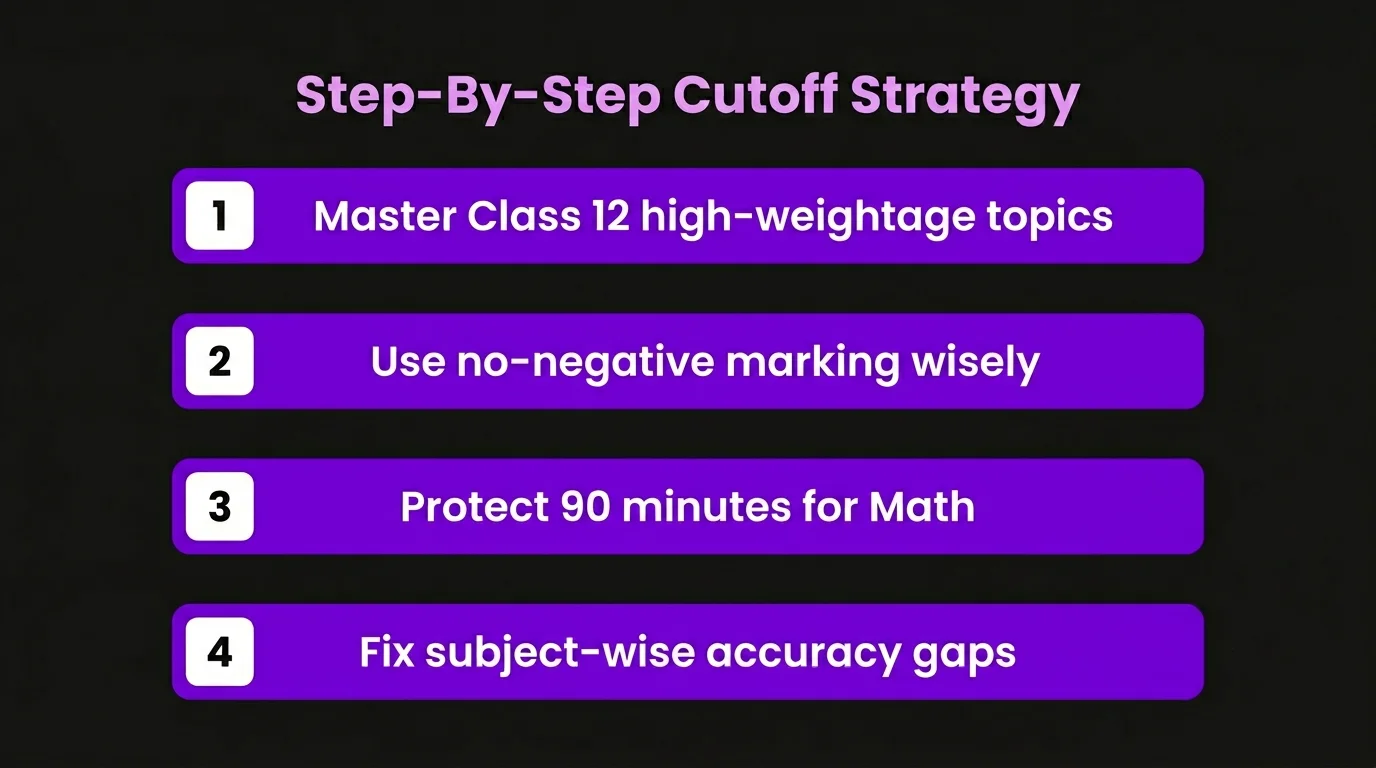
Here is the exact framework we use at Phodu Club for students stuck in the 80–90 percentile range who want to break into the 99s.
Step 1: The 60-40 Syllabus Rule
Most students miss this: 20% of the MHT CET syllabus (Class 11 topics) carries lower weightage, while Class 12 topics carry 80% weightage. Furthermore, within Class 12, certain topics are heavy hitters.
- Physics: Rotational Dynamics, Mechanical Properties of Fluids, Wave Optics, and Thermodynamics.
- Chemistry: Chemical Thermodynamics, Electrochemistry, Coordination Compounds, and Organic Name Reactions.
- Maths: Integration (Definite/Indefinite), Vectors, 3D Geometry, and Line & Plane.
- Action: Master these first. You cannot afford to make mistakes in high-weightage areas.
Step 2: Master the "No Negative Marking" Advantage
Many students think that because there is no negative marking in MHT CET , they can just guess the last 30 questions. This is a fatal flaw. While you should attempt every question (see our guide: No Negative Marking Changes Everything: Attempt All 150 Questions ), your guesses must be educated. Use elimination techniques. Eliminating two wrong options increases your probability of guessing correctly from 25% to 50%.
Step 3: The 90-Minute Math Isolation
Mathematics is the game-changer in MHT CET. It carries 100 marks (2 marks per question), while Physics and Chemistry carry 50 marks each (1 mark per question). If your Math is weak, your rank will tank. We train our students to isolate 90 minutes specifically for Math during mocks and aim for at least 35-40 highly accurate attempts before moving to educated guessing.
Crucial Step
Take a full-length mock today. Don't look at the overall score. Look at your accuracy in Math versus Physics/Chemistry. Fix the subject dragging your percentile down.
MHTCET: Category, Quotas, and the CAP Round Reality
Understanding Reservation Dynamics
You cannot look at a generic cutoff list and assume it applies to you. We’ve seen this pattern again and again: students get heartbroken looking at Open category cutoffs without realizing how reservation impacts the MHTCET cutoff across different demographics.
The Centralised Admission Process (CAP) allocates seats based on:
- Home University (HU) vs. Other Than Home University (OHU): If you gave your 12th boards from the Mumbai University jurisdiction, you have a separate (often slightly lower) cutoff for Mumbai colleges compared to a student from Pune applying to Mumbai.
- Category Reservations: SC, ST, OBC, VJ/DT, NT(A/B/C/D) have distinct seat matrices.
- TFWS (Tuition Fee Waiver Scheme): These seats are strictly on merit but offer massive fee reductions. The cutoffs here are generally higher than the Open category cutoffs.
A Real Student Example from Phodu Club
We advised an OBC category student from Nagpur who wanted to study in Pune (OHU). He was tracking the Open-HU cutoffs and feeling defeated. We pulled up the specific OBC-OHU cutoffs for his target colleges, and suddenly his target score dropped by a manageable 4 percentiles. He adjusted his preparation strategy, relaxed his test anxiety, and easily cleared his specific demographic cutoff.
Expert Guidance
When you check cutoffs on the official CET Cell website or our college predictor, ensure you are filtering by your exact Category and University type. Don't let the wrong data panic you.
How to Stay Consistent When MHTCET Mock Scores Fluctuate
The Psychological Battle
At Phodu Club, we tell our students that preparing for MHT CET is 50% academic and 50% psychological. You will have weeks where your mock scores drop by 15 marks. You will face papers that make you feel like you know nothing. This is normal.
What We Focus On First Is... Analysis!
Endless mocks without analysis are a waste of time. If you take a 3-hour mock, you must spend 2 hours analyzing it.
- Unforced Errors: Did you read "incorrect" as "correct"?
- Time Sinks: Did you spend 6 minutes on a single Math integration problem?
- Conceptual Gaps: Did you genuinely not know the formula for the magnetic field at the center of a coil?
If you are stuck in a score plateau, it’s not because you aren't working hard. It’s because you are repeating the same mistakes in every mock test. If you need a structured way to break this plateau, our MHT CET Crash Course is specifically designed to identify these exact gaps and fix them in the last critical months of preparation.
Key Insight
Keep an "Error Log" notebook. Write down every single mistake you make in a mock test. Before your next mock, read the notebook. You will naturally stop making those specific errors.
Conclusion
Understanding the numbers is half the battle won. We’ve worked with enough students to know this: effort alone doesn’t fix your score. The right strategy does. Worrying and stressing over the final MHTCET cutoff won't change your rank, but fixing your time management, mastering high-weightage chapters, and rigorously analyzing your mocks absolutely will.
If you are tired of generic advice, stagnant mock scores, and feeling lost in the competition, that’s exactly what we focus on fixing. At Phodu Club, we provide the mentorship, the tools, and the realistic strategies to help you cross your target percentile. Check out our MHT CET Online Coaching and take control of your preparation today. Let's get to work!
Frequently Asked Questions (FAQ)
1) What is a good MHTCET cutoff score for top colleges?
A "good" score depends heavily on the shift's difficulty. However, for top-tier colleges like VJTI or COEP, you generally need a 99.7–99.95+ percentile, which typically requires raw scores above 145-155 in standard difficulty shifts.
2) Does MHT CET have negative marking?
No, there is no negative marking in the MHT CET exam. You receive 1 mark for correct answers in Physics and Chemistry, and 2 marks for correct answers in Mathematics. You should attempt all 150 questions.
3) How is the MHT CET percentile calculated?
The percentile is calculated using a normalisation formula provided by the CET Cell. It reflects the percentage of candidates in your specific shift who have scored equal to or less than your raw score.
4) Can I get a good college with an 85 percentile?
Yes, an 85 percentile will roughly land you a state rank between 40,000 to 50,000. While you won't get CS/IT in Tier 1 colleges, you can secure good core branches (Mechanical, Civil, Electrical) in decent regional colleges, or CS/IT in emerging Tier 3 private institutions.
5) How much time is given for the MHT CET exam?
The exam is 180 minutes (3 hours) long. It is divided into two 90-minute sections. The first 90 minutes are strictly for Physics and Chemistry, and the next 90 minutes are strictly for Mathematics. You cannot switch between these sections.
6) Which is tougher: JEE Main or MHT CET?
Conceptually, JEE Main is tougher, especially in Physics and Mathematics. However, MHT CET is a test of intense speed and accuracy. Solving 150 questions in 180 minutes requires a completely different, faster test-taking strategy than JEE Main.
7) How can Phodu Club help me improve my MHT CET score?
At Phodu Club, we don't just give you video lectures and leave you alone. We provide a mentorship-driven approach. We help you analyze your mocks, identify your weak areas, provide structured crash courses, and give you realistic, data-backed strategies to push you past score plateaus.
8) What is the difference between Home University (HU) and Other Than Home University (OHU) quotas?
Maharashtra allocates 70% of seats in a college to students who passed their 12th board exams from the university jurisdiction where the college is located (HU). The remaining 30% are for students from other parts of Maharashtra (OHU). Cutoffs for HU are generally slightly lower than OHU for the same college.
Want to crack your exam with mentors who did?
Get test series, crash courses and free mentorship from students at IITs, NITs and BITS.