COMEDK Previous Year Question Papers: Previous Year Papers (PDF)
Every COMEDK season, we hear the same thing from students: "I've solved a stack of PDFs, why don't I feel ready?" Most of the time it's because they downloaded whatever showed up first in search results without checking whether it's actually from COMEDK, or a generic PCM paper with a COMEDK label stuck on top. COMEDK Previous Year Question Papers are genuinely useful, but only when you know where they actually came from and how the exam's own marking scheme should shape the way you solve them.
Quick Answer
- COMEDK does release official question papers and answer keys, through a login-gated candidate portal tied to the answer-key objection window, not as a permanent public archive.
- The exam pattern has stayed stable across 2023-2026: 180 MCQs, 180 marks, no negative marking, PCM only.
- Since there's no penalty for a wrong answer, previous year papers are best used to build speed and topic familiarity, not just raw accuracy.
COMEDK Previous Year Question Papers by Year (2023-2026)
Here's how each recent cycle actually played out. Since official access is login-gated and time-limited, treat the "View" column as a placeholder for what we're building out.
| Year | Exam Date | Total Questions | Total Marks | Negative Marking | View |
| 2026 | 9 May 2026 | 180 | 180 | None | Coming Soon |
| 2025 | 10 May 2025 | 180 | 180 | None | Coming Soon |
| 2024 | 12 May 2024 | 180 | 180 | None | Coming Soon |
| 2023 | 28 May 2023 | 180 | 180 | None | Coming Soon |
Scale is worth keeping in mind too. COMEDK has drawn well over a lakh candidates in recent cycles, competing for roughly 20,000 seats across 150-plus engineering colleges in Karnataka. That's a genuinely large applicant pool for what functions as a state-level exam, and it's part of why solving a wide spread of COMEDK previous year question paper sets matters, small differences in accuracy translate into real rank movement at this scale.
Does COMEDK Release Official Question Papers?
Unlike some entrance exams that never make their papers public, COMEDK genuinely does, just not in the way most students assume.
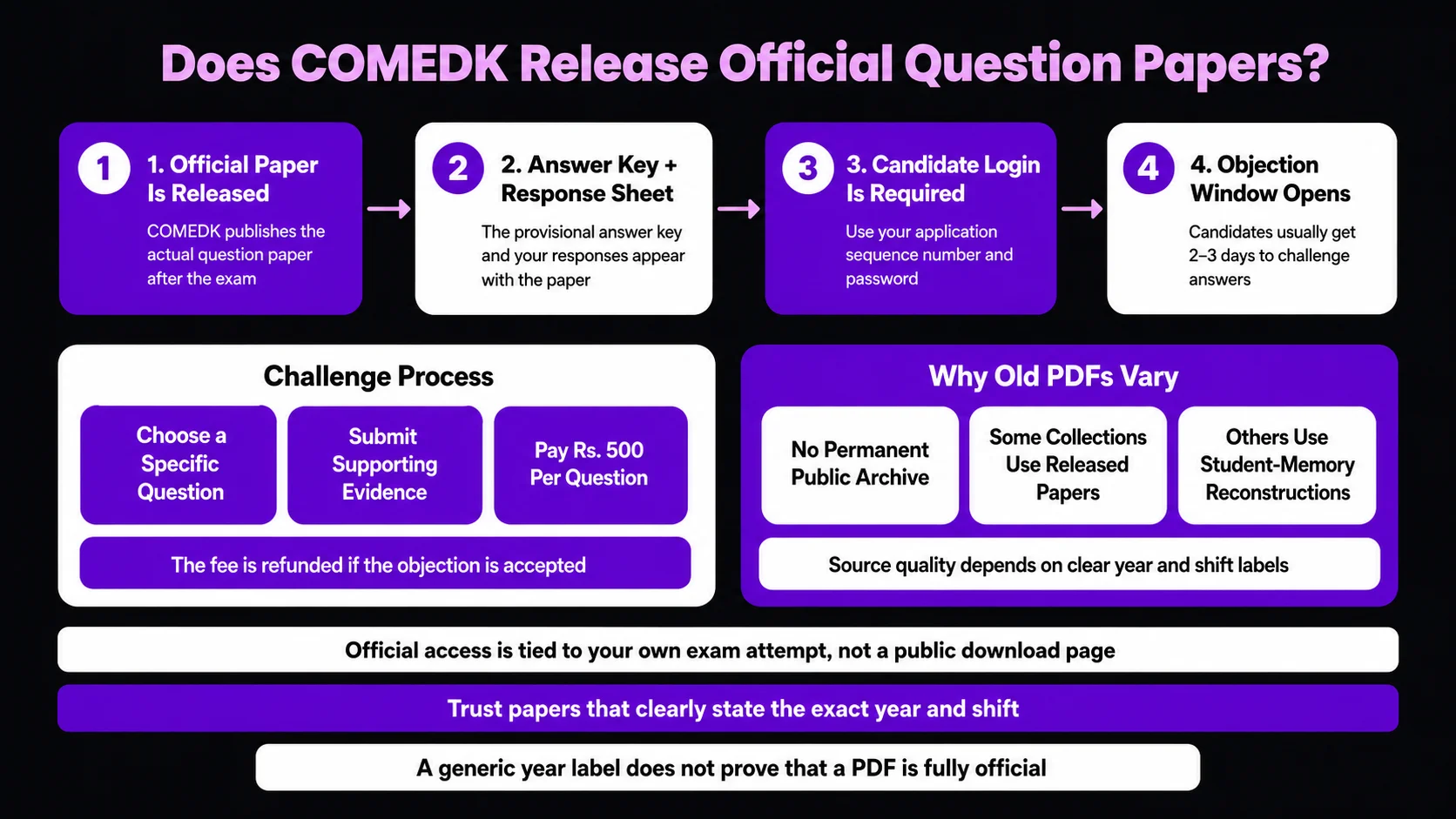
- After the exam, COMEDK releases the provisional answer key, your individual response sheet, and the actual question paper together on the official candidate portal.
- Access requires login. You need your application sequence number and password, and what you see is tied to your own exam attempt, not a public download page.
- It's connected to a short objection window. Candidates typically get 2-3 days to challenge specific answers, paying Rs. 500 per question challenged, refunded if the objection is accepted.
- It isn't kept as a long-term public archive. Once the objection window closes, that specific access isn't maintained the way a permanent PDF library would be. That's exactly why third-party platforms compile their own collections of past papers, some genuinely sourced from what COMEDK released that year, others reconstructed from student memory.
This matters because it changes how much weight you should put on a "100% official" claim attached to any random PDF. The underlying questions are often accurate, since COMEDK did release them at some point, but a source that's transparent about which year and shift a paper actually came from is more trustworthy than one that just slaps a year label on a stack of questions and calls it done.
The COMEDK Exam Pattern Behind Every Paper
Unlike some entrance exams that overhaul their marking scheme every year or two, COMEDK's pattern has stayed genuinely stable, which makes a paper from any recent year comparable to the next.
| Particular | Details |
| Total questions | 180 (60 Physics, 60 Chemistry, 60 Mathematics) |
| Total marks | 180 |
| Marks per correct answer | 1 |
| Negative marking | None |
| Exam duration | 3 hours |
| Mode | Computer-based test (CBT) |
| Medium | English only |
| Tie-breaking rule | Fewer incorrect answers ranks higher |
The no-negative-marking rule, combined with that tie-breaking rule, is worth internalizing before you solve a single paper. Since a wrong answer costs you nothing directly, attempting every question is close to always correct, but the tie-break rule means that if you're guessing wildly on questions you have zero idea about, you're still better off than leaving them blank, though a genuinely educated guess beats a random one. Review a few COMEDK previous year papers with this in mind and you'll notice toppers rarely leave anything unattempted.
What a Good COMEDK Previous Year Question Papers Set Should Cover
COMEDK doesn't publish an official chapter-wise weightage, so any breakdown you see, including the one below, comes from trend analysis of past papers rather than a confirmed COMEDK source. Use it as a checklist for whether the papers you're solving have realistic topic coverage.
| Subject | Areas that show up consistently |
| Mathematics | Calculus, Algebra, Coordinate Geometry, Vectors and 3D Geometry |
| Physics | Mechanics, Electrodynamics, Modern Physics, Optics |
| Chemistry | Organic Chemistry, Inorganic Chemistry (p/d/f-block), Physical Chemistry, NCERT-based recall questions |
Since COMEDK's PCM syllabus overlaps heavily with JEE Main, students who've already built a JEE-level foundation aren't starting from scratch. The real adjustment is pacing, since COMEDK's 180 questions in 3 hours moves faster than a JEE-style paper per question, and knowing you can never lose marks for a guess should change how aggressively you attempt borderline questions. Our list of COMEDK important chapters is a useful cross-check against whatever set of papers you're working through.
How to Tell a Reliable Source From a Weak One
Not every PDF labeled "COMEDK" online is worth your time. A few quick checks before you commit an hour to solving one:
- Check whether the marking scheme is stated correctly. A genuine COMEDK-style paper should confirm no negative marking and 1 mark per correct answer. If a source doesn't mention this, or gets it wrong, that's a signal to look elsewhere.
- Scan the section split. COMEDK's real paper carries exactly 60 questions each from Physics, Chemistry, and Mathematics. If a "COMEDK" paper looks noticeably different in structure, it's likely not built to the actual pattern.
- Look for solutions, not just a bare answer key. A paper with worked explanations lets you actually diagnose where your logic broke down, which matters more than the raw number of questions you get through.
- Watch for recycled question banks across "different" papers. Some low-effort sources reshuffle the same set of questions across multiple labeled years. If you notice the same setups repeating, you're not getting genuine additional practice.
How to Use These Papers the Right Way
A structured approach gets you far more out of the same number of practice hours than randomly downloading whatever loads first.
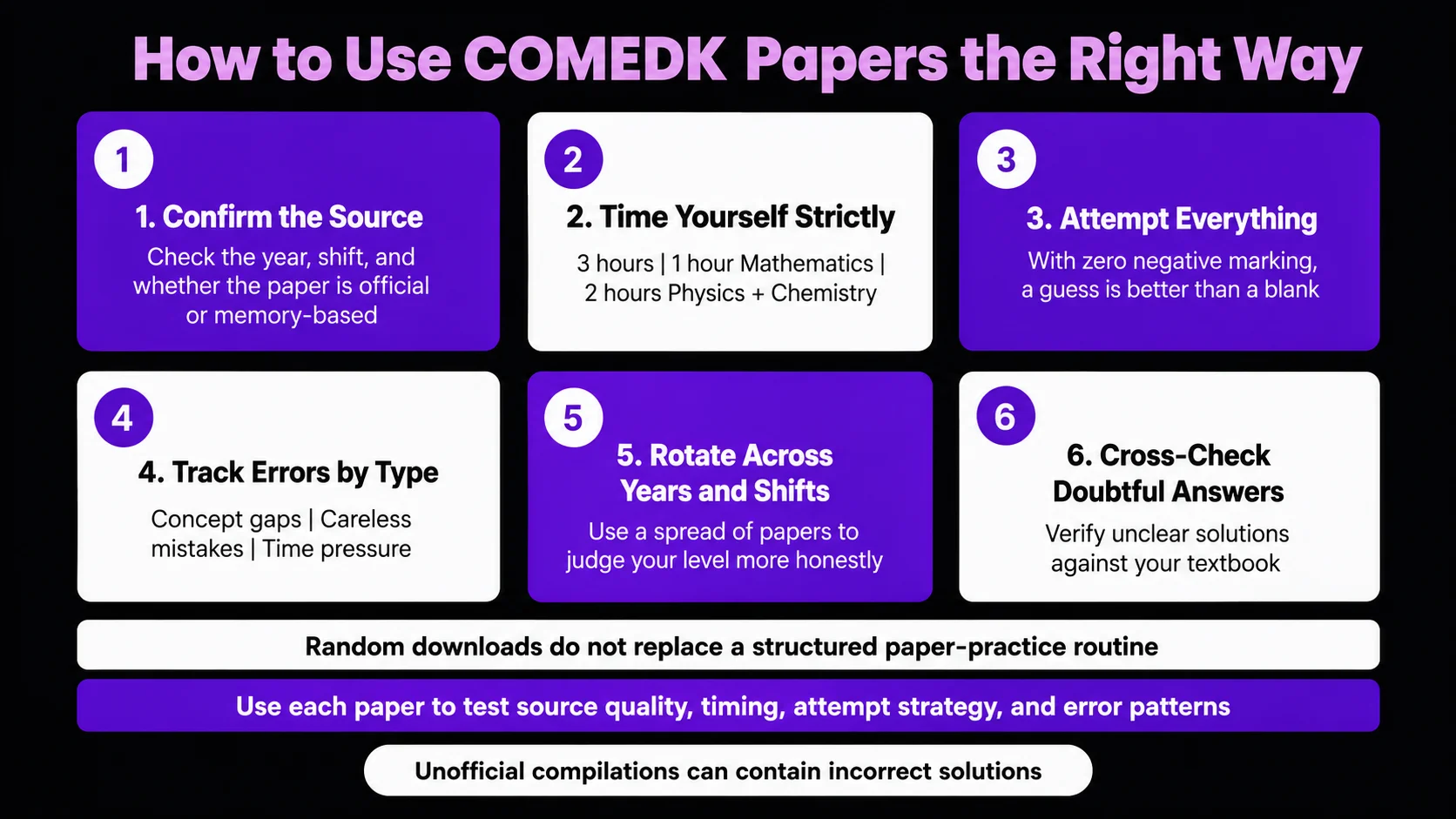
- Confirm the source before you start. Check whether a paper is labeled with its actual year, shift, and whether it's memory-based or drawn from an official release, so you know what you're actually solving.
- Time yourself strictly. Give yourself the full 3 hours, roughly 1 hour for Mathematics and 2 hours combined for Physics and Chemistry, matching COMEDK's own recommended split.
- Attempt everything. With zero negative marking, a blank answer is never better than a guess. Build this instinct now, not for the first time on exam day.
- Track errors by type. Separate concept gaps from careless mistakes from simple time pressure. Each needs a different fix, and lumping them together hides the real pattern.
- Rotate across multiple years. Since COMEDK's difficulty varies year to year and shift to shift, solving a spread of papers gives you a more honest read on your level than repeating just one or two sets.
- Cross-check answers you're unsure about. Since most publicly available papers are unofficial compilations, occasionally a solution is wrong. If something doesn't add up after a careful re-read, verify it against your textbook rather than assuming you made the error.
Mistakes Students Make With COMEDK Previous Year Question Papers
We see the same handful of habits undercut otherwise solid preparation, cycle after cycle.
- Leaving questions blank out of hesitation. With no negative marking, this is close to the single most avoidable way to lose marks in the entire exam.
- Solving without a timer. A relaxed, untimed attempt tells you almost nothing about whether you can genuinely finish 180 questions in 3 hours.
- Treating every downloaded PDF as equally reliable. Some past-year compilations are carefully built around the real syllabus weightage. Others are recycled generic PCM questions with a COMEDK label added on. Quality varies a lot between sources.
- Ignoring the tie-breaking rule. Two candidates with identical scores are ranked by who made fewer mistakes, not who attempted more. Wild, unfocused guessing across dozens of questions you have no idea about can quietly cost you in a close scenario.
- Only practicing with old, pre-merger papers. Since 2024, COMEDK UGET and Uni-GAUGE E run as a single combined exam. The question pattern itself hasn't changed, but it's worth knowing this context so you're not confused by references to two separate exams in older material.
Building a Complete Practice Routine
Previous year papers work best as one layer of a broader plan, not the entire plan.
- Finish a first pass of the COMEDK syllabus before you start timed practice, so a low score reflects test-taking gaps rather than untouched topics.
- Use COMEDK sample papers for extra volume once real previous year papers run out, since the pool of genuine past papers is limited.
- Run through the official COMEDK mock test at least once closer to the exam, since it's built on the real interface rather than a generic PDF.
- In your final weeks, solve exclusively under the current COMEDK marking scheme , attempting every question, so your habits match exactly what you'll face on exam day.
- Once you have a target score in mind, our COMEDK rank predictor can help translate it into a realistic sense of where you might land, and our full COMEDK preparation guide covers how to structure the months leading up to exam day.
What's Coming Next on Phodu Club
We're building out year-wise, subject-wise past papers with solutions, so keep this page bookmarked as they go live.
In the meantime, our Ultimate COMEDK Test Series 2026 gives you 5 full-length mock tests built to the latest COMEDK syllabus and pattern, with unlimited attempts and detailed solutions and analysis after every test, plus handwritten Ultimate Revision Notes covering the PCM chapters that keep showing up across years. It's the same instinct behind solving previous year papers, learning what the exam actually asks, just structured and built for the pattern you'll be sitting for.
Solving COMEDK Previous Year Question Papers earns its place in your prep the moment you know exactly what you're holding and why. Attempt everything, time yourself honestly, and don't let an unverified PDF cost you more than it teaches you. Between disciplined, timed practice and a clear-eyed read on which sources are actually reliable, a strong COMEDK score comes down to consistency, not luck.
Frequently Asked Questions
1) What are COMEDK Previous Year Question Papers?
They're compilations of questions from past COMEDK UGET exams, either drawn from what COMEDK officially released to candidates through its login-gated portal, or reconstructed from student memory by coaching platforms. Both types are used to understand real question phrasing, topic trends, and difficulty level.
2) Does COMEDK officially release its question papers?
Yes, but only through a login-gated candidate portal tied to each year's answer-key objection window, not as a permanent public download. Third-party sites compile and redistribute their own collections afterward, some accurately sourced, others reconstructed.
3) Is there negative marking in COMEDK UGET?
No. Every correct answer earns 1 mark, and incorrect or unanswered questions both score zero marks. This means attempting every single question is almost always the better strategy than leaving anything blank, regardless of how uncertain you feel about it.
4) How many years of past papers should I solve?
Most serious aspirants benefit from solving at least the last 3-4 years, ideally supplemented with sample papers once genuine past papers run out. Consistent, timed practice with proper review matters more than the raw number of papers solved, and reviewing every mistake carefully is worth more than rushing through one extra set.
5) Has the COMEDK exam pattern changed recently?
The core pattern has stayed stable: 180 questions, 180 marks, no negative marking, 3 hours. The main structural change was in 2024, when COMEDK UGET and Uni-GAUGE E began running as a single combined exam instead of two separate tests.
6) What is a good score based on COMEDK Previous Year Question Papers trends?
This varies significantly by target college and branch. Competitive CSE seats at top Karnataka colleges have historically needed scores well above 130-140 out of 180, while other branches and colleges accept considerably lower scores, sometimes well under 100. Treat any specific number as a rough trend indicator rather than a guarantee, since cutoffs shift year to year with the difficulty of that year's paper and the number of applicants.
7) Are past papers enough on their own, or do I need sample papers too?
Both have a role. Real previous year papers give you authentic question phrasing and difficulty, but the pool is limited. Sample papers, built to match the same pattern, give you the extra volume needed for consistent timed practice once you've worked through the genuine papers available.
8) Does Phodu Club provide COMEDK Previous Year Question Papers?
We're currently building out year-wise, subject-wise papers with solutions for this page. Until they're live, our Ultimate COMEDK Test Series 2026 offers full-length mock tests built to the current pattern along with revision notes, and our mentors can help you structure your practice in the meantime.
Want to crack your exam with mentors who did?
Get test series, crash courses and free mentorship from students at IITs, NITs and BITS.