COMEDK is a Time-Management Exam, Not a Hard One
At Phodu Club, we see this all the time: students study hard, know their concepts, but panic during the actual exam. They leave 30 to 40 questions unattempted and their scores completely flatline. Here is the truth they miss: solving COMEDK Questions is not about being a genius. It is a pure race against the clock. If you treat this exam like JEE Advanced, you will fail. We built this guide to show you exactly how to beat the timer, fix your weak areas, and maximize your score. Effort alone will not work today; you need the right strategy.
Quick Answer / TL;DR
- It is a Speed Test: You have 180 minutes for 180 questions. That is exactly 1 minute per question.
- Difficulty Level: Questions are direct, formula-based, and strictly stick to the syllabus.
- Best Strategy: Attempt the paper in 3 rounds (Easy, Moderate, Guess). Never solve linearly.
- Golden Rule: There is zero negative marking. Never leave a question blank on your screen.
Unpacking the Fundamentals: What is the COMEDK Exam?
Before we dive into the advanced strategies our students use to boost their scores, we need to understand the basic playing field. The Consortium of Medical, Engineering and Dental Colleges of Karnataka (COMEDK) conducts the UGET (Under Graduate Entrance Test) for engineering admissions.
Many students treat this as a backup option, but the reality is that it opens doors to some of the top private engineering colleges in the country, like RVCE, BMSCE, and MSRIT. To crack it, you need to know exactly how the exam is structured.
COMEDK Exam Particulars
| Particulars | Details |
| Mode of Exam | Computer Based Test (CBT) |
| Duration | 3 hours (180 minutes) |
| Medium of Exam | English |
| Sections | Three sections: Physics, Chemistry, Mathematics |
| Type of Questions | Multiple Choice Questions (MCQs) |
| Total Number of Questions | 180 Questions |
| Questions per Section | Physics: 60, Chemistry: 60, Mathematics: 60 |
| Marking Scheme | +1 mark for each correct answer |
| Negative Marking | No negative marking |
For a deeper dive into the exact syllabus breakdown, you can check our comprehensive guide on the COMEDK Exam Pattern .
Look closely at that table. 180 questions in 180 minutes with zero negative marking. This structure dictates your entire preparation. You are not being tested on your ability to solve complex, multi-layered problems. You are being tested on your decision-making speed, your memory recall, and your ability to let go of hard problems quickly.
Stop Overthinking: Why the Exam is Not Actually Hard
Many students fear that the COMEDK Questions will be tricky or heavily conceptual like JEE Main. This is a massive misconception that ruins preparation strategies. The exam is designed to test your breadth of knowledge across the Class 11 and 12 syllabus, not your depth of knowledge in a single chapter.
The Reality of the Difficulty Level
- Direct Application: Most physics and physical chemistry problems require you to simply identify the correct formula, plug in the given values, and calculate the answer.
- Fact-Based Chemistry: Inorganic chemistry is almost entirely fact-based. You either know the exception from the NCERT textbook, or you do not.
- Standard Math Models: The mathematics section rarely invents new question types. They use standard models that you have seen in your board exam preparations or basic state entrance materials.
We worked with a student last year who was scoring great in his JEE mock tests but was stuck at 80 marks in our COMEDK Test Series . We looked at his mock analysis and realized he was overcomplicating everything. He kept looking for "hidden tricks" in simple kinematics problems and wasted 3 minutes per question. Once we trained him to trust the simplicity of the paper and just apply basic formulas, his score jumped to 135 in three weeks.
When analyzing past COMEDK Questions, you will notice a trend: they test memory and basic application, not deep analytical thinking. If you know your NCERT and have a solid grip on basic formulas, you have the knowledge required to score 140+ marks.
The Phodu Club Takeaway: Stop studying from advanced JEE materials if your primary target is this exam. Stick to NCERT, grasp the fundamentals, and focus entirely on improving your calculation speed.
The Real Challenge: Beating the Clock
If the syllabus is easy, why do so many students score poorly? Because the real enemy is not the difficulty of COMEDK Questions; it is the ticking timer.
Let us break down the math of your exam day. You have 180 minutes. However, you need to factor in screen loading times, transitioning between sections, and the inevitable moments of panic or fatigue. Realistically, you have about 45 to 50 seconds of active problem-solving time per question.
The Psychology of Time Pressure
Time pressure does weird things to a student's brain. At Phodu Club, we have seen this pattern again and again in our mentorship sessions:
- The Sunk Cost Fallacy: You spend 2 minutes on a math question. You still do not have the answer. Because you have already invested 2 minutes, your brain tells you to keep trying. Suddenly, 5 minutes are gone on a single 1-mark question.
- The Reading Trap: Students read a long physics question 3 or 4 times because they are stressed, wasting 30 seconds before even starting the calculation.
- The End-of-Paper Panic: Because students waste time early on, they look at the clock with 15 minutes left and realize they have 40 questions untouched. They end up blindly guessing without even reading the easy questions hiding at the end of the paper.
Respect the clock above all else. Your goal is not to solve the hardest problem in the room; your goal is to collect as many easy marks as possible in the shortest amount of time.
Subject-Wise Preparation Strategies for Maximum Speed
To maximize your speed, you need a targeted approach to practicing COMEDK Questions every single day. Generic study plans do not work for speed-based exams. You need to align your preparation with exactly what the paper demands.
Here is how we tell our students to tackle each subject.
Physics: The Formula Game
Physics in this exam is not about deep, multi-concept problems. It is about recognizing the scenario and pulling the right formula from your brain instantly.
- Action Plan: You need a dedicated formula sheet for every single chapter. Do not just write the formula; write down the standard units and the common scenarios where it applies.
- High-Weightage Areas: Focus heavily on Modern Physics, Thermodynamics, Current Electricity, and Electrostatics. These chapters yield direct, calculation-light questions.
- Practice Focus: When solving COMEDK Previous Year Question Papers , focus on improving your mental math. Avoid writing down every single step of a calculation on your rough sheet.
Chemistry: The NCERT Goldmine
Chemistry is your ultimate time-saver. A well-prepared student should finish this 60-question section in 40 minutes or less.
- Inorganic Chemistry: This is purely NCERT based. You must memorize trends, exceptions in the periodic table, s-block, p-block, d and f-block elements, and coordination compounds. Create flashcards for exceptions.
- Organic Chemistry: Focus on named reactions, reagents and their functions, and basic IUPAC nomenclature. You will rarely see complex, multi-step synthesis mechanisms.
- Physical Chemistry: Similar to physics, keep a formula sheet handy. Practice calculating quickly with decimals and logs, as these are common hurdles.
Mathematics: Speed Over Elegance
Mathematics is where most students lose the battle against the clock. The syllabus is vast, and the calculations can be lengthy if you do not know the shortcuts.
- Action Plan: Master Class 11 and 12 NCERT formulas, especially in Calculus and Coordinate Geometry.
- High-Weightage Areas: Vectors, 3D Geometry, Matrices, Determinants, and Probability. These chapters often have shortcut tricks that can bypass pages of integration or algebra.
- Practice Focus: Learn to rely on the options. Many math questions can be solved by substituting the options back into the equation or by checking the boundary conditions.
The Phodu Club Takeaway: Your study table should have three things right now: the NCERT books, your customized short notes, and a timer. Stop reading theory all day. Start executing. For a detailed list of resources, check out our guide on the Best Books for COMEDK .
The Ultimate Exam Attempting Strategy: The 3-Round Method
This is the most critical section of this guide. Do not just solve COMEDK Questions linearly from 1 to 180. That is a guaranteed way to run out of time and miss out on easy marks.
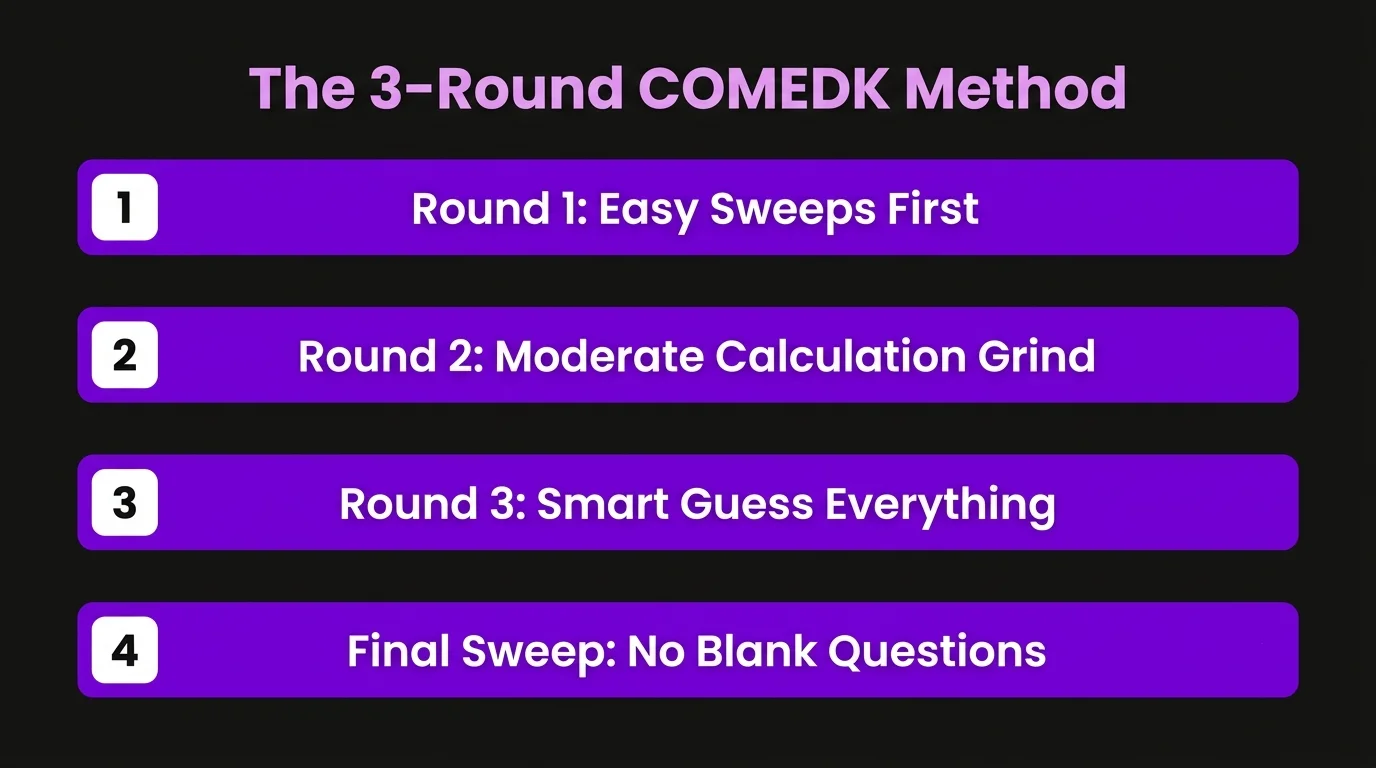
Round 1: The Easy Sweeps (First 60 to 70 Minutes)
Your goal in Round 1 is momentum. You want to go through the entire paper (or at least your strongest two sections) and hunt for the easiest questions.
- What to target: Fact-based chemistry questions, direct physics formula applications, and math questions you can solve by just looking at them.
- Time limit per question: Maximum 30 to 45 seconds.
- The Rule: If you read a question and do not immediately know the path to the answer, use the "Mark for Review" feature and skip it instantly. Do not let your ego make you solve it.
- Expected Outcome: By the end of this round, you should have secured 60 to 75 solid marks. This builds massive confidence for the rest of the exam.
Round 2: The Moderate Grind (Next 70 to 80 Minutes)
Now you go back to the questions you marked for review. These are the questions you know how to solve, but they require 1 or 2 minutes of calculation.
- What to target: Lengthy physics numericals, multi-step math problems, and organic chemistry conversions that require a bit of thought.
- Time limit per question: 1 to 2 minutes.
- The Rule: If your calculation gets messy or you hit a dead end, do not start over. Mark an educated guess, flag it if you want, and move on.
- Expected Outcome: This is where you push your score from average to excellent. You should be picking up another 40 to 50 marks here.
Round 3: The Smart Guessing Phase (Final 15 to 20 Minutes)
You should now only have the toughest questions left—the ones you have no clue how to solve, or the ones that require 5 minutes of calculation.
- The Golden Rule: Because there is no negative marking, you MUST attempt every single remaining question.
- How to Guess Smartly: Use the process of elimination. Cross out options that have the wrong units or wildly incorrect orders of magnitude.
- Final Sweep: In the last 2 minutes, check your exam palette to ensure absolutely no question is left unattempted.
Ideal Time Allocation
We highly recommend allocating your time strategically based on the historical length of the sections.
- Chemistry: 40 to 50 Minutes (Do this first to save time)
- Physics: 50 to 60 Minutes
- Mathematics: 60 to 70 Minutes (Always takes the longest)
- Buffer/Review: Final 5 to 10 Minutes
Exam strategy is just as important as syllabus completion. You need to practice this 3-Round method in every single mock test until it becomes muscle memory.
Practice Tips & Common Mistakes to Avoid
A major mistake we see is students getting stuck on ego battles with tough COMEDK Questions. You need to drop your ego at the door of the examination hall. A tough integration question carries the exact same 1 mark as a basic dimension-analysis question.
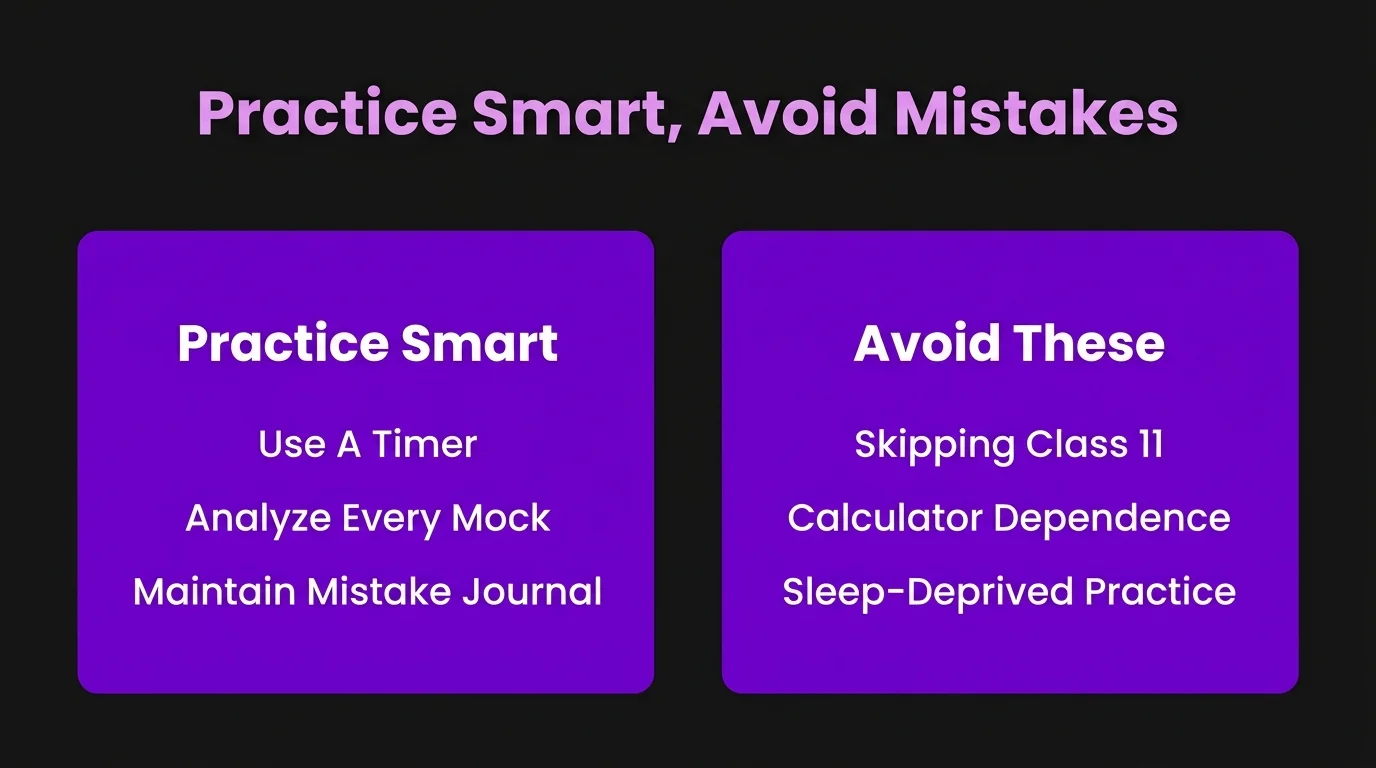
How to Practice Effectively
- Stop Solving Without a Timer: Every time you sit down to solve a worksheet, set a timer. If you have 30 questions, give yourself 30 minutes. Train your brain to operate under pressure.
- Mock Test Analysis is Non-Negotiable: Giving a 3-hour mock test is useless if you do not spend 2 hours analyzing it. You need to find out why you got a question wrong. Was it a conceptual gap? A calculation error? Or did you just misread the question?
- The "Silly Mistake" Journal: Create a separate notebook just for your mistakes. Write down things like "I forgot to convert cm to m" or "I misread INCORRECT as CORRECT". Review this journal before every mock test.
What to Avoid
- Ignoring Class 11 Syllabus: Nearly 40-45% of the paper comes from Class 11. You cannot skip it and expect a top rank.
- Over-relying on Calculators during Prep: There is no on-screen calculator in the exam. Do your manual calculations on paper during your preparation.
- Burnout: Ensure you are getting 7-8 hours of sleep. A tired brain makes slow calculations and silly errors.
If you are struggling to structure your preparation and need a clear, day-by-day plan, our COMEDK Crash Course is built specifically to address these gaps and boost your speed.
Conclusion
We have worked with enough students to know this: effort alone does not fix your score. The right strategy does. Practicing COMEDK Questions without a stopwatch is a complete waste of your time. You need to shift your mindset from "learning how to solve everything" to "learning how to maximize marks in 180 minutes."
Start building your formula sheets today. Start taking timed mock tests. Stop fighting the tough questions and start hunting for the easy ones. That is exactly what we focus on at Phodu Club, and it is the only proven way to break through your score plateau. Remember, this is a speed test. Train like a sprinter, and you will secure the rank you deserve.
Frequently Asked Questions (FAQ)
1) What is the overall difficulty level of the COMEDK exam compared to JEE Main?
The exam is significantly easier than JEE Main in terms of conceptual depth. While JEE Main requires multi-step problem solving and deep analytical thinking, this exam focuses on direct formula application, factual recall (especially in chemistry), and high-speed execution. If you have prepared decently for your Class 12 board exams, you already have the foundational knowledge required.
2) How should I manage my time effectively during the 3-hour exam?
The most effective method is the 3-Round Strategy. Dedicate your first 60-70 minutes to sweeping the entire paper for easy, 30-second questions. Allocate specific time limits per section: try to finish Chemistry in 45 minutes, Physics in 55 minutes, and leave at least 70 minutes for Mathematics, as it is usually the most calculation-heavy section. Always leave the last 10 minutes for review and marking final guesses.
3) My mock test scores are stuck at 90 marks. How can I improve?
A stagnant score usually means a flaw in your exam strategy, not just a lack of knowledge. First, start analyzing your unattempted questions. Are you running out of time because you spend 4 minutes on tough math problems? Fix your sequence (do Chemistry first) and practice skipping questions aggressively. Second, memorize inorganic chemistry facts and physical chemistry formulas completely to save calculation time.
4) Should I prepare differently for COMEDK than I do for KCET or VITEEE?
The core syllabus (NCERT Class 11 and 12) remains the same across these exams. However, the exact pacing differs. KCET is also highly speed-based, so preparation overlaps heavily. For a deeper understanding of how these exams compare, you can read our breakdown on Is COMEDK Tough? . The main difference is adapting to the specific CBT environment and strictly adhering to the 1-minute-per-question rule.
5) Is there any negative marking in the exam?
No, there is absolutely zero negative marking in the exam. You are awarded +1 mark for every correct answer, and 0 marks for incorrect or unattempted questions. You can verify the details in our guide on COMEDK Negative Marking .
6) Are NCERT books enough to crack this exam?
For Chemistry, NCERT is more than enough; it is your Bible. For Physics and Mathematics, NCERT provides the necessary foundation and formulas, but you must supplement it with speed-building practice using previous year papers and standard objective-type reference books to get used to the MCQ format.
7) How does Phodu Club help students who are struggling with this exam?
We built Phodu Club because we saw students studying 10 hours a day but failing to improve their mock scores. We focus on strategy over generic teaching. We help you identify exactly which chapters are draining your time, teach you how to analyze your mistakes, and provide targeted mentorship to fix your exam-taking strategy, ensuring you do not just work hard, but work smart.
8) Is there any penalty for guessing or attempting all 180 COMEDK Questions in the exam?
Absolutely not. Because there is no negative marking, leaving any question blank is the biggest mistake you can make. Even if you only have 2 minutes left on the clock and 20 questions remaining, you should quickly mark an option (like all 'B's or 'C's) for the remaining ones. You have a 25% chance of getting free marks with zero risk.
Want to crack your exam with mentors who did?
Get test series, crash courses and free mentorship from students at IITs, NITs and BITS.