COMEDK Application Form: Dates, Steps & How to Apply
Every year we talk to students who lose weeks of prep time chasing down basic information about the COMEDK application form: when it opens, what documents to keep ready, and where exactly they went wrong the first time they tried to submit it. One student we mentored had her form rejected during the correction window because she uploaded a signature scan in the wrong size, something that took five minutes to fix but nearly cost her a shot at applying on time. This guide exists so you don't repeat that mistake.
Quick Answer
COMEDK UGET registration usually opens in the first week of February and closes by mid-to-late March, with a short correction window in April before the exam in the first half of May. The 2027 form has not been released yet; based on the 2025 and 2026 cycles, expect it around early February 2027. Apply only at comedk.org .
Why Getting This Right Matters More Than Students Think
COMEDK UGET is the single gateway to more than 150 private engineering colleges in Karnataka, including names like RVCE, BMSCE and MSRIT that a lot of our students specifically target. Unlike JEE Main, there's no second attempt window within the same year. If your form gets rejected, or you miss a deadline because you assumed you had "a few more days," there's no do-over until the correction window opens, and even that only fixes select fields.
We've seen students treat the process as a formality, something to knock out in ten minutes between coaching classes. That's usually where the trouble starts. Small errors, like a name that doesn't match your Class 10 marksheet exactly, a category certificate uploaded in the wrong format, or a mobile number you no longer have access to, can create real friction later during counselling. Getting the COMEDK application form right the first time protects your rank card, your document verification, and ultimately your seat.
There's also a scale factor here that students underestimate. Over 1.4 lakh candidates registered for COMEDK UGET in recent cycles, all competing for roughly 20,000-plus seats across 85-plus engineering courses. A clean, accurate application isn't going to improve your rank, but a messy one can absolutely put your seat at risk during the verification stage of counselling, long after you thought the paperwork was behind you.
COMEDK UGET 2027 Application Form Dates You Need to Track
COMEDK has not announced the 2027 schedule yet. What we do know is that the pattern has been remarkably consistent for two cycles running, so this table gives you the actual 2026 dates alongside a reasonable, clearly labeled estimate for 2027.
| Event | 2025 (actual) | 2026 (actual) | 2027 (expected) |
| Registration opens | 3 Feb 2025 | 3 Feb 2026 | Early Feb 2027 (not yet confirmed) |
| Last date to apply | 15 Mar 2025 (extended to 24 Mar) | 16 Mar 2026 (extended to 23 Mar) | Mid-to-late Mar 2027 (estimate) |
| Correction window | 11-14 Apr 2025 | 10-13 Apr 2026 | Early-to-mid Apr 2027 (estimate) |
| Admit card release | 30 Apr 2025 | 29 Apr 2026 | Late Apr 2027 (estimate) |
| Exam date | 10 May 2025 | 9 May 2026 | Early-to-mid May 2027 (estimate) |
Two things worth flagging honestly. First, COMEDK has extended its application deadline in both of the last two cycles, sometimes twice, so treat the published last date as your real deadline, not the extension as a guarantee. Second, we will update this page the day COMEDK releases the official 2027 notification, so bookmark it rather than relying on a screenshot that's already a year old.
Historically, COMEDK UGET has been held on the second Sunday of May. In recent years the date has shifted slightly to avoid clashing with other national-level exams, so treat "early-to-mid May" as the safer working assumption for 2027 rather than locking in a single date until the official brochure is out.
Eligibility Criteria to Check Before You Start
COMEDK verifies eligibility at admission, not at the point of submission, which means an application that sails through registration can still run into trouble months later. Confirm these before you begin.
| Criterion | Requirement |
| Nationality | Indian citizens, OCI and PIO candidates |
| Qualifying exam | Class 12 / 2nd PUC or an equivalent recognised by a State or Central board |
| Compulsory subjects | Physics and Mathematics, plus Chemistry, Biotechnology, Biology, Computer Science or Electronics as the third subject, with English as a language subject |
| Minimum marks (General) | 45% aggregate in the compulsory subjects |
| Minimum marks (SC/ST/OBC, Karnataka) | 40% aggregate in the compulsory subjects |
| Age limit | No upper or lower age limit specified |
| Diploma holders | Not eligible; COMEDK UGET has no lateral entry route |
| Appearing candidates | Class 12 students awaiting results can apply, subject to meeting the eligibility at the time of admission |
If you're applying for B.Arch through the same portal, you don't sit the COMEDK UGET paper at all; admission runs on your NATA score instead, so make sure you're filling out the right form for the right course before you start.
How to Fill the COMEDK Application Form: Step by Step
This is the exact sequence, in the order COMEDK's portal walks you through it.
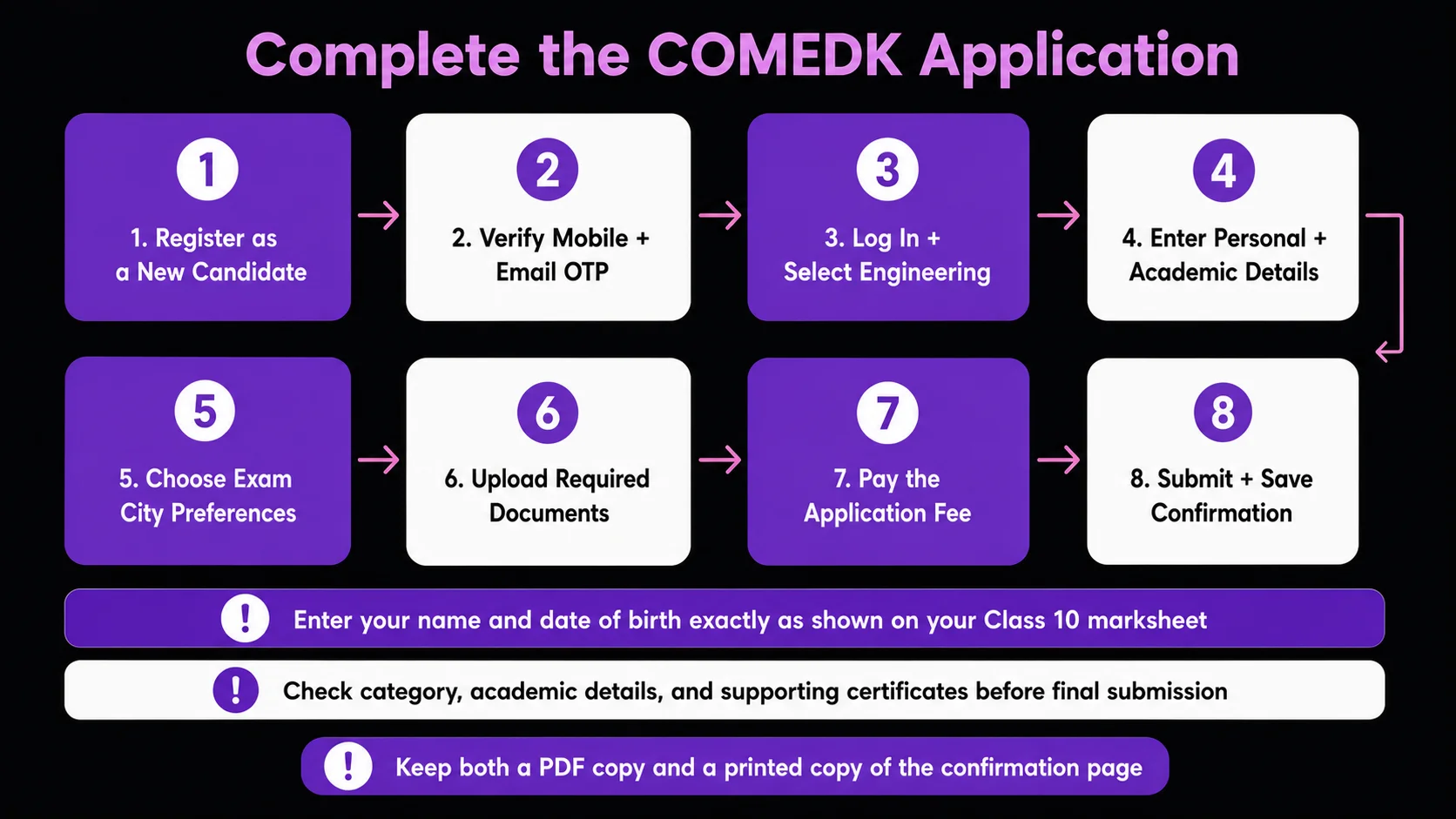
- Register as a new candidate. Go to comedk.org and click the UGET registration link. Enter your name, date of birth, mobile number and email ID exactly as they appear on your Class 10 marksheet.
- Verify with OTP. You'll receive an OTP on your registered mobile and email. Enter it to generate your User ID and password, sent back to you by SMS and email.
- Log in and start the application. Use your new credentials to log in, then select the exam (Engineering) you're applying for.
- Fill personal and academic details. This includes your address, category, nationality, gender, parents' details and your 10th/12th academic information.
- Choose your exam city preferences. Pick from the list of available centres; COMEDK runs the test across 400-plus centres in 200-plus cities, so most students get a reasonably close option.
- Upload your documents. Photograph, signature, category or income certificates if applicable, all in the specified size and format (more on this below).
- Pay the application fee. Payment is online only, via debit card, credit card or net banking.
- Submit and download. Once payment clears, submit the form and download or print the confirmation page. Keep both a digital and a physical copy.
Don't rush step 4. Most of the rejected or flagged applications we've seen trace back to a mismatched name, a wrong date of birth format, or a category selected without the certificate to back it up. Read every field twice before you hit save and continue, because several of these details can't be touched again once the correction window closes.
Documents Required for a Complete COMEDK Application Form
Keep these scanned and ready before you sit down to fill the form, not halfway through it.
| Document | Notes |
| Passport-size colour photograph | Recent, light background, specified size |
| Signature | Candidate's own signature, scanned |
| Parent or guardian signature | Scanned separately from the candidate's |
| Valid photo ID proof | Aadhaar, passport or similar |
| Class 10 marksheet | For name and date of birth verification |
| Class 12 / PUC marksheet or admit card | If already available; appearing candidates upload this later |
| Category certificate | Only if applying under SC/ST/OBC or another reserved category |
| Income certificate | Only where applicable for category-based fee concessions |
Names must match your Class 10 marksheet exactly. If you've legally changed your name since, you'll need to carry original proof of that change to counselling, even though the form itself won't ask for it upfront.
COMEDK Application Fee: What You'll Actually Pay
| Category | Fee (2026 cycle) |
| COMEDK UGET only | Rs 1,950 + applicable convenience charge |
| COMEDK UGET + Uni-GAUGE E | Rs 3,200 + applicable convenience charge |
Fees can shift slightly year to year, so treat the numbers above as the 2026 reference point and confirm the exact figure on comedk.org once the 2027 notification is out, rather than budgeting off last year's number alone. Payment is online-only; there's no offline or challan-based option, and the fee is non-refundable once paid regardless of whether you sit the exam.
Common Mistakes Students Make While Applying
We see the same handful of errors on repeat, cycle after cycle:
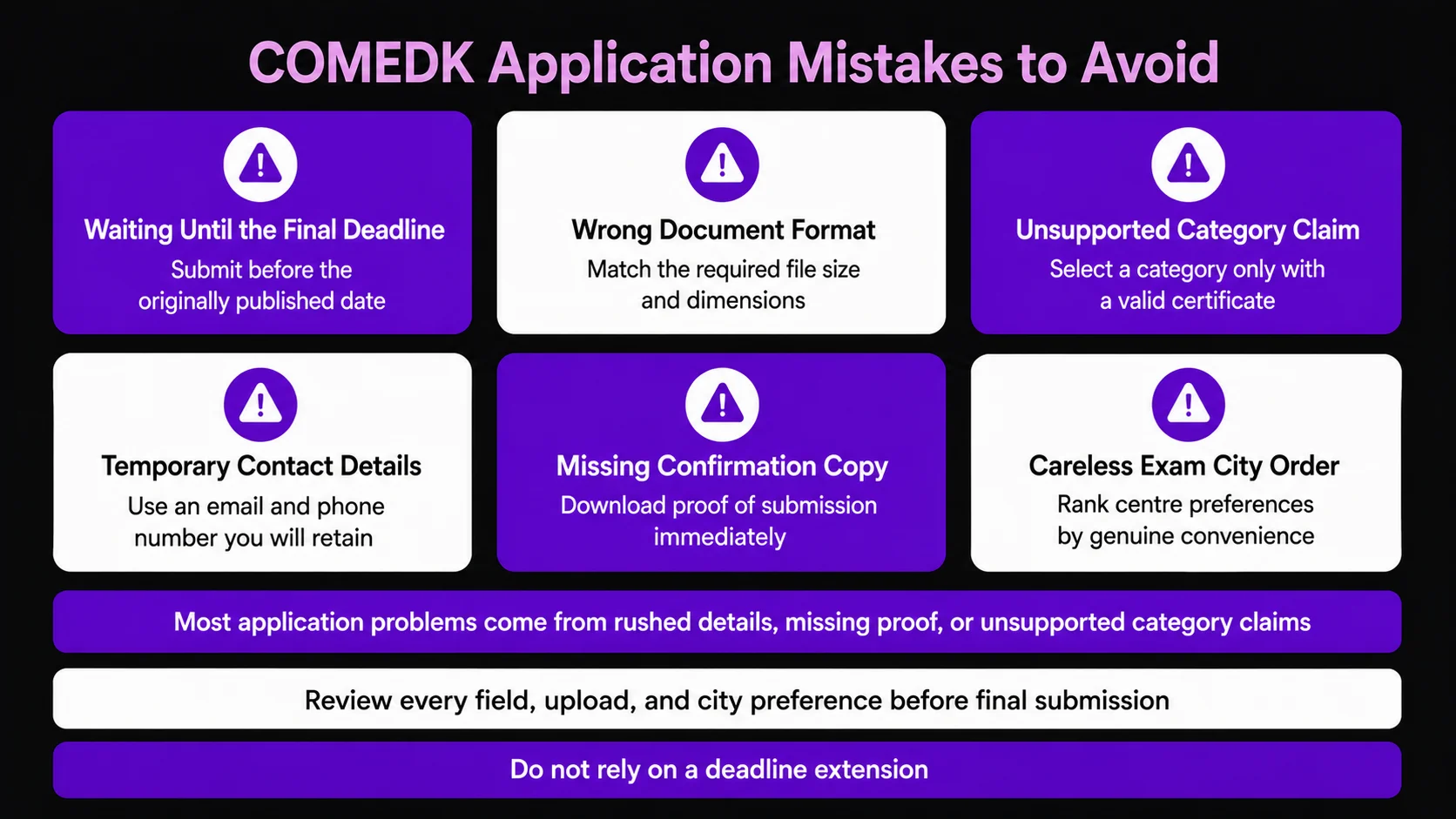
- Waiting for the "final" deadline. COMEDK has extended its last date in recent cycles, but assuming an extension will happen is a bad bet. Submit before the originally published date.
- Uploading documents in the wrong format. The portal specifies exact file size and dimensions for the photo and signature. Get this wrong and your upload either fails silently or gets flagged during verification.
- Selecting a category without the certificate. If you tick SC/ST/OBC but can't produce the certificate at verification, you're pushed back to general category rules, which can affect your eligibility marks.
- Using a phone number or email you'll lose access to. All official communication, including counselling updates, goes through the contact details you enter here. Use ones you'll control for the next six months.
- Skipping the confirmation page download. Candidates who close the browser right after payment sometimes struggle to retrieve proof of submission later. Download and save it immediately.
- Ignoring the exam city preference order. Students often pick their preferences carelessly, assuming they'll definitely get their first choice. Centre allotment depends on capacity, and a rushed choice can mean travelling further than necessary on exam day.
What Happens After You Submit
Submitting the COMEDK application form isn't the end of the process, it's the start of a longer sequence with its own set of deadlines. A short correction window opens a few weeks later, letting you fix select fields (not your name, date of birth or category in most cases, so get those right the first time). After that, your Test Admission Ticket becomes available for download, followed by the exam itself, the answer key window, and results. Once your rank is out, centralized counselling begins, where your COMEDK rank determines your choice-filling order across the participating colleges.
Each of these stages runs on its own timeline, and missing one, even after a flawless application, can cost you an entire counselling round. Set calendar reminders for the admit card date and the result date the moment they're announced, rather than trying to track them manually across multiple news sites.
What the COMEDK UGET Exam Looks Like Once You're Registered
Once your form is submitted, it helps to know what you're actually preparing for, because a lot of students only look this up in the final weeks before the exam.
| Exam Detail | Specification |
| Mode | Computer-based test (online) |
| Duration | 3 hours |
| Total questions | 180 (60 each from Physics, Chemistry, Mathematics) |
| Marking scheme | 1 mark per correct answer, no negative marking |
| Language | English |
| Sections | Physics, Chemistry, Mathematics |
The absence of negative marking is worth planning around. It changes exam-day strategy compared to something like JEE Main, where guessing carries a penalty. In COMEDK UGET, an educated guess on a question you're unsure about costs you nothing if it's wrong, so leaving questions blank rarely makes sense once you've eliminated at least one option.
Counselling: Why the Form You Filled Still Matters Later
A lot of students mentally close the chapter on their application the moment they get their admit card. That's a mistake. Everything you entered, your category, your personal details, your uploaded documents, gets re-verified during centralized counselling, which follows a choice-filling and seat-allotment structure across multiple rounds. If a document doesn't match what you submitted at the application stage, or a certificate you promised to carry doesn't match your declared category, you can lose your allotted seat even after clearing the exam with a good rank. Treat the application and the counselling documents as one continuous file, not two separate tasks.
Getting the Form Right Is Just the First Step
Filling out the COMEDK application form correctly gets you into the process, but it doesn't prepare you for the exam that decides your rank. That's where the real work starts, and it's also where we've seen the biggest gap between students who prepare with a plan and students who prepare on hope. Our Ultimate COMEDK Test Series is built around five full-length mock tests that mirror the latest COMEDK syllabus and pattern, with unlimited attempts so you can retake a mock until the concept actually sticks. Every mock comes with detailed solutions and analysis, and you also get handwritten-style revision notes covering PCM chapters, made by students who've cleared the exam themselves. If you're serious about converting a completed application into a strong rank, check out the current details on our COMEDK Test Series page.
Frequently Asked Questions
1) When will the COMEDK application form 2027 be released?
COMEDK hasn't announced 2027 dates yet. Going by the last two cycles, both of which opened on February 3, expect the form in early February 2027, though this is an estimate and not a confirmed date.
2) Can I edit my form after submitting it?
Yes, but only during the correction window, which typically opens a few weeks after registration closes and stays open for about three to four days. Core details like your name, date of birth and category usually can't be changed at this stage.
3) What is the minimum percentage required to apply?
You need 45% aggregate in Physics, Chemistry and Mathematics for the general category, and 40% for SC/ST/OBC candidates from Karnataka.
4) Is the application fee refundable if I don't appear for the exam?
No. Once paid, the application fee is not refunded regardless of whether you sit the exam.
5) Can Class 12 appearing students apply?
Yes. Candidates appearing for their Class 12 exams in the same year are eligible to apply, provided they meet the eligibility criteria by the time of admission.
6) How is COMEDK different from the JEE Main application process?
COMEDK is a state-level exam for private engineering colleges in Karnataka with a single application window and no re-attempt in the same year, while JEE Main runs two sessions and feeds NITs, IIITs and centrally funded institutes nationwide. If you're weighing both, our BITSAT vs JEE Main comparison covers similar ground for a related exam pair.
7) What documents are compulsory for the COMEDK application form?
A recent photograph, your own signature, your parent or guardian's signature, and a valid photo ID are compulsory. Category or income certificates are only needed if you're applying under a reserved category.
8) Does Phodu Club help with COMEDK preparation after the application is done?
Yes. Once your application is submitted, our Ultimate COMEDK Test Series gives you full-length mocks in the exact exam pattern along with revision notes, so you're not just registered for the exam, you're actually ready for it.
Want to crack your exam with mentors who did?
Get test series, crash courses and free mentorship from students at IITs, NITs and BITS.