BITSAT Result: Result & Scorecard
Every year, we see students stare at the score shown on their screen right after submitting BITSAT and treat it as final, only to find a genuinely different number on their official scorecard weeks later. That gap confuses more students than almost anything else in the BITSAT process. Your BITSAT result isn't the number you see on exam day. It's a moderated score released later, and understanding exactly how that works matters just as much as your actual preparation once the exam itself is behind you. This guide covers how the 2026 result process played out, what's on your scorecard, and what to expect for 2027.
Quick Answer
The BITSAT 2026 result for Session 1 was released April 29, 2026, and Session 2 on June 5, 2026, both on admissions.bits-pilani.ac.in . If you attempted both sessions, BITS Pilani automatically considers your better moderated score for admission, so there's nothing extra you need to do to claim it.
Why the Score You See on Screen Isn't Final
This is the single most misunderstood part of the entire process, so it's worth being precise about it upfront:
- The score shown immediately after your test is a raw, unofficial estimate only. It gives you a rough sense of performance but isn't what appears on your final scorecard.
- BITSAT applies a moderation process, not full percentile normalisation. Since the exam runs across multiple days and shifts, if a question is later found to be ambiguous or incorrect, appropriate credit is awarded to every candidate affected by it. This is different from a JEE Main-style statistical normalisation across the entire candidate pool.
- The moderated score is what counts everywhere that matters, your official scorecard, the merit list, and seat allotment. Treat your on-screen score as directional only, not something to plan your counselling strategy around.
- This distinction is a common source of confusion, since some secondary sources use "normalisation" loosely to describe this moderation step. The precise picture is that BITSAT corrects for flawed questions, not for overall shift difficulty the way some other national exams do.
Our BITSAT normalization page breaks this down in more detail if you want the full mechanics behind how your final score is calculated.
2026 Result Timeline (For Reference)
Here's exactly how the 2026 cycle played out, useful as a benchmark for what 2027 will likely resemble:
| Event | Date |
| Session 1 exam | April 15-17, 2026 |
| Session 1 result and scorecard | April 29, 2026 |
| FD (First Degree) Preference Form opens | April 21, 2026 |
| FD Preference Form last date | June 1, 2026 (11:55 PM IST) |
| Session 2 exam | May 24-26, 2026 |
| Session 2 result and scorecard | June 5, 2026 |
| Merit list and Iteration 1 result | June 15, 2026 |
Notice that the preference form window opens before Session 2 even happens, and its deadline sits close to the Session 2 result date. Missing this window because you were only tracking exam dates, not the full admission calendar, is a mistake we see repeat every single cycle without fail. Our BITSAT dates page tracks this complete timeline in one place.
How to Check and Download It
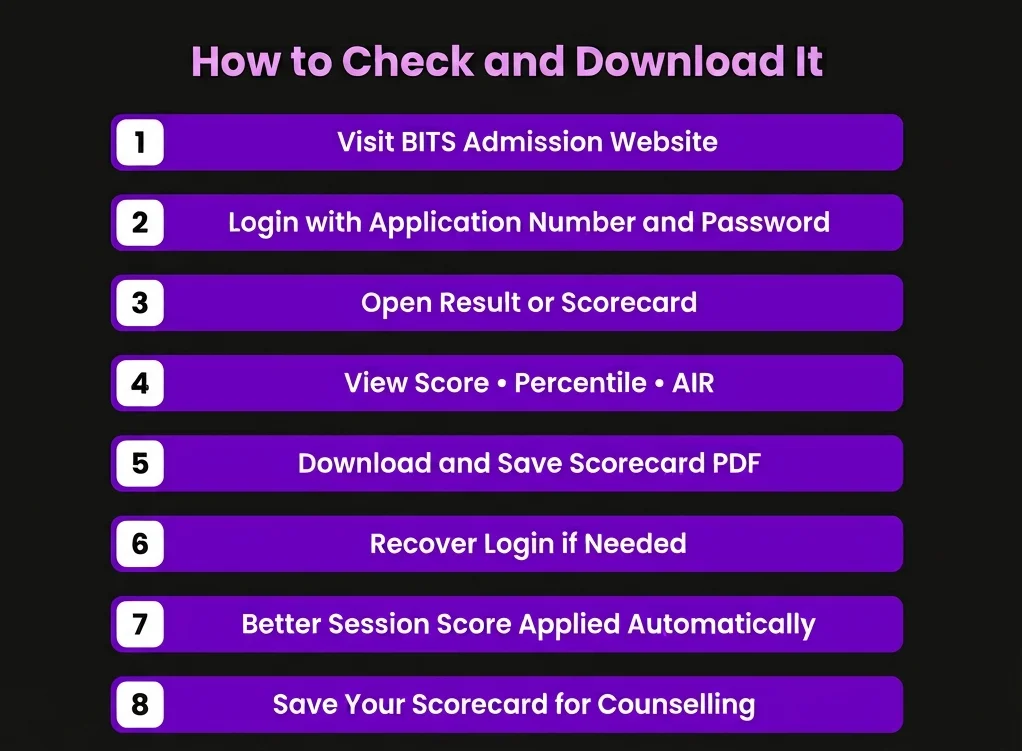
- Visit the official website, admissions.bits-pilani.ac.in (also referenced as bitsadmission.com ), once the result for your session is confirmed live.
- Log in using your Application Number and password, the same credentials from registration.
- Locate the "Result" or "Scorecard" link on your candidate dashboard.
- View your moderated score, percentile position, and All India category-wise rank on screen.
- Download and save the scorecard PDF for your own records, since you'll need it again during counselling and possibly at the time of physical reporting.
- Use "Forgot Application Number or Password" if you've lost your credentials, verifying with your registered mobile number, email, and date of birth.
If you attempt both sessions, there's no separate step to combine or select your better score, BITS Pilani does this automatically, and your scorecard reflects both attempts with the higher one used for the merit list.
What's Actually on Your BITSAT Scorecard
Beyond the headline score, your scorecard carries several details worth checking carefully:
- Candidate name and application number, which should match your registration exactly.
- Session details, including which session(s) you appeared for and the corresponding moderated scores.
- Your moderated score, the only number that counts for admission purposes.
- All India rank and category-wise position, giving you a sense of where you stand relative to other applicants across the full candidate pool.
- Counselling instructions, pointing you toward the next steps in the process.
Check every field the moment your scorecard is live. An error in your name, application number, or category here can create complications later in counselling, and catching it early gives you more time to raise it with BITS Pilani's helpdesk.
Common Mistakes Students Make at This Stage
A few patterns repeat every cycle with students we mentor, specifically right after results are out:
- Planning counselling strategy off the raw, on-screen score. Since the moderated score can differ from what you saw immediately after the exam, decisions made before the official scorecard is live are working off incomplete information.
- Missing the preference form deadline because it feels separate from the "real" result. The FD Preference Form window often opens before Session 2 even happens, and its deadline can arrive close to when Session 2 results are still being processed, making it easy to lose track of.
- Not checking scorecard details carefully after it goes live. A mismatched name, category, or application number is far easier to fix immediately after your scorecard goes live than weeks later once counselling is already underway.
- Assuming a single BITSAT attempt is your final and only word. Since your better score across both sessions counts automatically, students who only attempted Session 1 sometimes don't realise Session 2 is still a live option to improve their standing.
- Ignoring iteration rounds after a disappointing Iteration 1 outcome. BITS Pilani runs multiple rounds specifically because seat availability shifts as other candidates confirm, decline, or upgrade, so an early setback doesn't mean the process is over.
How BITSAT's Approach Compares to Other Engineering Entrance Exams
If you're also appearing for JEE Main or a state-level exam, it's worth understanding how differently BITSAT approaches scoring:
- JEE Main uses full percentile normalisation across every shift and session in the cycle, converting raw scores into a percentile relative to the entire candidate pool nationwide. BITSAT's moderation process is narrower, correcting specifically for flawed or ambiguous questions rather than adjusting for overall shift difficulty statistically.
- BITSAT's own scoring model has stayed relatively simple and stable over time compared to some other exams that have introduced more complex normalisation formulas over recent cycles, which is part of why understanding the moderation-versus-normalisation distinction matters if you're mentally comparing your BITSAT score against a JEE Main percentile.
- Both processes share one thing genuinely in common: the number you see immediately after the exam is never the final word, and students preparing for multiple exams should build the habit of waiting for the official scorecard before making any counselling decisions across any of them.
Building a Realistic Timeline Around Results
Since so many downstream deadlines cluster close to the result date, it helps to think of BITSAT result season as a compressed multi-step window rather than a single event:
- The days right after your scorecard goes live are for careful verification, checking every detail against your original application, not for major counselling decisions yet.
- The preference form window that follows deserves the same careful attention as your original application, since your ranked choices directly shape which iteration you're considered for.
- The merit list and Iteration 1 stage is where your moderated score actually translates into a concrete seat offer, and this is the point in the process where realistic planning, rather than hopeful guessing, genuinely pays off.
- Later iteration rounds reward patience and continued attention far more than they reward giving up entirely after a weaker-than-hoped first outcome in the very first round.
What Happens After Your Result Is Out
Getting your BITSAT result is the midpoint of the process, not the end of it. Here's what follows:
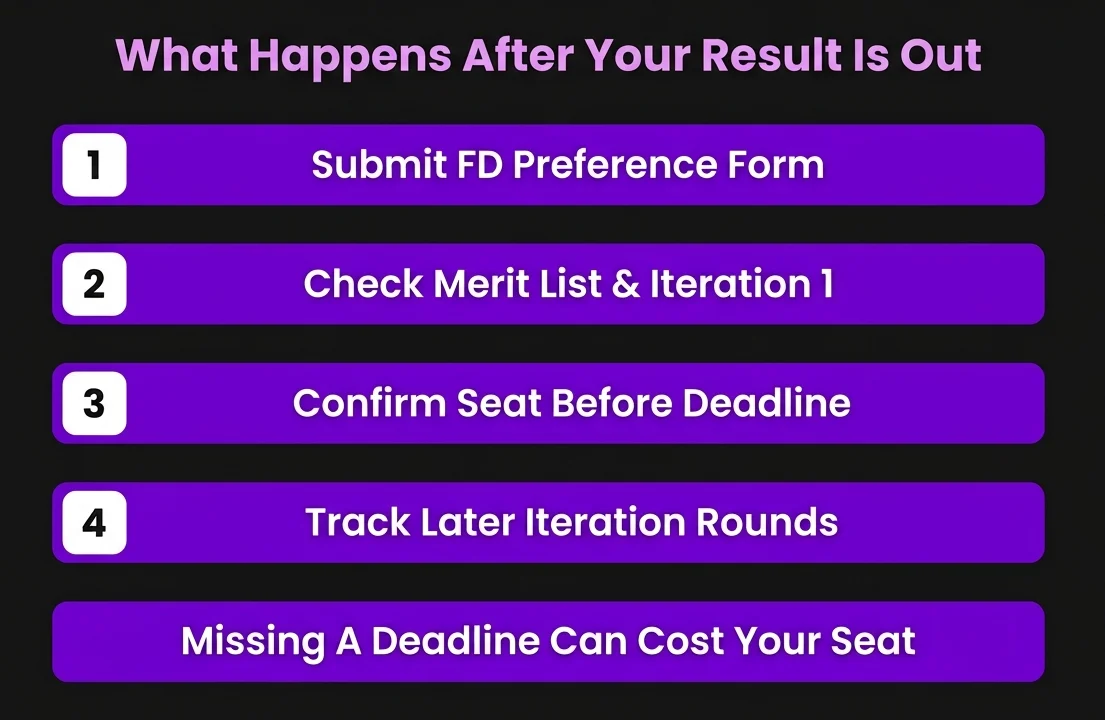
- Fill or update your FD Preference Form, ranking your preferred campuses and programmes, if you haven't already done so before the deadline.
- Wait for the merit list and Iteration 1 result, which combines candidates from both sessions using their better moderated score.
- Confirm your seat within the iteration-specific deadline if allotted, by paying the prescribed fee. Missing this window risks losing the seat entirely, with no guarantee of recovery in a later round.
- Track further iteration rounds if you're not satisfied with your Iteration 1 allotment or didn't receive one, since BITS Pilani runs multiple rounds to fill remaining seats as other candidates confirm, decline, or upgrade their own allotments.
Our BITSAT counselling page walks through the iteration process in more depth, and our free BITSAT Predictor can help you gauge realistic campus and branch options once you know your moderated score.
Understanding Tie-Breaking and Category-Wise Merit
A few things worth knowing if your score sits close to a cutoff line:
- Ties are broken using a defined sequence of criteria, typically starting with performance in specific sections before falling back to other factors like age.
- Category-wise merit lists are prepared entirely separately, so your position within your own category matters more for admission planning than your position in the overall list alone.
- Campus and programme-wise cutoffs vary significantly, so a score that clears the cutoff for one BITS campus or programme may not clear it for another.
- Cutoffs also shift year to year based on the overall difficulty of that cycle's papers and how many candidates appeared, so treating a past year's cutoff as a fixed target rather than a rough guide can lead to either false confidence or unnecessary panic.
- Reserved category and quota-based seats follow their own separate merit calculations, so if you qualify under a specific quota, checking that category's own historical cutoff trend is more useful than benchmarking against the general list.
What We Expect for 2027
BITS Pilani hasn't released its 2027 notification yet, so treat the following as a pattern-based estimate:
- Session 1 result: likely within two weeks of the Session 1 exam, based on the 2026 cycle's April 15-17 exam and April 29 result.
- Session 2 result: likely within about ten days of the Session 2 exam, following the 2026 pattern of a May 24-26 exam and June 5 result.
- The moderation process is likely to continue unchanged, since BITS Pilani has kept this methodology stable across recent cycles even as specific dates have shifted.
- The preference form and iteration-based counselling structure are also likely to remain consistent, based on how stable this process has been in recent years.
- The overall cutoff levels could shift slightly depending on how competitive the applicant pool is that cycle, so treat any pre-exam cutoff prediction as a rough guide rather than a locked number, the same way you would for the 2026 figures referenced throughout this guide.
Our BITSAT important dates page will reflect the confirmed 2027 schedule the moment BITS Pilani's official notification is released.
Conclusion
Your BITSAT result is only useful once you understand what it actually represents, a moderated score, not the raw number you saw on exam day, and only the starting point for a longer process involving preference forms, merit lists, and iteration-based seat allotment. Check your scorecard carefully the moment it's live, don't miss the preference form deadline while you're focused only on the result date, and track every iteration round rather than assuming your first allotment is final.
If your result didn't land where you'd hoped, or if you're gearing up for a future attempt, the preparation that gets you a stronger moderated score is what actually moves the needle. At Phodu Club, our Ultimate BITSAT Crash Course covers full Physics, Chemistry, and Maths lectures alongside English and Logical Reasoning, 20 full-syllabus mock tests plus memory-based previous year papers, chapter-wise tests, DPPs, and mentorship from BITSians, with a 100% course fee refund if you score 300+ on BITSAT. Our free BITSAT Predictor is also worth checking once your result is out, to see what your score realistically translates to in terms of campus and branch options.
Frequently Asked Questions
1) When was the BITSAT result declared for 2026?
Session 1 result was declared April 29, 2026, and Session 2 result on June 5, 2026, both on admissions.bits-pilani.ac.in .
2) Is the score shown right after the BITSAT exam my final result?
No. That's an unofficial raw estimate. Your official BITSAT result is the moderated score released later and shown on your scorecard, which is the only score used for admission.
3) Does BITSAT use percentile normalisation like JEE Main?
Not in the same way. BITSAT applies a moderation process, crediting all affected candidates if a question is found ambiguous or incorrect, rather than a full statistical normalisation across the entire candidate pool.
4) If I appeared in both BITSAT sessions, which result counts?
BITS Pilani automatically considers your better moderated score across both sessions for the merit list. You don't need to select or request this, it happens automatically.
5) What details appear on the BITSAT scorecard?
Your name, application number, session details, moderated score, All India rank, category-wise position, and counselling instructions.
6) What should I do immediately after my BITSAT result is out?
Check every scorecard field for accuracy, complete or update your FD Preference Form before its deadline, and track the merit list and iteration rounds that follow.
7) When is the BITSAT result expected for 2027?
BITS Pilani hasn't announced 2027 dates yet. Based on the 2026 pattern, expect Session 1 results roughly two weeks after the exam and Session 2 results around ten days after, though always confirmed on the official website.
8) Where can I get help preparing for a stronger BITSAT score?
Phodu Club's Ultimate BITSAT Crash Course covers full syllabus lectures, 20 mock tests, and mentorship from BITSians, with a 100% refund at a 300+ score. Our free BITSAT Predictor helps you plan once your result is declared.
Want to crack your exam with mentors who did?
Get test series, crash courses and free mentorship from students at IITs, NITs and BITS.